

Cockroaches in an Ontario apartment are the landlord's to treat, and the duty covers the whole residential complex (RTA s.20; O. Reg. 517/06 s.46). Because roaches spread through walls and plumbing, treat affected and neighbouring units together, give each unit its own 24-hour written notice with a time (RTA s.27), and help every tenant prepare.
Cockroaches are a building problem more than a unit problem. They live in wall voids, follow plumbing and electrical runs between units, and gather around shared garbage rooms. Treat one apartment and leave the rest, and the population simply moves next door and comes back. For the general rules on who is responsible for pests, see our overview of pest control in an Ontario rental. This guide is about running a building-wide cockroach treatment lawfully.
Why does an Ontario landlord's cockroach duty cover the whole building?
Because Ontario frames the duty at the level of the complex: section 20(1) of the Residential Tenancies Act, 2006 (RTA) makes the landlord responsible for maintaining "a residential complex, including the rental units in it," in a good state of repair and fit for habitation, and for complying with maintenance standards. The standards point the same way:
| Standard | Applies to | What it requires on pests |
|---|---|---|
| O. Reg. 517/06 (provincial) | Residential complexes without their own municipal by-law | s.46(1): "A residential complex shall be kept reasonably free of rodents, vermin and insects." s.45: suitable garbage containers in a building with more than one unit, kept clean and sanitary. |
| Toronto Chapter 629 | All properties in Toronto | s.629-9: all properties "shall at all times be kept free of pests and from conditions which may encourage infestation by pests"; cockroaches are named in the definition of pest; garbage stored "in a manner that will not attract pests." |
| Toronto Chapter 354 (RentSafeTO) | Purpose-built rental buildings with three or more storeys and ten or more units | Inspect common areas for pests at least once every 30 days, and any area within 72 hours of learning pests are there; take adequate measures to prevent spread and eliminate pests wherever detected (s.354-3.3). |
| Mississauga By-law 0089-2022 | Purpose-built buildings with two or more storeys and six or more rental units sharing a common area | Inspect common areas at least once every 30 days, and within 72 hours of a tenant service request about pests (s.20); prevent spread, resolve infestations in accordance with applicable law, and make pest-prevention information available to tenants. |
Our guide to multi-unit vs single-unit compliance in Ontario covers what else changes as a building grows.
How do you give entry notices for a building-wide treatment in Ontario?
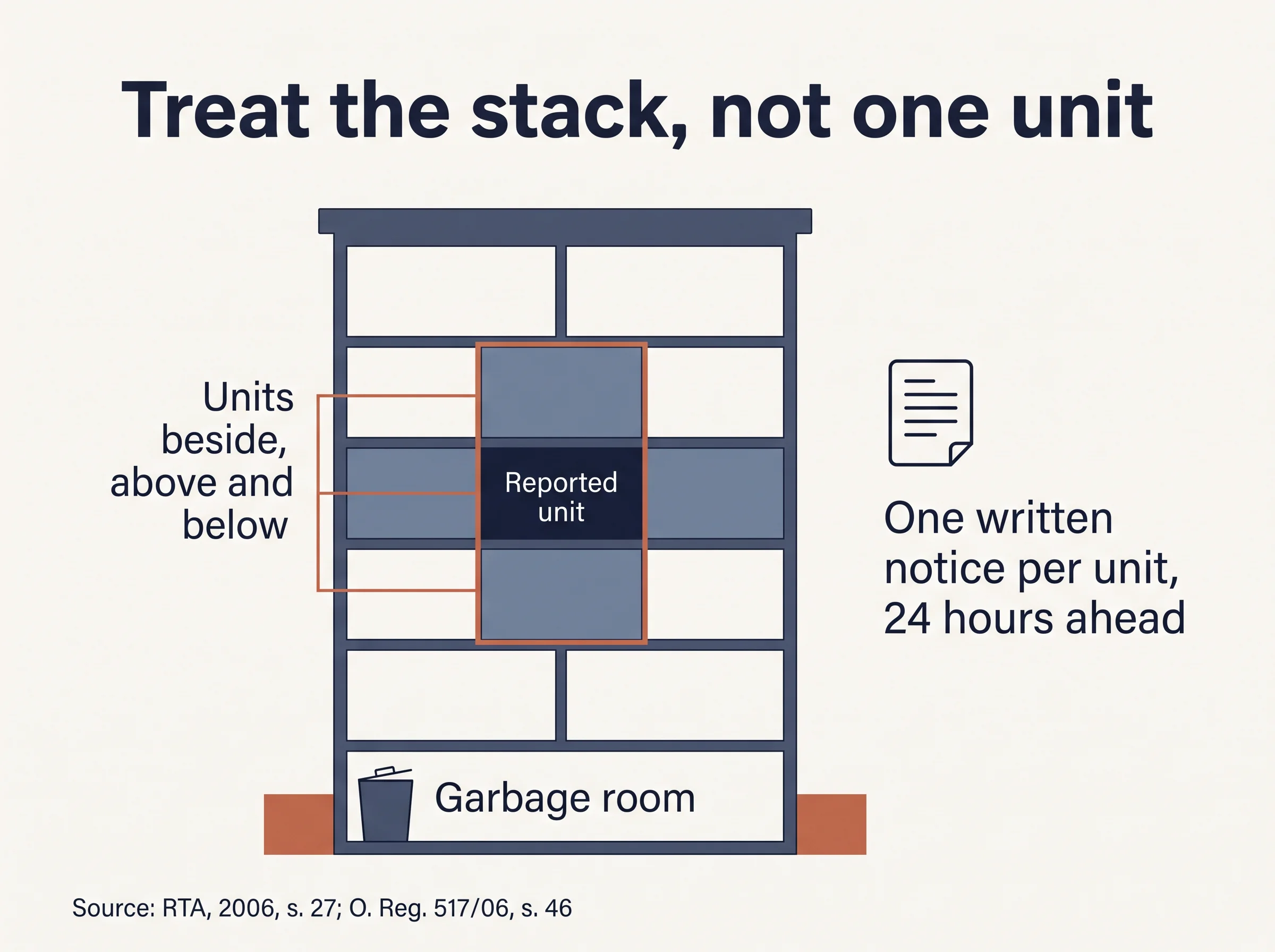
In Ontario, every unit you enter needs its own written notice at least 24 hours ahead, giving the reason, the day and a time between 8 a.m. and 8 p.m. (RTA s.27(3)). Under section 27(1), a landlord may enter on that notice to do work in the unit (paragraph 1) or to carry out a reasonable inspection of whether the unit complies with maintenance standards (paragraph 4).
- One notice per unit. A notice on the lobby notice board is not a notice to each tenant. Deliver each unit's notice by hand, in the tenant's mail box or by posting it on the unit door (LTB Rule 3.2), or by email where the tenant consented in writing.
- Give each unit a time. A building-wide day still needs "a time of entry" for each unit. A sequence of short windows by floor is a practical way to meet that.
- New notice for each round. Follow-up treatments are new entries; give notice again unless the tenant consents at the time.
Our guide to the notice to give before a pest treatment has sample wording, and the tenant communication templates guide covers delivery methods in more detail.
What preparation does each Ontario unit need for cockroach treatment?
Each Ontario unit needs the preparation on the provider's sheet, and it has to happen in every unit for the treatment to work. Cockroach preparation is usually lighter than bed bug preparation. The sheet typically asks tenants to empty kitchen and bathroom cupboards, clean food residue and grease, store food in sealed containers and keep pets away from treated areas. Follow the provider's sheet rather than a generic list, because what is needed depends on the products and method.
Make the preparation achievable for everyone. Some tenants will need help because of age or disability, and the Human Rights Code requires accommodation to the point of undue hardship (see the Ontario Human Rights Commission's policy). Building in a staff member or helper for those units is cheaper than a failed round.
What must an Ontario landlord do in common areas?
An Ontario landlord must keep garbage areas clean and seal gaps in the building, and in Toronto RentSafeTO buildings must also log and post treatment information:
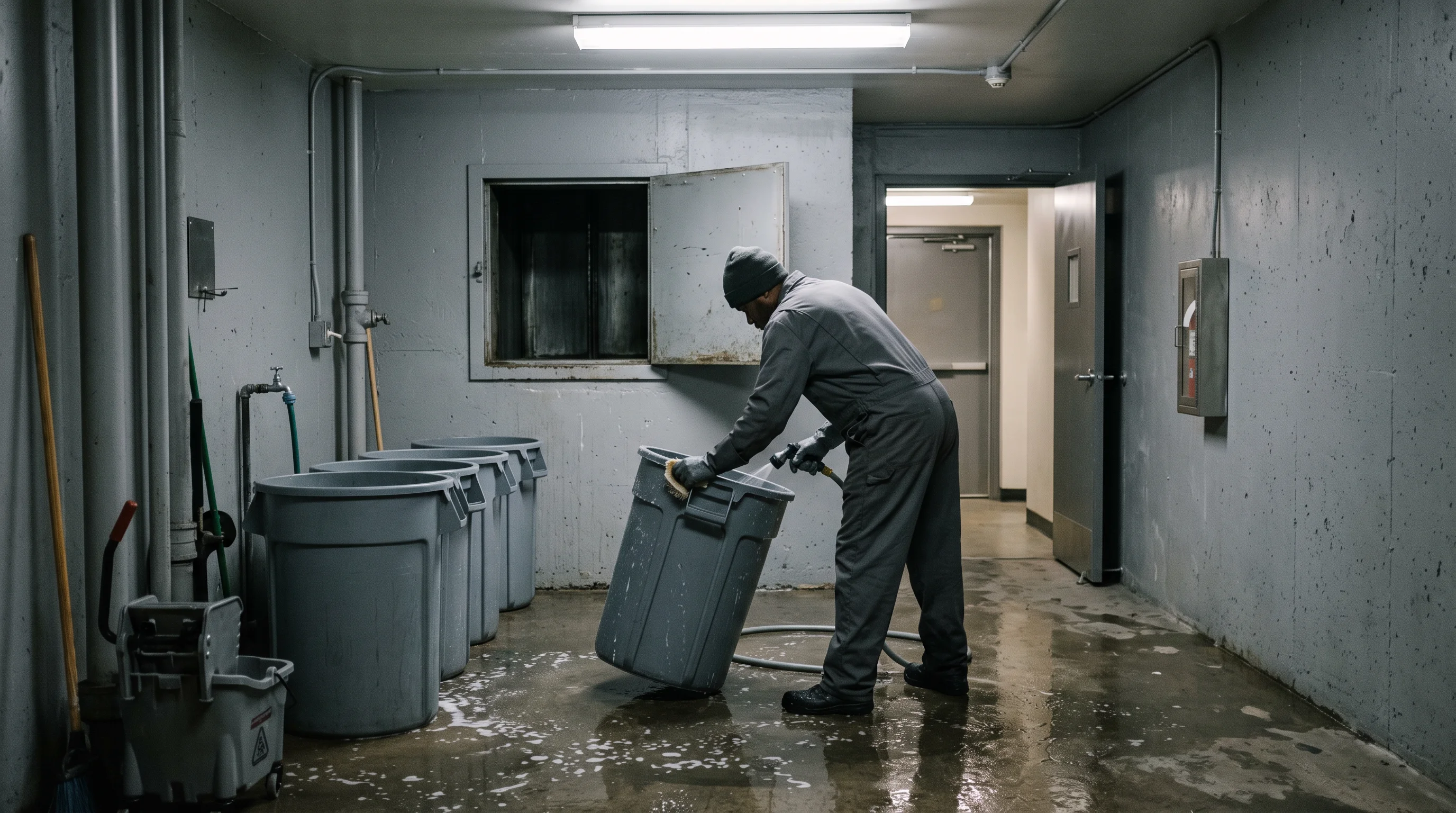
- Garbage rooms and chutes. Toronto's Chapter 629 requires garbage chutes, rooms and containers to be washed and disinfected as often as needed to keep them clean and odour-free.
- Sealing. O. Reg. 517/06, s.46(3), requires openings and holes in the building to be screened or sealed against insects and other pests. Gaps around pipes where they pass between units are worth sealing during treatment.
- Records and posting. In Toronto RentSafeTO buildings, the owner must keep logs of pest inspections and treatments and post treatment information on the tenant notification board, including the date of treatment, the licensed operator's name and the nature of the treatment (ss.354-3.2 and 354-4.1). See our guide to Toronto's pest control rules for rentals.
Choosing a licensed pest control provider in Ontario: what should you confirm?
In Ontario, confirm that the person treating holds an exterminator licence and the business an operator licence under the Pesticides Act; a landlord cannot use the Class D (domestic) exemption for a tenant's unit (O. Reg. 63/09, s.54(2)). Toronto's Chapter 354 requires apartment building owners to "retain a pest management operator or exterminator licensed by the Ministry of Environment to conduct all pest extermination activity" (s.354-3.3C). For a building-wide job, ask for a written plan: which units, how many visits, the preparation sheet, and what records the provider will give you. See our guide to hiring a licensed exterminator in Ontario.
What if an Ontario tenant will not co-operate with cockroach treatment?
In Ontario, the steps are a fresh valid notice, a conversation about why, accommodation where needed, and then the Landlord and Tenant Board (LTB) routes: an N5 for substantial interference and a claim for out-of-pocket costs under section 88.1. One unit that refuses entry can undo the treatment. Our guide on what a landlord can do when a tenant refuses pest control entry covers them. In Toronto RentSafeTO buildings, s.354-3.3F also says "No person shall obstruct the extermination of the pests."
What can Ontario tenants do about cockroaches?
Ontario tenants should report cockroaches in writing with dates and photos, keep the unit reasonably clean (RTA s.33), and allow access on proper notice. If the landlord does not act, call the city's property standards office (311 in Toronto), and consider a T6, Tenant Application about Maintenance, filed within one year (RTA s.29(2)).
How can Tenon10 help with a building-wide treatment?
Running a building-wide treatment means many units and many notices. On plans that include scheduled maintenance, Tenon10 lets you schedule pest control visits across the units of a property, checks the 24-hour and 8 a.m. to 8 p.m. rules, and emails each unit's tenants a Notice of Entry (valid email service needs the tenant's written consent). Tenant maintenance requests give you a dated record of every report.
Frequently asked questions
Does an Ontario landlord have to treat the whole building for cockroaches?
Not automatically, but the duty covers the whole complex. Where pests are spreading, treating only the reporting unit often does not meet it. In Toronto and Mississauga apartment buildings, the by-laws expressly require measures to prevent spread.
How much notice does each Ontario tenant need?
At least 24 hours' written notice per unit, with the reason, day and a time between 8 a.m. and 8 p.m. (RTA s.27). A notice on the lobby board does not count as notice to each tenant.
Can an Ontario landlord charge tenants for a building-wide treatment?
Not as a routine charge. Treatment is part of the landlord's maintenance duty. A cost can be claimed from a tenant only through the LTB, with proof, under sections 88.1 or 89.
Who cleans the garbage room in an Ontario apartment building?
The landlord. Garbage containers and storage areas in a multi-unit building must be kept clean and sanitary under section 45 of the provincial maintenance standard and Toronto's Chapter 629.
Which Ontario guides cover pest treatment in apartment buildings?
- Bed bugs in an Ontario rental: who pays and who treats?
- Pest control notice to tenants in Ontario
- Multi-Unit vs Single-Unit Compliance in Ontario
- Toronto's pest control rules for rentals
- Tenant communication templates for Ontario landlords
Plan the treatment, unit by unit
Schedule pest control visits across a building and keep every Notice of Entry with the unit's record in Tenon10.
Built for Canadian landlords and property managers.


