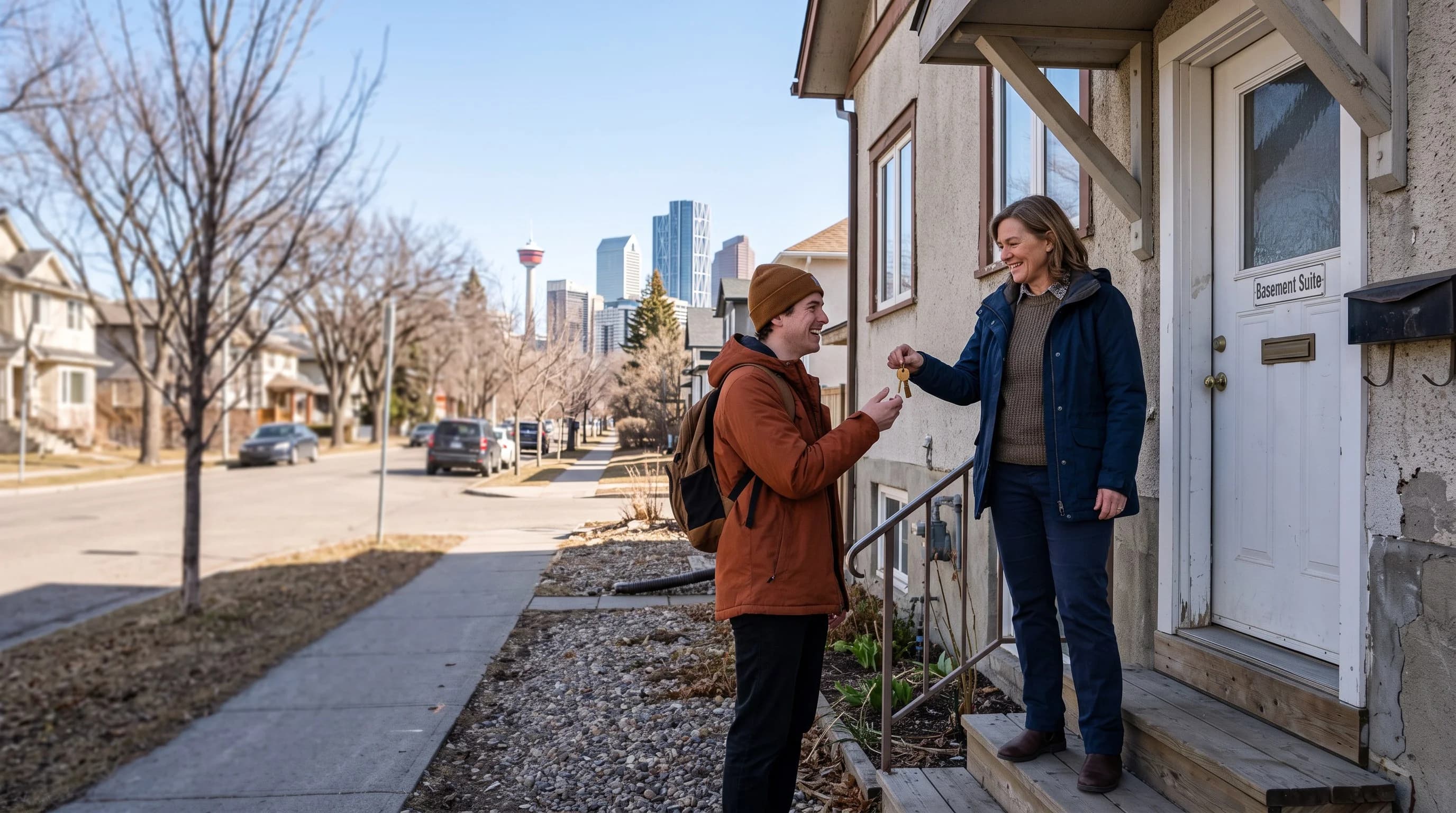
Renting a basement suite in Calgary? Before you sign, search the address on the City's Secondary Suite Registry map and look for the registration sticker in the unit, then walk the suite yourself: an escape window in every bedroom, working alarms, a door of its own, enough heat, safe hot water and a dry basement. The City says a suite on the registry has been inspected to Alberta's safety code requirements; the province's Minimum Housing and Health Standards apply to every rental, registered or not.
At a glance
- Registry: if the address is on the City's map, the City lists the suite as legal and safe; if not, it is not registered.
- Sticker: a registered suite gets a numbered sticker, which should be visible in the unit.
- Advertising: no one may advertise an unregistered suite for rent (Bylaw 11M2018 s.9).
- Bedroom window: opens from inside without tools, at least 0.35 m² with no side under 380 mm (MHHS s.3(b)).
- Deposit: no more than one month's rent (RTA s.43(1)).
Calgary Basement Suite Checklist
Checks before you sign: the City's registry, the province's housing standards and the RTA.
Get Free PDF →1. Check the registry and the sticker
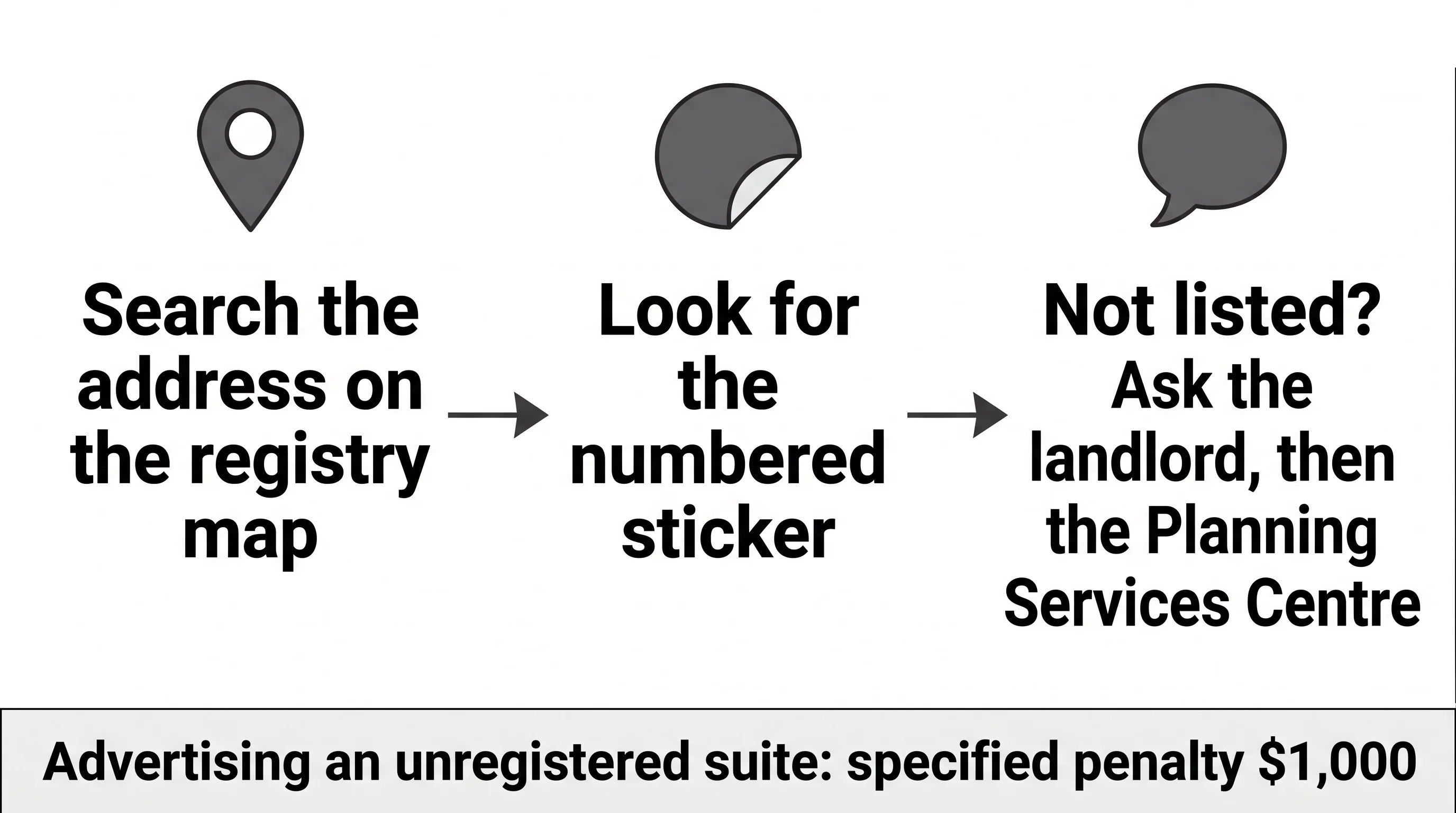
The City's renter page tells you to use the registry before you sign a lease: enter the address, and if it shows on the map the suite is registered. A registered suite also receives a numbered sticker, which the City says should be visible in the unit and recommends posting at the suite's entry. Under the Suite Registry Bylaw, the owner must display proof of registration (s.6(1)), and nobody may advertise or offer an unregistered suite for rent (s.9; specified penalty $1,000).
If the address does not appear, the City suggests asking the landlord whether the suite is being registered, and you can report the address to the Planning Services Centre. The City also warns that an owner may decide not to legalize a suite, and then it would need to be removed. For the owner's side, see Calgary Secondary Suite Registry: What Landlords and Renters Must Know.
2. Walk the suite: the safety checks
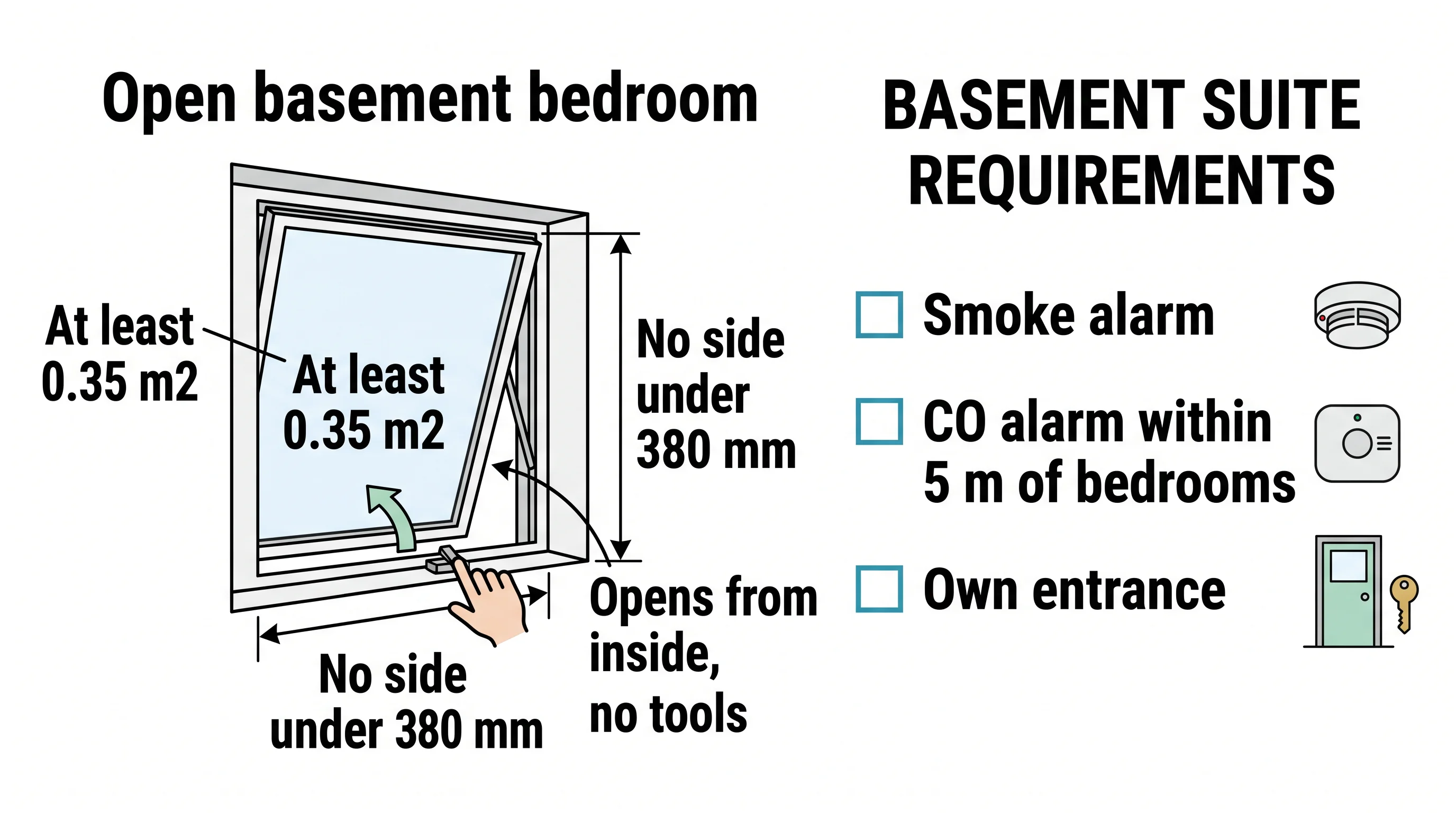
- Escape window in each bedroom. In a building of 3 storeys or less, each bedroom needs an outside window that opens from the inside without tools or special knowledge, unless the bedroom door opens directly outside or the suite is sprinklered. The opening must be at least 0.35 m² with no dimension under 380 mm (MHHS s.3(b)). Security bars must open from inside without tools.
- Smoke alarms. Provincially, an alarm must sit between each sleeping area and the rest of the suite and be operational at all times (MHHS s.12). For a suite to be registered, the City lists smoke alarms on each floor, in each bedroom, common space and mechanical room, interconnected so one sounds them all, including at least one in the main home.
- Carbon monoxide alarms. The City's registry requirements call for interconnected CO alarms, centrally located and within 5 m of any bedroom. Press each test button.
- Its own way in. The City says a secondary suite has its own bathroom, cooking facilities and sleeping area, with direct access that does not pass through the main home.
- A separation from upstairs. The City describes a smoke-tight separation between the suite and the main home, generally drywall on the ceiling and both sides of the separating walls.
3. Check comfort and dryness
- Heat. Heating must be able to warm all habitable rooms, bathrooms and toilet rooms to 22 °C (MHHS s.8(a)). Ask who controls the thermostat. See the 22 °C rule.
- Hot water. Between 46 °C and 60 °C at the tap (MHHS s.9(a)).
- A dry basement. Basements must be free from water infiltration and accumulation (MHHS s.1(b)). Look for stains, a musty smell or swollen baseboards.
- Utilities in writing. The owner must keep electricity, water and heat on unless the agreement makes a utility the tenant's sole responsibility (MHHS s.8(d)). If upstairs and downstairs share meters, get the split in the lease.
4. Before you hand over money
- Deposit: no more than one month's rent, and it cannot be increased later (RTA s.43). See Alberta security deposits.
- Inspection report: you and the landlord inspect within one week of move-in, and you get a copy of the report (RTA s.19(1)). See Alberta inspection report rules.
- Housing standards: meeting them is a landlord covenant in every tenancy (RTA s.16(c)).
Frequently asked questions
How do I know if a Calgary basement suite is legal?
Search the address on the City's Secondary Suite Registry map. If it appears, the City lists it as registered. Then look for the numbered sticker in the unit.
Can a landlord advertise a suite that is not registered yet?
No. Bylaw 11M2018 s.9 prohibits advertising or offering an unregistered suite for rent, with a minimum penalty of $500 and a specified penalty of $1,000.
Does the City's amnesty affect me as a renter?
The amnesty waives development permit charges and registration fees for owners who apply before it ends on Dec. 31, 2026. It may make an owner more willing to register a suite you are viewing.
For every provincial and City rule in one place, see the Calgary landlord and tenant guide.
Calgary Basement Suite Checklist
Checks before you sign: the City's registry, the province's housing standards and the RTA.
Get Free PDF →Start the suite on the record
Tenon10 creates Alberta leases and runs move-in and move-out inspection reports, so the suite's condition is documented from day one.
Free • No signup required