Fall is when mice start looking for a warm way in, and bed bugs and cockroaches do not wait for a season at all. When pests show up in an Alberta rental, both sides usually want the same thing: a fast, effective treatment. Disputes start over who has to arrange it, how the pest control company gets in, and what a tenant can do if nothing happens.
This guide sets out the rules for landlords and tenants, from the province's Minimum Housing and Health Standards and the Residential Tenancies Act.
Alberta Rental Pest Control Checklist
A pest control checklist for Alberta landlords and tenants: duties, entry notice, operator registration and the tenant's options.
Get Free PDF →The landlord's duty: free of infestations
Section 16(a) of the Minimum Housing and Health Standards (M.O. 57/2012) says the owner shall ensure the housing premises are free of insect and rodent infestations. It adds three rules about treatment:
- Pesticides must be applied in accordance with the Environmental Protection and Enhancement Act and its regulations.
- Whenever a pesticide is applied in a dwelling, the occupant must be notified in accordance with the latest edition of the Environmental Code of Practice for Pesticides.
- It is the occupant's responsibility to allow access, as the Residential Tenancies Act provides, and to do whatever is necessary so the unit is ready for pesticide application.
Section 16 of the same Standards also requires the owner to keep common rooms and areas clean and sanitary.
Under section 16(c) of the Residential Tenancies Act (RTA), every tenancy includes the landlord's promise that the premises will meet at least these minimum standards.
The tenant's duties
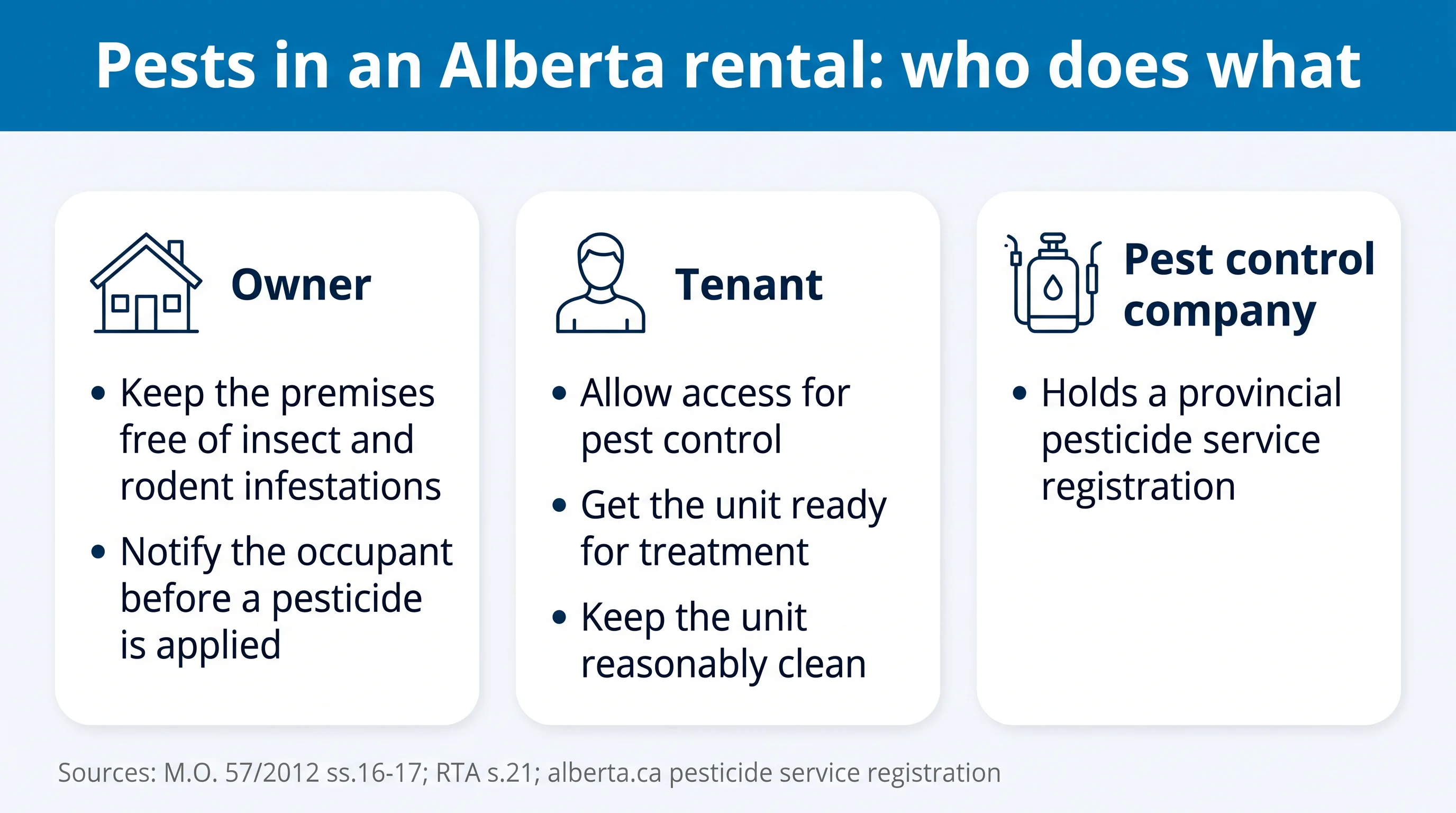
- Allow access. Section 17 of the Standards says every tenant shall allow access for repairs or pest control treatment as the RTA requires.
- Prepare the unit. Section 16(a)(iii) makes it the occupant's responsibility to do what is necessary so the unit is ready for pesticide application. The company's preparation instructions are the practical guide.
- Keep it reasonably clean. Section 21(f) of the RTA makes it a term of every tenancy that the tenant keeps the premises in a reasonably clean condition.
- No significant damage. Section 21(e) says the tenant will not do or permit significant damage to the premises.
Entering for pest control: the notice
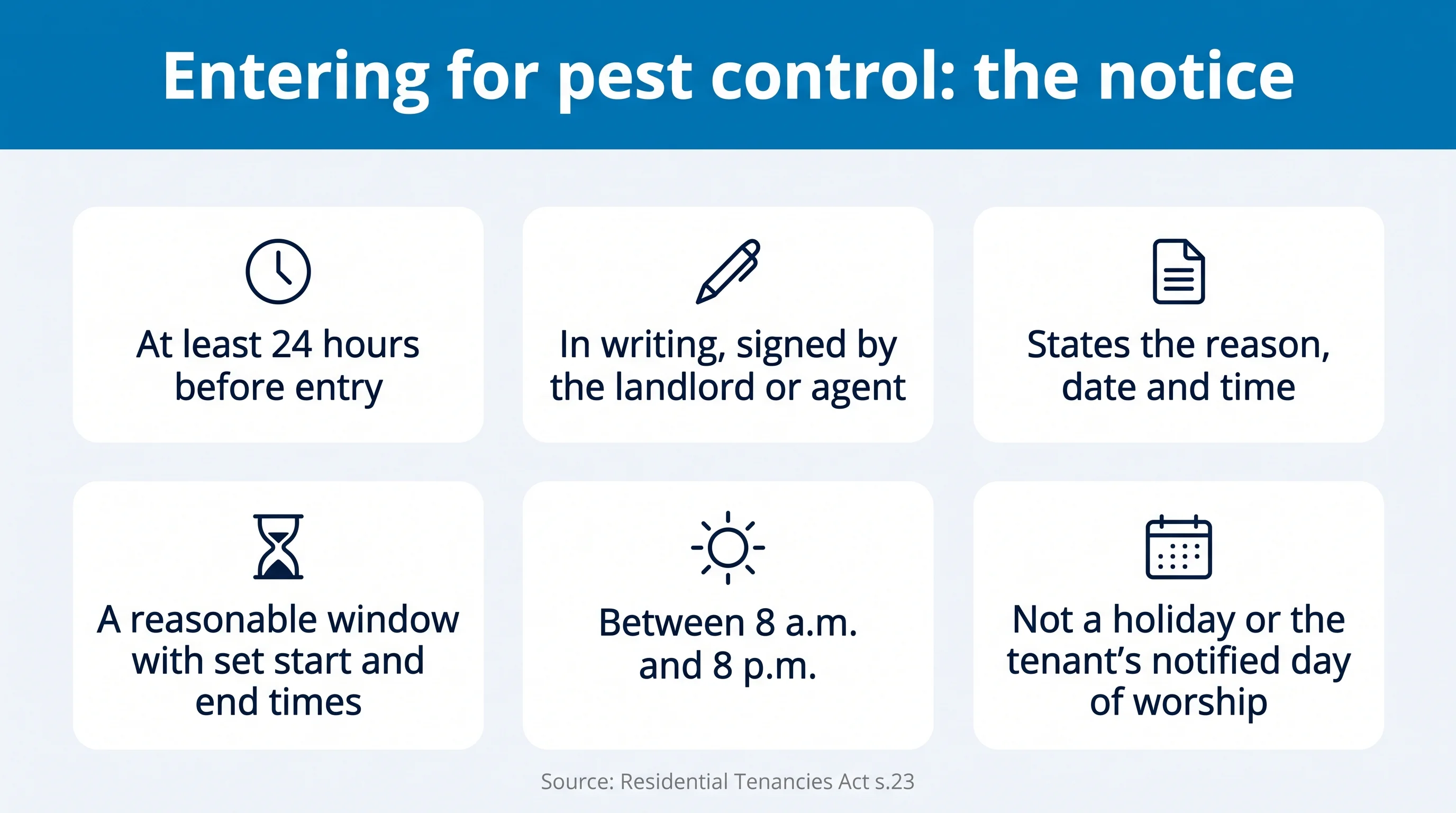
Section 23(3)(c) of the RTA lets a landlord enter without the tenant's consent, after notice, to take the steps needed to control pests so the premises meet the standards Alberta law requires. The notice rules in sections 23(4) to (6) are strict:
| Rule | What the Act requires |
|---|---|
| Timing | Served on the tenant at least 24 hours before the entry |
| Form | In writing and signed by the landlord or the landlord's agent |
| Content | The reason for entry, and a date and time of entry |
| Time window | Allowed if of reasonable length and it starts and ends at specified times |
| Hours | Between 8 a.m. and 8 p.m. |
| Days | Not a holiday, and not the tenant's day of religious worship if the tenant has notified the landlord of it in writing |
With the tenant's consent, or that of an adult lawfully on the premises, a landlord can enter at other times. In an emergency, section 23(2) allows entry without consent or notice.
Choosing a pest control company
Alberta's pesticide service registration page says that, under the Pesticide (Ministerial) Regulation, any business advertising or providing a pesticide service must hold a pesticide service registration. Registration is applied for through the province's Digital Regulatory Assurance System (DRAS). A registration is cancelled if the business does not employ a certified applicator with the right class of certificate, or if its insurance lapses, and registrations are not transferable when a business is sold.
For a landlord, that gives two simple questions to ask before booking: does the company hold a pesticide service registration, and does it employ a certified applicator for this kind of work?
When pests are not dealt with: the tenant's options
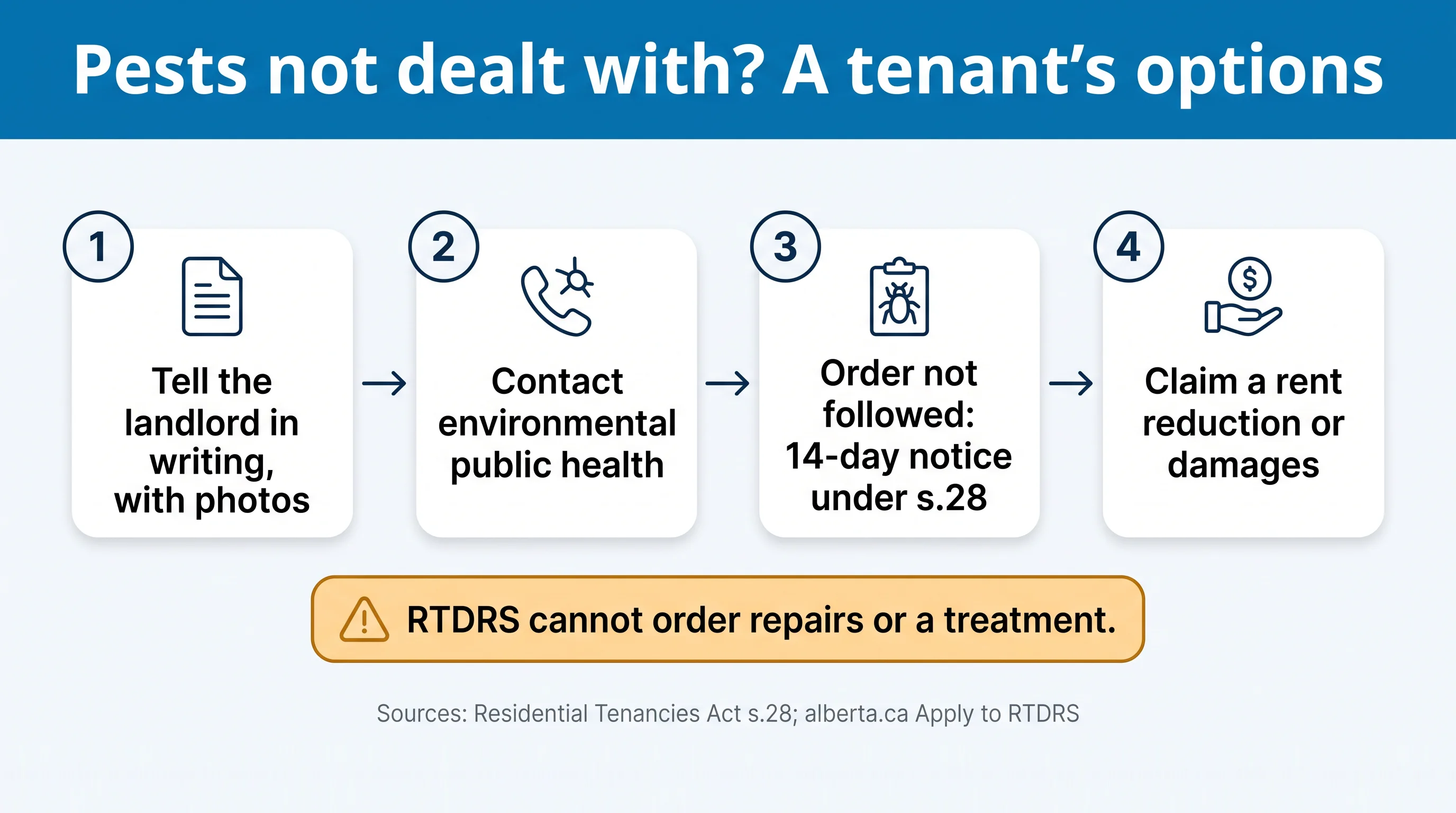
- Tell the landlord in writing. Describe what you have seen, where and when, and include photos.
- Contact public health. Alberta Health Services environmental public health enforces the Minimum Housing and Health Standards and can issue orders.
- If an order is not followed. Under section 28 of the RTA, where the landlord commits a substantial breach, an executive officer has issued an order under section 62 of the Public Health Act about it, and the tenant believes on reasonable grounds that the landlord has not complied, the tenant may serve a notice ending the tenancy at least 14 days ahead, or apply to court. The notice must be in writing, signed, and set out the reasons and the termination date. It is ineffective if, within 7 days of receiving it, the landlord serves a written objection and has complied with the order or obtained a stay.
- Money claims. A tenant can apply to RTDRS or the court for a rent reduction (abatement) or damages for a landlord's breach.
Note what RTDRS cannot do. Its "how to apply" page says it does not have the authority to order specific performance, such as repairs. It cannot order a landlord to book a treatment, which is why the public health route matters.
Bed bugs, mice and cockroaches: what changes
The rules above apply to all three. What changes is the preparation and the number of visits, which the pest control company sets. In multi-unit buildings, the duty to keep the premises free of infestations and common areas clean means checking neighbouring units and shared spaces too.
Common mistakes
- Sending the technician with a verbal heads-up. Entry without consent needs written, signed notice at least 24 hours ahead.
- Booking a Saturday treatment for a tenant who has given notice of that day as their day of worship.
- Hiring an unregistered operator. Businesses providing a pesticide service must be registered.
- Tenants refusing access or skipping preparation. Both are tenant duties under the Standards.
- Tenants withholding rent. The Act's routes are public health orders, section 28, and claims to RTDRS or court.
What to do next
- Landlords: confirm the company's registration, get its preparation sheet, and serve a section 23 notice for each visit.
- Tenants: report in writing with photos, prepare the unit as instructed, and keep copies.
- Both: keep the notices, invoices and treatment reports with the tenancy file.
How Tenon10 helps
Tenon10 runs the Alberta move-in and move-out inspection reports, so any signs of pests or pest damage are recorded at the start and end of a tenancy, room by room.
Tenon10 also lets you create an Alberta lease, so every tenancy's terms are in one place when a question about responsibilities comes up.
Frequently asked questions
Is the landlord responsible for pest control in Alberta?
The Minimum Housing and Health Standards make the owner responsible for keeping the premises free of insect and rodent infestations.
Do I have to let the exterminator in?
Yes, if the landlord has served a valid section 23 notice. The Standards say tenants must allow access for pest control treatment as the RTA requires.
How much notice is needed for pest control entry?
At least 24 hours' written, signed notice stating the reason, date and time, for an entry between 8 a.m. and 8 p.m. that is not on a holiday.
Can I end my lease because of bed bugs?
Only through the routes in the Act. Section 28 allows a 14-day termination notice where a Public Health Act order about the landlord's substantial breach has not been complied with, subject to the landlord's right to object within 7 days.
Can RTDRS order my landlord to fumigate?
No. RTDRS cannot order specific performance. It can award a rent reduction or damages.
Alberta Rental Pest Control Checklist
A pest control checklist for Alberta landlords and tenants: duties, entry notice, operator registration and the tenant's options.
Get Free PDF →Record the condition of every unit
Run Alberta move-in and move-out inspection reports in Tenon10, with each tenancy's lease in the same place.
Built for Canadian landlords and property managers.