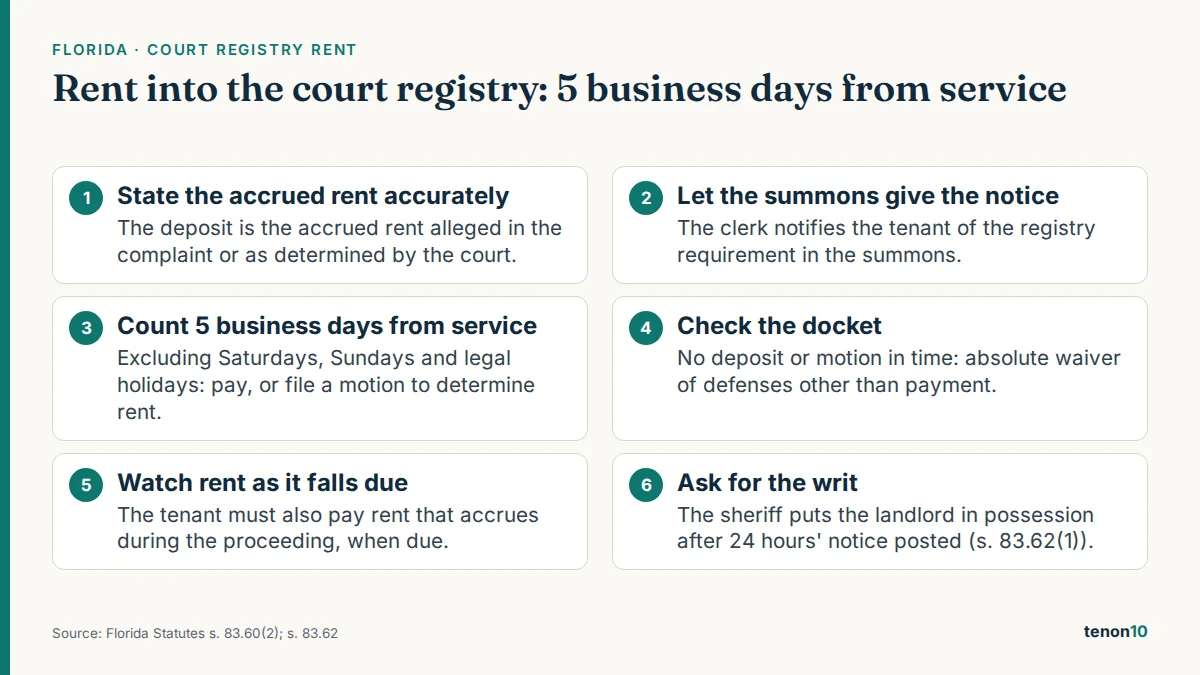
In a Florida eviction, a tenant who raises any defense other than payment must pay rent into the court registry: the accrued rent alleged in the complaint, or the amount the court sets, plus rent as it falls due. Missing the 5-business-day deadline waives those defenses and lets the landlord seek an immediate default (s. 83.60(2)).
The rule is in section 83.60 of the Florida Residential Landlord and Tenant Act (Chapter 83, Part II). This how-to walks a landlord through what to put in the complaint, what to watch for after service and what to ask the court for. Amounts are in US dollars.
Florida Court Registry Rent: Landlord Checklist
A one-page checklist for Florida landlords: the accrued rent in the complaint, the 5-business-day registry deadline, the default judgment and the writ of possession.
Get Free PDF →What you'll need before filing a Florida eviction for unpaid rent
In Florida, the registry rule works from the rent your complaint alleges, so the numbers must be right before you file in county court (s. 83.59(2)). Have these ready:
- The served 3-day notice and proof of delivery; see the Florida 3-day notice to pay rent.
- A rent ledger showing every payment credited, with dates.
- The lease, showing the rent amount and due date.
- Any written notice from the tenant about repairs or withholding rent.
Steps: how does the Florida court registry rule work for landlords?
Step 1: State the accrued rent accurately in the complaint
The tenant's deposit is measured by "the accrued rent as alleged in the complaint or as determined by the court" (s. 83.60(2)). If the tenant files a motion to determine rent, the tenant must include documentation supporting the claim that the complaint's figure is wrong.
Step 2: Let the summons give the notice
Florida puts the notice on the clerk: "The clerk shall notify the tenant of such requirement in the summons" (s. 83.60(2)).
Step 3: Count 5 business days from service
The tenant has 5 days, excluding Saturdays, Sundays and legal holidays, after the date of service of process to pay the rent into the registry or file a motion to determine the amount (s. 83.60(2)).
| Day served | Count runs over | Last day (no holidays) |
|---|---|---|
| Monday | Tue, Wed, Thu, Fri, Mon | Following Monday |
| Wednesday | Thu, Fri, Mon, Tue, Wed | Following Wednesday |
| Friday | Mon, Tue, Wed, Thu, Fri | Following Friday |
Step 4: Check the docket for a deposit or a motion
If the tenant raised a defense other than payment, including a defective 3-day notice, and neither paid nor moved to determine rent in time, the statute calls that "an absolute waiver of the tenant's defenses other than payment." The landlord "is entitled to an immediate default judgment for removal of the tenant with a writ of possession to issue without further notice or hearing thereon" (s. 83.60(2)).
Step 5: Keep watching as rent falls due during the case
The deposit is not a one-time payment. The tenant must also pay "the rent that accrues during the pendency of the proceeding, when due" (s. 83.60(2)). Track each new due date while the case is open.
Step 6: Ask for the writ and a money judgment
After judgment for the landlord, the clerk issues a writ to the sheriff, who puts the landlord in possession after 24 hours' notice posted on the premises; weekends and holidays do not stop that period (s. 83.62(1)). Where rent is found due, the court also enters a money judgment with costs, if service was personal or otherwise authorized for that purpose (s. 83.625). The Florida eviction process in county court covers each stage.
Which Florida tenants deposit less than the full rent?
In Florida, public housing tenants and tenants receiving rent subsidies are "required to deposit only that portion of the full rent for which they are responsible" under the program they are in (s. 83.60(2)). For a voucher tenant, that is the tenant's share, not the housing authority's; see Section 8 for landlords.
Troubleshooting
The tenant claims the rent was paid. Payment is the one defense the registry rule does not require a deposit for. The court decides it on the evidence, so bring the ledger and bank records.
The tenant says you failed to make repairs. A material failure to comply with s. 83.51(1) is a complete defense to possession for nonpayment, but only if 7 days passed after the tenant delivered written notice naming the problem and stating an intent to withhold rent (s. 83.60(1)(b)). The court then sets any rent reduction. The registry rule still applies to that defense. See Florida repair duties under section 83.51.
Your 3-day notice had an error. The court must give the landlord an opportunity to cure a deficiency in a notice or in the pleadings before dismissing the action (s. 83.60(1)(a)).
The tenant alleges retaliation. That is a defense under s. 83.64, and the deposit rule applies to it too. See Florida lockout and retaliation rules.
Frequently asked questions
How long does a Florida tenant have to pay rent into the court registry?
Five days after service of process, not counting Saturdays, Sundays or legal holidays, to pay the rent or file a motion to determine the amount (s. 83.60(2)). Rent that comes due during the case must also be paid when due.
What happens if a Florida tenant does not deposit rent with the court?
The failure is an absolute waiver of the tenant's defenses other than payment, and the landlord is entitled to an immediate default judgment for removal with a writ of possession, without further notice or hearing (s. 83.60(2)).
Does the Florida registry rule apply if the tenant only says the notice was defective?
Yes. Section 83.60(2) names "the defense of a defective 3-day notice" as one of the defenses that triggers the deposit requirement.
Florida Court Registry Rent: Landlord Checklist
A one-page checklist for Florida landlords: the accrued rent in the complaint, the 5-business-day registry deadline, the default judgment and the writ of possession.
Get Free PDF →The bottom line
In Florida, allege accrued rent you can prove, let the summons give notice, count 5 business days from service and check the docket. More Florida topics are in the Tenon10 guides by topic.
More guides for Florida landlords
Read our free guides on Florida notices, deposits, repairs and evictions.
Free • No signup required