When a Georgia rental is foreclosed, the federal Protecting Tenants at Foreclosure Act gives a bona fide tenant at least 90 days' notice to vacate, and a tenant with a bona fide lease generally keeps it to the end of the term. Only a buyer who will live there may end that lease early, still on 90 days' notice.
A Georgia foreclosure catches tenants and landlords off guard because the state's own landlord-tenant code says little about it, and the state's plain-language guide is out of date on the federal rule. This guide explains what the federal law requires of whoever takes title, how Georgia's tenancy-at-will and dispossessory rules fit around it, and what an owner who rents out a property facing foreclosure should do. It is written for landlords, investors who buy foreclosed homes with tenants in them, and property managers. Amounts are in US dollars.
Georgia Foreclosure with Tenants: Checklist
A one-page checklist for Georgia landlords and buyers when a rental is foreclosed: bona fide tenant tests, the 90-day notice, leases that survive, and the dispossessory path.
Get Free PDF →Does the federal 90-day foreclosure notice rule apply in Georgia?
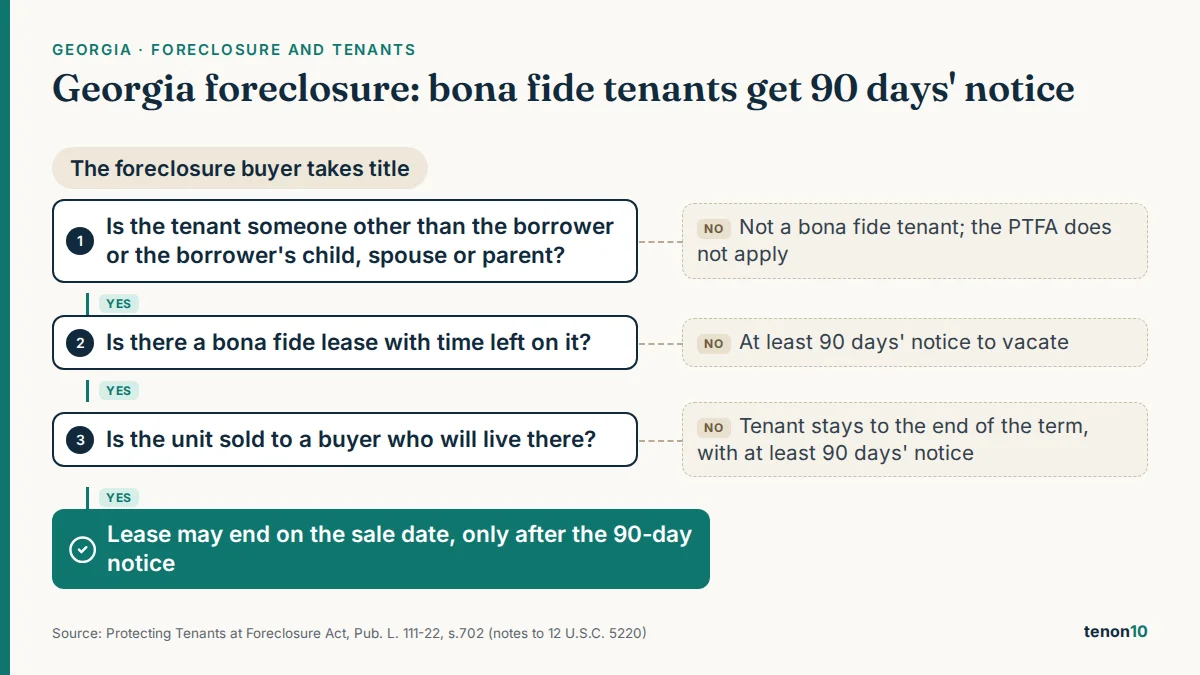
Yes. The Protecting Tenants at Foreclosure Act (PTFA), Pub. L. 111-22, section 702, is federal law and applies in Georgia as in every state. It covers "any foreclosure on a federally-related mortgage loan or on any dwelling or residential real property," and requires the immediate successor in interest to give a bona fide tenant a notice to vacate "at least 90 days before the effective date of such notice." The text is reproduced in the notes to 12 U.S.C. 5220.
The Georgia Department of Community Affairs' Landlord-Tenant Handbook (revised August 29, 2024) says in a footnote that the PTFA protected tenants until December 31, 2014 and "has since expired." That was true for a few years, but it is no longer the law. The Economic Growth, Regulatory Relief, and Consumer Protection Act, Pub. L. 115-174, section 304, repealed the sunset and restored the PTFA as in effect on December 30, 2014, effective 30 days after May 24, 2018 (as recorded in the notes to 12 U.S.C. 5220). Treat the 90-day rule as current.
Who counts as a bona fide tenant in Georgia foreclosures?

Under PTFA section 702(b), a lease or tenancy is bona fide only if all three conditions are met:
- The mortgagor, or the child, spouse or parent of the mortgagor, is not the tenant.
- The lease or tenancy was the result of an arm's-length transaction.
- The rent is not substantially less than fair market rent for the property, unless it is reduced or subsidized by a federal, state or local subsidy.
A Georgia owner who rents the house to a parent at a token rent, for example, has not created a bona fide tenancy for PTFA purposes. An ordinary tenant who answered an advertisement and pays market rent has.
What happens to a Georgia tenant's lease after foreclosure?

A Georgia tenant with a bona fide lease entered into before the notice of foreclosure may occupy the premises until the end of the remaining term, under PTFA section 702(a)(2)(A). The one exception: the successor in interest "may terminate a lease effective on the date of sale of the unit to a purchaser who will occupy the unit as a primary residence," and even then the tenant must first receive the 90-day notice.
The "notice of foreclosure" date that decides which leases count is not the date of a default letter. Section 702(c) deems it to be "the date on which complete title to a property is transferred to a successor entity or person" by court order or under a mortgage, deed of trust or security deed. So the cut-off is the date complete title passes to the lender or buyer, not the date of a default letter or a sale advertisement.
| Tenant's situation at title transfer | Federal protection (PTFA s.702) |
|---|---|
| Bona fide lease with time left on it | Stays to the end of the term, with at least 90 days' notice to vacate |
| Bona fide lease, unit sold to a buyer who will live there | Lease may end on the date of that sale, but only after the 90-day notice |
| No lease, or a lease terminable at will under state law | At least 90 days' notice to vacate |
| Tenant is the borrower or the borrower's child, spouse or parent | Not a bona fide tenant; PTFA does not apply |
How does Georgia's tenancy-at-will rule fit with the 90 days?
A Georgia tenant with no lease, or with a lease that has run out, is usually a tenant at will, and PTFA section 702(a)(2)(B) gives that tenant the same 90-day notice. Georgia's own rule is shorter: under O.C.G.A. 44-7-7, "Sixty days' notice from the landlord or 30 days' notice from the tenant is necessary to terminate a tenancy at will." Where the PTFA applies, give at least 90 days.
The DCA handbook adds two practical points for a new owner. A Georgia tenant is "not automatically evicted when someone new gains ownership of the property," and if the new owner starts eviction proceedings, "accepting or demanding rent from you can create a valid tenancy-at-will." Decide early whether you want to keep the tenant, and put that decision in writing before you collect any rent. If you keep the tenant, our Georgia tenancy-at-will guide explains the 60-day notice that applies from then on.
The PTFA also preserves stronger protections: it does not affect "the requirements for termination of any Federal- or State-subsidized tenancy or of any State or local law that provides longer time periods or other additional protections for tenants." A tenant with a housing voucher, for instance, may have program rules on top of the 90 days; see our Section 8 guide for landlords.
How does a Georgia buyer remove a tenant after the notice runs?
Through the dispossessory process, never by self-help. O.C.G.A. 44-7-50(a) covers a tenant who holds over beyond the term and any tenant "at will or sufferance," and allows the owner to demand possession and, if the tenant refuses, to file a sworn affidavit in court. The demand must be posted in a sealed envelope conspicuously on the door of the property and delivered by any additional method the rental agreement names (44-7-50(d), as amended by HB 404). Our Georgia dispossessory guide walks through filing, the seven-day answer period and the writ of possession.
Utilities stay on until the case is finished: O.C.G.A. 44-7-14.1 makes it unlawful to knowingly and willfully suspend utility service to a tenant before final disposition of a dispossessory. The DCA handbook also states that self-help evictions are illegal in Georgia.
What should a Georgia landlord do if their own rental is in foreclosure?
Keep meeting your obligations as landlord until title passes. The lease, the security deposit rules and the duty to keep the premises in repair stay with you while you own the property. Practical steps:
- Keep the security deposit records current, because the next owner and the tenant will both ask what was paid and where it is held (see our Georgia security deposit guide).
- Do not sign a new lease you know you cannot honor without telling the tenant about the foreclosure. Some states require that disclosure in writing; Arizona does, as our Arizona foreclosure notice guide explains.
- Do not lease to a relative at below-market rent expecting PTFA protection for them; section 702(b) excludes that tenancy.
- Keep repairs going. Georgia's repair and habitability duty in O.C.G.A. 44-7-13 is the landlord's, and you are the landlord until title passes; see our Georgia repair duties guide.
What should a Georgia buyer of a tenanted foreclosure do?
- Record the date title transferred to you; that is the PTFA "notice of foreclosure" date.
- Get the lease, the rent ledger and the identity of the occupants.
- Decide whether the tenancy is bona fide under the three tests in section 702(b).
- Decide whether to keep the tenant, sell to an owner-occupant, or end the tenancy.
- Serve a written notice to vacate giving at least 90 days, and do not accept rent in a way that creates a new tenancy you did not intend.
- If the tenant stays past the notice or the lease term, demand possession under O.C.G.A. 44-7-50 and file a dispossessory.
Frequently asked questions
How long does a tenant have to move after a foreclosure in Georgia?
At least 90 days after receiving a notice to vacate from the new owner, under the federal Protecting Tenants at Foreclosure Act. A bona fide tenant with a lease may stay to the end of the lease unless the unit is sold to a buyer who will live there.
Did the Protecting Tenants at Foreclosure Act expire?
It lapsed at the end of 2014 and was restored by Pub. L. 115-174, section 304, effective 30 days after May 24, 2018. The DCA handbook's footnote still describes it as expired, but the restored federal law is in force.
Can the bank evict a Georgia tenant right after a foreclosure sale?
Not without the 90-day notice where the tenant is bona fide, and not without a court order in any case. Removal goes through the dispossessory process in O.C.G.A. 44-7-50.
Does a Georgia tenant have to pay rent to the new owner?
The PTFA lets a bona fide tenant occupy under the lease until its term ends, so the lease does not simply vanish at the sale. The DCA handbook notes that a new owner accepting or demanding rent can create a tenancy at will, so both sides should confirm in writing who is to be paid and on what terms.
Is a relative renting from the owner protected?
No. A tenancy where the tenant is the mortgagor or the mortgagor's child, spouse or parent is not bona fide under PTFA section 702(b)(1).
Georgia Foreclosure with Tenants: Checklist
A one-page checklist for Georgia landlords and buyers when a rental is foreclosed: bona fide tenant tests, the 90-day notice, leases that survive, and the dispossessory path.
Get Free PDF →Plan for a Georgia foreclosure before the sale date
Read Tenon10's free guides for US landlords on notices, evictions and deposits.
Free • No signup required