A rent increase notice in your mailbox raises two questions at once: is this allowed, and when does it start? In Alberta there is no cap on how much rent can go up, so the protection a tenant has is in the timing. The landlord must give enough written notice, in the right form, and no more often than once every 365 days.
This FAQ explains how much notice an Alberta landlord must give, how to count it, what a valid notice looks like, and what to do if yours falls short.
Alberta Rent Increase Notice Checklist
A renter's checklist to test an Alberta rent increase notice: notice period, form, 365-day rule and fixed terms.
Get Free PDF →How much notice is needed for a rent increase in Alberta?
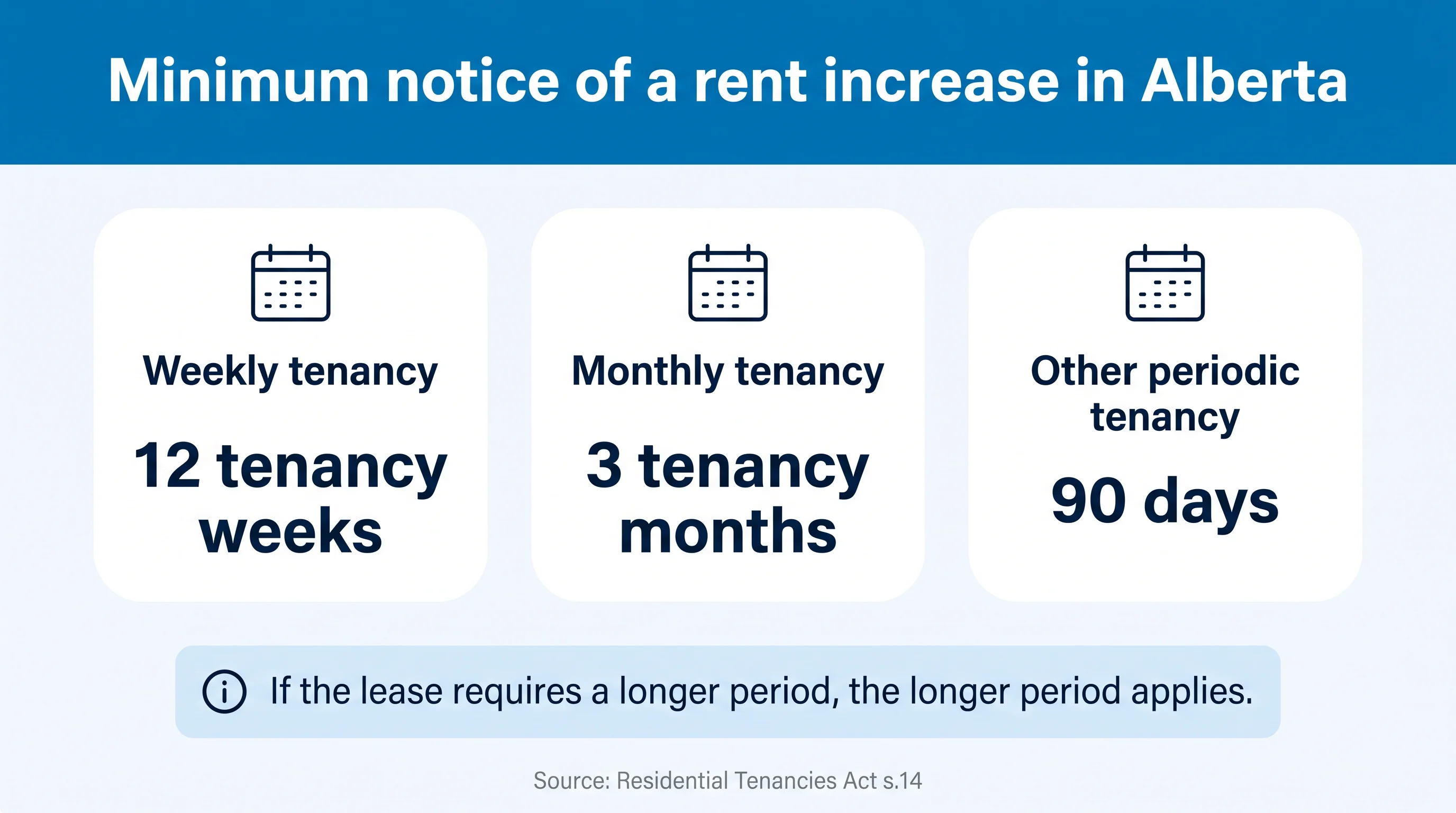
Section 14(1) of the Residential Tenancies Act (RTA) sets the minimum written notice before the date the increase takes effect:
| Type of tenancy | Minimum written notice |
|---|---|
| Weekly | At least 12 tenancy weeks |
| Monthly | At least 3 tenancy months |
| Any other periodic tenancy | At least 90 days |
If your lease requires a longer notice period, section 14(3) says the landlord must give at least that longer period.
What is a "tenancy month"?
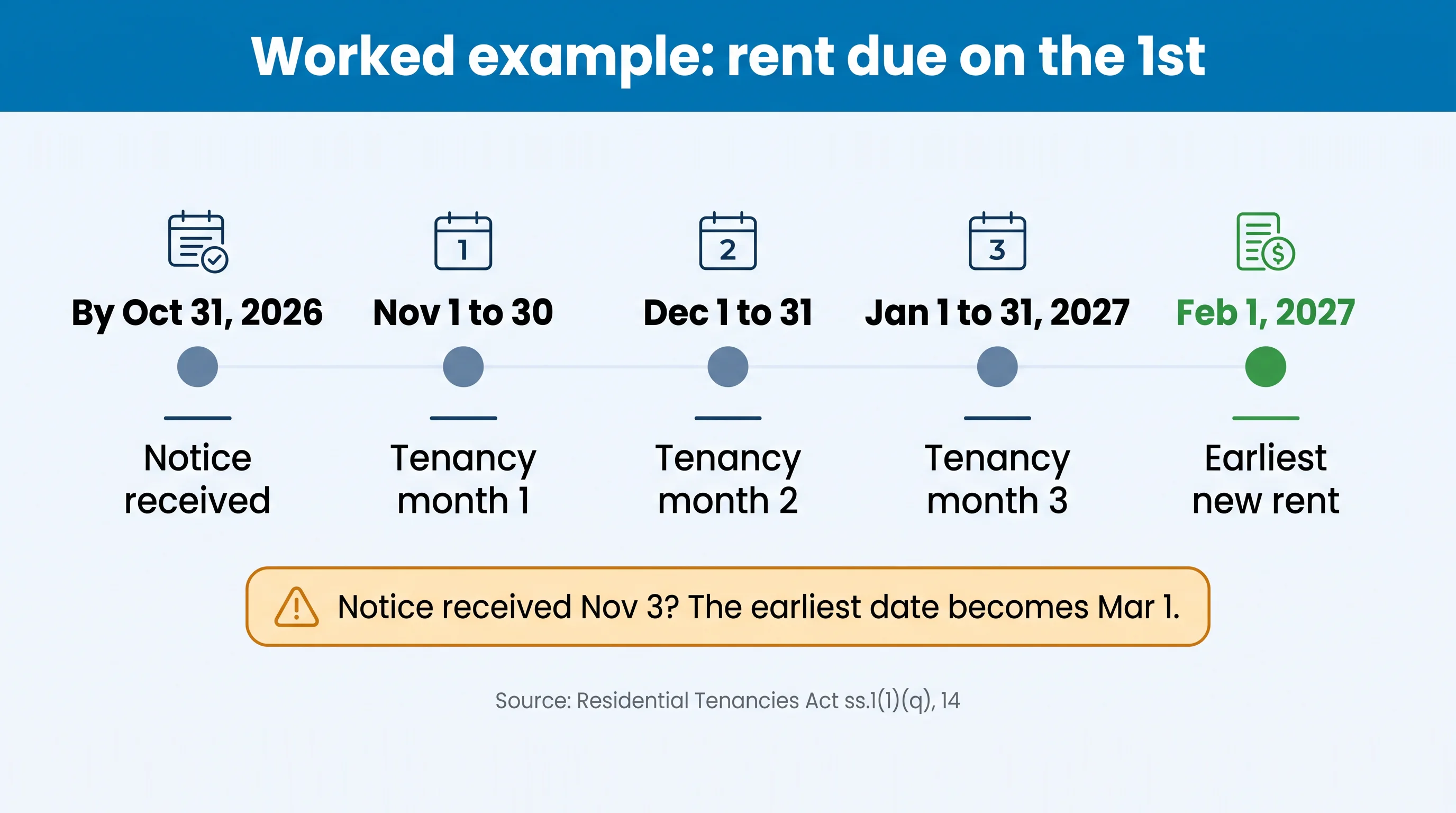
Section 1(1)(q) defines a tenancy month as the period a monthly tenancy is based on, whether or not it is a calendar month. It begins on the day rent is payable, unless the lease names another date. If your rent is due on the 15th, your tenancy months run from the 15th to the 14th.
Worked example: rent due on the 1st
| Date | What happens |
|---|---|
| By October 31, 2026 | The notice is in the tenant's hands |
| November 1 to 30 | Tenancy month 1 |
| December 1 to 31 | Tenancy month 2 |
| January 1 to 31, 2027 | Tenancy month 3 |
| February 1, 2027 | The earliest date the new rent can take effect |
A notice that arrives on November 3 does not give three full tenancy months before February 1. The earliest effective date would then be March 1.
What must the notice say?
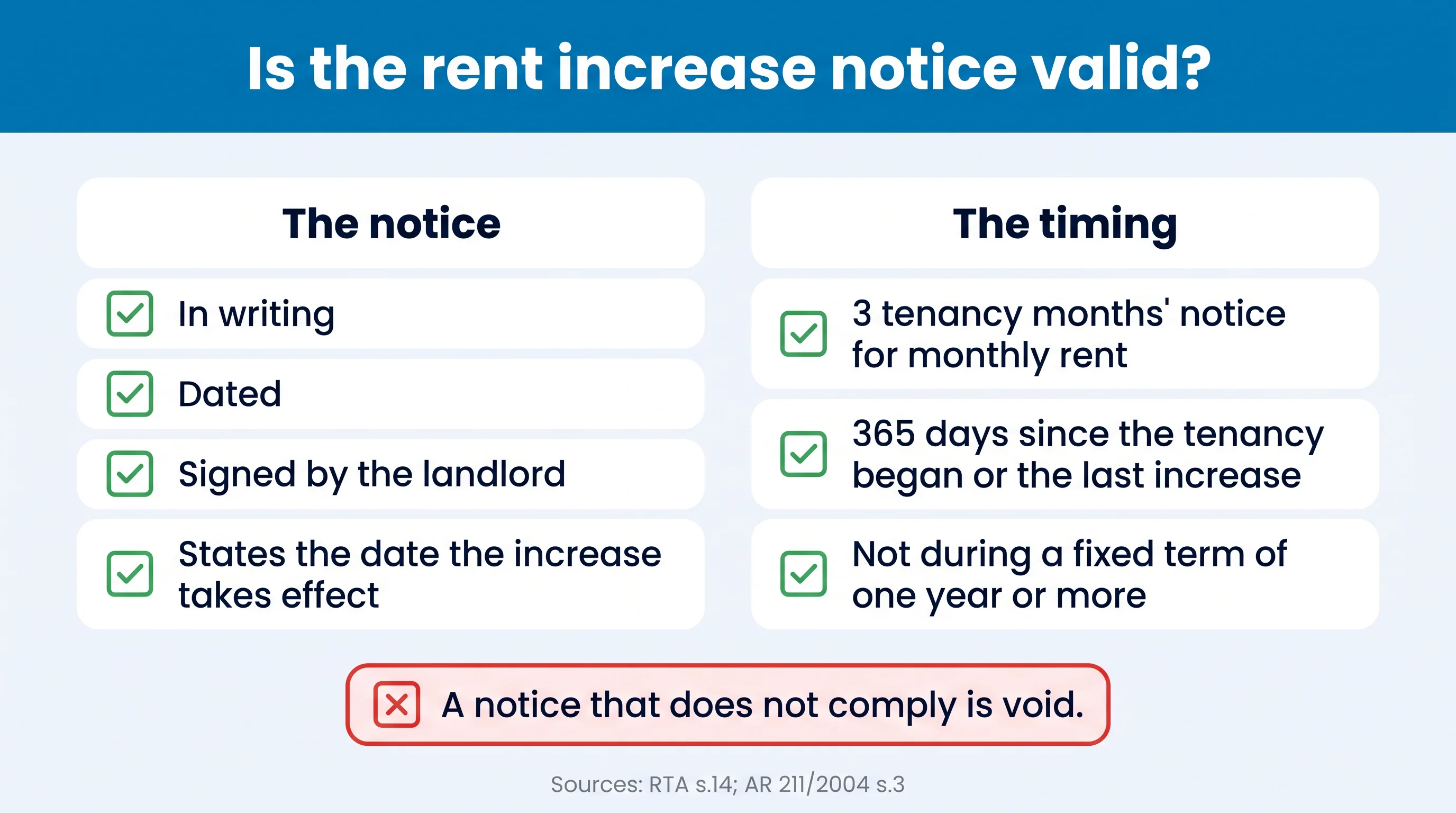
Section 14(2) says the notice must:
- be in writing;
- be dated;
- be signed by the landlord; and
- state the date on which the increase takes effect.
Alberta has no official rent increase form. A letter that meets these four points is enough.
How often can rent go up?
Section 3 of the Residential Tenancies Ministerial Regulation (AR 211/2004) adds limits on frequency:
- Periodic tenancies: at least 365 days must have passed since the tenancy began or since the last increase, whichever is later.
- Fixed terms of one year or more: no increase during the term.
- Back-to-back fixed terms of less than one year each in the same unit: at least 365 days since the first of those tenancies began or since the last increase, whichever is later.
- After certain termination notices: no increase after the landlord serves a condominium-conversion termination notice, or one for the major-renovation reason in the regulation.
The 365-day rule and the notice period are separate tests. Both must be met.
What if the notice is too short or missing something?
Section 14(6) says a notice that does not comply with section 14 is void. You do not have to pay the increase under a void notice. If you already paid it, section 14(7) says you can recover the amount of the increase as a debt.
A claim for overpaid rent can go to the Residential Tenancy Dispute Resolution Service (RTDRS) or to court. The RTDRS filing fee for a claim of $7,500 or less is $75, as of April 1, 2026. RTDRS cannot stop a future rent increase before it happens, so the claim is for money already paid.
Do I have to agree to the increase?
On a periodic tenancy, section 14(5) says a tenant who receives a valid notice and does not give notice ending the tenancy, effective on or before the date of the increase, is deemed to have agreed to it.
For a monthly tenancy, section 8(1)(a) says a tenant's notice to end the tenancy must be served on or before the first day of a tenancy month, to take effect on the last day of that month. In the example above, a tenant who wanted to leave rather than pay the new rent from February 1 would serve notice on or before January 1, effective January 31.
Common mistakes
- Counting calendar months when rent is due mid-month. Tenancy months start on the rent day.
- Ignoring a longer period in the lease. The lease's longer period governs.
- Missing the signature or the effective date. Either makes the notice void.
- A second increase inside 365 days. Not allowed.
- An increase in the middle of a one-year lease. Not allowed.
What to do next
- Write down the date you received the notice and how it arrived.
- Check it is written, dated, signed and states the effective date.
- Count the tenancy months (or weeks or days) to the effective date.
- Check when the tenancy began and when rent last went up.
- If the notice falls short, tell the landlord in writing and keep paying your current rent.
How Tenon10 helps
For landlords, Tenon10 lets you create an Alberta lease that records the rent, the rent day and the term from the start, which are the dates every notice period is counted from.
The same record holds the move-in and move-out inspection reports and tracks the 10-day deposit return date when a tenancy ends.
Frequently asked questions
Can my landlord give 30 days' notice of a rent increase?
Not for a monthly tenancy. The minimum is 3 tenancy months, or longer if your lease says so.
Can a rent increase notice be sent by text?
The notice must be in writing, dated and signed by the landlord. Keep whatever you received, and if you are unsure whether it was properly served, the safest course for a landlord is to serve it again in person or by registered mail with full notice.
Is there a limit on how much rent can increase in Alberta?
No. There is no cap on the amount.
My lease is for one year. Can rent go up in month 6?
No. Rent cannot be increased during a fixed term of one year or more.
What if I paid the increase and the notice was invalid?
A non-compliant notice is void, and you can recover the increase you paid as a debt, through RTDRS or the court.
Alberta Rent Increase Notice Checklist
A renter's checklist to test an Alberta rent increase notice: notice period, form, 365-day rule and fixed terms.
Get Free PDF →Keep every Alberta lease date in one place
Create your Alberta leases in Tenon10, with the rent, rent day and term recorded for every unit.
Built for Canadian landlords and property managers.