If you rent in British Columbia, you may already have heard that the 2027 rent increase limit is out. What you really want to know is simple: how much can my rent go up next year, when, and what should I watch for on the notice?
The short answer is 2.2%, at most once a year, with at least three full months' written notice on an official form. The longer answer helps you check that your own increase is correct, plan your budget, and spot an error before you pay it.
BC 2027 Rent Increase Renter Checklist
A renter checklist for the 2027 BC rent increase limit: your highest new rent, your earliest increase date and what to check on the notice.
Get Free PDF →The rule for 2027
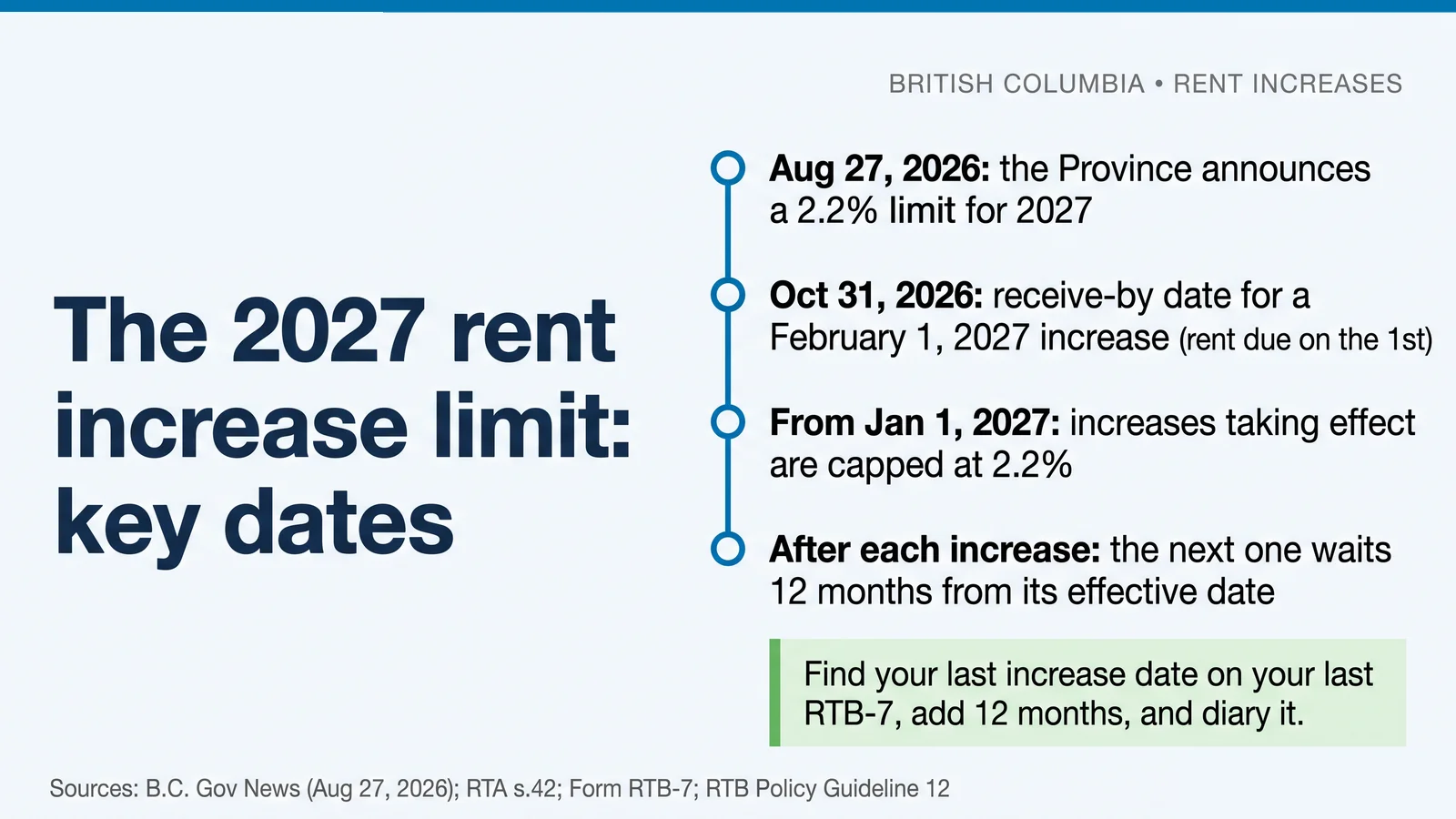
On August 27, 2026, the province announced that the maximum rent increase for 2027 is 2.2%. It applies to increases that take effect on or after January 1, 2027. The 2026 limit was 2.3%.
The limit follows inflation: it equals the 12-month average change in B.C.'s all-items Consumer Price Index, ending in July of the year before. The province says 2027 is the seventh year in a row the cap is at or below inflation.
What your landlord must do
Under Part 3 of the Residential Tenancy Act and the Residential Tenancy Branch (RTB) rent increase page, your landlord must:
- use the official Notice of Rent Increase, Form RTB-7;
- state the exact new rent in dollars and the date it starts;
- give you at least three full months' notice;
- wait at least 12 months after your rent was first payable or after your last increase took effect; and
- stay at or under the limit, with no rounding up and no "catching up" on increases skipped in past years.
What 2.2% looks like
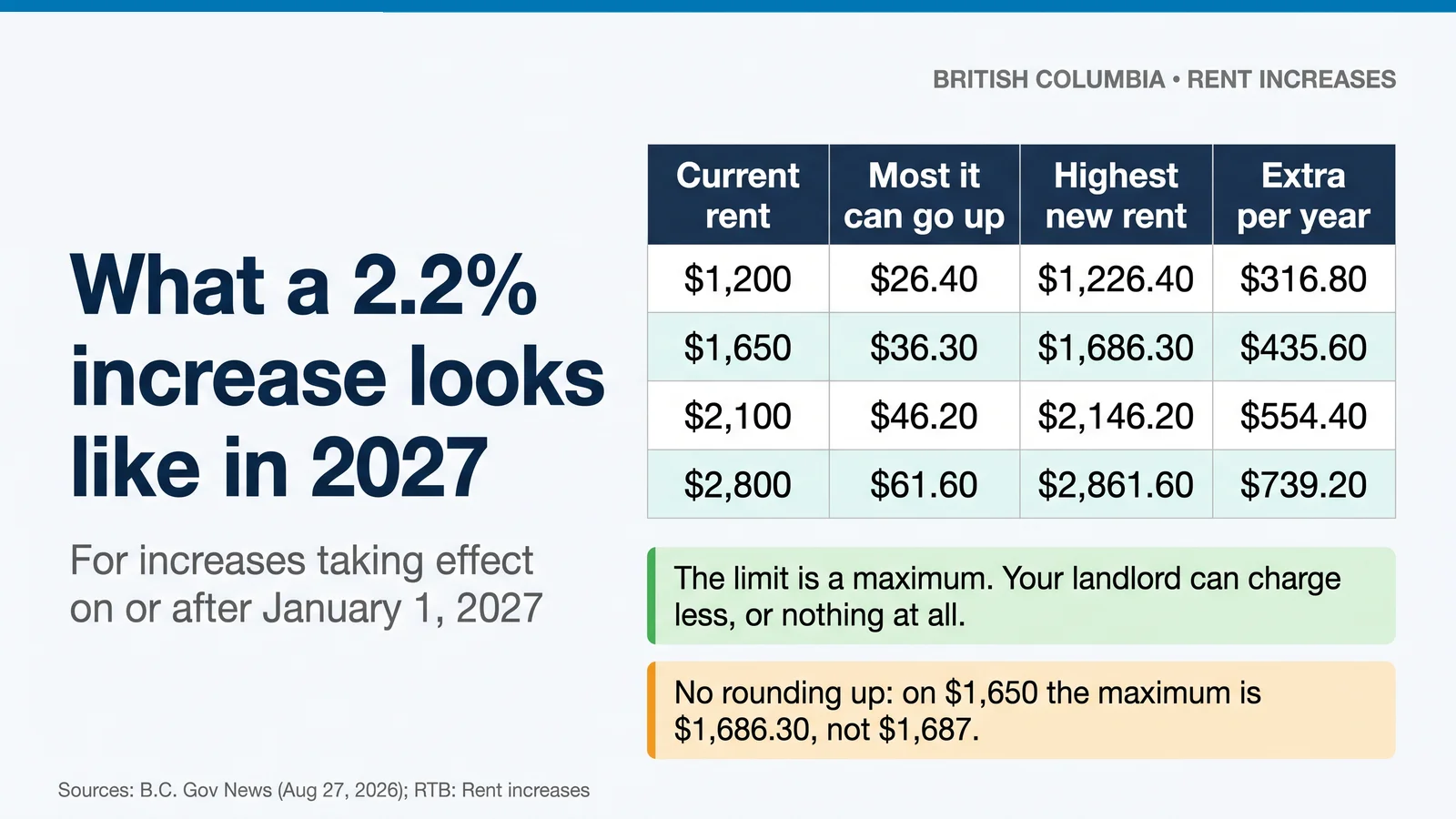
| Your current rent | Most it can go up | Highest new rent | Extra per year |
|---|---|---|---|
| $1,200 | $26.40 | $1,226.40 | $316.80 |
| $1,650 | $36.30 | $1,686.30 | $435.60 |
| $2,100 | $46.20 | $2,146.20 | $554.40 |
| $2,800 | $61.60 | $2,861.60 | $739.20 |
Your landlord can charge less, or nothing at all. The limit is a maximum, not an automatic increase.
The RTB also says your landlord cannot round the amount up and cannot "catch up" on an increase they skipped. If your landlord raised rent by only 1% in a year when more was allowed, the difference is gone for good. So if your rent is $1,650 today, the 2027 maximum is $1,686.30, whatever happened in earlier years.
Which year's limit applies depends on when the increase starts, not when the notice was written. An increase that takes effect in 2027 is capped at 2.2%, even if the notice arrived in the fall of 2026.
When could your increase start?
Two dates decide it. First, the 12-month date: if your last increase took effect on April 1, 2026, the next cannot start before April 1, 2027. Second, the notice: with rent due on the 1st, you must receive the RTB-7 before three full months begin. The RTB-7 itself gives the example that a notice given any time in January allows an increase on May 1.
| If the increase starts | You must receive notice by |
|---|---|
| February 1, 2027 | October 31, 2026 |
| March 1, 2027 | November 30, 2026 |
| April 1, 2027 | December 31, 2026 |
| May 1, 2027 | January 31, 2027 |
A mailed notice counts as received on the fifth day after it was mailed. One emailed to an address you gave for service, attached to your door, or left in your mailbox counts as received on the third day (RTB Policy Guideline 12).
If the notice is late, the increase is not cancelled. Section 42(4) of the Act moves it to the earliest date that complies.
When rent can go up by more
Your rent can rise above 2.2% only if:
- you agree in writing to a specific dollar amount and start date, with any conditions, and sign it. You never have to agree; or
- the RTB approves an additional rent increase for your landlord, for example after major capital work. Tenants can take part and give evidence. See the RTB's additional rent increase page.
The 2.2% limit does not cover every home. The province lists commercial tenancies, co-operative housing, non-profit rent-geared-to-income housing and some assisted-living facilities as outside it. Manufactured home park tenancies follow a different formula.
Common mistakes renters make
- Assuming the increase is automatic. No valid RTB-7 means no increase.
- Paying a rounded-up amount. On $1,650, the maximum new rent is $1,686.30, not $1,687.
- Signing a "voluntary" agreement without reading it. A signed written agreement can allow more than 2.2%.
- Accepting a text or verbal notice. The law requires the approved form.
- Not checking the 12-month date. A new owner does not restart the clock; the RTB says the rule applies even when there is a new landlord.
What to do next
- Check the notice against the rules above when it arrives. Note the date and how you received it.
- Budget for the new amount if it is correct. A lawful increase on the right form cannot be disputed (section 43(2) of the Act).
- Raise any error with your landlord in writing, with your numbers. Most mistakes get fixed this way.
- Do not pay the unlawful part. The RTB says you do not have to pay an increase above the limit or without proper notice. If you already paid it, section 43(5) lets you deduct it from rent or otherwise recover it; explain the deduction in writing.
- Contact the RTB or apply for dispute resolution if you cannot resolve it. Keep paying your lawful rent meanwhile.
How Tenon10 helps
Tenon10 is software for landlords and property managers. It generates the official B.C. Notice of Rent Increase (RTB-7), so landlords who use it serve the approved form with the dollar amount and start date filled in.
For renters, our free forms page and tenant hub gather plain-language guides you can use to check your situation.
FAQ
Does the 2.2% limit apply if my increase was served in 2026?
The limit depends on when the increase takes effect. An increase starting in 2027 is capped at 2.2%, even if you got the notice in 2026.
Can my landlord raise rent twice in 2027?
No. Rent can go up only once every 12 months, counted from the date the last increase took effect.
My landlord skipped an increase last year. Can they add it now?
No. The RTB says unused increases cannot be carried forward.
Hydro is included in my rent. Can my landlord raise it separately?
Not above the limit. The RTB says included utilities are capped with the rent, even if the landlord's costs go up.
BC 2027 Rent Increase Renter Checklist
A renter checklist for the 2027 BC rent increase limit: your highest new rent, your earliest increase date and what to check on the notice.
Get Free PDF →Free B.C. renter resources
Check our free forms and tenant guides. Landlords can use Tenon10 to generate the official RTB-7 notice.
Built for Canadian landlords and property managers.
Related BC guides
Sources: B.C. Gov News, 2027 rent increase limit (Aug 27, 2026); Residential Tenancy Act, Part 3; RTB: Rent increases; RTB: Additional rent increases; Form RTB-7; RTB Policy Guideline 12. This article is a summary of British Columbia rules as of October 2026, not legal advice. Check the Residential Tenancy Branch for your situation.