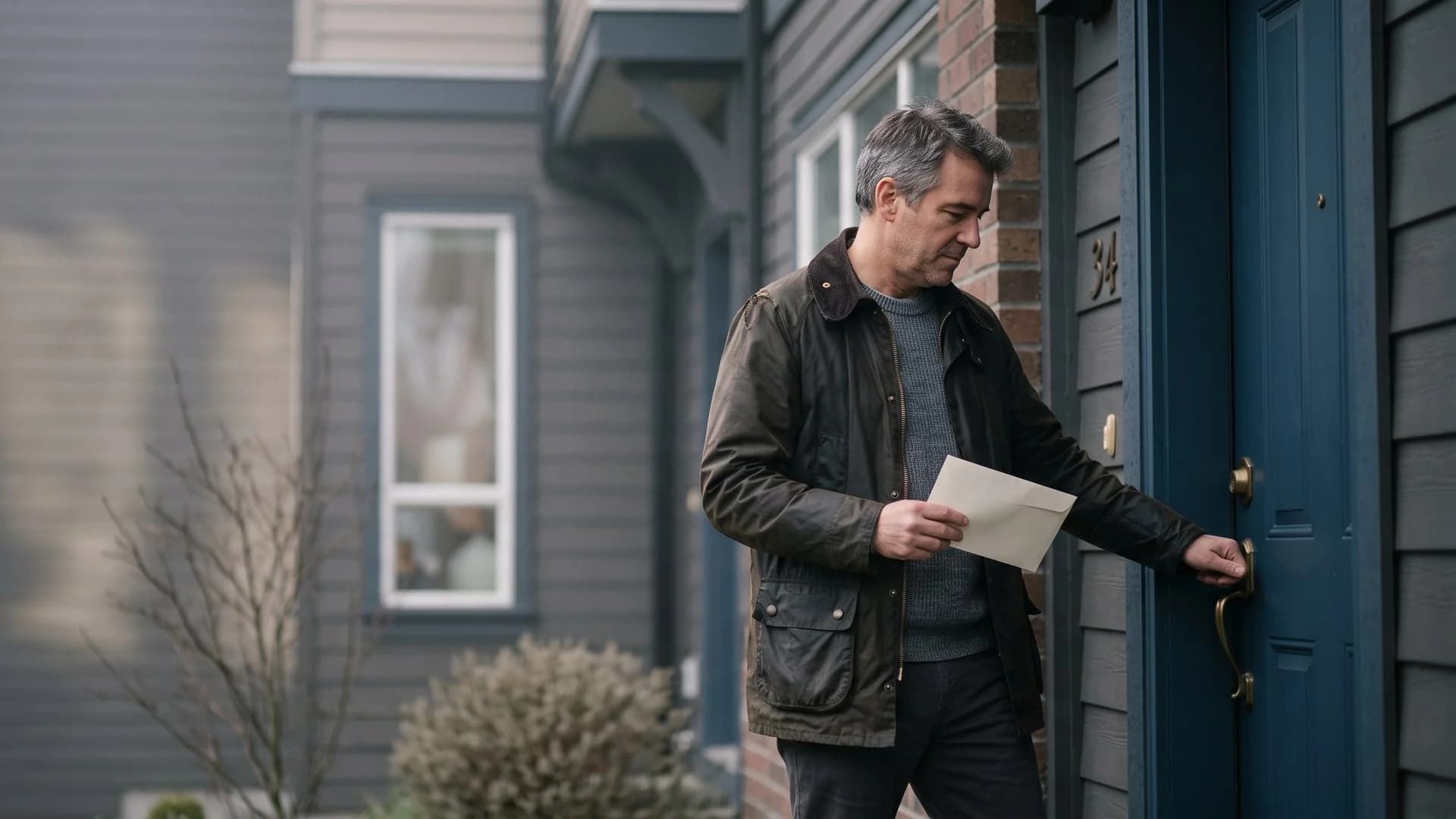
You found a form on your door, in your mailbox or in your inbox. It says "10 Day Notice to End Tenancy for Unpaid Rent or Utilities," and it has a move-out date on it. It is normal to feel panic. Try to set that aside for a moment, because the next few days matter more than anything else.
A 10 Day Notice does not mean you must be out in 10 days no matter what. In British Columbia you have 5 days to respond, and what you do in those 5 days decides whether the tenancy continues.
This guide explains what the notice means, how to count your deadline, and your options.
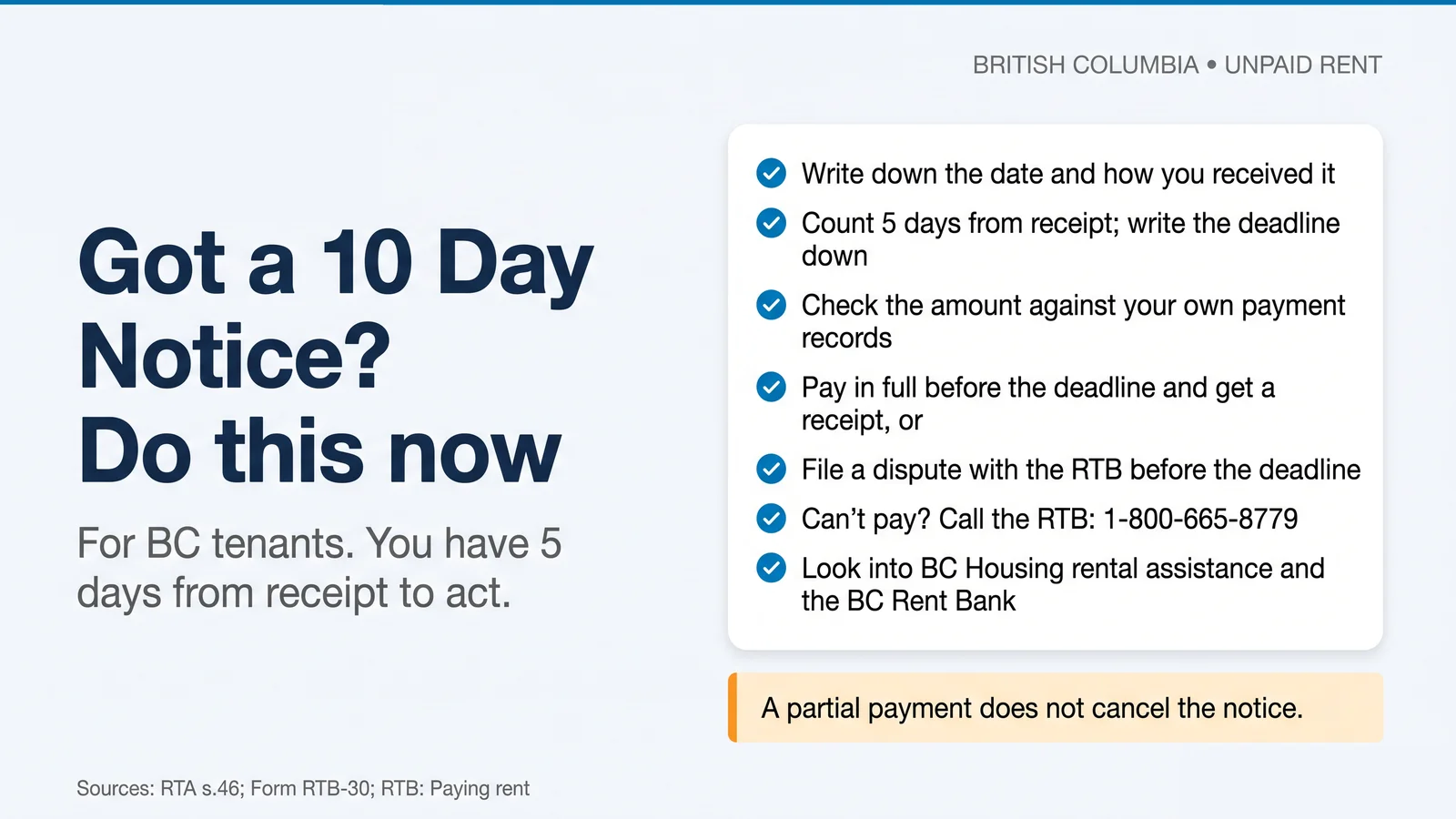
Got a BC 10 Day Notice? Tenant Checklist
A tenant checklist for a BC 10 Day Notice for unpaid rent: work out your 5-day deadline, check the notice, and choose to pay or dispute in time.
Get Free PDF →What the law says
Section 46 of the Residential Tenancy Act lets your landlord give this notice on any day after rent was due, if it was not paid. The Residential Tenancy Branch (RTB) says this applies even if rent is only one day late, or only partly unpaid.
Within 5 days after you receive the notice, you can:
- Pay the overdue rent in full. The notice then has no effect, and your tenancy continues.
- Dispute the notice by applying to the RTB for dispute resolution, if you believe it is wrong.
If you do neither, the law says you are conclusively presumed to have accepted that your tenancy ends on the notice's effective date, and you must move out by then.
When your 5 days start
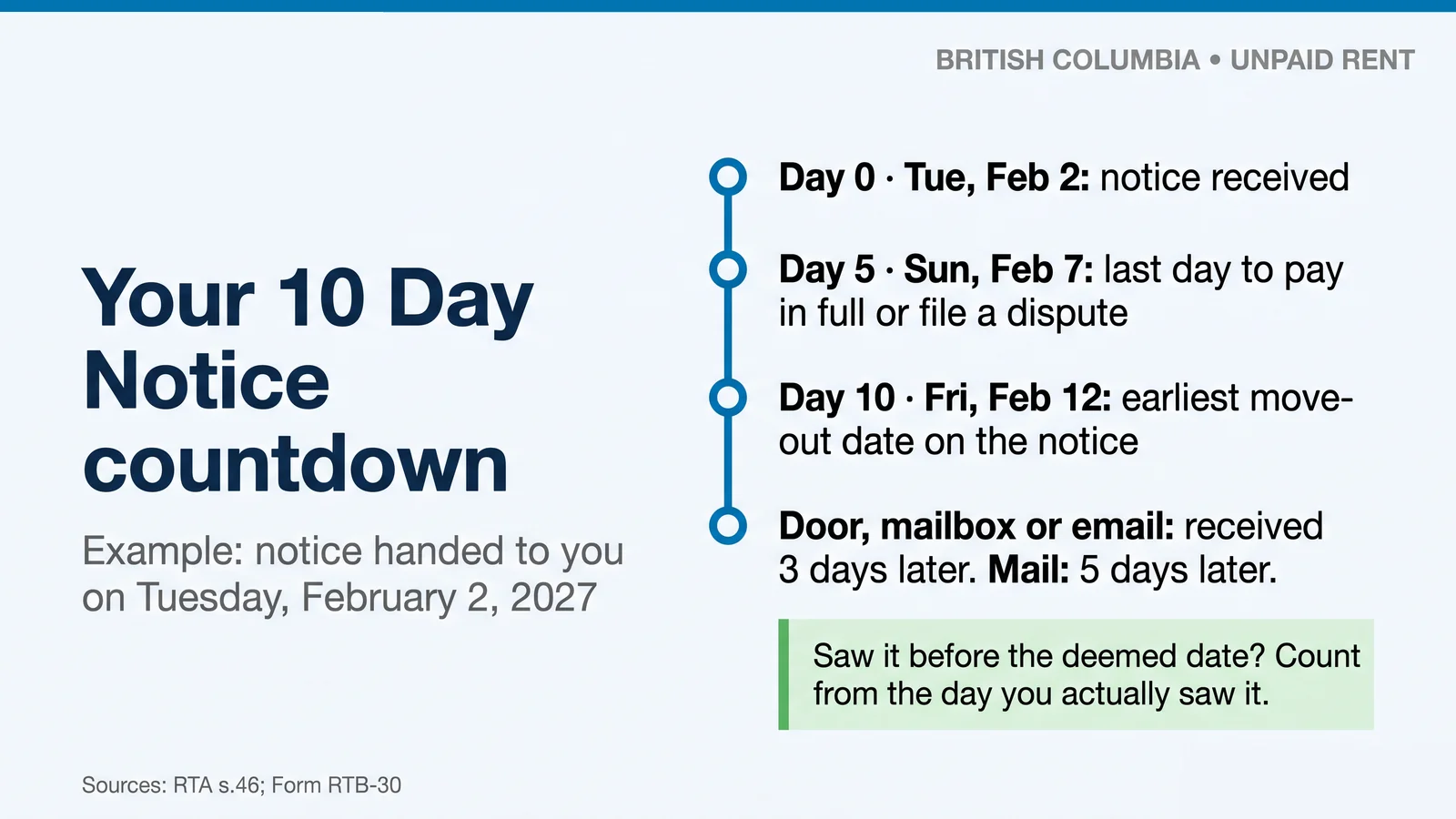
Your 5 days start when you receive the notice. The RTB-30 form explains when a notice is treated as received:
| How you got it | Treated as received |
|---|---|
| Handed to you, or to an adult who lives with you | That day |
| Mailbox, mail slot, taped to your door, or emailed to an address you gave for service | 3 days later |
| Registered or regular mail | 5 days later |
If you actually saw it earlier, count from the day you saw it. The safest approach is to treat the day you found it as day zero.
Example: your landlord hands you the notice on Tuesday, February 2, 2027. Your last day to pay in full or file a dispute is Sunday, February 7. The move-out date on the notice must be at least 10 days after you received it, so no earlier than Friday, February 12.
Because February 7 is a Sunday, section 25 of BC's Interpretation Act would carry the deadline to Monday, February 8. Do not rely on that: pay or file by the Sunday. The RTB's online dispute application is open every day.
Is the notice valid?
To be effective, a landlord's notice must be in writing on the approved form (RTB-30), signed and dated by the landlord, give the rental unit's address, state the effective date and state the reason. If the move-out date is too early, the law changes it to the earliest correct date; a wrong date alone does not cancel the notice.
If the unpaid amount is for utilities, your landlord can only use this notice if your tenancy agreement requires you to pay utilities to the landlord and the bills were still unpaid more than 30 days after the landlord gave you a written demand.
Your options, one by one
Option 1: Pay in full within 5 days
Pay every dollar listed as overdue on the notice. A partial payment does not cancel it. Get a receipt, especially if you pay in cash, and keep a copy of any e-transfer confirmation.
Option 2: Dispute within 5 days
Apply for dispute resolution online, at a Service BC office, or at the RTB office in Burnaby. The RTB-30 lists examples of good reasons to dispute: proof you already paid, an arbitrator's order letting you keep the rent, or money you spent on emergency repairs after notifying the landlord. An arbitrator will decide at a hearing. Telling your landlord you disagree, by text or in person, is not a dispute.
Option 3: Talk to your landlord
Your landlord may agree to a payment plan. That is their choice, not a requirement. If you agree on something, get it in writing. A promise to "sort it out" does not stop the 5-day clock.
Common mistakes
- Paying part of the rent and assuming the notice is gone.
- Waiting for the move-out date before acting. By then, your 5 days are long over.
- Disputing by text instead of filing with the RTB.
- Not keeping proof of payment.
- Assuming a late dispute will be accepted. The RTB-30 says an arbitrator may only extend the deadline for a serious and compelling reason.
What to do next
- Today: work out your deadline from the table above. Write it down.
- Check the numbers. Compare the amount on the notice to your own records of what you paid.
- If you can pay in full, pay before the deadline and get a receipt.
- If the notice is wrong, file a dispute before the deadline. Gather receipts, bank records and messages.
- If you cannot pay, contact the RTB for information and look at rental help. The RTB's paying rent page lists BC Housing's rental assistance programs and the BC Rent Bank.
The RTB's information line is 1-800-665-8779 (Greater Vancouver 604-660-1020, Victoria 250-387-1602).
What happens if you do nothing
Your landlord can apply to the RTB for an order of possession, often through the Direct Request process, which is decided on documents without a hearing. Even then, your landlord cannot change the locks, remove your things or physically remove you on their own. The RTB says only the BC Supreme Court and an authorized court bailiff can enforce an order of possession, and illegal evictions can bring penalties for landlords.
If an order of possession is served on you, the RTB says the party who lost has 2 days after receiving it to apply for a review, if there are grounds. Contact the RTB straight away if this happens.
How Tenon10 helps
Tenon10 is software for landlords and property managers, and it generates the BC forms they use, including the RTB-30. That means the notice you receive from a Tenon10 landlord is on the approved form.
Tenants can find free resources on our forms page and more plain-language guides on our tenant hub.
FAQ
Do I have to move out in 10 days?
Not if you pay all the overdue rent within 5 days, or dispute the notice within 5 days. If you do neither, you must leave by the effective date.
My landlord accepted money after the 5 days. Is the notice cancelled?
Not automatically. Ask your landlord in writing whether the tenancy is continuing, and get a receipt for what you paid.
Can my landlord evict me in winter?
Yes. The RTB says evictions can happen at any time of year.
Does it cost money to dispute?
There is a filing fee. The RTB offers a fee waiver if you have very low income or expenses that make the fee a hardship.
Got a BC 10 Day Notice? Tenant Checklist
A tenant checklist for a BC 10 Day Notice for unpaid rent: work out your 5-day deadline, check the notice, and choose to pay or dispute in time.
Get Free PDF →BC tenancy forms, done right
Tenon10 generates BC tenancy forms on the approved RTB templates, including the tenant's notice to end tenancy.
Built for Canadian landlords and property managers.
Related BC guides
Sources: Residential Tenancy Act, SBC 2002 c.78; RTB-30 10 Day Notice to End Tenancy; RTB: Paying rent; RTB: Types of evictions; RTB: Order of possession; RTB: Complete and serve the direct request application. This article is a summary of British Columbia rules as of October 2026, not legal advice. Check the Residential Tenancy Branch for your situation.