Rent was due on the first. It is now the second, and the money has not arrived. Maybe it is the first time this tenant has been late, or maybe it is the third time this year. Either way, you need to know what British Columbia allows you to do next, and in what order.
In BC, the tool for unpaid rent is the 10 Day Notice to End Tenancy for Unpaid Rent or Utilities, form RTB-30. It is a strict document. Serve it correctly and the process is predictable: the tenant pays, disputes or moves out. Serve it with a missing signature or a sloppy service record, and you may lose weeks at the Residential Tenancy Branch (RTB).
This guide walks through the rule, the form, service, the five-day window and what to do when nothing happens. It is written for landlords and property managers.
BC 10 Day Notice (RTB-30) Serving Checklist
A landlord checklist for giving a BC 10 Day Notice for unpaid rent (RTB-30): what to fill in, how to serve it, deemed receipt and the five-day window.
Get Free PDF →What the law says about the 10 Day Notice
The rule sits in section 46 of the Residential Tenancy Act. In plain terms:
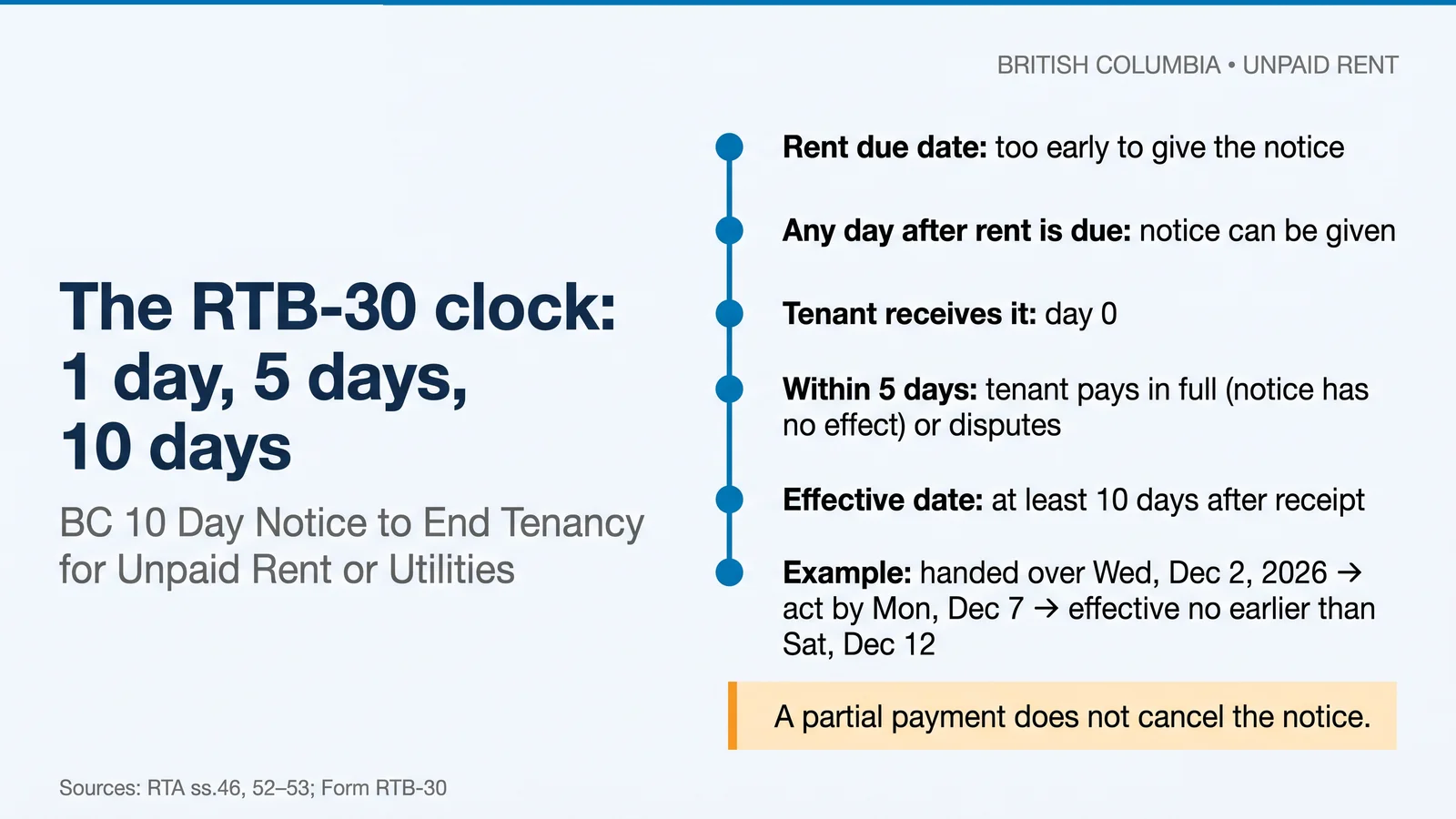
- When you can give it: on any day after the day rent is due, if rent is unpaid. Even one day late, or a shortfall of any amount, is enough.
- Effective date: the date must be at least 10 days after the date the tenant receives the notice.
- Tenant's window: within 5 days after receiving it, the tenant may pay the overdue rent, in which case the notice has no effect, or dispute it by applying for dispute resolution.
- If the tenant does neither: the tenant is conclusively presumed to have accepted that the tenancy ends on the effective date and must move out by that date.
- Permitted deductions: the notice has no effect if the unpaid amount is one the tenant was allowed to deduct under the Act, for example under an arbitrator's order.
What the notice must contain
Section 52 says a landlord's notice to end a tenancy is only effective if it is in writing and:
- is signed and dated by you (or your agent),
- gives the address of the rental unit,
- states the effective date,
- states the grounds for ending the tenancy, and
- is on the approved form.
For unpaid rent, the approved form is the RTB-30. The form asks for both parties' names and addresses, the rental unit address, the move-out date, the amount of rent owing and the date it was due. Page 1 must be signed, and the tenant must receive all three pages.
If you get the effective date wrong
Section 53 protects you from a counting error. If the date you write is earlier than the law allows, the effective date is deemed to be the earliest date that complies. The RTB-30 form also says a wrong move-out date does not invalidate the notice. That said, a correct date avoids arguments. For a 10 Day Notice, you do not need to line the date up with the day before rent is due; that rule in section 53(3) does not apply to section 46 notices.
Unpaid utilities are different
You can treat unpaid utilities as unpaid rent only if the tenancy agreement requires the tenant to pay utility charges to you, and the charges are still unpaid more than 30 days after you gave the tenant a written demand for them (s.46(6)). No written demand, no 10 Day Notice for utilities. Keep a copy of the demand showing the amount and due date, and the related bills.
Serving the notice and counting the days
The clock does not start when you sign the form. It starts when the tenant receives it, or is deemed to receive it. The RTB-30 form sets out the deemed-receipt rules:
- Handed to the tenant, or to an adult who appears to live with the tenant: received that day.
- Left in the mailbox or mail slot, attached to the door, or emailed to an address the tenant gave for service: received 3 days later.
- Sent by registered or regular mail: received 5 days later.
Here is a worked example. Rent of $2,100 was due Tuesday, December 1, 2026. You serve the notice on Wednesday, December 2, 2026.
| Service method | Received (or deemed) | Last day to pay or dispute | Earliest effective date |
|---|---|---|---|
| In person | Wed, Dec 2 | Mon, Dec 7 | Sat, Dec 12 |
| Door, mail slot or email | Sat, Dec 5 | Thu, Dec 10 | Tue, Dec 15 |
| Registered or regular mail | Mon, Dec 7 | Sat, Dec 12 | Thu, Dec 17 |
Two cautions. First, if the tenant actually gets the notice earlier than the deemed date, the actual date counts. Second, if a deadline lands on a weekend or holiday, do not assume extra time either way; check with the RTB before you act on that date.
Service under the Act has its own rules. Sliding the notice under the door is not a recognized method. Text messages are not on the list of service methods. Email only works to an address the tenant provided for service.
Proof of service
Fill out the RTB-34 Proof of Service at the time you serve. If you later use the Direct Request process, the RTB decides on paper alone, with no hearing. RTB Policy Guideline 39 says substantive proof of service is essential because the tenant does not get to respond. Good proof looks like a registered mail receipt and tracking printout, a receipt signed by the tenant, or a signed witness statement.
What happens after the five days
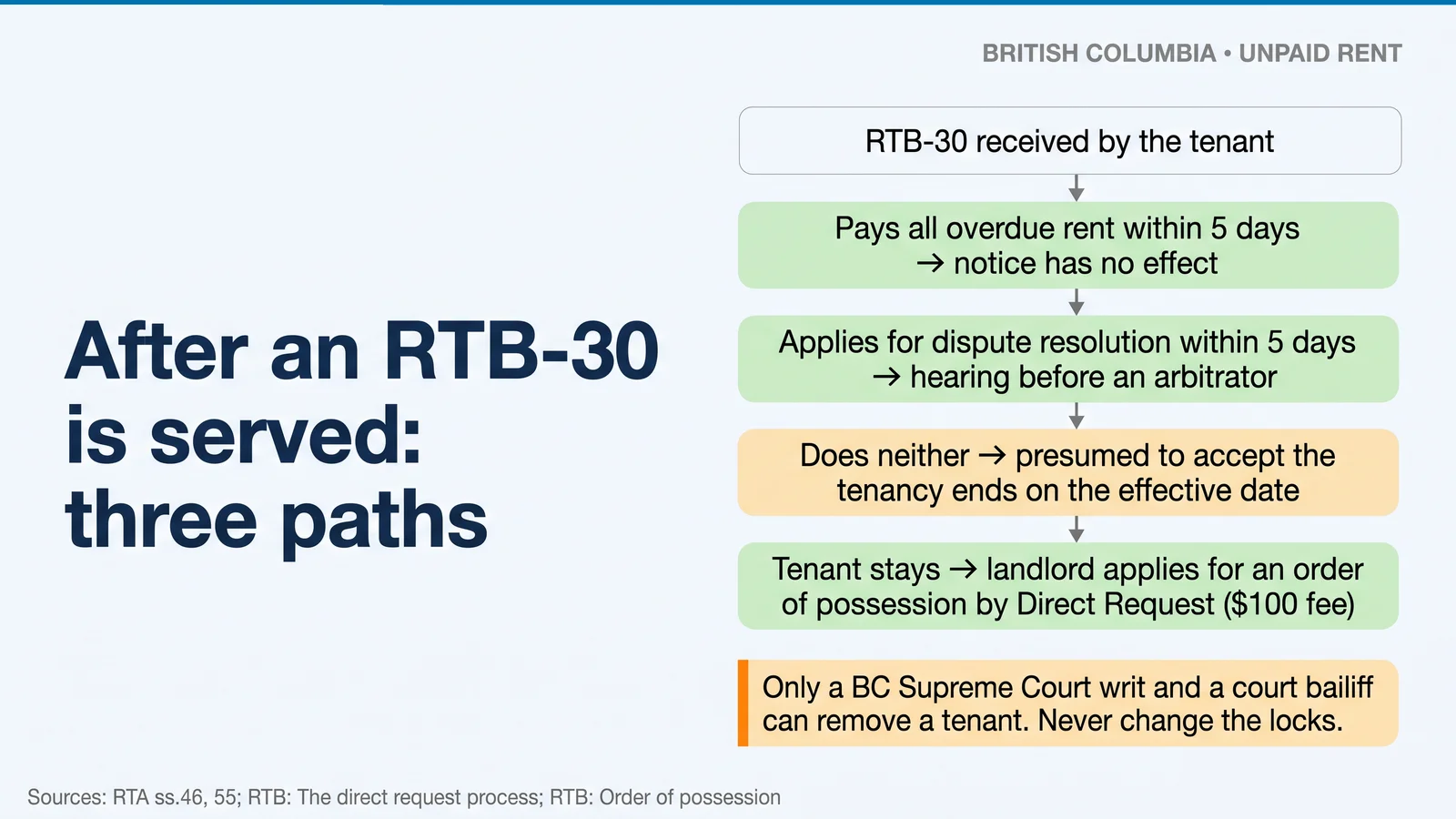
There are three paths.
- The tenant pays the overdue rent in full within 5 days. The notice has no effect. Partial payment does not meet this condition.
- The tenant applies for dispute resolution within 5 days. The matter goes to a hearing. Under section 55, if the arbitrator dismisses the tenant's application or upholds your notice, and your notice complies with section 52, the arbitrator must grant you an order of possession and an order for the unpaid rent.
- The tenant does neither. You can apply for an order of possession through the RTB's Direct Request process, which is decided on documents without a hearing. The filing fee is $100.
Before you apply, confirm the tenant did not file a dispute. The RTB asks landlords to check with [email protected].
Common mistakes
- Serving on the due date. The notice can be given on any day after the day rent is due, not on the due date itself.
- Using a homemade letter. A notice that is not on the approved form fails section 52.
- Forgetting the signature or date. Both are required for the notice to be effective.
- Serving only page 1. The tenant must receive all three pages of the RTB-30.
- Skipping the utilities demand. Without a written demand and a 30-day wait, a utilities-based notice is premature.
- Sliding it under the door. Not a recognized method. Attach it to the door instead, and have a witness.
- No proof of service. A Direct Request without clear proof can be dismissed or sent to a hearing.
- Ignoring a pattern. If a tenant is late at least three separate times, the RTB says you can give a One Month Notice for Cause (RTB-33) instead of serving 10 Day Notices every month.
Doing it across many units
One late tenant is manageable. Twelve late tenants in a 90-unit portfolio on December 2 is a process problem. A few habits keep it under control:
- Run a payment check on the first business day after rent is due. Build the list of units that are short, with the exact amount owing.
- Prepare notices in a batch, serve them individually. Each tenant gets their own signed, dated, three-page notice.
- Pick one service method per building. Registered mail gives clean proof; door attachment with a witness is faster. Consistency makes the RTB-34 easy to complete.
- Log the deemed-receipt date for each unit. Your five-day and effective-date deadlines differ by method.
- On day six, sort the list into three groups: paid in full, disputed, and no response. The third group moves to Direct Request.
How Tenon10 helps
Tenon10 generates the RTB-30 10 Day Notice on the approved form. It also generates the RTB-33 One Month Notice for Cause, which you may need for repeated late payment.
Your lease, notices and payment records stay together in one place. When you need to file a Direct Request or attend a hearing, that record is your evidence file.
FAQ
Can I serve a 10 Day Notice if the tenant paid most of the rent?
Yes. The RTB says a shortfall of any amount allows the notice. To cancel it, the tenant must pay all the overdue rent within 5 days.
Can I charge a late fee on top of the rent?
Only if your tenancy agreement clearly provides for it, and the maximum is $25.
What if the tenant pays on day six?
The five-day window has passed. Whether you accept the money and continue the tenancy is your decision. Give a receipt either way, and include it if you apply for a Direct Request.
Can the tenant get more time to pay?
Under section 66, the RTB can extend the time to pay only if you agree, or if the tenant deducted the amount believing it was allowed for emergency repairs or under an RTB order.
Do I need a hearing to get an order of possession?
Not if the tenant did not pay or dispute. The Direct Request process is decided on your documents. If the tenant disputed, there is a hearing.
BC 10 Day Notice (RTB-30) Serving Checklist
A landlord checklist for giving a BC 10 Day Notice for unpaid rent (RTB-30): what to fill in, how to serve it, deemed receipt and the five-day window.
Get Free PDF →Generate your RTB-30 in minutes
Tenon10 generates the BC 10 Day Notice and keeps your lease, notice and payment records together as your evidence record.
Built for Canadian landlords and property managers.
Related BC guides
- Five Days to Pay or Dispute: What Happens After a BC 10 Day Notice
- Direct Request for an Order of Possession in BC
- Serving Documents in BC: Every Method the RTA Allows
- Got a 10 Day Notice in BC? What Tenants Should Do Now
Sources: Residential Tenancy Act, SBC 2002 c.78; RTB-30 10 Day Notice to End Tenancy; RTB: Types of evictions; RTB: Paying rent; RTB: The direct request process; RTB Policy Guideline 39; RTB: Order of possession. This article is a summary of British Columbia rules as of October 2026, not legal advice. Check the Residential Tenancy Branch for your situation.