

Update, 26 Sep 2026: The September 21 changes this guide looks ahead to are now in force — see the LTB's September 21 operational update. An N4 given on or after September 21, 2026 needs at least 7 days' notice. On an L1 filed on or after that date, a tenant who wants to raise other issues at the hearing must pay the landlord half the arrears claimed at least seven days before the hearing, on top of the existing requirement to describe those issues to the landlord and the LTB at least seven days ahead. A personal-use N12 served on or after that date with at least 120 days' notice owes no compensation and no offer of another unit (an N12 for a purchaser's use is not covered). Rent received more than seven days after the due date at least three times in six months now counts as persistent late payment for an N8 (a payment the landlord applied to another amount owed, such as arrears, doesn't count as late). New limits on when the Board can delay an eviction, or cancel an eviction order issued without a hearing on the basis of an agreement or a tenant's notice, also took effect that day. The LTB has also updated its Rules of Procedure, published an updated N4, and replaced the N5, N6, N8, N12, N13, L1, L2, L9, L10 and T5 forms; previous versions of those ten forms won't be accepted as of November 30, 2026.
Every dispute that reaches Ontario's Landlord and Tenant Board — all forty-one-thousand-odd files currently in the system — travels the same road: a notice, an application, a queue, a fork, a hearing, an order, and sometimes the Sheriff. Seven stages, each with its own rules, fees, and clocks. And here's the problem: most people only ever learn the stage they're standing in, usually in a panic, usually the night before a deadline.
Single-stage knowledge produces the classic failures — notices that die on one wrong date, applications that sit unbuilt through a three-month queue, settlements signed without knowing the teeth behind them, orders celebrated while three clocks quietly start, and "wins" that stall at the courthouse door because nobody mentioned the Sheriff has a queue too. This guide is the whole map: the seven stages with the honest numbers at each junction, for landlords, tenants, and property managers alike. It's also the hub of a fourteen-guide series — at every stage below, a deep-dive guide is linked, and the full index sits at the end. Read the road once, end to end; then follow the link at the stage you're standing in. General information, not legal advice.
The Whole-Road Kit: The LTB Process in Seven Stages — Every Fee, Wait, and Clock on Two Pages
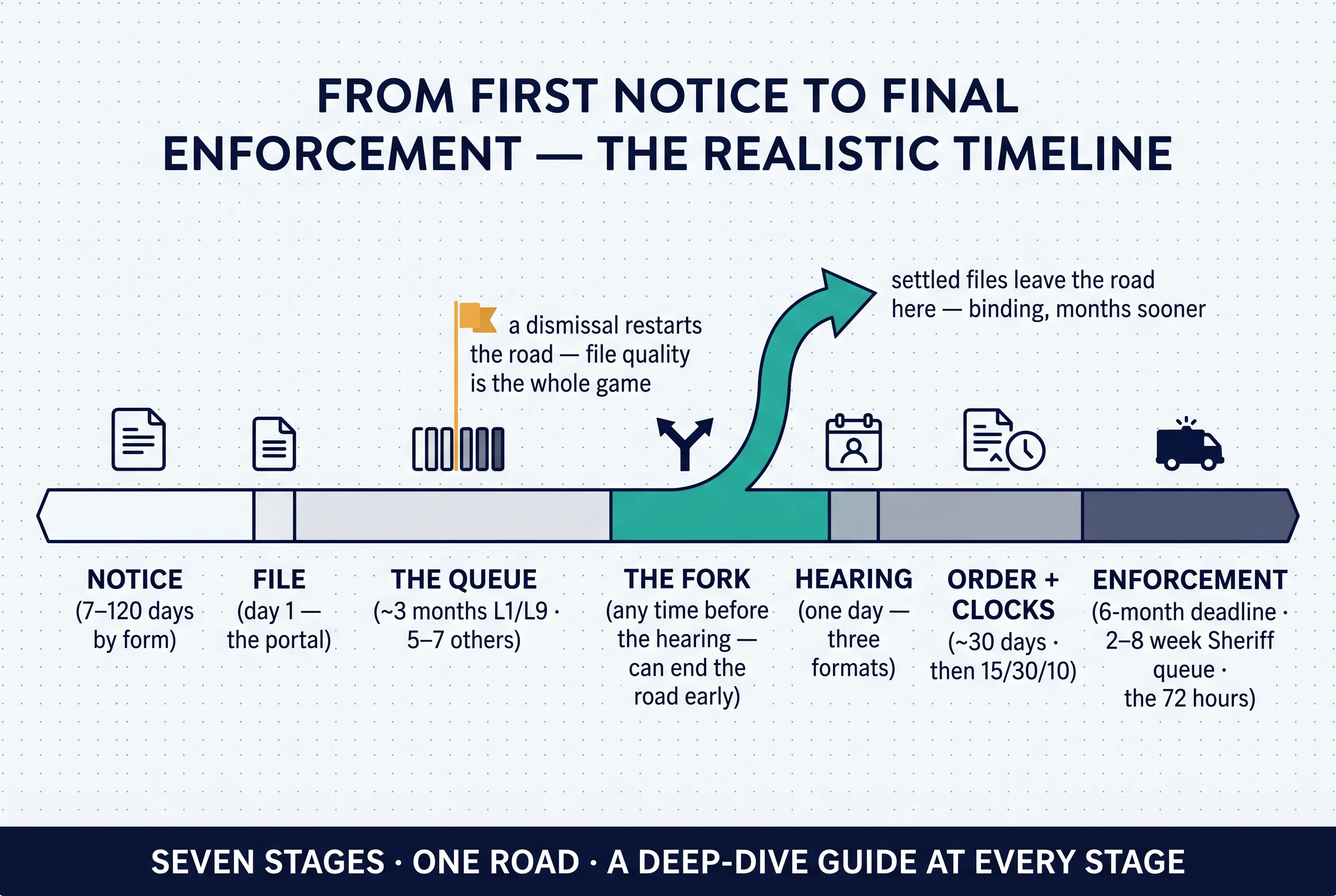
Every LTB file travels the same road: notice → application → queue → fork → hearing → order → enforcement. This free kit consolidates all seven stages for landlords, tenants, and PMs — the filing fees, the honest wait times, the settlement fork's teeth, the after-order clocks (15/30/10 days and month 6), and the Sheriff's final mile — into one printable two-page checklist you can pin to the front of every file.
Get Free PDF →Stages 1–2: The Notice and the Application
First, the system in one paragraph. The LTB is a quasi-judicial tribunal under the Residential Tenancies Act, 2006, resolving disputes through mediation or adjudication. Its Rules of Procedure were last updated January 1, 2026, a set of practice directions governs everything from representation to hearing formats to evidence, and a July 1 operational update brought the Bill 60 and Bill 97 changes live on the Board's own pages. It is faster than it was in 2023 and slower than it was before 2020 — which is exactly why knowing the road matters.
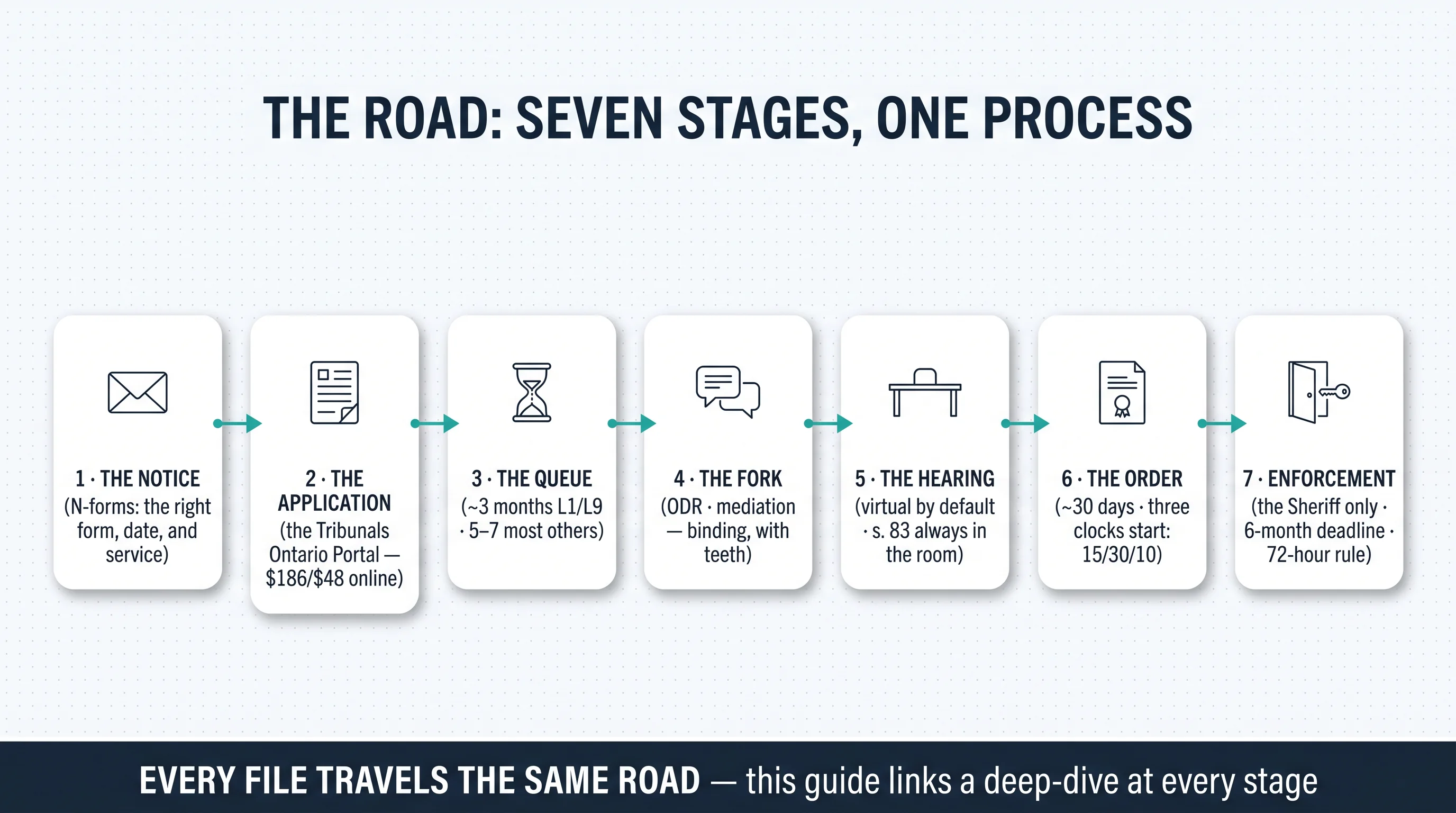
Stage one is the notice — nothing starts without one. The RTA requires a valid ground and the matching form: the N4 for non-payment (7 days for notices given on or after September 21, 2026; 14 for a monthly or yearly tenancy before that), the N5 with its cure window, the N6 and N7 for conduct, the N8 for persistent lateness, the N12 and N13 for own-use and renovation, and the N9/N11 lane when the tenant gives notice or both sides agree. Three basics are fatal when wrong: the right form for the real reason, a correct termination date (deemed-service rules trip people constantly — use the termination date calculator), and clean proof of service with the Certificate of Service kept. The notice is the first document in the case, not the case. And the tenant's anchor, worth stating in bold: a notice is not an order — nobody has to move out on a notice alone.
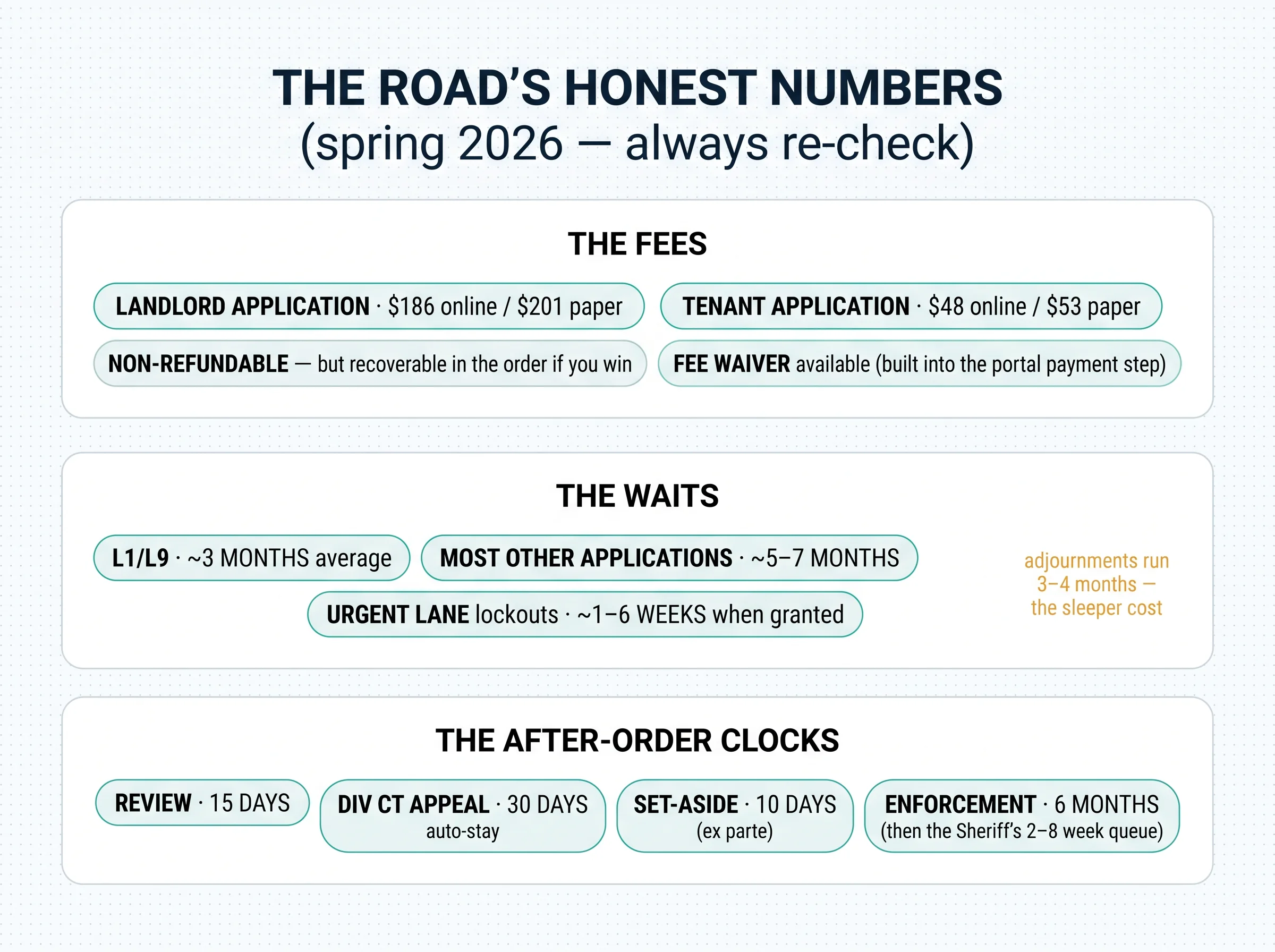
Stage two is the application, and the Tribunals Ontario Portal is the front door. The L1, L2, L3, L4, L9, L10, T1, T2, T5, T6 and combined applications all file online — guided step by step, with payment, file status, evidence upload, and the dispute-resolution tool in one place. The fees: landlord applications run $186 online or $201 on paper; tenant applications $48 online or $53 on paper — non-refundable, but typically recoverable in the order if you win, with a fee waiver for eligible filers built right into the payment step. Which application fits which situation is its own science — start with L1 vs L2, and know that each lane has its own trap (the L1's mandatory Information Update five business days before the hearing is the classic). Every form lives in the Ontario LTB Forms Hub.
Stages 3–4: The Queue and the Fork
Stage three is the queue, and honesty helps more than optimism. As of spring 2026, L1 and L9 arrears applications are being scheduled in roughly 3 months on average; most other application types run 5–7 months. There's an urgent lane — a Request to Shorten Time for genuine emergencies like illegal lockouts, vital-service cutoffs, or safety issues, heard in roughly one to six weeks when granted — but it's rarely granted otherwise. And the sleeper cost nobody budgets: an adjournment adds 3–4 months. The discipline that separates good files from stalled ones is treating the queue as preparation time, not dead time: evidence assembled and organized, the L1/L9 update diarized, payment-plan conversations started, and — for tenants raising issues at an arrears hearing — written notice of each issue plus the evidence served seven days ahead (with a 50% pay-in gate arriving September 21). The full queue math lives in our backlog guide.
Stage four is the fork — and most files should genuinely try it. The portal's online dispute resolution is, in the Board's own framing, "not mediation, not adjudication — the first step in determining which avenue fits": a monitored negotiation space where a Dispute Resolution Officer can step in, producing payment plans, consent orders, mediated agreements, or withdrawals. Mediation proper is voluntary and confidential, run by RTA-literate mediators, and nothing said there can be used at a hearing. The fork's honest appeal is speed: a binding agreement months before any hearing date. Its teeth are just as real: breaching a mediated agreement or consent order can send the file down the L4 ex parte lane — an eviction order without a fresh notice or an ordinary hearing — so the rule on both sides of the table is the same: sign only what you can perform. Picture the tenant with a documented T6 repair log who leaves the DRO session with a repair schedule and a rent credit, months before the hearing would have happened: the fork that saved a season.

Stages 5–6: The Hearing and the Order's Clocks
Stage five is the hearing — one day, three possible formats. Virtual is the default (Zoom video or phone), with written and in-person hearings for cases that suit them; the Board decides the format, and a practice direction governs requests to change it, including to in-person. The access supports are real and underused: the Board can loan a phone, airtime, or a computer; French-language decision-makers are available; so are ASL/LSQ interpretation and CART captioning. The day's shape: sign in on time (tenants — thirty minutes early, and ask for Tenant Duty Counsel before proceeding; it's free and triaged toward evictions), evidence already disclosed on schedule, arithmetic that reconciles, and one constant that both sides should understand — relief from eviction under section 83 is a mandatory consideration in every eviction hearing, with conditional payment-plan outcomes a routine result. The fatal-day errors are always the same: missing the hearing (orders issued in absence are now harder to set aside), undisclosed evidence, and numbers that don't add up. The full hearing playbooks are the landlord's and tenant's self-representation editions — and if you're deciding whether to hire instead, the paralegal-vs-lawyer guide maps that choice.
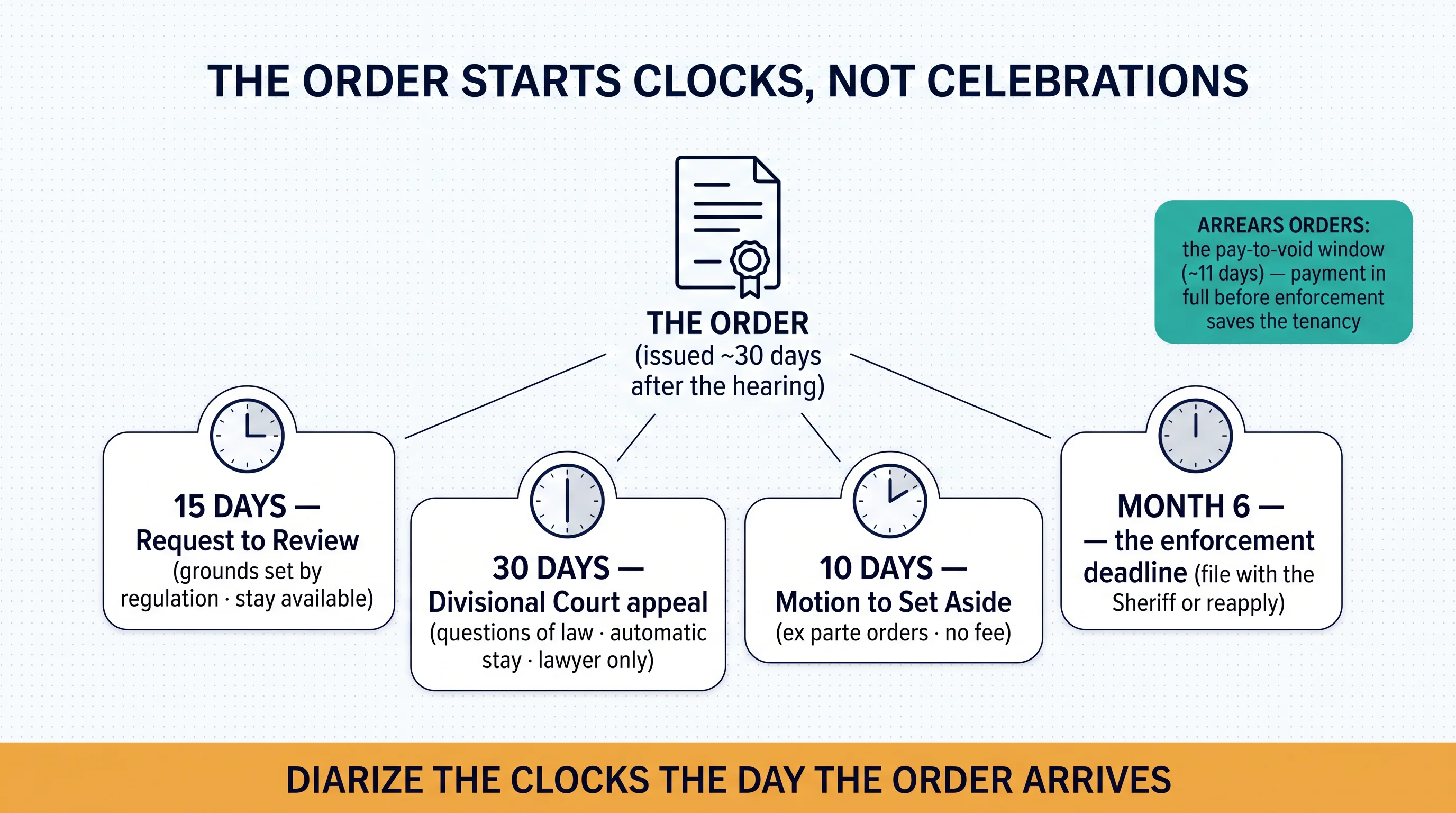
Stage six is the order — and the order starts clocks, not celebrations. Orders issue within the Board's 30-day service standard on average (chase at 60). The moment one arrives, up to four clocks are running. Fifteen days: the Request to Review, on grounds now enumerated by regulation — inadequate notice, an inability to participate attributable to the LTB, a serious error, or new evidence — one request only, with a stay available. Thirty days: the Divisional Court appeal on questions of law, which carries an automatic stay and is lawyer territory. Ten days: the Motion to Set Aside an ex parte order, no fee. And on arrears orders, the pay-to-void window (commonly around eleven days) — payment in full before enforcement saves the tenancy. Landlords add a fifth date: month six, when the order expires for enforcement. Diarize the clocks the day the order arrives — and remember what one wrong date costs at any stage: a dismissal at month six means re-serve, re-file, re-queue. The whole road, twice.
Stage 7: Enforcement — and Where the System Is Heading
If the order requires the tenant to leave and they don't, the file enters its last stage — and the last stage has its own building. Only the Court Enforcement Office (the Sheriff) can enforce an eviction order, which the RTA treats "in the same manner as a writ of possession." Self-enforcement is illegal even with the order in hand — and the mirror rule holds for tenants at every stage: a lockout without a Sheriff is illegal, full stop, with an urgent-lane T2 waiting for landlords who forget it. The mechanics, compressed: file within six months (a certified copy, the Eviction Information Request Sheet, and the fees, at the territorially correct office); budget the flat fee ($318–$333) plus mileage plus a locksmith; the Sheriff issues a Notice to Vacate, the landlord schedules the enforcement, and the regional queue runs roughly 2–8 weeks, weekdays only. Eviction day is an appointment the landlord cannot miss, and the 72 hours after it are governed by the belongings rule — retrieval access 8 a.m. to 8 p.m., at or close to the unit, with breach penalties up to the greater of $10,000 or the Small Claims limit. Three things can still stop a scheduled enforcement: payment in full before execution, a stayed review, or the appeal's certificate of stay. And possession is not collection — money owed lives in Small Claims enforcement and the L10 lane. The complete final-mile playbook is the Sheriff guide.
Where is all of this heading? In one direction, uniformly. September 21 brings the 7-day N4, the s. 82 pay-in gate, and the N12 changes — more filings, moving faster. Temporary enforcement officers are being added to work the final-mile backlog. Regulation-making authority now exists to set prescribed criteria for eviction postponements and set-asides. Shorter windows, more rule-bound discretion, on every side of every file. The preparation is the same for everyone, whichever chair you sit in: know the road, act inside the windows, and keep the file clean from stage one — because the full-length journey, run right, looks exactly like the map: notice served correctly, application filed the day the window opens, queue used to build, the fork genuinely tried, the hearing presented from a finished file, the clocks diarized, and the final mile run by the book.
Practical Takeaways — One Check Per Stage
- The notice: right form, right termination date (use the calculator), Certificate of Service kept.
- The application: file on the portal with the correct fee (or waiver), names exactly as the lease, and read the deep-dive for your specific application first.
- The queue: preparation time, not dead time — updates diarized, evidence served on schedule.
- The fork: genuinely try it — and sign nothing you can't perform.
- The hearing: format confirmed, help layers used, evidence disclosed, arithmetic reconciled, the s. 83 story ready.
- The order: read line by line; the day-15 and month-6 clocks diarized immediately; the right after-order lane chosen.
- Enforcement: Sheriff filed within six months, eviction-day attendance guaranteed, the 72 hours documented.
The Whole-Road Kit: The LTB Process in Seven Stages — Every Fee, Wait, and Clock on Two Pages
Every LTB file travels the same road: notice → application → queue → fork → hearing → order → enforcement. This free kit consolidates all seven stages for landlords, tenants, and PMs — the filing fees, the honest wait times, the settlement fork's teeth, the after-order clocks (15/30/10 days and month 6), and the Sheriff's final mile — into one printable two-page checklist you can pin to the front of every file.
Get Free PDF →The Bottom Line
Seven stages, one road, no shortcuts — and no stage that can't be run well by someone who knows what it's for. The notice decides the case's foundation; the application opens the door; the queue is preparation; the fork resolves most files; the hearing weighs what was built; the order starts clocks; and the Sheriff finishes what only the Sheriff can. Landlords who respect the road get possession cleanly. Tenants who know it keep every right the statute gives them. And both sides do better at every junction where the other side is guessing. General information, not legal advice — and the numbers on this page (fees, waits) always deserve a same-day check against the Board's own pages before you rely on them. This pillar completes our LTB Applications series: the index below is the whole library, one deep-dive per stage of the road.
Fourteen Guides. One System. Your Whole Road in One Place.
From the first notice to the last clock — Tenon10 keeps the paperwork, deadlines, and evidence for every stage of the road organized and hearing-ready.
Free • No signup required • Updated for the Bill 60 changes in force 21 Sep 2026
Related Resources — The Complete Series Index
The road, stage by stage:
- Stage 1 — The notice: The N4 Complete Guide · Got an N4? Here's What to Do · N5 Notices · N12 Own-Use Endings
- Stage 2 — The application: L1 vs L2 · The L3 (Tenant Gave Notice) · The L5 AGI Application · The AGI Process · The L10 (Former Tenants) · The T1 Rebate · The T3 Rent Reduction · The T6 Maintenance Application · Bad-Faith N12s and the T5
- Stage 3 — The queue: The LTB Backlog: Real Wait Times
- Stage 4 — The fork (and its teeth): The L4 Breached-Settlement Lane
- Stage 5 — The hearing: Self-Rep: The Landlord's Edition · Self-Rep: The Tenant's Edition · Paralegals vs Lawyers: Who to Hire · The Substantial-Interference Standard
- Stage 7 — Enforcement: After the Order: The Sheriff, the Wait, and Eviction Day
- The rulebook behind it all: Ontario Rental Law Changes: Bill 60 and Bill 97 · The Ontario LTB Forms Hub · Free Calculators & Tools
Frequently Asked Questions
What is the LTB process from start to finish?
Seven stages: a valid notice of termination (or a tenant's grounds), an application filed with the Landlord and Tenant Board (usually via the Tribunals Ontario Portal), a scheduling queue (roughly 3 months for L1/L9 arrears files, 5–7 months for most others), a resolution fork (online dispute resolution and mediation), the hearing (virtual by default), the order (typically within 30 days of the hearing), and — if the tenant doesn't leave — enforcement by the Sheriff. Each stage has its own rules and deadlines.
How much does it cost to file with the LTB?
Landlord applications cost $186 filed online through the Tribunals Ontario Portal or $201 on paper; tenant applications cost $48 online or $53 on paper. Fees are non-refundable, but if you win, the order typically requires the other side to reimburse your filing fee. A fee waiver is available for low-income filers, built into the portal's payment step.
How long does the whole LTB process take in Ontario?
From notice to order: the notice period (7–120 days depending on the form), then the queue (about 3 months for L1/L9, 5–7 for most others), the hearing, and the order within about 30 days. If enforcement is needed, add the Sheriff's stage — filing, the Notice to Vacate, and a regional queue of roughly 2–8 weeks. Contested files commonly run several months end to end; adjournments add 3–4 months each.
Do I have to move out when I get an eviction notice?
No. A notice is not an order — it's the first step in a process that includes an application, a hearing where you can respond, and an order. Only an LTB order enforced by the Court Enforcement Office (the Sheriff) ends a tenancy. That said, take notices seriously: respond, get help early (duty counsel, community legal clinics), and know your deadlines.
What happens if we settle instead of going to a hearing?
Settlements are a core part of the process — through the portal's dispute-resolution tool, a Dispute Resolution Officer, or mediation. A mediated agreement or consent order is binding and enforceable, and nothing said in mediation can be used at a hearing. One caution: breaching a mediated agreement can send the file down the L4 ex parte lane — an eviction order without a new hearing — so only sign terms you can actually perform.
What happens after the LTB makes an order?
Three clocks can start: 15 days to request a review (on grounds set by regulation, with a stay available), 30 days for a Divisional Court appeal (questions of law, automatic stay, lawyer required), and 10 days to move to set aside an ex parte order. On arrears orders, paying everything owed plus the filing fee before enforcement voids the eviction. If the tenant stays, the landlord files the order with the Sheriff — within six months — for the enforcement stage.


