Ontario Landlord Resource Center

Complete guide to landlord responsibilities, LTB forms, eviction procedures, and rental laws in Ontario. Expert resources for Ontario property owners and managers.

Audience hub
171guides
0tools & forms
2524min of reading

Start here

The pillar guide: read it first and the rest of the hub falls into place.

Pillar guide
ONArticle

Ontario Standard Lease 2026: The Complete Guide for Landlords

Everything Ontario landlords need to know about the Standard Lease in 2026. Learn what's required, what you can add, common mistakes to avoid, and how to create a legally compliant lease under the new Bill 60 rules.

  1. What Is the Ontario Standard Lease?
  2. 2026 Updates: What's Changed and Why It Matters
  3. Common Mistakes That Void Your Lease Terms
  4. How to Create a Bulletproof Ontario Lease
  5. What Happens If Things Go Wrong
  6. Practical Takeaways

+3 more chapters in the guide

17 min read · 9 chapters

All articles

  • Legal insurance
    ONArticle

    How Bill 60 Affects Ontario Landlords

    Discover essential how bill 60 affects ontario landlords tips and insights for Ontario. Expert guidance for property managers, landlords, and tenants.

    14 min read
  • Legal insurance
    ONArticle

    What You Can and Can't Add to the Ontario Standard Lease

    A complete breakdown of legal vs illegal lease clauses in Ontario. Learn which additional terms hold up at the LTB, which get thrown out, and copy-paste templates for Section 15 of your Standard Lease.

    16 min read
  • Legal insurance
    ONArticle

    Is My Lease Legal? Common Ontario Lease Mistakes That Void Your Terms

    Think your Ontario lease is solid? Many landlords discover too late that their lease contains errors that get thrown out at the LTB. Learn how to audit your existing lease, identify red flags, and fix problems before they cost you thousands.

    15 min read
  • Legal insurance
    ONArticle

    The 60-Day Rule: How Ontario Landlords Accidentally Create New Tenancies

    Miss this critical 60-day window and your unauthorized occupant becomes a legal tenant—with full RTA protections and rent control intact. Learn how section 104(4) of the Residential Tenancies Act creates "deemed assignments" and what every Ontario landlord must do to protect their property.

    16 min read
  • Legal insurance
    ONArticle

    Fixed-Term Leases in Ontario: Why They All Convert to Month-to-Month

    Think your tenant's lease "expires" when the term ends? Think again. In Ontario, fixed-term leases automatically convert to month-to-month tenancies—and landlords can't force tenants to leave or sign a new lease. Learn how this works and what your options really are.

    14 min read
  • Legal insurance
    ONArticle

    Ontario Rent Increases 2026: The Complete N1 Guide

    A complete 2026 guide to rent increases in Ontario. Understand the 2.1% provincial guideline, the 90-day N1 notice requirement, when rent increases apply, what voids them, and how the process works for landlords, property managers, and tenants alike.

    16 min read
  • Legal insurance
    ONArticle

    Ontario N12 Notices: A Complete Guide to Own-Use Tenancy Endings

    A complete 2026 guide to Ontario N12 notices. Understand when own-use ends a tenancy, the compensation rules under Bill 60, the good faith requirement, and how the process works for landlords, property managers, and tenants receiving an N12.

    17 min read
  • Legal insurance
    ONArticle

    Becoming a Landlord in Ontario: The Complete First-Timer's Guide

    Thinking about renting out your property in Ontario? A complete 2026 guide to becoming a landlord — from your first legal obligations under the RTA to setting rent, screening tenants, collecting rent, and avoiding the mistakes that catch first-timers off guard.

    22 min read
  • Legal insurance
    ONArticle

    L1 vs L2 LTB Applications: Understanding the Difference

    Confused about whether to file an L1 or L2 at the Ontario LTB? This 2026 guide breaks down when each application applies, what notices they follow, how hearings differ, and what documentation landlords need to win.

    16 min read
  • Legal insurance
    ONArticle

    N11 Mutual Agreements: How Parties Reach Fair End-of-Tenancy Terms

    Both parties want to end the tenancy peacefully? The N11 is Ontario's cooperative path — no LTB hearing, no notice periods, no penalties. This 2026 guide explains when N11 makes sense, how to negotiate fair terms, and the protections both sides need to understand before signing.

    17 min read
  • Legal insurance
    ONArticle

    N5 Notices in Ontario: A Complete Guide to Addressing Disturbances

    The N5 is Ontario's most-used notice for tenancy issues that aren't about money — interference, damage, or overcrowding. This 2026 guide explains the unique two-N5 rule, what tenants can do to void the notice, and what landlords must document to make an N5 stand up at the LTB.

    18 min read
  • Legal insurance
    ONArticle

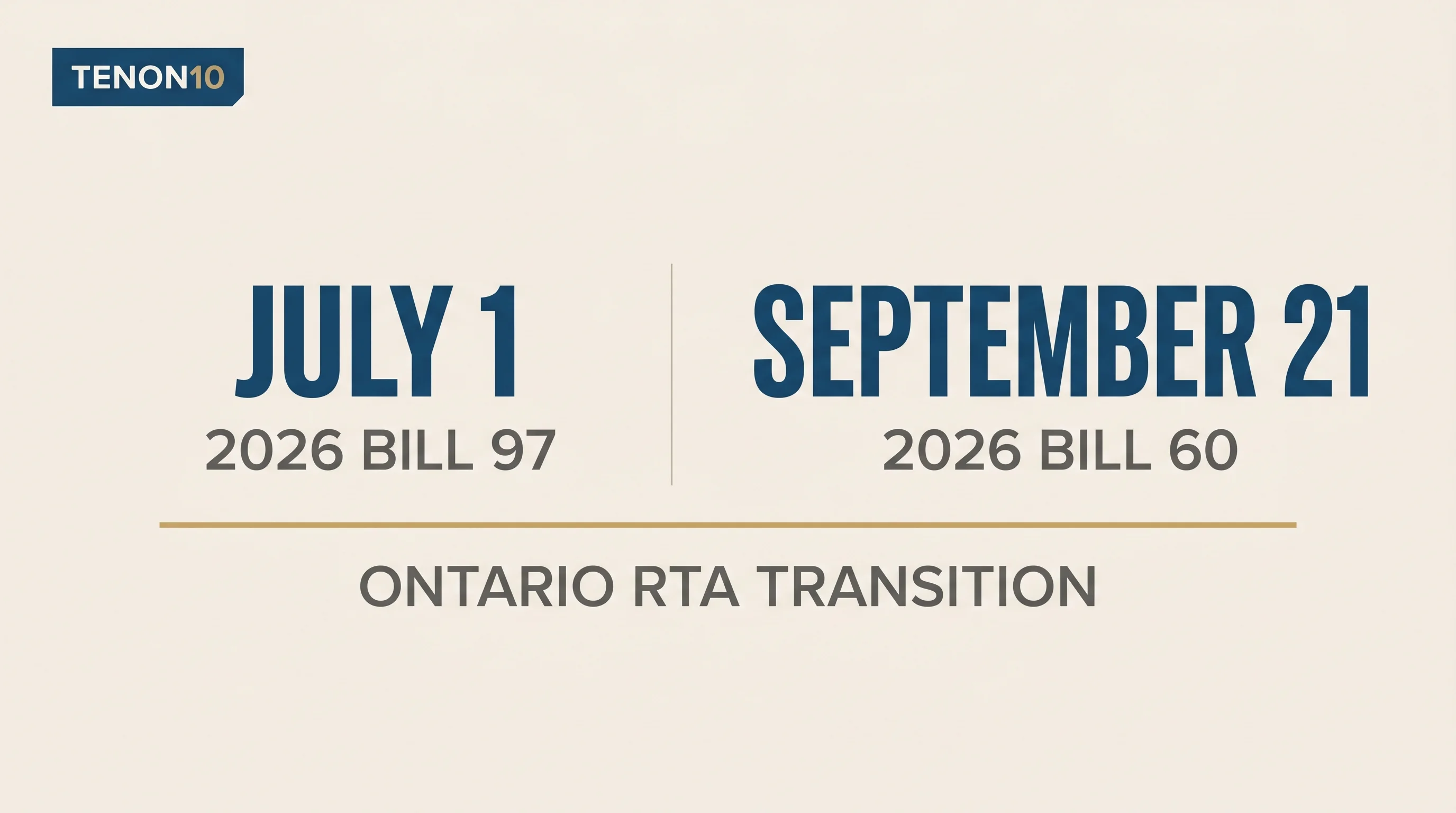
    Ontario Rental Law Changes Coming July 1 and September 21, 2026: A Landlord's Guide to Bill 60 and Bill 97

    Ontario landlords face the biggest rental law changes in years. Bill 60's N4 and landlord's-own-use N12 changes are in force for notices given on or after September 21, 2026 — a 7-day N4, and no compensation on a landlord's-own-use N12 (never a purchaser's) served with at least 120 days' notice; the 15-day LTB review request has applied since July 1, 2026, and one provision is not yet proclaimed. Bill 97 changes landed July 1 and September 21 — covering tenant AC installation rights, mandatory rent arrears forms, doubled fines up to $100,000, and stronger right of first refusal. This 2026 guide explains every change, every effective date, and what landlords should do now.

    20 min read
  • Legal insurance
    ONArticle

    N7 Notice in Ontario: A Landlord's Guide to Ending a Tenancy for Serious Problems

    The N7 is Ontario's notice for ending a tenancy when a tenant causes serious problems — safety threats, wilful damage, or dangerous misuse. Here's when landlords can use it, the strict 10-day timeline, why it can't be voided, and the mistakes that get applications thrown out at the LTB.

    13 min read
  • Financial compliance
    CanadaArticle

    The T776 Form: How to Report Rental Income on Your Canadian Tax Return

    A plain-language guide to Form T776, Statement of Real Estate Rentals — what counts as rental income, which expenses you can deduct, how capital cost allowance (CCA) works and when to skip it, and how to file it with your personal tax return.

    11 min read
  • Legal insurance
    ONArticle

    N9 in Ontario: How Tenants Give Proper Notice to End a Tenancy

    The N9 is the form Ontario tenants use to end their own tenancy — and getting the notice period and termination date right is what makes it valid. Here's how much notice you need to give, how to calculate the correct end date, and the mistakes that leave you on the hook for another month's rent.

    11 min read
  • Legal insurance
    ONArticle

    The L10 Application: How Ontario Landlords Collect Money a Former Tenant Owes

    When a tenant moves out still owing you money, the L10 lets you take them to the LTB to collect — rent arrears, NSF charges, and utility costs. Here's who can use it, the one-year deadline that catches landlords out, what you can claim, and how to file and actually get paid.

    10 min read
  • Legal insurance
    ONArticle

    Ontario Renovictions: A Complete Guide for Landlords and Tenants

    "Renoviction" is when a landlord uses renovations to end a tenancy — sometimes legitimately, sometimes not. This complete guide explains how the N13 process actually works, the compensation and right-to-return rules, the new licensing crackdown under Bill 60/97, and how both landlords and tenants can stay on the right side of the law.

    13 min read
  • Legal insurance
    ONArticle

    The N13 Notice in Ontario: Demolition, Conversion, and Major Repairs Explained

    The N13 is the notice an Ontario landlord uses to end a tenancy to demolish, convert, or do major repairs that need the unit empty. This guide walks through the three grounds, the 120-day notice rules, the compensation and right-to-return, and exactly how the process works — for both landlords serving one and tenants who've received one.

    12 min read
  • Operations
    ONArticle

    How to Screen Tenants in Ontario: A Landlord's Complete Guide

    Screening the right tenant is the single best way to avoid problems later — but in Ontario you have to do it within strict Human Rights Code limits. This complete guide walks landlords and property managers through a legal, effective screening process: applications, credit and reference checks, income verification, what you can and can't ask, and how to choose fairly.

    13 min read
  • Operations
    ONArticle

    Tenant Application Red Flags: What Ontario Landlords Should Watch For

    A clean-looking application can still hide trouble. This guide walks Ontario landlords through the real red flags on a rental application — refusal to consent, inconsistent details, references that don't check out, gaps in rental history — and, just as importantly, how to act on them lawfully without crossing into Human Rights Code discrimination.

    12 min read
  • Operations
    ONArticle

    Credit Checks for Ontario Landlords: How to Run One Legally

    A credit check is one of the few screening tools Ontario law actually permits — but only if you do it right. This guide shows landlords how to get consent, run the check, read the report, and use it lawfully under the Human Rights Code, including the 2026 rules that make rental credit checks a no-score-impact soft inquiry.

    10 min read
  • Operations
    ONArticle

    Reference Check Questions That Actually Work: A Landlord's Guide

    A reference call is only as good as the questions you ask — and most landlords ask the wrong ones. This guide gives Ontario landlords the specific previous-landlord and employer questions that reveal real risk, the ones that catch coached or fake references, and how to ask them without straying into Human Rights Code territory.

    11 min read
  • Operations
    CanadaArticle

    Income Verification for Self-Employed Tenants: A Landlord's Guide

    No pay stub doesn't mean no proof. Self-employed applicants — freelancers, contractors, gig workers, small-business owners — are a fast-growing share of Ontario renters, and screening them out for lacking a T4 is both bad business and a legal risk. This guide shows landlords which documents actually verify self-employed income (Notices of Assessment, T1s, bank statements), how to read them, and how to stay onside the Human Rights Code.

    10 min read
  • Legal insurance
    ONArticle

    Guarantor Agreements in Ontario: A Landlord's Guide

    A guarantor can turn a borderline applicant into a safe one — but only if the agreement is set up properly and offered fairly. This guide shows Ontario landlords what a guarantor actually does, how to put a guarantee in place that holds up, how to screen and verify one, and the human-rights line you can't cross by demanding a guarantor only from certain applicants.

    11 min read
  • Financial compliance
    ONArticle

    Bookkeeping for Ontario Landlords: The Complete Guide

    Good bookkeeping is the difference between a rental that runs like a business and one that costs you at tax time. This complete guide shows Ontario landlords what records to keep, how to track income and expenses, which costs are deductible, how long the CRA expects you to keep everything, and how clean books flow straight into your T776 at year-end — whether you own one unit or a growing portfolio.

    13 min read
  • Financial compliance
    ONArticle

    The Last Month's Rent Deposit Rules in Ontario: A Landlord's Guide

    The last month's rent deposit is the most common — and most misunderstood — deposit in Ontario. It can only be used for the last month's rent, never for damage, and you owe your tenant interest on it every year. This guide shows landlords exactly what you can collect, how the annual interest and top-up work, and why almost every other "deposit" is illegal.

    12 min read
  • Financial compliance
    ONArticle

    Ontario Rent Increases 2027: The Complete N1 Guide

    Ontario's 2027 rent increase guideline is 1.9% — the maximum most landlords can raise rent without going to the LTB. This complete guide covers the 1.9% cap, the exact N1 notice rules, the 90-day timing (you can serve as early as October 2026 for a January 2027 increase), who's exempt, and the mistakes that quietly void an increase.

    13 min read
  • Legal insurance
    ONArticle

    The T5 Application: How Ontario Tenants Fight a Bad-Faith Eviction

    You moved out because your landlord "needed the unit" — then it went back on the market at a higher rent. That's a bad-faith eviction, and the T5 is how you fight back. This complete guide covers what counts as bad faith, the deadlines that split by reason (one year for an N12, up to two for an N13 renovation), the evidence that proves it, and compensation up to 12 months' rent plus a fine.

    13 min read
  • Legal insurance
    ONArticle

    Can Your Landlord Ban Your Air Conditioner? Ontario's New AC Rules (July 2026)

    As of July 1, 2026, Ontario tenants have an explicit right to install a window or portable air conditioner — even when the landlord doesn't provide cooling. But the right comes with conditions: written notice first, a safe install, and a seasonal electricity charge the landlord can add in a way that breaks all the usual rent-increase rules. Here's exactly how the new s.36.1 rule works for tenants and landlords.

    11 min read
  • Legal insurance
    ONArticle

    Ontario's New Rent Repayment Agreement Rules (July 2026): The Mandatory LTB Form Explained

    As of July 1, 2026, a rent-arrears repayment agreement filed with the Landlord and Tenant Board must use the Board's official form — no more handwritten deals on the back of an envelope. Here's how the new s.206 rule works: what the mandatory form covers, the section 78 clause that lets a landlord skip a new eviction notice if the deal is broken, the 30-day reopening window, and what it all means for tenants and landlords trying to keep a tenancy intact.

    10 min read
  • Operations
    ONArticle

    Move-In and Move-Out Inspections in Ontario: The Right Way to Document a Rental

    Ontario doesn't legally require a move-in or move-out inspection — but skipping one is how landlords lose damage claims and tenants lose deposits. Because Ontario bans damage deposits, an inspection report isn't a deduction tool; it's your evidence at the Landlord and Tenant Board. Here's how to document a rental properly at both ends of a tenancy, for landlords and tenants alike.

    10 min read
  • Legal insurance
    ONArticle

    Pet Policies in Ontario: Why "No Pets" Clauses Don't Hold (and the Exceptions That Do)

    That "no pets" line in your Ontario lease? It's void — section 14 of the Residential Tenancies Act makes no-pet clauses unenforceable once you're a tenant. But the rule has real limits: a landlord can refuse a pet owner before you sign, a condo declaration can still ban pets, and behaviour like damage, danger, or allergies can be grounds for eviction. Here's exactly how pet rules work in Ontario, for tenants and landlords.

    10 min read
  • Legal insurance
    ONArticle

    Smoking and Cannabis Policies in Ontario Rentals: What a Landlord Can Actually Ban

    Here's the twist that surprises people: a "no smoking" clause in an Ontario lease IS enforceable — unlike a "no pets" clause, which is void. But the rule has limits. A landlord can't add a smoking ban mid-tenancy, a clause that names tobacco doesn't automatically cover cannabis or vaping, and even a grandfathered smoker can be evicted if the smoke drifts. Here's exactly how smoking and cannabis rules work in Ontario, for tenants and landlords.

    9 min read
  • Legal insurance
    ONArticle

    Subletting vs Assignment in Ontario: The Difference That Changes Everything

    "Subletting" and "assigning" get used interchangeably — but in Ontario they're legally different, and mixing them up can cost you. A sublet means you're coming back; an assignment means you're gone for good. The rules on landlord consent differ too: a landlord can refuse a general assignment outright, but can't unreasonably refuse a sublet or a specific assignee. Here's exactly how both work — and the 30-day escape hatch most tenants don't know about.

    10 min read
  • Legal insurance
    ONArticle

    Tenant Insurance in Ontario: What a Landlord Can Actually Require

    Can your Ontario landlord make you get tenant insurance? There's no law that requires it — but a landlord can make it a condition of your lease, and once it's in a signed lease, it's enforceable. Here's what tenant insurance actually covers (your stuff and your liability, not the building), what a landlord can and can't demand, whether you can be evicted for not having it, and how to prove coverage — for tenants and landlords alike.

    9 min read
  • Legal insurance
    ONArticle

    The 24-Hour Notice of Entry Rule in Ontario: When a Landlord Can (and Can't) Come In

    Your landlord can't just show up. In Ontario, entering your rental almost always takes 24 hours' written notice, stating the reason and a time between 8 a.m. and 8 p.m. — and the LTB enforces that to the minute. But there are narrow exceptions (a real emergency, your consent at the door), a fixed list of valid reasons, and rules about what actually counts as "written" notice. Here's exactly how the entry rules work, and what to do when they're broken — for tenants and landlords alike.

    10 min read
  • Operations
    ONArticle

    Vital Services in Ontario: Heat, Water, and What a Landlord Can Never Cut Off

    Heat, water, electricity, gas — these are "vital services" in Ontario, and a landlord can't withhold or deliberately interfere with them, ever. Not for unpaid rent, not for a damaged unit, not until an eviction is actually enforced. There's a minimum heat standard (and stricter city bylaws), a rule that makes the landlord responsible even when they forget to pay the utility bill, and clear remedies when a service gets cut off. Here's exactly what counts as a vital service, what a landlord must provide, and what to do when it fails — for tenants and landlords alike.

    9 min read
  • Operations
    ONArticle

    Maintenance Standards in Ontario: The Landlord's Duty to Repair (and How Tenants Enforce It)

    In Ontario, keeping a rental in good repair isn't optional or negotiable — it's a legal duty that a landlord can't sign away, and that applies even if the tenant knew about the problem before moving in. This is the complete guide to maintenance standards under the RTA: what "good state of repair and fit for habitation" actually means, the provincial and municipal standards that layer on top, who's responsible for what, and exactly how a tenant enforces it with a T6 — including what rent abatements real cases produce. For tenants and landlords alike.

    11 min read
  • Operations
    ONArticle

    Mold in an Ontario Rental: Who's Responsible, and How to Get It Fixed

    There's no "mold law" in Ontario — but there doesn't need to be. Mold caused by a building problem (a leak, bad ventilation, water getting in) is the landlord's to fix under the same duty to keep a unit in a good state of repair. This guide draws the responsibility line clearly: what the landlord must remediate (and pay for), the narrow cases where a tenant is on the hook, why "normal use" like showering and cooking is never the tenant's fault, and exactly how to document mold and enforce a repair with a T6 — for tenants and landlords alike.

    10 min read
  • Operations
    ONArticle

    Pest Control in an Ontario Rental: Who's Responsible, and What to Document

    Bed bugs, cockroaches, mice — in Ontario, dealing with them is almost always the landlord's job, and paying for it is too. There's an actual regulation that says a rental must be kept "reasonably free of rodents, vermin and insects," a landlord can't pass the exterminator's bill to a tenant without proving the tenant caused the problem, and a "you deal with pests" lease clause is void. But tenants have real duties too — report fast, keep the unit reasonably clean, and cooperate with treatment. This guide draws the responsibility line, covers the cooperation trap on both sides, and shows exactly what to document — for tenants and landlords alike.

    9 min read
  • Operations
    ONArticle

    Heat Bylaws in Toronto, Hamilton, and Ottawa: The Minimum Temperature Rules by City

    There's no single "Ontario heating law" — the minimum temperature your landlord must maintain, the dates it applies, and the fines all come from your city's bylaw. Toronto requires 21°C (Oct 1–May 15); Ottawa requires 20°C by day and 16.67°C overnight; Hamilton requires 20°C (Sept 15–May 15). This guide lays out the exact rules for all three cities, the provincial floor underneath them, the "calendar, not weather" trap that catches landlords every spring, how to complain when your unit is too cold, and the maximum-heat rules now emerging — for tenants and landlords alike.

    10 min read
  • Financial compliance
    CanadaArticle

    CCA for Ontario Landlords: How Rental Depreciation Works (and When Not to Claim It)

    Capital Cost Allowance lets Canadian landlords deduct a slice of their building's cost each year — but it's the most misunderstood line on a rental tax return. It's optional, it can't create a loss, and every dollar you claim can come back to bite you as fully taxed "recapture" when you sell. This guide explains how CCA actually works for an Ontario rental — the 4% Class 1 rate, the half-year rule, the land split, and the appliance classes — and, just as important, the situations where claiming it is a mistake. General information, not tax advice.

    10 min read
  • Financial compliance
    ONArticle

    The T776 Expense Deep-Dive: Every Rental Deduction Ontario Landlords Can Actually Claim

    The expense section is where a T776 is won or lost — it's the largest part of the form and where landlords both overpay (by missing deductions) and get audited (by claiming the wrong ones). This deep-dive walks every T776 expense line, the one distinction that governs all of them — current vs. capital — and the traps that trip people up: mortgage principal, your own labour, prepaid and prorated costs, and the personal-use split on a basement suite. Line by line, what you can claim and what you can't. General information, not tax advice.

    10 min read
  • Financial compliance
    ONArticle

    The Landlord's Year-End Tax Prep Checklist: Get Ready to File Your Rental Return

    Tax time is painful only when you leave everything to April. This year-end checklist turns filing your rental return into a four-step routine: gather your income and receipts, sort every cost into current vs capital, make the calls that matter (like whether to claim CCA), and file on time. It walks the documents to collect, the deadlines you can't miss, the two decisions that shape your tax bill, and the record-keeping that protects you in an audit — so the T776 becomes an export, not an ordeal. General information, not tax advice.

    8 min read
  • Financial compliance
    ONArticle

    CRA Audits of Rental Income: What Triggers Them, and How to Stay Audit-Ready

    Real estate is the CRA's single biggest audit focus, and rental returns get looked at more than most. The good news: rental audits are predictable. They start from a short list of red flags — under-reported income, repeated losses, outsized repairs, mis-split mortgage interest, and over-claimed personal use — and almost always begin with a letter, not a knock at the door. This guide explains what actually triggers a review or audit, what survives one, and what to do if a CRA letter lands. General information, not tax advice.

    9 min read
  • Financial compliance
    ONArticle

    How Lenders Count Rental Income: The Mortgage Math Every Canadian Investor Should Know

    Rental income can qualify you for a much bigger mortgage — but only a fraction of it usually counts, and how much depends on the method your lender uses. This guide explains the two ways lenders treat rental income (offset vs add-back), how the debt-service ratios and the stress test actually work, what the 2026 OSFI capital change did and didn't do to portfolio investors, and how to document rent so it counts. The mortgage math, in plain language. General information, not financial advice.

    10 min read
  • Legal insurance
    ONArticle

    Property Standards Officers: How Ontario's Municipal Enforcement Actually Works

    When a landlord won't fix a serious problem, tenants have a route many don't know about: the municipal property standards officer. These bylaw inspectors can order repairs, set deadlines, and even bill the landlord for work the city does itself — and their orders are powerful evidence at the Landlord and Tenant Board. This guide explains who property standards officers are, how the complaint-and-order process works, how the appeal committee fits in, and how a municipal order and an LTB application work together. Practical, plain-language, and Ontario-specific.

    9 min read
  • Operations
    ONArticle

    Background Checks Beyond Credit: What Ontario Landlords Can (and Can't) Legally Check

    A credit check is just one piece of tenant screening — and the moment you go beyond it, the legal lines get sharp. Criminal record checks, references, employment and income verification, eviction history, even a social-media search: each is governed by the Human Rights Code, Ontario's screening regulation, and privacy law all at once. This guide explains what you can legally check, what you can't, why a blanket "no criminal records" rule can land you at the Human Rights Tribunal, and how to build a screening process you can actually defend. Practical and Ontario-specific.

    9 min read
  • Legal insurance
    ONArticle

    Tenant Insurance in Ontario: What's Required and What's Smart

    Tenant insurance isn't required by Ontario law — but your lease can require liability coverage, and skipping it can put your tenancy at risk. Here's what landlords can and can't demand under the standard lease, what coverage actually protects you, and how to get insured for less than a dollar a day.

    14 min read
  • Legal insurance
    ONArticle

    The N2 Notice in Ontario: Rent Increases for Rent-Control-Exempt Units

    If your rental was first occupied after November 15, 2018, the annual guideline doesn't cap your rent increases — but using the N1 instead of the N2, skipping the 90-day notice, or failing to prove the exemption can void the increase entirely. Here's how the N2 actually works.

    13 min read
  • Legal insurance
    ONArticle

    The N6 Notice in Ontario: Ending a Tenancy for Illegal Acts or Misrepresented RGI Income

    The N6 is Ontario's notice for two serious situations: illegal acts at the rental unit, and misrepresented income in rent-geared-to-income housing. It carries the shortest notice periods in the LTB stack — 10 or 20 days — and no remedy window, but the burden of proving what happened at the hearing is entirely the landlord's. Here's how it actually works.

    13 min read
  • Legal insurance
    ONArticle

    The N8 Notice in Ontario: Ending a Tenancy at the End of the Term

    The tenant who always pays — but always pays late — is exactly who the N8 exists for. Here's how Ontario's end-of-term notice works: what "persistent" late payment really means, the four lesser-known grounds, the last-day-of-the-period timing rule that voids most N8s, and why the Board usually orders a payment plan before an eviction.

    13 min read
  • Legal insurance
    ONArticle

    Bill 60's Doubled Fines: What Section 238 of the RTA Now Costs Ontario Landlords

    As of July 1, 2026, the maximum fine for an RTA offence is $100,000 for individuals and $500,000 for corporations — double the old caps. Here's which offences carry that exposure, why directors and officers can be personally liable, and the compliance file that keeps the new numbers theoretical.

    12 min read
  • Legal insurance
    ONArticle

    The N12 120-Day Path: How Landlords Can Skip the Compensation (and the Trap to Avoid)

    Bill 60 gives Ontario landlords a new choice on own-use evictions: serve the N12 the fast way and pay a month's compensation, or give at least 120 days' notice and pay nothing. On a $3,000 unit, that timing choice is worth $3,000. This guide breaks down exactly how the new 120-day path works under RTA s.48.1(2), when it applies, and the good-faith trap that can turn a few thousand dollars saved into a much larger bad-faith penalty. General information, not legal advice.

    13 min read
  • Legal insurance
    ONArticle

    The N13 Paper Trail: Ontario's New Renoviction Documentation Rules

    Ontario's renoviction rules now run on paperwork: a qualified professional's report, building permits, written timeline estimates, update obligations, a completion notice, and a 60-day window for the tenant to come back. Here's the full document trail — what landlords must produce, what tenants can demand, and where municipal licensing bylaws add a second layer.

    12 min read
  • Legal insurance
    ONArticle

    The Right of First Refusal: How Ontario Tenants Come Back After Renovations

    Ontario's right of first refusal used to fail at the follow-through: tenants left, renovations dragged, and nobody wrote. The new rules change the physics — missed updates or a skipped 60-day window are now deemed a denial of the right itself. Here's the complete lifecycle: the letter before you leave, the notices the landlord owes, the return at the uninterrupted rent, and the application when it all breaks.

    11 min read
  • Legal insurance
    ONArticle

    The 7-Day N4: What Ontario's Faster Non-Payment Notice Really Changes

    On September 21, 2026, the N4's waiting period drops from 14 days to 7 for monthly tenancies — the most-felt change in the entire Bill 60 package. Here's what the week actually is (a payment window, not an eviction countdown), everything that doesn't change, the 50%-arrears defence rule arriving with it, and the transition trap for notices served near the date.

    12 min read
  • Legal insurance
    ONArticle

    The AGI Process in Ontario: When Landlords Can Raise Rent Above the Guideline

    Ontario's rent guideline isn't always the ceiling. Through an Above-Guideline Increase, landlords can recover extraordinary tax hikes, major capital work, and security costs — but only on three statutory grounds, under strict caps, with a hearing at the end and an expiry date built in. Here's the full process: grounds, math, timelines, and whether an AGI is worth it.

    11 min read
  • Legal insurance
    ONArticle

    Adding a Co-Tenant to an Existing Lease in Ontario: The Right Way

    "Can my partner move in?" is a simple question with a layered answer. Occupant, authorized occupant, or co-tenant — each status carries different rights, and only one adds a second person fully responsible for the rent. Here's how to add a co-tenant properly: the paperwork that works, the joint-and-several prize, the accidental-tenancy trap, and the exits nobody plans for.

    12 min read
  • Legal insurance
    ONArticle

    Ontario Standard Lease vs Custom Leases: Why It's Not Actually a Choice

    Searching "Standard Lease vs custom lease Ontario" implies a decision that mostly doesn't exist: since April 2018, Form 2229E is mandatory for nearly every new residential tenancy. What's really worth knowing is the territory around that rule — where lawful customization lives (Section 15), which rentals are genuinely exempt, and the 51-day enforcement timeline that can cost a non-compliant landlord a month's rent and their fixed term.

    12 min read
  • Legal insurance
    ONArticle

    Lease Renewal Strategies in Ontario: What to Do When the Term Ends

    In Ontario, a lease that ends doesn't end anything — it converts. So "renewal" is really a strategy question: stay month-to-month or sign a new fixed term? The answer is different for landlords (retention economics, flexibility), tenants (no-fault eviction protection, leverage you didn't know you had), and property managers (renewal calendars that prevent surprise vacancies). Here's the playbook for all three seats.

    12 min read
  • Legal insurance
    ONArticle

    The L5 Application: How to File for an Above-Guideline Rent Increase in Ontario

    You've confirmed your AGI grounds — now comes the paperwork. The L5 is the LTB's most unusual filing: it skips the portal entirely, runs on an Excel form with strict naming rules, demands every receipt up front, and bills $233-plus before anyone reads a word. Here's the complete filing walkthrough — schedules, RUI, fee, hearing, and what happens after the order.

    13 min read
  • Legal insurance
    ONArticle

    The L3 Application: When a Tenant Gave Notice or Agreed to Leave — but Didn't

    The tenant handed you an N9 — or signed an N11 — and then simply stayed. The L3 converts their own paperwork into an eviction order, often without a hearing. But it runs on a 30-day fuse that voids the notice entirely, and an affidavit with five required elements the LTB will refuse the file over. Here's the complete walkthrough.

    13 min read
  • Legal insurance
    ONArticle

    The L4 Application: Enforcing a Settlement or Order the Tenant Didn't Keep

    The hearing ended in a deal — a payment plan, conditions, a second chance. Then a condition broke. The L4 converts that breach into an eviction order, normally without another hearing. But it runs on a 30-day clock from the breach itself, a relatedness rule that filters which conditions count, and a declaration that must show exactly what failed. Both sides' playbooks, here.

    13 min read
  • Legal insurance
    ONArticle

    The T6 Application: How Tenants Enforce Repairs at the LTB

    Your landlord's duty to repair is absolute — but it enforces itself exactly never. The T6 is the application that turns ignored repair requests into orders: rent abatements, deadlines, reimbursements, even a freeze on rent increases until the work is done. It costs $48, runs on a one-year clock, and lives or dies on dated evidence. Here's the complete playbook.

    12 min read
  • Legal insurance
    ONArticle

    The T1 Application: Getting Money Back From Your Landlord

    Key deposits. Pet fees. An unreturned last month's rent. Interest nobody ever paid. N12 compensation that never arrived. Ontario law makes all of it recoverable — through one application with eight grounds and a filing fee under $60. But the T1 runs on a strict one-year lookback, and unchallenged rent increases become legal if you wait. Here's the complete recovery playbook.

    12 min read
  • Legal insurance
    ONArticle

    The T3 Application: When Your Rent Should Go Down

    The parking that vanished. The laundry room that became storage. The pool that never reopened. In Ontario, rent buys a package — and when the landlord shrinks the package, the law shrinks the rent. The T3 is the application that resets your rent permanently, not just once. It runs on a 12-month window, precise valuation math, and one honest limit. Here's how it works.

    13 min read
  • Legal insurance
    ONArticle

    Bad-Faith N12: How the LTB Decides

    The landlord said they needed the unit for family. You moved out. A week later it was on the market at $500 more. Ontario law presumes what that looks like: an own-use eviction followed by re-listing within 12 months is presumed bad faith — and suddenly the landlord must prove innocence. Here's the T5 application from both sides of the hearing room: the test, the presumption, the remedy stack, and the honest defences.

    13 min read
  • Legal insurance
    ONArticle

    The 'Substantial Interference' Standard: The RTA's Vaguest Phrase, Explained

    It's the ground for more LTB disputes than almost any other phrase: "substantial interference with reasonable enjoyment." The noise complaint, the smoke drifting between units, the landlord who won't stop dropping by — all of it lives here. But the standard cuts every direction: it's the landlord's eviction ground, the tenant's 7-day escape hatch, and the tenant's application back. Here's how the Board actually draws the line — and the 2002 case that still voids more notices than any other.

    14 min read
  • Legal insurance
    ONArticle

    The LTB Backlog: Real Wait Times, Root Causes, and How to Protect Your Case

    Every guide in this series ends the same way: "…and then you wait." This one measures the wait. Arrears cases now schedule in about three months; most other applications take five to seven; some tenant applications have taken years. How Ontario's busiest tribunal fell from 32-day orders to a 53,000-case backlog, what the recovery actually fixed (and didn't), what Bill 60 changes — and the file-hygiene habits that keep your case from waiting longer than it must.

    12 min read
  • Legal insurance
    ONArticle

    Representing Yourself at the LTB: The Landlord's Edition

    Most parties at the LTB appear without a lawyer — the Board is built for it. But it dismisses landlord applications every day on technicalities, not merits: a miscalculated termination date, an arrears figure that doesn't match the ledger, service that can't be proven. This guide covers what self-representation actually requires — who can appear for you (and the agent-authority trap), the evidence and disclosure rules, hearing-day mechanics, section 83 relief, and the honest math on when a paralegal pays for itself.

    14 min read
  • Legal insurance
    ONArticle

    Paralegals vs Lawyers at the LTB: Who to Hire, and When

    At the Landlord and Tenant Board, paralegals and lawyers hold the same regulator, the same insurance, and the same right to appear — so the hiring decision isn't about prestige. It's about scope (only lawyers appear at Divisional Court), specialization (LTB-focused paralegals live in that tribunal), and fee structure ($500–$2,000 flat-fee files vs $300–$600/hour). This guide gives landlords and tenants the honest framework: when self-rep holds, when a paralegal is the smart buy, when only a lawyer will do — and the questions to ask before retaining anyone.

    15 min read
  • Legal insurance
    ONArticle

    After the LTB Order: The Sheriff, the Wait, and Eviction Day

    An LTB eviction order is not possession — only the Sheriff can enforce it, and the Sheriff has a queue of their own. This guide covers the whole after-the-order world for landlords and tenants: the filing package and the six-month deadline, the fees and the regional wait, the Notice to Vacate, what actually happens on eviction day (and why the landlord must be there), the 72-hour belongings rule with its five-figure penalties, and the three things that can still stop an enforcement — payment, a stay, or another order.

    15 min read
  • Legal insurance
    ONArticle

    The LTB Process, End to End: From First Notice to Final Enforcement

    Every LTB journey follows the same road: a notice, an application on the Tribunals Ontario Portal, a queue, a fork at mediation, a hearing, an order — and sometimes the Sheriff. This pillar guide maps the entire process end to end for landlords, tenants, and property managers: which notice starts which application, what the portal actually does, how long each stage really takes, what happens in the hearing room, the after-order clocks, and the enforcement final mile — with a deep-dive guide linked at every single stage of the road.

    16 min read
  • Legal insurance
    ONArticle

    Removing a Tenant Without Eviction: The Legal Alternatives to the LTB Queue

    Not every tenancy has to end at the Landlord and Tenant Board. Ontario law gives landlords and tenants several legal ways to part company without an eviction hearing — the N11 mutual agreement and cash-for-keys deal, the tenant's own N9 notice, assignment, and negotiated moves — each faster than the queue when done right, and each with strict rules that protect the deal from falling apart. This guide maps every non-eviction exit: what each path costs, the L3 backstop that makes agreements enforceable, the coercion and bad-faith lines you cannot cross, and when the formal route is actually the better choice.

    14 min read
  • Financial compliance
    ONArticle

    Landlord Insurance in Ontario: What's Standard, What It Costs, and Where the Gaps Are

    A homeowner policy does not cover a rental — most Ontario landlords learn that one the expensive way. This guide covers what standard landlord insurance actually includes (structure, liability, lost rental income), what the common endorsements add (sewer backup, overland flood, legal expenses), what a typical policy costs in Ontario, the exclusions that surprise owners at claim time, the tenant-insurance clause every lease should handle properly, and the renewal traps — from vacancy clauses to the new non-resident requirements — that quietly void coverage.

    15 min read
  • Legal insurance
    ONArticle

    Online Showings and Self-Showings in Ontario: The Tech, the Entry Rules, and the Privacy Lines

    Virtual tours, video walkthroughs, and lockbox self-showings promise to fill vacancies faster — but Ontario's entry rules didn't get the memo. This guide maps where showing tech is genuinely legal and useful (vacant units, video pre-screening), where it collides with the RTA (self-showings in occupied units, filming a tenant's home), the 24-hour notice rules and the "reasonable efforts" exception that changes everything after a termination notice, the tenant privacy lines that turn a listing into a T2, and the fraud checks that keep self-showings from becoming a scammer's tool.

    15 min read
  • Legal insurance
    ONArticle

    Holiday Rentals and Short-Term Tenancies in Ontario: When a Guest Becomes a Tenant

    The line between a holiday guest and a legal tenant is the most expensive line in Ontario short-term rentals — and it isn't the 28-day switch most hosts believe it is. This guide maps when the RTA's transient-accommodation exemption actually applies, the municipal licensing patchwork (Toronto's principal-residence rule, the 180-night cap, and the platform API that now auto-blocks unregistered listings), the tax stack from HST to the MAT, the winter-rental and mid-term traps that quietly create full tenancies, and what happens when a "guest" stops leaving.

    17 min read
  • Financial compliance
    ONArticle

    Buying Your First Rental Property in Ontario: The Numbers, the Financing, and the Tenants Who May Come With It

    The listing says "great investment." The honest spreadsheet often says otherwise — at current Ontario prices, many rentals run cash-flow negative when you count every line, and the ones that work are found with conservative math, not optimism. This guide walks first-time investors through the real numbers (the 20% down rule, the stress test, what lenders actually count of your rental income), the full cost stack from land transfer tax to the capex reserve, the rent-control line that splits the market at November 15, 2018 — and the part most buying guides skip entirely: what it means when the property comes with tenants already in it.

    17 min read
  • Financial compliance
    ONArticle

    Pre-Construction Condo as a Rental in Ontario: The Two Closings, the HST Trap, and the Unit You Don't Own Yet

    A pre-construction condo is the only rental you'll pay for years before you own — through staged deposits, an interim-occupancy period of "phantom rent" that builds no equity, and a final closing where investors discover the advertised price assumed someone else's rebate. This guide maps the whole timeline for Ontario investors: the two closings and what each one costs, the HST rebate you repay and reclaim, the owner-right-to-lease clause that decides whether you can rent during occupancy, the appraisal-gap risk of the record-completion era — and the payoff on the other side: a unit whose first tenancy is exempt from the rent-increase guideline.

    17 min read
  • Legal insurance
    ONArticle

    Automation in Rental Management: What Ontario Landlords Should Automate, and What the Law Says They Can't

    Automation has become standard practice in rental management — rent collection that reconciles itself, maintenance portals that never sleep, AI that reads a stack of applications in minutes. But the listicles skip the part that matters in Ontario: the RTA and the Human Rights Code draw hard lines around what can run on autopilot. An auto-generated N4 that's wrong by a dollar is void. An algorithm that rejects an applicant is a human-rights problem, not a time-saver. This guide maps both sides — the workflows worth automating this month, the decisions that must stay human by law, and the rollout discipline that separates landlords who compound the time savings from the ones who automate their way into a hearing.

    21 min read
  • Legal insurance
    ONArticle

    Rent Collection at Scale: The System Ontario Property Managers Actually Need

    One unit, rent is a payment. Twenty units, rent is a system — rails, reminders, reconciliation, arrears escalation, and owner draws, all running against rules the platforms don't mention: in Ontario you can't require post-dated cheques or automatic payments, you can't charge late fees, and receipts are a legal duty. This guide builds the collection system portfolio by portfolio — why pre-authorized debit is the best rail in Canada and why it can only be offered, where e-Transfer breaks at scale, the day-by-day arrears machine that ends in a valid N4 instead of a void one, and the reconciliation discipline that turns your ledger into your best evidence at the LTB.

    18 min read
  • Legal insurance
    ONArticle

    Tenant Communication Templates: What Ontario Landlords Must Put in Writing, and How to Say It

    Every message to a tenant carries a legal weight — and most landlords can't tell the three tiers apart. Some things must be LTB forms, and no friendly letter can substitute. Some must be written with exact contents the RTA prescribes: the 24-hour entry notice's reason, date, and time; the email-service consent that makes an inbox a legal address; the payment plan that holds up later. And the rest is relationship writing, where tone decides whether a tenancy gets easier or ends up at a hearing — with maximum RTA fines now doubled, harassment included. This guide sorts the whole library by legal weight, gives you the templates for each tier, and shows how the paper trail becomes your best exhibit.

    19 min read
  • Legal insurance
    ONArticle

    Tenant Turnover in Ontario: The System That Reduces Vacancy Days

    Every day a unit sits empty costs you rent you never get back — and most vacancy isn't created by the market. It's created inside the turnover process: the notice window that gets treated as dead time, the make-ready that starts after the keys come back, the listing that goes live before the unit is ready. Ontario hands landlords a runway most jurisdictions don't — the N9's 60-day notice period — and the operators who win start the turn the day notice arrives: showings run lawfully during the tenancy, vendors booked before move-out, the make-ready compressed to days, and the next tenancy pre-leased so vacancy approaches zero. This guide builds the whole system, from the notice-day checklist to the move-in that starts the next record.

    18 min read
  • Legal insurance
    ONArticle

    How to Scale a Rental Portfolio in Ontario: From First Door to Twenty

    Scaling a rental portfolio isn't buying the first property eleven more times — it's a ladder with three rungs and a wall between each. Rungs one through four run on residential rules: 20% down, the stress test, your personal income carrying every door. Then comes the wall almost nobody warns you about: most major banks quietly cap investor exposure at four to five doors, no matter how strong your equity. And past it sits the paradox — financing a five-plus-unit building is often easier than financing your fifth house, because CMHC's multifamily programs qualify the property, not you, at up to 95% financing and 50-year amortizations. This pillar maps the whole climb: the financing ladder, the Ontario legal layer that scales with you, and the operating system — collection, communication, turnover, automation — that decides whether twenty doors is a portfolio or a second job.

    20 min read
  • Location specific
    ONArticle

    Best Ontario Cities to Buy a Rental Property in 2026

    There is no single best Ontario city to buy a rental property — there's a best city for your strategy, and the numbers to prove it. This data-driven guide compares Ontario's major rental markets the way an underwriter would: cap rates and price-to-rent ratios, CMHC vacancy rates and average rents, property taxes, tenant demand drivers, and the local rules that change the math. Cash-flow markets like Hamilton, London, and Kitchener-Waterloo; the stability case for Ottawa; what Toronto's numbers actually support; and the honest look at cheap markets that don't always deliver. Every figure sourced and dated — no hype, no hot takes, just the scorecard.

    21 min read
  • Location specific
    ONArticle

    Cap Rates and Average Rents by Ontario City: The 2026 Data Page

    The reference table for Ontario rental investors: cap rates and average rents for every major city, in one place, with the methodology shown and every figure dated. Multifamily cap-rate bands from CBRE and broker data (Toronto's compressed 4s to the 6-plus territory of smaller markets), CMHC average rents by city from the October 2025 survey, and the yield math that connects them — plus what a cap rate can and can't tell you, the NOI discipline that keeps the number honest, and the rent-control mix that changes it city by city. Refreshed quarterly. Built to be cited.

    18 min read
  • Location specific
    ONArticle

    Best Toronto Neighbourhoods to Buy a Rental Property

    Toronto isn't one rental market — it's dozens stitched together, and the neighbourhood decides the business you're buying. This landlord's guide maps the city the way an underwriter would: the value zones (Scarborough, Etobicoke, York–East York) where secondary suites and multiplexes cash-flow, the transit corridors (Crosstown, Ontario Line, Finch West) where the growth story is real, the EHON multiplex zoning that changed what a Toronto lot can earn, the condo correction's honest math, and the tenant profile behind every area. Sourced and dated figures, the rules layer scored — VHT, multi-tenant licensing, the rent-control mix — and the neighbourhoods where the answer is "not at that price."

    19 min read
  • Location specific
    ONArticle

    Average Rents by Bedroom Type in Ontario Cities: The 2026 Data Page

    "What's the average rent?" is an unanswerable question until you say which bedroom count, which city, and which data series. This reference page holds the table everyone needs and nobody maintains: studio through three-bedroom rents for every major Ontario city, in both series — CMHC's occupied-stock averages and current asking rents — with the methodology shown, the source spread explained (the same city prints $1,601 or $2,075 depending on who's counting), every figure dated, and a quarterly refresh contract. Built for landlords pricing a unit, investors underwriting a floor plan, and anyone tired of arguing with an undated screenshot.

    17 min read
  • Technology innovation
    CanadaArticle

    Tenon10 Feature Deep-Dive: The Accounting Module

    Most landlords don't have an accounting problem in April — they have a records problem all year that becomes visible in April. This deep-dive walks through Tenon10's accounting module the way a landlord actually meets it: the ledger that builds itself as rent comes in (card, bank, e-Transfer, even cash — one ledger), the general-ledger engine underneath with adjustments and bank reconciliation, per-unit financial history, and the tax-time financials your accountant actually wants. Includes what's free, what's Pro, honest notes on what the module doesn't do, and a downloadable landlord chart of accounts mapped to the T776.

    14 min read
  • Technology innovation
    CanadaArticle

    Owner Sub-Accounts: How They Work in Tenon10

    The moment a property manager takes on a second owner, one question decides whether the business scales or unravels: whose money is this? This guide walks through how Tenon10 keeps every owner's world separate — per-owner properties and books, team and organization structure for multi-user firms, and trust-accounting configuration that follows provincial rules — plus the records discipline Canadian PMs owe their owners regardless of software: separate books per client, clean statements, and money that never mingles. Includes what's confirmed on the platform today, what to ask on a sales tour, and a downloadable owner-onboarding checklist.

    14 min read
  • Technology innovation
    CanadaArticle

    Keya, Explained: Inside Tenon10's AI Copilot for Landlords

    Every property platform now claims an AI. The honest questions are: what can it actually see, what can it actually do, and what happens when it's wrong? This deep-dive walks through Keya, Tenon10's AI copilot, the way a landlord meets it — plain-English answers drawn from your own ledger ("What's my collection rate this month?" → "$8,400 collected of $9,600 due — 87.5%"), Q&A on the Essentials plan, the full copilot on Pro, and how an AI grounded in your real books and Ontario's actual rules differs from a chatbot with opinions. Plus the honest limits, what to verify on a demo, and a downloadable set of ten questions to ask before trusting any AI with your tenancy paperwork.

    14 min read
  • Technology innovation
    CanadaArticle

    Tenon10 on Your Phone: What Works Today, What's Coming, and the Mobile-First Landlord Workflow

    Landlording is a mobile job that most software treats as a desk job — showings, move-in photos, the furnace invoice in your hand, the e-Transfer that arrives while you're in line for coffee. Tenon10's iOS and Android apps are officially coming soon, and this guide is honest about exactly that: what the platform publicly offers today, what the mobile launch signals say, and the five questions to ask when the apps land. Around it, the part you can use tonight: the mobile-first landlord workflow — how to capture receipts, confirm payments, and run the away-from-desk half of the job well right now, plus a downloadable pocket workflow checklist. Updated at app launch.

    13 min read
  • Location specific
    ONArticle

    Best Ottawa Neighbourhoods to Buy a Rental Property

    Ottawa is absorbing its biggest rental supply wave in almost fifty years — vacancy has eased, new towers are offering incentives, and the student pockets softened the moment immigration flows slowed. Which makes neighbourhood choice matter more in 2026, not less: the capital isn't one rental market but several demand engines — federal employment, Kanata's tech cluster, two universities, and an expanding LRT — each rewarding different streets. This guide walks the neighbourhoods through an investor's lens: where family-sized units stay tight while new studios sit, what the CMHC-versus-asking-rent gap means at turnover, and how to match a neighbourhood to your strategy instead of chasing a citywide average. Data refreshed quarterly.

    17 min read
  • Location specific
    ONArticle

    Best Hamilton Neighbourhoods to Buy a Rental Property

    Hamilton's rental data is telling two stories at once: one report claims double-digit rent growth while listing platforms show asking rents drifting down, and CMHC projects rising vacancy until the supply wave is absorbed. Both camps agree on one thing — the market has split by segment: premium single-family rentals in Ancaster and Dundas run under 2% vacancy while new downtown towers sit north of 6%. This guide sorts the noise the way an investor should: neighbourhood by neighbourhood, engine by engine — GTA migration, McMaster, the hospital corridor — with the two-rents turnover math and a downloadable deal-analyzer workbook so you underwrite with your own comps, not a headline average. Data refreshed quarterly.

    16 min read
  • Location specific
    ONArticle

    Property Tax Rates Across Ontario Cities: A 2026 Investor's Comparison

    Toronto has one of the lowest property tax rates in Ontario — about 0.77% — and Windsor one of the highest at roughly 2.09%. But the rate is the number that fools people: Toronto's low rate on a high assessment produces almost the same annual bill as Ottawa's higher rate on a cheaper home, because rate and assessment base move inversely. For rental investors, property tax is one of the largest fixed line items in the pro forma — and, unlike on a principal residence, it's deductible against rental income. This guide ranks the major Ontario cities by 2026 residential rate, shows why the dollar bill matters more than the percentage, explains MPAC's frozen-2016 assessments, and turns the whole thing into a line in your underwriting. Data refreshed as municipalities finalize 2026 rates.

    15 min read
  • Location specific
    ONArticle

    Best London Neighbourhoods to Buy a Rental Property

    London is Southwestern Ontario's value play: homes 40–50% cheaper than Toronto, cap rates local operators quote at 6–7%, and two post-secondary institutions — Western University and Fanshawe College — driving rental demand into different neighbourhoods for different tenants. But it's also the city where the "which campus does your property serve" question decides your rent, where student-visa policy has softened the market unevenly, and where Ontario's near-highest big-city property tax rate makes the dollar-bill math matter. This guide sorts London into three plays — student, cash-flow-value, and family-commuter — profiles eight neighbourhoods, and hands you the homework: the two-university split, the tax bite, the old-stock diligence near campus. Figures dated July 2026, refreshed quarterly; market data, not investment advice.

    15 min read
  • Location specific
    ONArticle

    Windsor, Sudbury & Thunder Bay: Do Cheap Ontario Cities Actually Cash-Flow?

    On paper, Ontario's cheap cities look like a cash-flow dream: Thunder Bay homes at a fraction of Toronto's price, Sudbury and Windsor rents that rival cities costing twice as much, and cap rates local investors quote well above anything in the GTA. But "cheap" and "cash-flows" aren't the same word. Windsor is the province's most tariff-exposed economy, with unemployment at 8.1% and a tenant base tied to cross-border manufacturing. Sudbury's low vacancy rides on nickel-mining cycles. Thunder Bay's attractive yields come with a thin renter pool, slower lease-up, and property taxes near the top of the province — the same rate-versus-bill trap that turns a cheap sticker into a not-so-cheap carrying cost. This guide runs the honest numbers on all three: what actually rents, what the real dollar tax bill does to the cap, and the single-industry and thin-market risks the yield tables never show. Figures dated July 2026, refreshed quarterly; market data, not investment advice.

    15 min read
  • Location specific
    ONArticle

    Best Neighbourhoods to Buy Student Rentals: Waterloo, London & Kingston

    Student rentals are their own asset class — different tenant, different lease, different rules — and in 2026 they're at an inflection point. Ottawa cut Ontario's study-permit allocation 42% this year, and the pullback is reshaping every university town: landlords who once had September bidding wars are now offering one to three months free. But the softening is uneven, and that's the whole opportunity. This guide runs the three markets an investor actually shortlists — Waterloo (the province's most concentrated student-housing market, UW plus Laurier plus Conestoga, with new licensing rules landing July 1), London (Western's scale, with incentives already on the table), and Kingston (Queen's, which held up because it leans domestic). It covers the neighbourhoods, the per-room-versus-joint-lease math, the licensing traps, and the single lesson that separates the winners: which institution — and which permit stream — your building actually serves. Figures dated July 2026, refreshed quarterly; market data, not investment advice.

    16 min read
  • Location specific
    ONArticle

    Buying Near Future Transit: How Ontario's LRT and GO Expansion Reshape Where to Invest

    "Buy near transit" is the most repeated tip in Ontario real estate — and the most casually misused. The premium is real: properties within a short walk of a station command higher rents and tend to appreciate faster, and Ontario's Major Transit Station Area rules now bake density and zoning certainty right into these corridors. But the tip skips the part that actually decides your return: timing. The Eglinton Crosstown was slated to open in 2020 and opened in February 2026 — a fifteen-year build. The Hurontario line broke ground in 2020 for a 2024 finish and is now aimed at 2028. The Ontario Line's "by 2027" is now the early 2030s. If you buy on the ribbon-cutting and carry the property for six extra years of delays, the premium can vanish into interest. This guide maps what's actually open, what's under construction, and what's still a promise — then shows how to underwrite the premium honestly, price in the delay risk, and use the MTSA zoning layer that most investors never mention. Figures dated July 2026, refreshed quarterly; market data, not investment advice.

    15 min read
  • Location specific
    ONArticle

    Where NOT to Buy in Ontario: The Red Flags That Sink a Rental Investment

    Every "best places to buy" list has a shadow: the deals that quietly lose money. But here's the honest version almost nobody writes — there is no city in Ontario you should blanket-avoid. There are deals to avoid, and every one of them fails the same handful of tests. This guide is the counterweight to the best-of lists: the five red flags that sink a rental investment, each with the 2026 data behind it and, more importantly, the way to price it in before you offer. The negative-cash-flow trap that caught 81% of GTA condo investors. The oversupply that turned new condos into assignment sales at a loss. The flood-and-insurance risk now repricing premiums by 20%+ in some markets — with no national backstop. The single-industry town with a thin exit. And the demand headwind as immigration targets fall. None of these is "don't buy here." All of them are "don't buy this without running the numbers." Figures dated July 2026, refreshed quarterly; market data, not investment advice.

    15 min read
  • Location specific
    ONArticle

    Vacancy Rates by Ontario City: Where Units Sit Empty and Where They Don't

    Ontario's rental market just loosened for the first time in years — Toronto's purpose-built vacancy rate hit 3.0% in the latest CMHC survey, a level it hadn't seen since before the pandemic. But a vacancy rate is the most misread number in a landlord's toolkit. A rising rate doesn't mean "avoid this city," and a very low one doesn't mean "buy here" — the same rate can signal healthy demand or an affordability crunch with nowhere to move, genuine softness or a temporary wave of new supply still leasing up. This data page gives you the current vacancy picture across Ontario's major markets, and teaches you to read it the way it's actually built: purpose-built versus condo, vacancy versus availability, new stock versus old, and city average versus the spread underneath. Because what vacancy really tells you isn't where to buy — it's how fast you'll fill a unit and how much rent-setting leverage you'll have when you do. Figures dated July 2026, from CMHC's latest survey, refreshed on each release; market data, not investment advice.

    13 min read
  • Location specific
    ONArticle

    The True Monthly Cost of Owning a Rental: Toronto vs Hamilton vs London

    Most people size up a rental by its mortgage. But the mortgage is the smallest surprise in the deal. What actually decides whether a rental cash-flows is the carrying-cost stack underneath it — property tax that swings from about 0.77% in Toronto to roughly 1.37% in London, insurance that runs $1,500 to $2,500 a year and reprices with flood risk, condo fees that climb 3 to 5% annually, a real maintenance and reserve line, and vacancy. Take the same purchase price and the same rent, drop it into Toronto, Hamilton, and London, and you get three completely different true monthly costs — and the gap is mostly tax, insurance, and fees, not the mortgage. This Pro-tier data page walks the full stack line by line across the three cities, shows why a "low tax" city can still hand you a big bill (assessments are frozen at 2016 values), and gives you the framework to price any rental honestly before you sign. All figures dated July 2026 and sourced; illustrative, not investment advice.

    12 min read
  • Location specific
    ONArticle

    Duplex vs Condo vs Single-Family: What Rents Best in Each Ontario City

    Ask which property type "rents best" and you'll get a confident answer from whoever you ask — condo investors swear by low management, duplex owners by two income streams, single-family holders by stability and appreciation. They're all right, and that's the point: there is no universal winner. What rents best is per-strategy and per-city, because each form trades off differently. A condo is low-maintenance but carries a fee and sits in the middle of Ontario's condo-oversupply story; a duplex gives you two income streams and house-hack potential but older-stock repair bills; a single-family leans toward stability and appreciation but fails 100% the month it sits empty. The right form flips by city depending on price-to-rent, the tenant pool, and which forms the local market actually supplies. This guide compares the three the honest way — gross rent versus net after each form's cost profile, and single-tenant versus multi-tenant risk — so you can match the form to your strategy and your city. Figures dated July 2026, CMHC-sourced; market data, not investment advice.

    13 min read
  • Location specific
    ONArticle

    The Ontario Municipal Landlord Licensing Tracker: Which Cities Require a Licence in 2026

    There's no province-wide landlord licence in Ontario — licensing is municipal, patchwork, and changing fast. Some cities license small rentals of 1–4 units; others only register large apartment buildings; many require nothing. This tracker sorts the two regimes city by city, with a hard verify-lesson: the fee you read last year may already be wrong.

    11 min read
  • Location specific
    ONArticle

    Short-Term Rental Rules by Ontario City: Where Airbnb Is Allowed in 2026

    Ontario has no province-wide Airbnb rule — every city sets its own. The dividing line for investors is the principal-residence rule: most big cities allow a short-term rental only in the home you actually live in, so a pure investment property often can't be one. But it flips by city, and the 28-day line changes everything.

    15 min read
  • Location specific
    ONArticle

    Multi-Tenant House Rules by Ontario City: When a Rental Becomes a Rooming House in 2026

    Rent a five-bedroom house to five students on one joint lease and it's an ordinary rental. Rent the same house to the same five people on five separate room leases and it's a multi-tenant house needing a licence. Same house, same tenants — the lease structure decides. And the rules flip hard by city.

    16 min read
  • Location specific
    ONArticle

    Garden Suites & Laneway Homes in Toronto: The Landlord's Guide

    Your lot decides which rulebook you get: touch a public laneway and it's a laneway suite, don't and it's a garden suite. You get one, never both. But the two things most likely to kill the project — emergency access and a protected tree — aren't in the zoning bylaw at all.

    24 min read
  • Location specific
    ONArticle

    Renting to Students in Waterloo, London & Kingston: Licensing, Leases and Turnover

    Every guide tells you to put all five students on one joint lease so they're each liable for the whole rent. Waterloo's licensing bylaw says one tenant per lease. The structure you were told protects you may be the one your licence prohibits — and the year is decided in January, not September.

    22 min read
  • Legal insurance
    ONArticle

    Tenant Screening in Ontario: What the Human Rights Code Actually Lets You Ask

    Most Ontario landlords screen on income first — three times the rent, or a 30% cut-off. The Human Rights Commission says that rule is illegal, and the regulation makes income the one tool you can't use on its own. Credit and rental history can stand alone. Income can't. Here's what you may actually ask.

    24 min read
  • Legal insurance
    ONArticle

    Winter-Proofing Ontario Rentals: Heat By-laws, Pipes and City Standards

    Ontario has no single heating law. Your minimum temperature and your heating season come from your municipality — and Toronto's dates moved in 2025, which most guides still haven't noticed. What the province requires, what four cities require, and the winter obligations that start before you think.

    25 min read
  • Legal insurance
    ONArticle

    Managing a Toronto Rental While Living Elsewhere: The Remote Landlord's Guide

    Moving away doesn't change your obligations under the RTA — but crossing the tax-residency line changes who your tenant owes money to. A Tax Court case put six years of your tax bill on a tenant who had no idea. Here's what actually changes when you leave, and what to set up before you go.

    26 min read
  • Legal insurance
    ONArticle

    Condo Rentals in Toronto: Board Rules, Status Certificates and What Landlords Miss

    Your lease is not where the rules live. A condo tenant is bound by a declaration they never signed — and when they breach it, the corporation doesn't chase them. It charges you, and the charge attaches to your unit ahead of your mortgage. Here's the second rulebook, and the deadline most owners miss by three weeks.

    26 min read
  • Legal insurance
    ONArticle

    Should You Rent Out Your Toronto Condo or Sell It in 2026?

    You think you're choosing between two doors. There are three, and every one is a tax event. The day you rent it out, the Income Tax Act deems you to have sold it — at fair market value, to nobody, for no money. The fix is a one-page letter with no form number, and it's due with that year's return.

    27 min read
  • Legal insurance
    ONArticle

    Accidental Landlord in Ontario: You Inherited or Kept a Property — Now What?

    Nobody asked whether you wanted to be a landlord. A parent died, or a move happened, and now there's a tenancy with your name on it — a rent you didn't set, terms you didn't write, a deposit you never took. The lease is attached to the property, not the person. You stepped into the shoes, and the Act doesn't care that you never chose them.

    28 min read
  • Legal insurance
    ONArticle

    House Hacking in Ontario: Living in One Unit, Renting the Other

    House hacking sounds like a financing strategy. In Ontario it's a legal one. Whether your tenant shares a kitchen or bathroom with you decides whether the Residential Tenancies Act applies at all — and whether the Human Rights Code does either. Same house, same rent, same person. One fact, two statutes, and most of the internet has it wrong.

    30 min read
  • Location specific
    ONArticle

    Is Being a Landlord in Toronto Still Worth It? An Honest Look at the Numbers

    Every answer to this question has an expiry date, and most of the internet quotes numbers three years past theirs. Here is the honest 2026 version: the LTB's real wait times, the investor math that stopped working, what changed with rates and rents — and the date on which every figure in this article stops being true.

    28 min read
  • Operations
    CanadaArticle

    Modern Property Management: How Canadian PM Firms Run in 2026

    The property management firms winning in Canada right now don't look like the ones from 2019. This pillar guide covers how modern PM firms actually operate — the provincial licensing map most people get wrong, owner reporting that retains clients, trust-account discipline, tenant communication at scale, and the tech stack that makes 100 doors feel like 20.

    21 min read
  • Operations
    ONArticle

    Trust Accounting for Ontario Property Managers: The Rules, RECO's New Filings, and the Craft

    Ontario's trust-account rules are having their biggest overhaul in a generation: after roughly $10 million went missing from brokerage trust accounts, RECO's mandatory annual financial filings arrive October 1, 2026 — with monthly trust reporting planned for 2027. Here's what Ontario property managers need to run clean books under every regime: the TRESA trust machinery if you're registered, the contract-and-craft discipline if you're not, and the last month's rent rules that bind everyone.

    20 min read
  • Legal insurance
    CanadaArticle

    Tenant Privacy and Data Protection for Property Managers: PIPEDA, Screening, Cameras, and the Files You Keep

    Every rental file is a privacy file: applications, credit checks, IDs, camera footage, smart-entry logs. Under PIPEDA, landlords and property managers are data custodians with real obligations — consent, purpose limits, safeguards, 30-day access requests, and mandatory breach reporting with fines up to $100,000. Here's the whole discipline: what you may collect at screening, what the OPC's rules say about cameras and photos, why "bad tenant" lists are off-limits, and how to run tenant data like the professional asset it is.

    20 min read
  • Legal insurance
    ONArticle

    Co-op Housing and Property Management in Ontario: Members, Not Tenants — and Why That Changes Everything

    A housing co-op looks like a rental building and runs like a small democracy: members instead of tenants, occupancy charges instead of rent, by-laws instead of a lease, and a board — not a landlord — in charge. For property managers, that changes the client, the money, and the eviction machinery entirely: the Co-operative Corporations Act governs the relationship, the RTA applies only through its co-op eviction rules, and the LTB process runs on its own C-series forms. Here's how the whole system works — for the firms that manage co-ops, the boards that hire them, and the members who live there.

    20 min read
  • Legal insurance
    ONArticle

    Property Management and Real Estate Brokerages in Ontario: When Leasing for Others Means RECO Registration

    Ontario has no property management licence — and that sentence misleads more PM founders than any other. Lease units for other people as a business and you're "trading in real estate" under TRESA, which means a RECO-registered brokerage: a broker of record, representation agreements, the Information Guide before you serve a single lease client, a trust account, and — new this fall — annual financial filings to RECO. Here's the whole map: who needs registration, what a brokerage actually is, how the leasing rules work under TRESA, and how a property management practice runs cleanly inside one.

    20 min read
  • Financial compliance
    CanadaArticle

    Setting Property Management Fees in Canada: What to Charge, What to Pay, and How to Read a Quote in 2026

    Every property management fee conversation in Canada starts from the same two numbers — 6 to 12 percent of rent collected, with the national average near 8 to 10 — and almost every expensive mistake happens after that sentence ends. The headline percentage isn't the price: leasing fees, renewals, inspections, and maintenance markups can turn an advertised 8% into an 18–22% effective rate. This guide owns the full table — the models, the regional ranges, the add-on stack, the worked math — for managers pricing their services honestly and landlords reading quotes like professionals.

    19 min read
  • Legal insurance
    CanadaArticle

    Property Management Service Agreements: The Contract That Decides Everything Before Anything Happens

    Every property management relationship runs on one document most people read twice: once before signing, once during a dispute. The service agreement decides who speaks for the owner, what the manager may spend without asking, what the fee schedule actually contains, how many days' notice ends the relationship — and what happens to the keys, the files, and the tenants when it does. This is the contract's full anatomy for both sides: not a template, but the map of every clause that matters, the auto-renewal trap, the spending-cap logic, and the handover discipline that protects everyone including the tenant who lives there.

    20 min read
  • Legal insurance
    CanadaArticle

    Onboarding New Owner Clients: The First 30 Days That Decide the Next Five Years

    Every property management relationship is decided twice — once in the service agreement, and once in the thirty days after it's signed. Onboarding a new owner client is where the custody inventory arrives, the lease files get audited, the deposits get reconciled, the tenants get one calm letter, and the working rhythm gets set — or where one giant email goes half-read and the pattern of the next five years quietly sets wrong. This is the complete intake discipline for Canadian property managers, and the view from the other chair for owners being onboarded: the document inventory, the takeover inspection, the compliance verifications, and the behavioural craft that gets setup finished.

    22 min read
  • Legal insurance
    ONArticle

    Multi-Unit vs Single-Unit Compliance in Ontario: Where the Rules Change as You Scale

    Compliance doesn't scale smoothly with your portfolio — it steps. A purchaser's own-use notice works at three units and fails at four. Fire alarm obligations change character the day a building has a monitored system. Toronto's RentSafeTO program switches on at three storeys and ten units, the multi-residential tax class at seven, and the purpose-built rental HST relief at four. This guide maps every threshold an Ontario landlord or property manager crosses on the way from one unit to a building — what changes, when it changes, and the compliance calendar that keeps a growing portfolio ahead of the lines instead of surprised by them.

    21 min read
  • Legal insurance
    ONArticle

    Handling Tenant Complaints in Ontario: The System That Turns Problems Into Trust

    Every complaint a tenant brings you is two things at once: a problem to fix and a test of whether your word means anything. Ontario landlords who handle complaints well run a system — acknowledgment inside a day, categories that route urgent from routine, one written record per issue, and a close-the-loop message when it's done — and that system is also their legal posture, because a complaint that goes nowhere becomes a T6 or T2 application, and a neighbour complaint ignored becomes everyone's problem. This guide covers the complete complaint-handling discipline for landlords and property managers: the clock, the categories, the documentation, the tenant-to-tenant middle ground, and the craft that turns your most annoyed tenant into your longest renewal.

    22 min read
  • Legal insurance
    ONArticle

    Bill 60 and Bill 97, Six Months In: What Landed July 1 — and What September 21 Brings

    Ontario's biggest tenancy-law overhaul in a generation arrived in two waves — and the first one wasn't the one making headlines. Since July 1, the quiet procedural wave has been in force: review deadlines cut to 15 days, the LTB's Payment Agreement Form now mandatory for every repayment plan, above-guideline document service tightened to 7 days, tenants' new right to install air conditioners, and fines doubled to $100,000 for individuals and $500,000 for corporations. The loud wave — the 7-day N4 and the 120-day no-compensation N12 — lands September 21. This capstone covers what three weeks of the first wave have actually taught Ontario landlords, the mistakes already appearing, and the preparation window that closes in nine weeks: your rent tracking, your N12 timing decision, and your lease's air-conditioner clause all have a deadline now.

    16 min read
  • Legal insurance
    ONArticle

    LTB Orders Are Now Public: What Ontario's Open Data Release Means for Landlords

    As of July 24, 2026, the LTB's final orders are public data: every non-confidential order from January through May 2026 is live on Ontario's Open Data Catalogue, with orders back to 2021 following in phases and new ones publishing monthly — on a disclosed 2-to-3-month lag. This guide covers what's in the release and what isn't, how to find and read an order, and where the hard limits sit before any of it goes near a rental application.

    15 min read
  • Legal insurance
    ONArticle

    LTB Portal Emails Changed Sender: Check Your Spam Filter

    As of July 24, 2026 at 5:00 p.m., every Tribunals Ontario Portal notification to LTB applicants, respondents, and other parties comes from a new address — [email protected] — replacing the old ontario.ca sender. If your inbox rules, safe-sender list, or spam filter still expect the old address, hearing notices can land in junk. Here's the two-minute fix, and why it matters more under this year's tighter deadlines.

    5 min read
  • Legal insurance
    ONArticle

    Ottawa's Renoviction Bylaw: What Landlords Must Do Before January 1, 2027

    Ottawa city council passed its Rental Renovation Licence bylaw 21–5 on July 15, 2026, and it takes effect January 1, 2027: a municipal licence within 7 days of issuing an N13, a building permit secured before the notice goes out, and a city-produced tenant rights guide served alongside it. Here's what the bylaw actually requires, how it layers onto the provincial rules — including September's Bill 60 changes — and the planning-order change every Ottawa landlord should make now.

    15 min read
  • Legal insurance
    ONArticle

    Renoviction Licensing by Ontario City: Toronto, Hamilton and Ottawa Compared

    Three Ontario cities now license renovation evictions, and a pattern has emerged: all three give landlords seven days from the N13 to apply, and almost everything else differs — Hamilton charges $715 per unit with annual renewals, Toronto $700 with compensation proven before approval, and Ottawa (from January 1, 2027) puts the building permit before the notice itself. This tracker compares all three regimes side by side and stays current as the details evolve.

    15 min read
  • Operations
    ONArticle

    Can You Screen a Tenant Using LTB Orders? What the Human Rights Code Actually Allows

    LTB orders became public data on July 24, 2026, and the screening question became live the same day: can a landlord look up a prospective tenant's Board history — and act on it? The honest answer has two halves: no law forbids reading a public order, and the Human Rights Code governs every rental decision exactly as it did before. This guide covers the permitted screening toolkit, the five risks specific to order-based screening, and the process that keeps a file defensible.

    14 min read
  • Location specific
    ONArticle

    Are Toronto Rents Bottoming Out? A Mid-2026 Market Check

    Toronto asking rents fell for the better part of two years — then rose 1.2% from May to June, with the annual decline narrowing to 1.9%, and the market's own analysts called it "a possible early signal" of stabilization. Signal isn't confirmation: incentives still run as deep as months of free rent, supply keeps completing, and the sitting-tenant market tells a different story than the asking market. Here's the honest mid-2026 read, with every number sourced and dated.

    15 min read
  • Legal insurance
    ONArticle

    The September 21 Checklist: Getting Ready for Ontario's Second Wave of Tenancy Changes

    Eight weeks from now, Ontario's second wave of tenancy-law changes takes effect: the 7-day N4, the 120-day no-compensation N12 route, the renoviction documentation rules, and the fixed-term changes — all on September 21, 2026, per the LTB's own operational update. This is the preparation checklist: what changes, what doesn't (the evidence-disclosure rule isn't in this wave), the decisions that expire on day one, and the week-by-week countdown.

    15 min read
  • Financial compliance
    ONArticle

    The N1 Window for 2027 Opens October 3: Serve-Date Math for the 1.9% Year

    Ontario's 2027 rent increase guideline is 1.9% — and the first day a landlord can serve an N1 for a January 1, 2027 increase is October 3, 2026, exactly 90 days out. This is the timing piece: the serve-date math for any 2027 effective date, the 12-month rule check, what the effective date controls (including which year's percentage applies), and why a 1.9% year in a soft market makes the serve-or-retain question worth an evening. Our complete N1 guide carries the full how-to.

    15 min read
  • Legal insurance
    ONArticle

    How to Advertise a Rental Property in Ontario: The Complete Guide

    Advertising a rental in Ontario is a five-step craft with a legal layer at every step: confirm the unit can lawfully be listed, price it to the market that exists, write and shoot a listing that works, choose platforms deliberately (only one major site is agent-gated), and run enquiries without drowning. This pillar covers the whole sequence — including the ad-language rules most listings quietly break and the soft-market reality that makes 2026 advertising actually matter.

    15 min read
  • General
    ONArticle

    Where to List a Rental in Ontario: 9 Sites Compared

    Nine places Ontario landlords actually list rentals — Kijiji, Facebook Marketplace, Craigslist, Rentals.ca, Zumper, PadMapper, ViewIt.ca, RentSeeker, and the agent-gated Realtor.ca — compared honestly on cost, audience, posting friction, scam exposure, and where each one earns its place. Dated cells, no pay-to-play, and a criteria table you can reuse every time a new platform launches. Part of our advertising series; the pillar carries the full five-step method.

    14 min read
  • Operations
    ONArticle

    How to Write a Rental Listing That Attracts Good Tenants

    A rental listing has one job: get the right people to enquire and the wrong fits to self-select out — honestly and lawfully. This guide is the writing method: the headline formula, the specifics-beat-adjectives rule, the facts tenants filter by, the response promise that signals a professional process, and the language layer most listings quietly get wrong (what you can say, what you can't, and why "describe the unit, never the tenant" is both the law and the better ad). Part of our advertising series.

    14 min read
  • Operations
    ONArticle

    What You Can and Can't Ask a Rental Applicant in Ontario

    Every rental application is a list of questions, and Ontario law has an opinion about all of them: five things are expressly authorized (income, consented credit checks, references, rental history, guarantees — weighed together, never income alone), the Human Rights Code's protected grounds are flatly off-limits, and a surprising middle band is lawful only in a particular wording. This is the question-by-question map, with the rapid-fire list and the one-test form audit.

    10 min read
  • Legal insurance
    ONArticle

    Can You Ask for First and Last Month's Rent in Ontario?

    Yes — and almost everything attached to that yes is where landlords get into trouble and tenants overpay. First month's rent is just rent; last month's is Ontario's only legal deposit, capped at one rental period, earning interest every year at that year's guideline rate. Damage, security, cleaning, and pet deposits are all illegal — and recoverable. Here's the whole picture: the lawful list, the interest math by year, the top-up rule, and what the deposit can never be used for.

    12 min read
  • Legal insurance
    ONArticle

    Can You Refuse a Tenant With Pets in Ontario?

    Ontario pet law does something almost nobody expects, and both sides routinely get it backwards: at the application stage, a landlord may generally choose not to rent to someone because they have a pet — but once the tenancy exists, a "no pets" lease clause is void, and a tenant who gets a pet after moving in usually can't be evicted for the pet's mere existence. Selection is allowed; prohibition is not. Here's the accurate map, including the two exceptions that flip specific cases: service animals and condo declarations.

    11 min read
  • Legal insurance
    ONArticle

    Do You Need a Licence to Rent Out Property in Ontario?

    The short answer: Ontario has no provincial licence for renting out residential property. The complete answer is why the question stays confusing — licensing is municipal, and three different licence types now share the word: ordinary rental licensing in some cities, renoviction licensing in Hamilton, Toronto, and Ottawa (triggered only by an N13), and short-term rental licensing. Which applies to you depends on the city and the activity — this is the disambiguation, with the sixty-second decision tree and the tracker as the lookup table.

    10 min read
  • Operations
    ONArticle

    How to Screen a Tenant in Ontario: The 7-Step Method

    The complete lawful screening sequence, from the listing to the lease: seven stages, each with its legal instrument and its output — the listing that screens by self-selection, enquiry triage, the showing that isn't a loophole, the application built from the five authorized factors, verification including the new public-orders era, the decision weighed together and written down in four lines, and the outcome with Ontario's lawful money ask. Design the process once; run it identically for everyone — that's the Code's expectation and your best evidence.

    13 min read
  • General
    ONArticle

    Rental Listing Description Templates for Ontario Landlords

    Five ready-to-use rental listing templates — basement suite, condo one-bedroom, family house, student unit, and executive rental — each built on the six-part method: a factual headline, a lede that proves you've met the unit, the complete facts block, specifics instead of adjectives, a response promise, and Ontario's lawful money line. Copy, fill the brackets, post. Every template pre-cleared of the language the Human Rights Code reads and the deposit lines the RTA forbids.

    13 min read
  • Operations
    ONArticle

    What to Include in an Ontario Rental Application

    The rental application is the one screening document you design in advance — and Ontario law effectively writes its table of contents: five authorized information categories, a written consent block for the credit check, and a short list of fields that should never appear (starting with the SIN line most template forms still carry). This is the form, section by section: what goes in, the exact order that serves the weighed-package rule, the consent text pattern, and the one-test audit that keeps every question defensible.

    15 min read
  • Operations
    ONArticle

    How to Run a Tenant Credit Check in Ontario

    The tenant credit check is the most misunderstood step in Ontario screening — landlords fear it's complicated, applicants fear it hurts their score, and both fears are out of date. Here's the whole process: the written consent that must come first, where to actually run the check (and what each route costs), why rental checks have been soft inquiries since November 2024, running it without a SIN, and — the part most guides skip — how to read the report lawfully: patterns over scores, weighed with the package, never a number-alone decision.

    13 min read
  • Operations
    ONArticle

    Tenant Reference Check Questions That Actually Work

    The reference call is screening's cheapest instrument and its most badly run: most landlords either skip it, ask questions that invite rehearsed answers, or drift into territory the Human Rights Code governs even on a phone call. Here's the call done properly — why previous landlords beat current ones, the twelve questions that get facts instead of adjectives, the exact script structure, what you can't ask about an applicant even second-hand, and how to read what you hear (including the too-polished reference).

    13 min read
  • Specialty markets
    ONArticle

    Rental Listing Scams in Ontario: How Landlords and Tenants Both Get Burned

    Rental scams run in both directions, and most guides only warn one side. Tenants get burned by cloned listings, phantom units, and deposit-wire pressure; landlords get burned by their own photos scamming their own applicants, fake pay stubs, and overpayment cheques. Here's the two-sided defence: the scam patterns by name, the clone-search habit that catches stolen listings in ninety seconds, the verification steps each side runs before money or keys move, and what to do the day you find your unit — or your deposit — in someone else's hands.

    13 min read
  • Legal insurance
    ONArticle

    The Human Rights Code and Rental Advertising: What Ontario Landlords Can't Say

    Rental ad discrimination rarely looks like discrimination — it looks like friendliness: "perfect for young professionals," "ideal for a quiet couple," "great family neighbourhood." Under Ontario's Human Rights Code, the ad is where compliance starts, and warmly-phrased tenant preferences are the same violation as blunt ones. Here's the full language layer: the fifteen protected grounds translated into ad-copy terms, the describe-the-unit rule that solves almost everything, worked rewrites of the lines landlords actually use, and the narrow exemptions that genuinely exist.

    14 min read
  • Financial compliance
    ONArticle

    What an Empty Unit Actually Costs You Per Day

    Every landlord knows vacancy costs money; almost none has done the arithmetic — which is why units sit unlisted for "just another week" of painting, and why underpriced-versus-vacant decisions get made on instinct. Here's the per-day math done properly: what an empty unit costs in rent alone, what it costs fully loaded (carrying costs don't pause when tenants leave), the worksheet to run your own number, and how that one figure changes every decision downstream — ad spend, pricing, turnaround speed, and the week you can't afford to waste.

    13 min read
  • Legal insurance
    ONArticle

    Advertising a Basement Apartment: What's Legal in Ontario

    Before a basement apartment can be advertised, it has to be a legal unit — and "legal" is a specific, checkable status, not a vibe: zoning that permits the second unit, Building and Fire Code compliance, electrical safety, and registration where your municipality requires it. This guide walks the legality layer in order, explains what an ad can and can't claim ("registered second unit" is a verifiable fact, not decoration), what advertising an illegal unit actually risks, and the honest path for landlords partway through making a unit compliant.

    13 min read
  • Financial compliance
    CanadaArticle

    The Best Free Rental Listing Sites in Canada

    Free rental listing sites are genuinely good now — the question is which ones earn a spot in your posting routine, because "free" varies: some sites are free forever, some are free tiers with paid upsells, and some are free in one city and paid in another. Here's the honest ranking for Canadian landlords: the sites worth posting on, what each is actually best at, the regional strongholds most lists miss, the free-tier fine print as of this month, and the thirty-minute posting routine that covers the country's renters without spending a dollar.

    12 min read
  • Legal insurance
    ONArticle

    Rent Control and What You Can Advertise

    Rent control in Ontario doesn't limit what rent you can advertise — and that surprise cuts both ways. Vacancy decontrol means a new tenancy's rent is set freely, so the number in your ad is yours to choose; but the moment a tenant signs at that number, the control regime takes over, and the advertised rent becomes the base every future increase builds from. Here's the listing-stage view of rent control: what you may advertise, what the ad's number commits you to, the post-2018 exemption handled honestly, and the ad claims about rent control that help or hurt.

    13 min read
  • General
    ONArticle

    Free Rental Listing Tools for Ontario Landlords

    The listing process is full of jobs a free tool does better than willpower — pricing sanity checks, photo prep, description drafting, deposit math, scam checks, and the paperwork around a signed lease. Here's the honest toolkit for Ontario landlords: the free tools worth bookmarking for each job in the listing workflow, what each genuinely does and doesn't do, and full disclosure where the tool is ours — including exactly what our calculators and forms hub cover, and where a general-purpose tool beats anything purpose-built.

    12 min read
  • Location specific
    ONArticle

    How Long Does It Take to Rent a Unit in Ontario?

    Days-on-market is the number every Ontario landlord guesses at and almost nobody measures — and the guess usually runs in the expensive direction. This piece puts a real figure on it: what current listing data says about how long a unit actually sits in Toronto, Ottawa, Hamilton, and the smaller Ontario markets, why the same unit rents in nine days one month and thirty the next, what genuinely moves the timeline (price, photos, response speed, season), and how to read your own listing's clock against the benchmark. Every figure carries its source and month; no blended indices.

    20 min read
  • Specialty markets
    ONArticle

    How to Verify an Applicant Is Real

    A name is not an identity. Every rental application arrives with one attached, and almost none of them get checked — which is why fake pay stubs, borrowed credit files, and applicants who are not who the form says they are keep reaching the lease-signing table. This guide is the verification layer: what an Ontario landlord may lawfully confirm about an applicant, the checks that catch a fabricated identity in minutes, the documents that are easiest to forge and how to spot them, and the line between verifying someone and investigating them. Privacy-respecting methods only, and every step audited against the Human Rights Code.

    21 min read
  • General
    ONArticle

    How to Handle 40 Rental Enquiries Without Losing Your Mind

    Post a well-priced unit in a decent Ontario market and you will not get three enquiries — you will get forty, most of them within the first forty-eight hours, most of them one line long, and a meaningful share of them from people who will never reply again. This is the triage system: how to structure the listing so the wrong enquiries never arrive, how to answer thirty in twenty minutes without writing thirty messages, which questions separate a real applicant from a browser, and how to move the serious ones to a showing before a faster landlord does. Response speed is the variable you control most directly and the one most often surrendered.

    18 min read
  • Location specific
    ONArticle

    The Leasing Funnel: How to Measure Why Your Unit Isn't Renting

    Every stalled listing has a specific broken stage, and almost no Ontario landlord knows which one theirs is. Views without enquiries is a pricing or photography problem. Enquiries without showings is a reply problem. Showings without applications means the unit or the listing is overselling. Applications without a signed lease means you are losing to someone else on terms. This is the leasing funnel as a diagnostic instrument: the four conversion points, what each drop-off actually tells you, the numbers to track on your own units because nobody publishes Ontario benchmarks, and what each stalled week is costing while you guess.

    18 min read
  • General
    ONArticle

    How Property Managers Can Cut Vacancy Days

    A single landlord loses a fortnight and feels it. A property manager running eighty units loses a fortnight per turnover and calls it normal — because nobody has ever put a portfolio number on it. This is the operator's guide to vacancy days: where they actually accumulate across a portfolio (rarely where owners think), the three stages that compound at scale, what a day of vacancy costs when you multiply it by your unit count, and the workflow changes that move the number rather than the anecdote. Built for firms managing ten units or a thousand.

    17 min read
  • General
    ONArticle

    The Listing Workflow for 50+ Unit Portfolios

    One landlord writing one listing is a craft problem. Fifty listings a year across a dozen buildings is a systems problem, and the two have almost nothing in common. This is the operator's guide to listing at scale: the template architecture that keeps every ad Human Rights Code-compliant without a lawyer reviewing each one, what genuinely has to vary by unit and what should never vary at all, how photo libraries and syndication actually work below enterprise budgets, and the approval structure that stops a junior coordinator from publishing something the firm has to answer for.

    16 min read
  • Legal insurance
    ONArticle

    Mississauga's Renoviction Licence Starts September 1: What Landlords Need to Know

    From September 1, 2026, serving an N13 in Mississauga starts a second clock the province doesn't run: within seven days, the landlord must apply to the City for a Rental Repairs and Renovations Licence — and no work starts, and no tenant leaves, until both the building permit and the licence are in hand. Here's the municipal layer explained on its own terms: who it applies to, the seven-day application window, what the City requires you to prove and post, the fee, the tenant-side obligations, and how it sits beside the provincial N13 process it doesn't replace.

    12 min read
  • Legal insurance
    ONArticle

    Ontario's New Persistent Late Payment Test: The 3-in-6 Rule and the Other 7-Day Clock

    On September 21, 2026, "persistent late payment" stops being a judgment call and becomes a statutory test: under O. Reg. 516/06, rent counts as late only if it's unpaid more than seven days after the due date, and a tenant is persistently late after at least three late payments within any six-month period — a floor, not a ceiling, because the regulation is expressly non-exhaustive. Here's what the new test changes for the N8, how it differs from the other seven-day clock arriving the same day (the N4's shortened cure period), what the ledger now needs to show, and what it means from the tenant's chair.

    12 min read
  • Legal insurance
    ONArticle

    Ontario's 50% Arrears Rule: The New Price of Raising Issues at a Non-Payment Hearing

    From September 21, 2026, the L1 non-payment hearing changes shape: a tenant who wants to raise section 82 issues — maintenance, illegal entry, harassment — inside the arrears case must first pay at least 50% of the arrears claimed, at least seven days before the hearing, with advance notice of the issues. The right to complain doesn't vanish — separate T2 and T6 applications remain open with no financial gate — but the defence-inside-the-hearing now has a price. Here's how the rule works from both chairs, what it changes about hearing strategy, the exceptions question, and why filing your own application early is now the tenant's strongest move.

    11 min read
  • Legal insurance
    CanadaArticle

    The LTB Order Catalogue: How to Use Ontario's New Public Orders — Lawfully

    Since July 24, 2026, the Landlord and Tenant Board's final orders have been publishing to Ontario's Open Data Catalogue — free, no login, monthly updates, with history filling back to December 2021 in phases. It's the biggest transparency shift the rental market has seen in years, and the most misused tool of the fall: an order is a record of a proceeding, not a verdict on a person. Here's what the catalogue actually contains (and what it doesn't), how to search it, the reading method that gets you the reasoning instead of just the outcome, the Human Rights Code and privacy rails that govern using it in screening — and the mirror most coverage skips: landlords are in there too.

    11 min read
  • Legal insurance
    ONArticle

    The 15-Day Review Window: How to Challenge an LTB Order Before It's Final

    Since July 1, 2026, the clock to challenge a Landlord and Tenant Board order has run half as long: a Request to Review must be filed within 15 days of the order's issue date — down from 30 — under new s.209(3) of the RTA, with orders issued before that date keeping the old deadline. Two months in, the mistakes have a pattern: parties who treat the review as an appeal, discover the deadline on day 16, or assume filing pauses the Sheriff. Here's the mechanism in full — the narrow grounds that actually qualify, the two-stage process, the amend-vs-review fork, the fee, the stay you must separately request, and the order-day habit that keeps all four clocks visible from both chairs.

    12 min read
  • Legal insurance
    ONArticle

    The Renoviction Paper Trail: N13 Documents and the Right of First Refusal After September 21

    An N13 renoviction runs on paper, and from September 21, 2026 there's more of it: Bill 97 amends the RTA's right-of-first-refusal rules, adding written-notification duties for landlords once a tenant has preserved the right — including keeping the tenant updated when the completion date slips, which it usually does. The notice itself doesn't change: still 120 days, still a termination date at the end of a rental period, still the tenant's written notice before vacating. What changes is the file you have to keep afterward. Here's the whole paper trail from both chairs — what the tenant must send before vacating to preserve the right, what the landlord must send during the work, the rent the returning tenant pays, the compensation tiers, and the municipal licences that add duties on top.

    12 min read

Explore more

More from Tenon10

Find more resources

Browse all our articles, guides, and tools — built for Canadian landlords, PMs, and tenants.

Stay in the loop

Get the latest insights on property management delivered to your inbox.

I am a: