

Post a well-priced one-bedroom in Toronto on a Friday afternoon and you will have forty messages by Sunday night. Most are one line long. Most come from people who sent the same line to eight other landlords the same evening. A meaningful share are from people who will never reply to you again.
The instinct is to answer the promising ones first. That instinct is the problem — and not only for the reason you would expect. Triaging by feel is slow, it loses good applicants to faster landlords, and it is the stage of the Ontario rental process where discrimination happens most easily and leaves the least evidence behind. A rejected application creates a file. An unanswered message creates nothing at all.
This guide, current as of August 2026, gives you realistic volume expectations for your actual market segment, a first-reply template and five pre-showing questions that are lawful in Ontario, a batching method that turns forty messages into two showing blocks, a decline message that takes eight seconds, and a one-line log that doubles as a Human Rights Code defence. It is general information rather than legal advice.
The Forty-Enquiry Survival Kit: An Ontario Landlord's Triage Checklist
Forty messages by Sunday night, most of them one line long. This free checklist gives you the first-reply template, the five pre-showing questions that are lawful in Ontario, the eight-second decline message, and the one-line log that proves you treated everyone the same way.
Get Free PDF →How many enquiries should you actually expect?
Forty is a real number, not a headline. In our own comparison of where to list a rental in Ontario, a well-priced listing on the free platforms pulled roughly forty enquiries in a weekend — of which about a quarter answered follow-up questions, and a handful actually turned up to a showing.
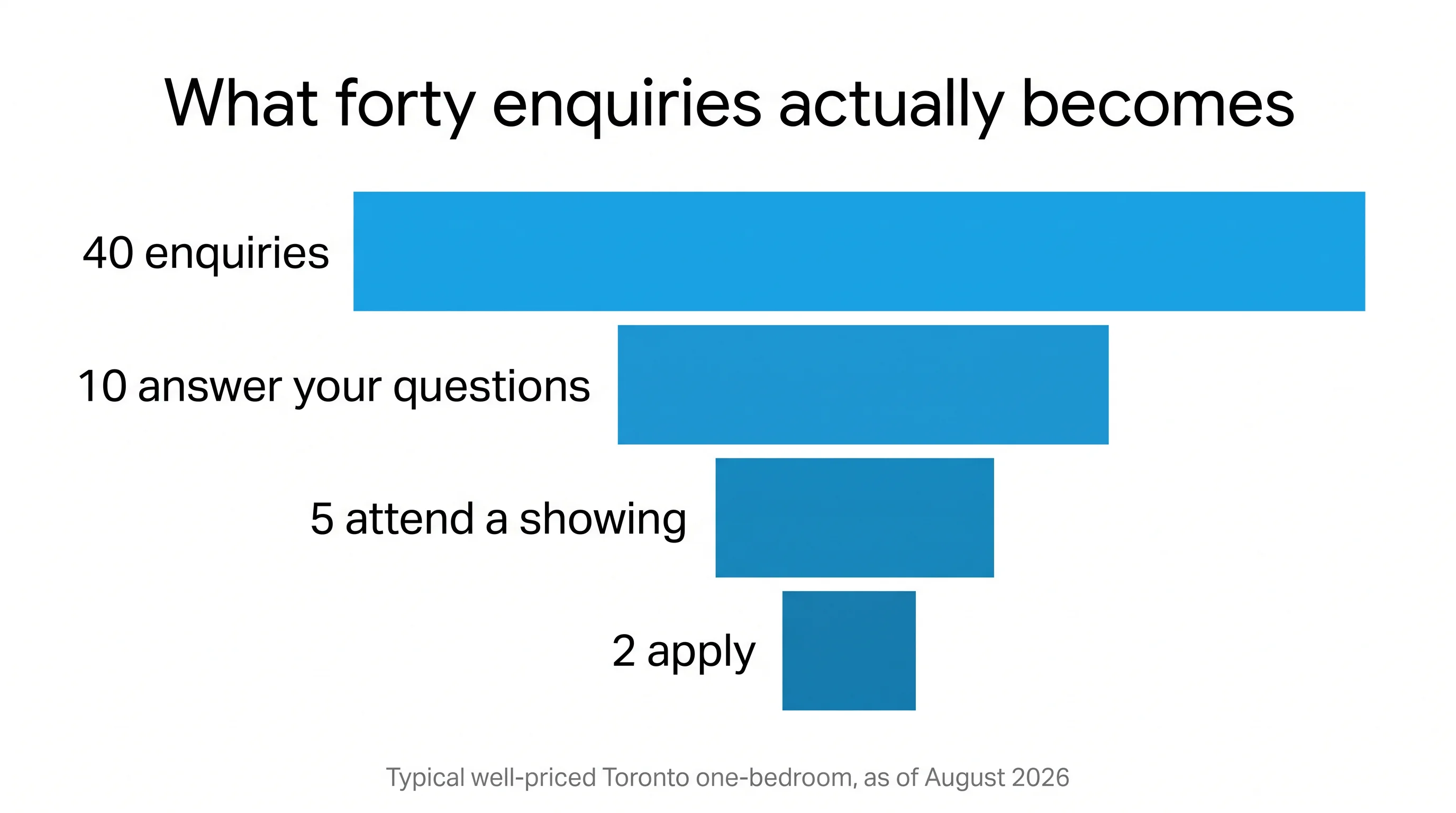
That shape — roughly 40 enquiries → 10 real conversations → 5 showings → 2 applications — is what to plan around. The headline number is alarming. The funnel is manageable.
The market conditions producing it
Three figures explain why Toronto listings are drawing this kind of volume as of August 2026:
- GTHA condo months of supply fell to 0.9 months in Q2 2026, down from 1.2 a year earlier, with a record 18,923 leases signed and active listings down 13% to 5,366 (Urbanation, July 27, 2026).
- Toronto apartment and condo asking rents reached $2,577 in July, up 1.6% month over month, with listings down roughly 6% year over year (Rentals.ca / Urbanation, August 6, 2026).
- One-bedroom units made up 49.80% of active GTA listings in May 2026 (liv.rent) — simultaneously the most competitive category to list in and the most competitive to rent in.
High-volume conditions: expect 30 to 60-plus
A well-priced one-bedroom in the City of Toronto. Free-platform listings, which deliver the biggest audiences and the most noise. May through August. Older, family-sized units in the tight segments CMHC identifies as still under pressure.
Low-volume conditions: expect 5 to 15, of better quality
New-build lease-up buildings, where CMHC reports vacancies are highest. Campus-adjacent studios out of season. The 905 — Markham asking rents fell 11.9% year over year, with Brampton, Mississauga, Oakville and Oshawa all down more than 7%, which means more choice for renters and less urgency per listing. And January and February, always.
The seasonality point most guides miss
Volume peaks and quality drops at the same moment. Summer brings more demand and more competing listings, so a larger share of your messages come from people shopping everything at once. One Ontario property management firm makes the sharper version of this argument: high enquiry volume hides weak listings, and strong demand covers slow response times. Which is why a quiet January is the honest test of whether your process actually works.
The reply that does the filtering
The principle is simple and it is the whole method: filter with logistics, never with instinct.
Every enquiry gets the identical first reply. That message answers the questions everyone asks — parking, utilities, pets, availability date — so you never type them again. It states your showing windows. And it asks five questions back. Personalise exactly one line, referencing something specific they wrote, which is what stops a template reading as a bot.
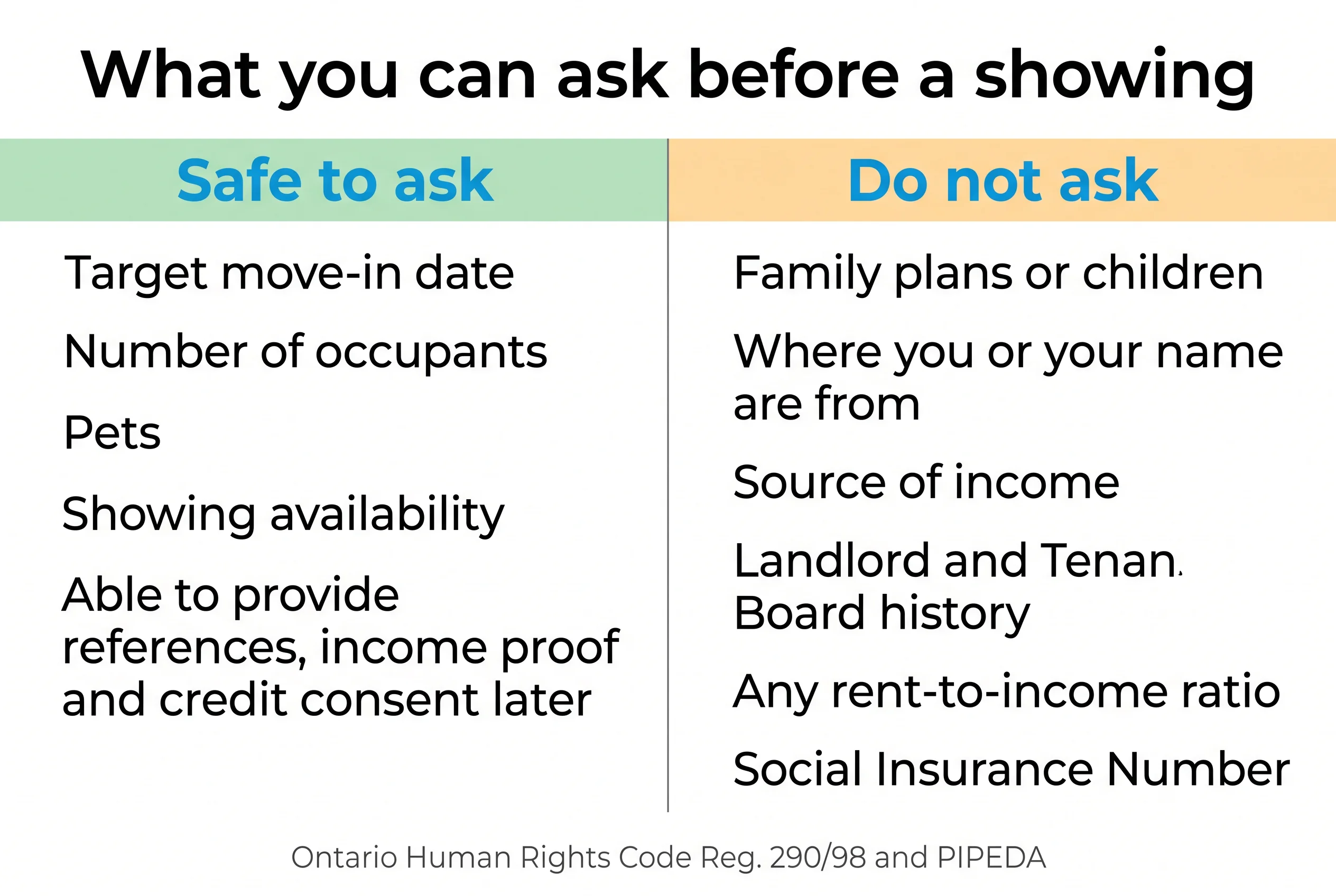
The five questions you may lawfully ask before a showing
- What is your target move-in date?
- How many people would be living in the unit?
- Do you have pets?
- Which of these showing windows works for you?
- When the time comes, will you be able to provide references, proof of income, and consent to a credit check?
These work because they are logistical, answerable in thirty seconds, and they resolve mismatches honestly. If someone needs to move in two weeks and your unit is free in forty-five days, you have both just saved an evening. Nobody has been judged; a fact was established.
The questions that create exposure
Anything about children, family plans or marital status. Where the applicant or their name is from. Whether their income comes from employment or another source. Whether they have ever been to the Landlord and Tenant Board — which landlords are not permitted to ask in tenant selection, and which surprises almost everyone. Anything implying a rent-to-income cut-off. And a SIN, which is not required to screen an applicant or to sign a lease.
Regulation 290/98 under the Human Rights Code governs the money questions: income information may be requested only alongside credit references, rental history and credit checks, and must be weighed together rather than used alone. That is precisely why question five above bundles them instead of leading with income. Our guide to what you can and can't ask a rental applicant carries the question-by-question map.
No documents at the enquiry stage
Pay stubs and identification arriving unsolicited in a Marketplace thread — from thirty-eight people who will never be your tenant — is a privacy problem, not a time-saver. PIPEDA binds every for-profit Ontario landlord, including single-property owners. Ask whether someone will be able to provide documents later. Collect them with the application, after the showing, with consent captured.
How fast is fast enough
One Canadian property management firm calls under two hours non-negotiable at peak, on the reasoning that the best applicants are talking to three landlords at once. American survey data puts renter expectations at a reply within 24 hours and finds renters contacting more than four landlords on average — directionally useful, but worth labelling honestly: those are US figures, and the widely quoted "five-minute rule" comes from US business-to-business sales research rather than anything rental-specific.
The Canadian operating standard is simpler. Same day, always. Under two hours in peak season. You do not need a study to know that the showing goes to whoever offers one first.
Turning forty replies into two showing blocks
Five problems account for most of the pain, and four of them have the same fix.

The volume is front-loaded and lands after hours
Most of forty enquiries arrive in the first 48 hours, largely in the evening, when you are not at a desk. The fix is preparation rather than availability: the pack written in advance means an evening reply takes thirty seconds on a phone.
Answering individually costs two hours you do not have
Forty bespoke replies at three minutes each is two hours spread across four evenings, with nothing to show for it afterwards. The identical template plus one personalised line takes about thirty seconds per message. Forty replies in twenty minutes.
Twelve individual showing appointments
Batch them. Offer two or three fixed windows in the first reply and let people self-select. Twenty-minute slots run sequentially, or a single open block. You are not scheduling around forty calendars — you are publishing yours.
The momentum trap
This is the most expensive mistake at high volume, and it is well documented: a landlord floods with enquiries, starts cutting corners on screening to keep momentum, and places a tenant who looked fine under speed but did not hold up under scrutiny.
The rule that prevents it: compress the reply, never the verification. Everything after the showing slows down deliberately — application, references, employer, credit. Our 7-step screening method covers the sequence that starts where this article stops.
Answering the same question nine times
Repeated questions are a listing defect, not an inbox problem. If you have explained parking to nine people, the ad is missing a line. One Ontario firm treats this as an explicit refresh trigger — refresh the listing when enquiry volume is high but showings are not converting into applications, or when you find yourself answering the same basic cost or rules question repeatedly. Our guide to writing a rental listing that attracts good tenants covers what belongs in the ad in the first place.
What the system is worth
Ad-hoc handling costs about two hours per vacancy and leaves no record. The system costs one hour to build, then twenty minutes per vacancy, and produces a record. And the vacancy arithmetic makes the case on its own: a Toronto condo at $2,577 costs roughly $85 per vacant day. If slow replies lose you the strongest applicant and add a week to the lease-up, that is $595 — several times the cost of building the system in the first place. Our piece on what an empty unit actually costs you per day runs the full model.
Why your inbox is a compliance surface
Here is the part almost nobody writes about, and the reason a triage system is worth more than the time it saves.
The enquiry stage is the least documented stage of the Ontario rental process. It is also, for that exact reason, the stage where discrimination is easiest — not because landlords are malicious, but because an undocumented inbox produces the outcome the Human Rights Code prohibits and leaves nothing behind to examine.
What that looks like in practice
CBC documented the mechanism in Kitchener-Waterloo. A Black woman messaged a Facebook Marketplace listing and her enquiry was read without a reply. She followed up; read again, no reply. She then asked two friends to contact the same lister — one white, one Black. Her white friend received a response within the hour, asking to set up a viewing. Her Black friend's message was read and never answered. She filed with the Human Rights Tribunal of Ontario.
No application was submitted. No rejection was issued. Nothing was written down by anyone. The pattern only became visible because someone tested it deliberately.
This is a process problem, not a character problem
The Ontario Human Rights Commission is explicit that screening out a prospective tenant by telephone because she has an accent can amount to discrimination on grounds including language, place of origin, ethnic origin, race, ancestry and creed. Names and accents arrive before anything else does — before the income, before the references, before you know a single relevant fact.
Which means "I answer the ones who seem promising" is, viewed from outside, indistinguishable from the Kitchener-Waterloo pattern. Not because the landlord intended it. Because instinct-based triage runs on exactly the signals the Code protects, and because there is no record to show otherwise.
The fix is the same one that saves you time
Identical reply to everyone. Reply to every enquiry, including the ones you decline — silence is the risk, not the workload. And log it.
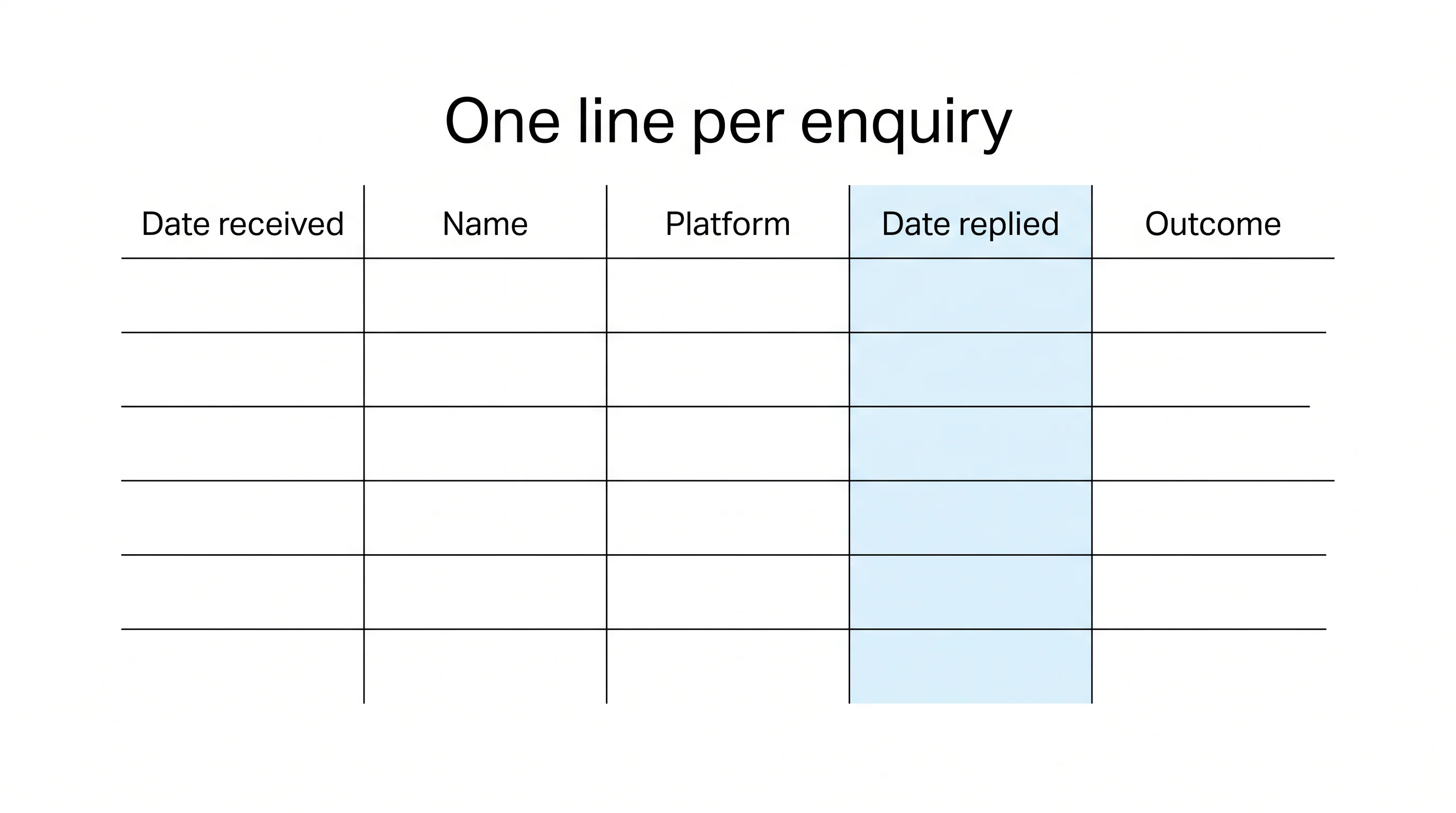
Date received, name, platform, date replied, outcome. One line per enquiry, nothing more. That log takes seconds to keep and it is the only evidence you have that you treated forty people the same way. It costs nothing and it is the entire compliance apparatus.
One forward-looking caution while we are here. The Landlord and Tenant Board began publishing final orders through the Ontario Open Data Catalogue on July 24, 2026. It is a research tool, not a screening tool — using it to check whether an enquirer has appeared before the Board runs straight into the prohibition on asking about LTB history, and into PIPEDA besides. Expect landlords to try anyway.
Declining well, and what's coming

The decline message
Most landlords ghost because they do not know what to say. Here is the whole thing:
"Thanks for your interest in the unit. We've moved forward with another applicant, so I won't be scheduling a showing. I appreciate you taking the time to write, and good luck with your search."
It is short. It closes the loop. It makes no statement about the person — you are reporting an outcome, not offering feedback. And it takes eight seconds. Sending forty of these is a better day's work than ignoring thirty of them, both because it is decent and because it is the thing your log will show you did.
The two-minute audit
When the unit is leased, read your log once. Did anyone go unanswered? Is there a pattern in who? That is the audit, it takes two minutes, and it is the point at which a problem is still cheap to fix. Then delete the enquiry-stage personal information — you have no reason to keep contact details for thirty-eight people who did not rent from you.
What's coming over the next year
- Toronto volume rises further. Listings down 6%, supply below its long-term average, leases at record levels — more enquiries per listing in the core through the autumn.
- The 905 stays slower. Fewer enquiries per listing, longer lease-up, rents still falling.
- Peak keeps compressing around the April-to-July lease-expiry cluster, concentrating both demand and competing supply into the same weeks.
- Automation is arriving. AI-assisted enquiry response is entering the Canadian property management stack, and the Code question follows it directly: an automated filter can discriminate as effectively as an instinct can, and with better records of having done so. Anyone adopting one should be able to explain exactly what it filters on.
- Labour supports demand. Ontario unemployment fell to 6.8% in July 2026 from 7.9% in December 2025.
Practical takeaways
Seven things to change before your next listing goes live:
- Write the template pack before the listing goes live — first reply, five questions, showing windows, decline message.
- Reply to every enquiry, including the ones you decline. Silence is the risk, not the workload.
- Send the identical first reply to everyone; personalise exactly one line.
- Keep pre-showing questions logistical: dates, occupancy, pets, availability, willingness to provide documents later.
- Publish two or three showing windows instead of negotiating twelve appointments.
- Ask for no documents and no SIN at the enquiry stage.
- Log every enquiry on one line, and read the log once when the unit is leased.
Quick wins: draft the first reply today, set a same-day response standard, batch your next set of showings into two blocks, and add the answer to whatever question you have now answered nine times to the listing itself. Longer-term: build the pack once and reuse it, track your own funnel numbers so you know what normal looks like for your units, audit the log after each lease, and keep screening rigour where it belongs — after the showing.
The Forty-Enquiry Survival Kit: An Ontario Landlord's Triage Checklist
Forty messages by Sunday night, most of them one line long. This free checklist gives you the first-reply template, the five pre-showing questions that are lawful in Ontario, the eight-second decline message, and the one-line log that proves you treated everyone the same way.
Get Free PDF →Frequently asked questions
How many enquiries should a rental listing get in Ontario?
It depends heavily on the segment. A well-priced one-bedroom in the City of Toronto listed on a free platform in summer can pull forty in a weekend. A new-build studio near a campus in January might get eight. Expect roughly a quarter of enquirers to answer follow-up questions and a handful to attend showings — the funnel matters more than the headline number.
What can I ask a rental applicant before a showing in Ontario?
Logistics: move-in date, number of occupants, pets, showing availability, and whether they will be able to provide references, proof of income and credit-check consent when they apply. Avoid anything about family plans, origin, or source of income. You may not ask whether someone has been to the Landlord and Tenant Board, and you may not apply a rent-to-income ratio.
Is it illegal to ignore a rental enquiry in Ontario?
There is no rule requiring a reply to every message. But if the pattern of who gets answered correlates with a protected ground under the Human Rights Code, that is discrimination — and with no records, it is very difficult to demonstrate otherwise. A documented Kitchener-Waterloo case showed exactly this pattern. Replying to everyone, identically, is both faster and safer.
How fast should I respond to a rental enquiry?
Same day at minimum; under two hours during peak season, which is the standard experienced Canadian property managers work to. Strong applicants are usually in conversation with several landlords at once, and the showing tends to go to whoever offers one first.
Should I ask for documents in the first reply?
No. Pay stubs and identification arriving in an open messaging thread from people who will never be your tenant is a privacy problem, not a shortcut. Ask whether they will be able to provide documents later; collect them with the application, after the showing, with consent captured.
The bottom line
Forty enquiries is not a crisis. It is the predictable output of a well-priced listing in a tightening market, and it narrows to about ten real conversations, five showings and a couple of applications. What turns that from an ordeal into a Tuesday is a template pack written before the listing goes live, showing windows you publish rather than negotiate, and a decline message that takes eight seconds.
The part worth remembering is that the system doing the work is also the system doing the protecting. Replying to everyone identically is faster than triaging by feel, and it is the only evidence that you treated forty people the same way. In Ontario, where the Code applies from the advertisement onward and an unanswered message leaves no record at all, those turn out to be the same discipline.
Next steps: draft the first reply, set the showing windows, and start the log on your next vacancy rather than your next problem.
The same system that saves you time is the one that protects you
Tenon10's screening workflow builds the sequence into the process — the same steps for every applicant, consent captured before the check, and the decision recorded where you can find it if anyone ever asks why.
Free • No signup required • Updated for the Bill 60 changes in force 21 Sep 2026
Related resources
- How to Write a Rental Listing That Attracts Good Tenants — the ad is your first filter, and a precise one reduces volume while raising quality.
- Where to List a Rental in Ontario: 9 Sites Compared — which platforms produce the volume, and which produce the noise.
- How to Screen a Tenant in Ontario: The 7-Step Method — the sequence that starts where this article stops.
- What an Empty Unit Actually Costs You Per Day — the vacancy arithmetic behind the $85-a-day figure.
- What You Can and Can't Ask a Rental Applicant in Ontario — the question-by-question map for the application stage.
- Rental Listing Scams in Ontario — why some enquiries move suspiciously fast toward money.
This article is general information, not legal advice. All figures are current as of August 2026 and carry their original source and date. Verify current rules at ontario.ca, ohrc.on.ca, or with the Landlord and Tenant Board before making decisions about your own leasing process.


