As of July 30, 2026. Every rental application is a list of questions, and Ontario law has an opinion about every one of them. Some are expressly authorized. Some are flatly off-limits. And a surprising number sit in the middle — lawful only in a particular form, or only when weighed a particular way. This is the question-by-question map: what you can ask, what you can't, and the handful where the wording is the whole difference.
The legal spine is short: the Residential Tenancies Act's application rules and Ontario Regulation 290/98 under the Human Rights Code authorize a specific screening package, and the Code's protected grounds bound everything else. The details are where applications go wrong — so the details are the piece.
The Tenant Screening Checklist
The authorized package, the together rule, the grounds that never enter a file, and the public-orders-era sequence — one page, updated.
Get Free PDF →The authorized package — what the law expects you to ask
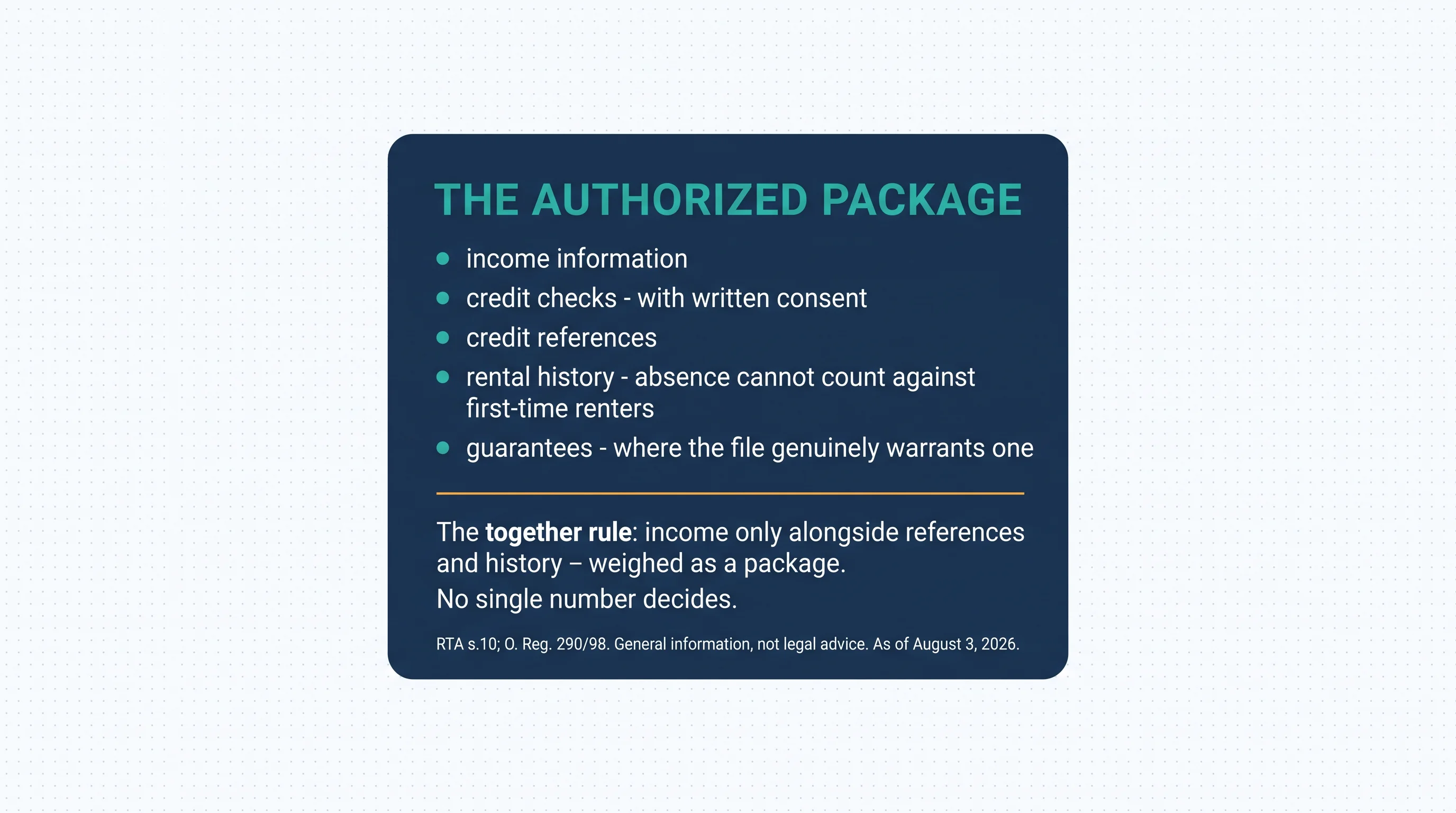
Five things are expressly on the table [RTA s.10; O. Reg. 290/98]: income information, credit checks (with written consent — the Consumer Reporting Act's requirement), credit references, rental history, and guarantees. These aren't merely tolerated; they're the package the framework was built around — and it's worth seeing why it predicts: credit shows obligations handled across years, references show how a tenancy actually ran, income shows current capacity, and the together rule forces them to be read against each other. Any question you're tempted to add should have to beat that standard.
One rule inside the package carries the Code's whole philosophy: income information may be sought and considered only if the landlord also seeks and considers credit references and rental history — weighed together, never income alone as a threshold. No single number decides. Two corollaries do daily work: a first-time renter's absence of rental history cannot be counted against them, and income ratios (the "30 per cent rule") are guidelines — a rigid automatic cutoff is exactly the single-number decision the regulation forbids.
The off-limits list — questions that never belong on an application
The Human Rights Code's protected grounds in housing draw the hard lines. Applications cannot probe: race, ancestry, place of origin, colour, ethnic origin, citizenship ("where are you from?" and "are you Canadian?" both fail); creed; sex, sexual orientation, gender identity or expression; age beyond confirming the applicant can contract; marital and family status — including the classics "are you married?", "do you have kids?", and "are you planning a family?"; disability — including any medical questions outside an accommodation the applicant raises themselves; and receipt of public assistance, the housing-specific ground — "are you on Ontario Works?" is off-limits, and so is engineering the income questions to find out.
Add the non-Code items: a Social Insurance Number cannot be demanded (it may be volunteered for a credit check, never required), and ID is for viewing, not keeping. The pattern behind the whole list: the application asks whether the person can sustain the tenancy — never who they are.
The middle path — lawful in one form, unlawful in another
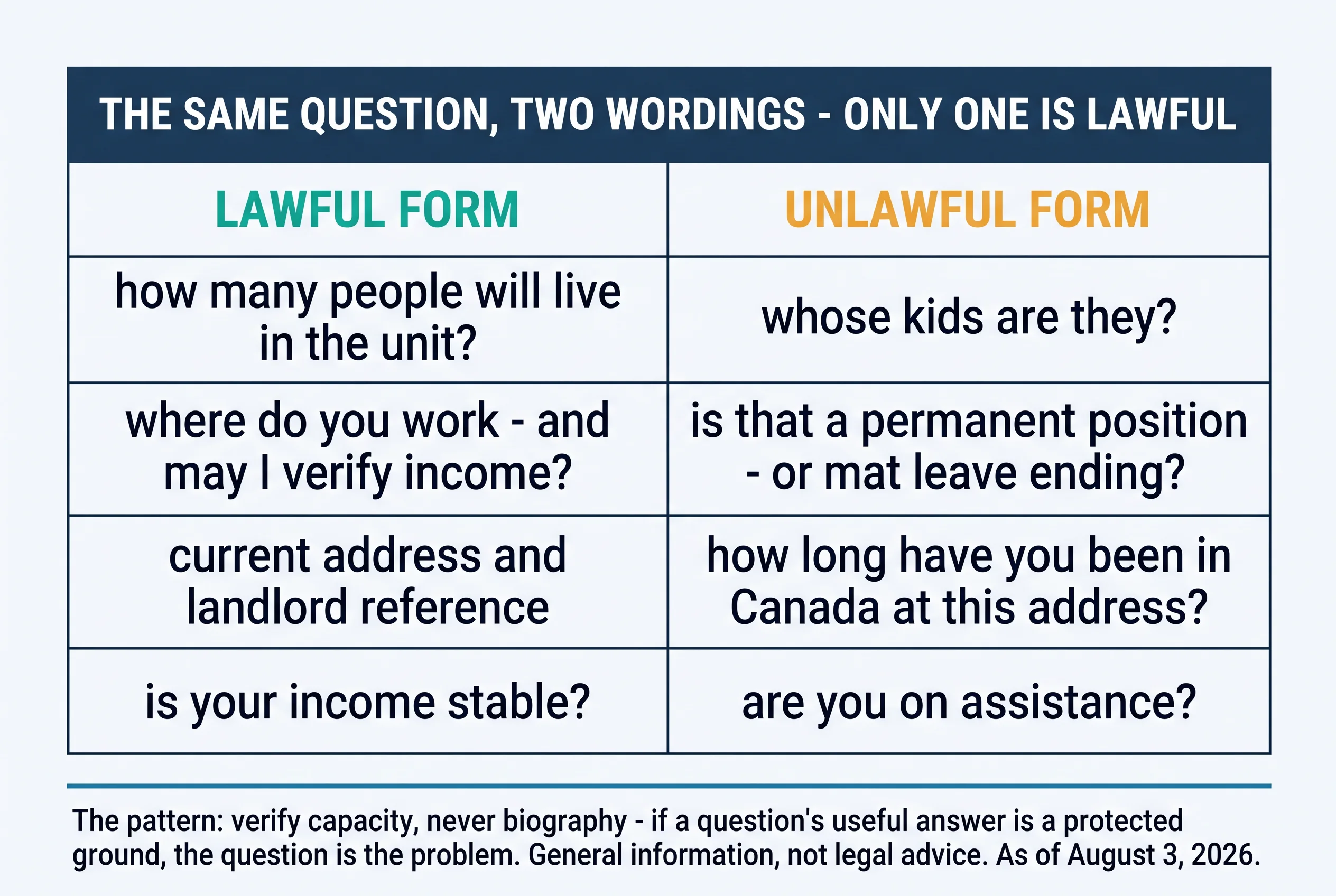
Occupants: "how many people will live in the unit?" — yes. "Whose kids are they?" — no. Employment: "where do you work, and may I verify income?" — yes. "Is that a permanent position?" pushes toward proxies; verify the income, not the biography. Pets: askable, and generally a lawful selection basis at application — with the service-animal carve-out that our pets guide covers in full. Smoking: askable; a lawful preference at selection. References: current and prior landlords, yes — and note the referee call is bound by the same Code: the off-limits list applies to what you ask about an applicant, not just what you ask them. LTB history: the new one — reading public orders is lawful; deciding on them engages the Code exactly as any other basis, with five risks the authorized package doesn't carry; our full analysis covers that sequence. Guarantors: askable "where appropriate" — thin credit, a first-time renter, unverifiable income — but not as a blanket surcharge on categories of applicants; a guarantor policy that only ever activates for certain kinds of people is a proxy with a co-signer. Money at signing: its own body of law — first and last is lawful, damage deposits never are; the deposit guide carries the full list.
The rapid-fire list — thirty seconds per question
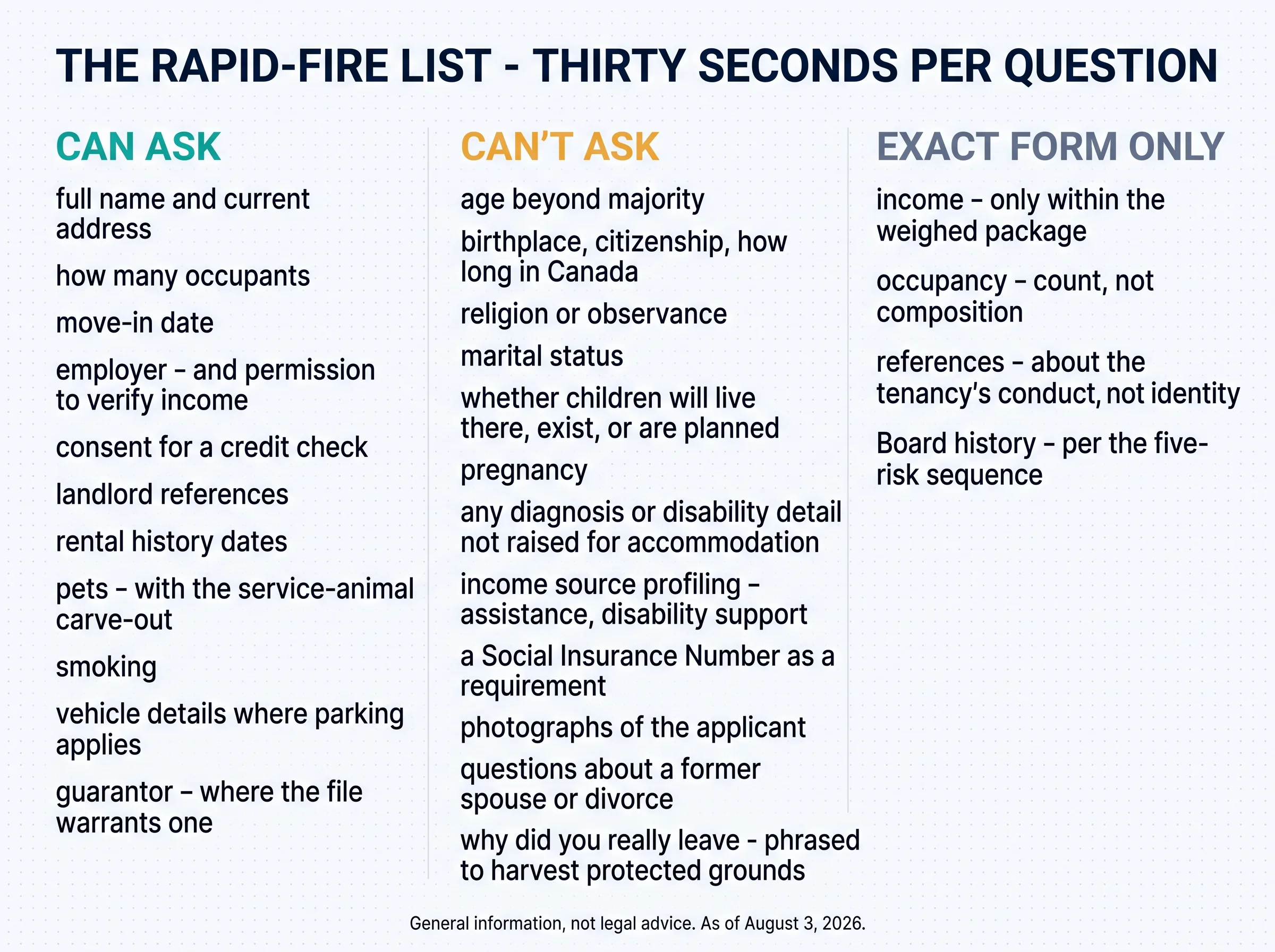
Can ask: full name and current address · how many occupants · desired move-in date · employer and permission to verify income · consent for a credit check · current and previous landlord references · rental history dates · whether a guarantor is available (where the file genuinely warrants one) · pets (with the service-animal carve-out) · smoking · vehicle details where parking is part of the tenancy.
Can't ask: age beyond majority · birthplace, citizenship, or "how long in Canada" · religion or observance · marital status · whether children will live there, exist, or are planned · pregnancy · any diagnosis, medication, or disability detail the applicant didn't raise for accommodation · income source profiling (assistance, disability support) · a Social Insurance Number as a requirement · photographs of the applicant · anything about a former spouse, a divorce, or "why did you really leave your last place" phrased to harvest protected-ground answers.
Asks that need their exact form: income — only within the weighed package · occupancy — count, not composition · references — about the tenancy's conduct, not the tenant's identity · Board history — read lawfully, decided on carefully, per the five-risk sequence.
Both chairs

💡 For landlords: The authorized package is not a constraint on good screening — it is good screening: it triangulates capacity across years, sources, and references, and it's the standard any extra question should have to beat. Run the same form, the same consents, the same sequence for every applicant, and document the basis of every decision. Consistency is both the Code's expectation and your best evidence.
💡 For tenants: You can decline off-limits questions — and how a landlord reacts to a polite decline tells you plenty. You cannot be required to provide a SIN, medical information, or your family plans; your missing rental history can't count against you if you've never rented; and if you suspect a rejection turned on a protected ground, ask for the basis in writing, keep everything, and know the Human Rights Tribunal route exists. Most bad questions are copied forms, not malice — but the paper trail protects you either way.
The Tenant Screening Checklist
The authorized package, the together rule, the grounds that never enter a file, and the public-orders-era sequence — one page, updated.
Get Free PDF →Key takeaways
- Five things are expressly authorized: income information, consented credit checks, credit references, rental history, guarantees.
- The together rule governs: income only alongside references and history, weighed as a package — no single number decides.
- The protected grounds are the hard lines — family status, citizenship, disability, receipt of public assistance and the rest never belong on a form, directly or by proxy.
- No SIN demands; no medical questions outside applicant-raised accommodation; first-time renters' missing history can't count against them.
- The middle path is about wording: occupants not children; income not biography; pets with the service-animal carve-out.
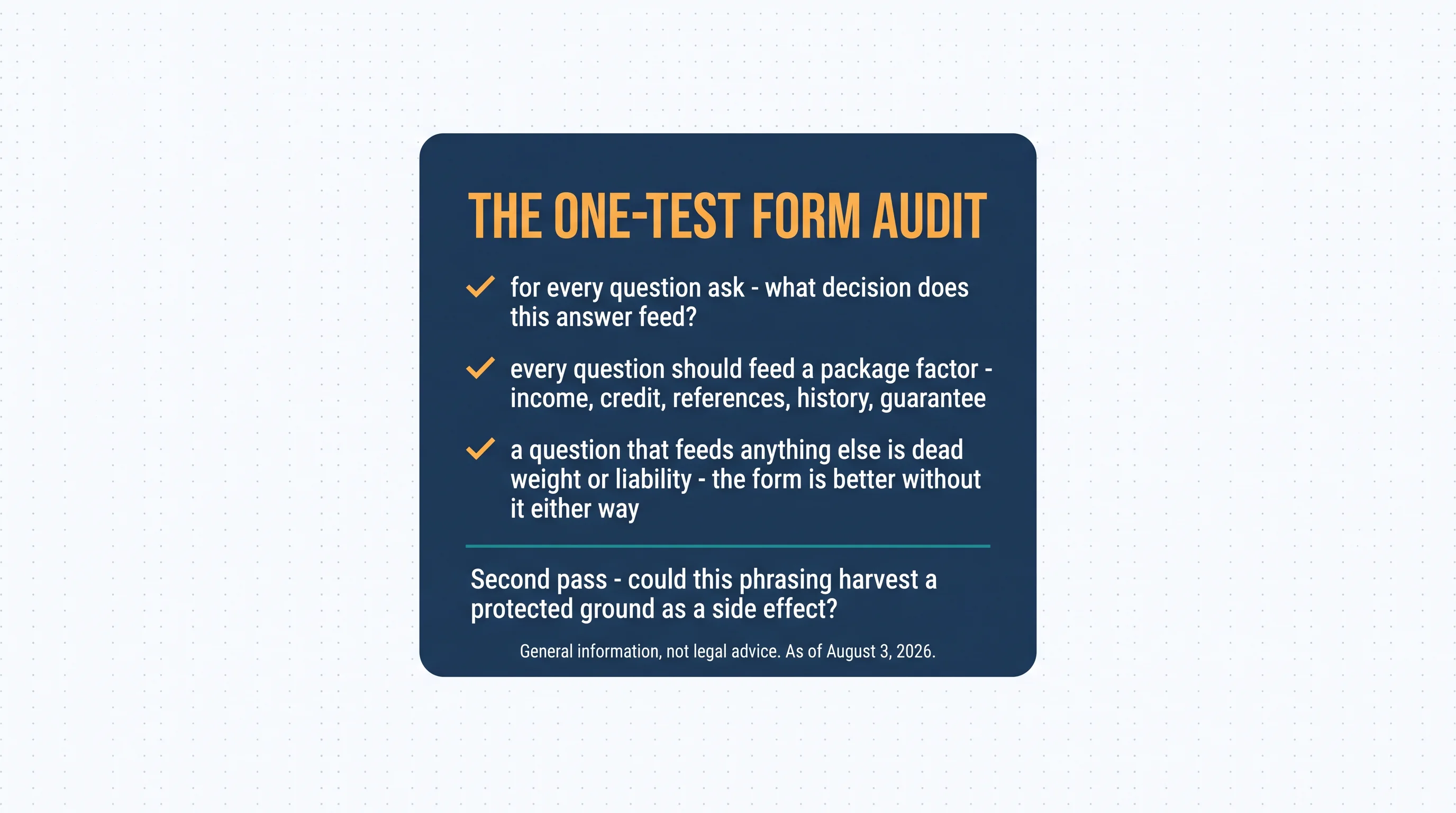
- One test cleans any form: every question must feed a package factor.
The form is the law in miniature
A rental application done right is almost boring: five factors, consistent wording, written consents, identical treatment. Everything interesting that could be added — the biography questions, the family questions, the shortcuts — is precisely what the law strips out, because none of it predicts a tenancy and all of it predicts a complaint. Ask what the package asks, weigh it together, write the basis down. This is general information, not legal advice. As of July 30, 2026 — this piece is the standing reference; it revs as OHRC guidance evolves.
The application that's already compliant
The authorized package as a ready-to-use workflow — right questions, written consents, identical process every time. Free to start.
Free for up to 3 units • Tenants always free • See current plans
Related resources
- How to Screen a Tenant in Ontario — the pillar: the full method this map plugs into.
- Screening With LTB Orders — the public-orders era, the five risks, the defensible sequence.
- Refusing Tenants With Pets — the two-stage rule and the service-animal carve-out.
- First and Last Month's Rent — what you can ask for in money, not just information.
Frequently asked questions
Can a landlord ask for my SIN on a rental application?
No — a SIN cannot be required. It may be volunteered to facilitate a credit check, but an application that demands it is over-asking, and a credit check runs fine without it.
Can a landlord ask if I have children?
No — family status is a protected ground. "How many occupants?" is the lawful version; who they are and whether they're children is not the landlord's question to ask.
Can a landlord ask about my income?
Yes — but only as part of the package: income may be considered only alongside credit references and rental history, weighed together. Rigid income-ratio cutoffs applied alone create Human Rights Code risk.
Can a landlord ask if I'm on social assistance?
No — receipt of public assistance is a protected ground in housing, and questions engineered to reveal it fail the same way direct ones do. Income verification is lawful; income-source profiling is not.
What if I was asked an illegal question and then rejected?
Ask for the rejection basis in writing, keep the application and correspondence, and know that where a protected ground is engaged, the Human Rights Tribunal of Ontario route exists. Many bad questions are copied templates rather than intent — but document first, assume second. This is general information, not legal advice.