Last summer, Ontario learned in public that "held in trust" is a promise, not a law of physics: roughly $10 million allegedly went missing from one Toronto-area brokerage's trust accounts. This October, the regulatory answer arrives — every registered brokerage in the province begins proving its trust position to RECO annually, with monthly reporting already on the horizon for 2027. And whether or not that new regime touches your firm directly, the question it has planted in every Ontario owner's head touches everyone who holds someone else's money: where does my money sleep?
Here's the part almost nobody has written down for property managers and landlords: Ontario trust accounting isn't one rulebook. It's three, and which one binds you depends on what you are. A quick vocabulary note for readers newer to this: a trust account holds money that belongs to your clients or tenants, kept separate from your own; a ledger is the running record of every dollar in and out for one owner or one tenancy; reconciliation is the monthly proof that the records and the bank agree; and a registrant is a brokerage or agent registered with RECO, Ontario's real estate regulator.
This guide runs all three tracks — the registrant machinery with its brand-new filing regime, the discipline that governs unregistered managers, and the last month's rent rules that bind every landlord in the province — plus the month-end craft underneath them all.
The Ontario PM Trust Account Month-End Checklist: Prove It, Every Month
A 19-point checklist for Ontario property managers and landlords — the month-end reconciliation craft, the registrant machinery with RECO's new October 2026 filing dates, the last month's rent file with its interest anniversary, and the owner-facing answer that wins clients. Custody you can prove, on one page.
Get Free PDF →Why 2026 is the year trust accounting got serious
The story that changed everything is a matter of public record. In the summer of 2025, news broke that roughly $10 million had allegedly been misappropriated from the trust accounts of iPro Realty, one of Ontario's larger brokerages — money that was supposed to be legally untouchable. As reported at the time, the regulator had been aware of a shortfall since May, while the public learned of it in August, and that disclosure gap drew criticism of its own. An independent review — the Dentons Report — followed, and RECO launched what it calls its transformation initiatives, the most significant overhaul of brokerage financial oversight since the Trust in Real Estate Services Act itself came into force on December 1, 2023.
A backstop does exist: RECO's Consumer Deposit Insurance can cover losses up to $200,000 per claimant, with a $4 million aggregate cap per event. But note the framing carefully — the program is designed around consumer deposits in real estate transactions. Whether and how it applies to any other funds in any particular situation is a question to confirm with RECO directly, not an assumption to build a business on.
What changed because of all this is concrete and dated: effective October 1, 2026, every Ontario brokerage must submit an annual financial filing to RECO, and the regulator has said monthly trust reconciliation reporting is planned for 2027 (RECO, June 2026). We'll walk the details in Track 1 below.

The market backdrop makes the timing sharper. Toronto-area rental conditions favour tenants right now — TRREB's Q1 2026 figures showed 24,012 condo apartments listed for rent, up 6 per cent year over year, with net rents at a sixteen-quarter low (TRREB, Q1 2026) — and vacancy-nervous owners scrutinize everything, including where their rent sits between collection and distribution. After 2025, "where does my money sleep?" has become a standard owner-vetting question in this province. This article's job is to make sure that whichever kind of reader you are — a firm managing fifty doors or a landlord holding one deposit — you have the written answer.
Which rules bind you? Ontario's three tracks
Start by noticing a trap in almost everything written about the reform so far: it's buyer-deposit coverage. The scandal involved purchase deposits, so the explainers talk about buyers, sellers, and closings — useful, but the wrong frame for people whose trust position is rent, owner floats, and tenant deposits. The property management translation starts with a structural fact our pillar guide to modern property management in Canada untangles in full: Ontario has no property management licence. Whether the trust machinery applies to you isn't about what you do — it's about what you are.
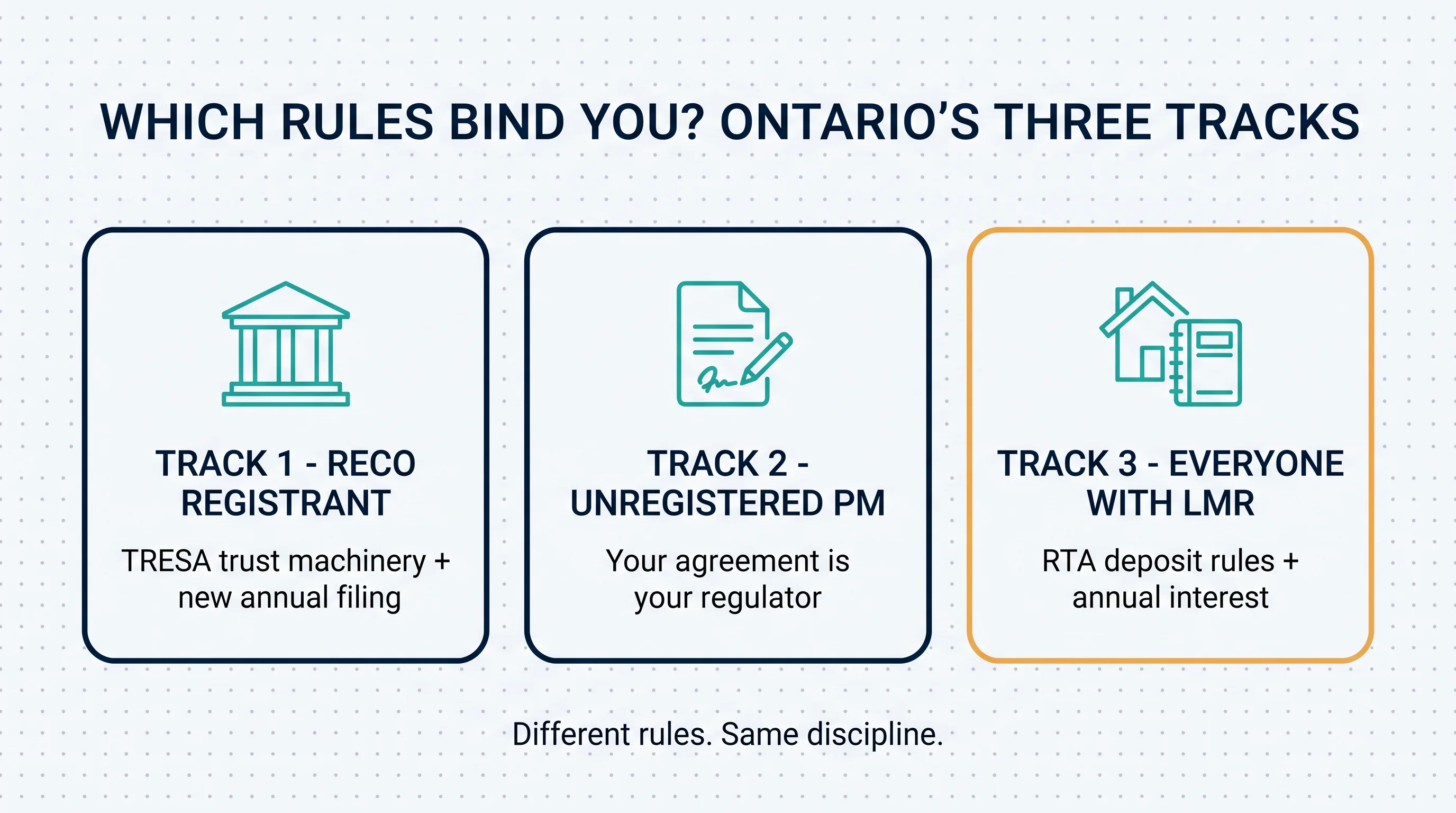
Track 1 — you're a RECO registrant. Leasing is trading in real estate under Ontario's framework, so a registered brokerage that holds rent or other money in connection with its leasing and management work holds that money inside the TRESA trust machinery — segregated account, monthly reconciliation, and, from this October, the new annual filing. Track 2 — you manage property without being registered. No RECO machinery applies to you; your management agreement, general trust and fiduciary principles, and the craft itself are your regime. Different rules, same discipline. Track 3 — everyone. The moment any Ontario landlord or manager collects last month's rent, the Residential Tenancies Act's deposit rules apply — registered or not, one unit or a thousand.
The dual-audience point, stated plainly: if you're a landlord hiring a manager, the first custody question is which track the firm is on — registered brokerage or unregistered manager — and the answer belongs in writing, in the management agreement, before any money moves.
Track 1: The registrant machinery — and the filing that changes this October
The standing rules
For a registered brokerage, the trust rules are the regulator's, and the core machinery has been stable for years. Trust money lives in a segregated real estate trust account, fully separate from the brokerage's operating funds — client money is legally not the brokerage's money, and the account structure enforces that. The account is reconciled monthly. Records are kept to the standard the TRESA regulation stack requires. And money that goes unclaimed doesn't sit in trust forever: under RECO's published guidance, trust money held for two years past entitlement — or where entitlement can't be determined or the person can't be located — must be paid to RECO, along with the interest it accrued (RECO Bulletin 8.1). Every one of those obligations applies whether the trust money is a buyer's deposit or a tenant's rent flowing through a leasing operation.
It's worth pausing on what "trust position" actually means for a brokerage whose business is leasing and management rather than sales, because this is the translation the buyer-deposit coverage never makes. Your trust position is the rent float between collection and owner distribution; it's tenants' last month's rent deposits; it's owner contributions waiting for a renovation invoice; it's every dollar that is momentarily yours to hold and never yours to have. When the annual filing asks for trust assets and liabilities, that's the money it's asking about — and a leasing brokerage with a hundred doors can easily hold a larger, faster-moving trust position than a small sales brokerage holding a handful of purchase deposits. The reform wasn't written about you, but it was written for exactly the kind of money you hold. RECO regulates more than 110,000 registrants, and from October, every brokerage among them answers the same questions about that money annually.
New — the annual financial filing
Here is the change this article exists to put on your calendar. Effective October 1, 2026, every Ontario brokerage must submit an annual financial filing to RECO through its MyWeb portal — documentation demonstrating, in the regulator's words, proper financial management and compliance with TRESA (RECO, read July 2026). As reported when the June 16, 2026 announcement landed, the filing includes financial-statement information, the brokerage's trust assets and liabilities, its unclaimed trust monies, and a compliance attestation signed by the broker of record. The first deadline is close: brokerages with fiscal years ending between August 1, 2025 and July 31, 2026 must file by October 30, 2026, with later fiscal year-ends getting a 90-day window after year-end. Non-compliance, as reported, can mean fines, suspension, or revocation of registration. Because details of a brand-new regime can shift, verify the current requirements at reco.on.ca before you build your process around any secondhand summary — including this one.
The immediately actionable part: RECO is running education webinars in August and September 2026, with registration opening this month. If you're a registrant reading this in July, registering for one is the single highest-value fifteen minutes available to you today. Picture the alternative as a prospective composite: a brokerage with a July 31 fiscal year-end that discovers, in mid-October, that its filing — trust figures, unclaimed-money accounting, attestation and all — is due October 30. Nothing about that scramble is illegal yet; everything about it is avoidable now.
What's coming next
The annual filing is the beginning, not the end. RECO has said monthly trust reconciliation reporting is planned for 2027, with guidance to come before it lands. And industry consultation has floated reform of commission trust accounts — reported options include bringing them under the same oversight as real estate trust accounts or eliminating them entirely (field reporting on RECO's consultations, March 2026 — under consideration, not decided). The direction is unmistakable: a brokerage's trust position is moving from something inspected occasionally to something demonstrated continuously. The firms that treat month-end reconciliation as a signed institution rather than a spreadsheet habit will find 2027 a formality; the others will find it an audit.
Track 2: Not registered? Your agreement is your regulator
Now the track most PM content ignores entirely. Ontario has no property management licence, so a manager who isn't a RECO registrant — a common and lawful way to run plain rental management in this province — sits outside the trust machinery above. No segregated-account requirement, no RECO reconciliation rule, no annual filing. What there is instead: the management agreement you signed, the general trust and fiduciary principles that apply whenever you hold money that isn't yours, and the Residential Tenancies Act wherever the money is a tenant's. Different rules, same discipline — and in some ways a heavier responsibility, because no regulator is coming to catch your mistakes early.
The agreement as constitution
For an unregistered manager, the management agreement does the work legislation does elsewhere, which means it should say — in actual clauses, not vibes — five things. A separate-account covenant: client money lives in its own account, never mixed with the firm's operating funds. A monthly-reconciliation covenant: the books are proven against the bank every month. A reporting cadence: statements land on a named day. Owner audit rights: the owner may inspect the records that concern them. And a fee-sweep schedule: the firm's earned fees move out of client funds on a defined rhythm, because earned money left sitting with client money is the quiet form of mixing that looks worst in hindsight.
The craft, imported
The mechanics underneath are identical to what licensed regimes require, because the logic of holding other people's money doesn't care about your registration status. Every owner gets their own ledger, and no ledger ever goes negative — a negative balance means someone else's money is floating the shortfall. Then the centrepiece: three-way reconciliation — the bank balance, the trust ledger, and the sum of every individual owner ledger, all matching to the dollar, every month, with a named person's initials on the match. Then the order of operations: reconcile, then distribute, then statement — never distribute unreconciled funds. Our companion guide to managing multiple property owners walks the full craft, ledger anatomy to statement design; this is the same discipline in its Ontario context.
And here's the box for the other half of our readership — the landlord vetting a manager. Five questions, ask them all: Is my money in a separate account from yours? Do I have my own ledger? Do you reconcile monthly — and who signs it? What day do my statements arrive? Where does my tenant's last month's rent sit, and who pays its interest? A professional firm answers all five without blinking, in writing. Hesitation on any of them is your answer too.
Where Tenon10 fits: Tenon10 isn't a trust account — it's the record-keeping layer that makes the discipline provable: rent collection, expenses, and per-property records organized from the day money moves, so the ledger side of your month-end match is always ready. Canadian-first, with Ontario compliance automated in-product today. See plans
Track 3: Last month's rent — the trust obligation everyone shares

Strip away the regimes and one trust obligation remains that binds every Ontario landlord and every manager, registered or not, one unit or a thousand: the rent deposit under the Residential Tenancies Act — sections 105 and 106, the rules most people call the last month's rent, or LMR.
The rules, plainly
A rent deposit can be required only at or before the tenancy begins — not sprung mid-tenancy — and it can't exceed one rental period's rent: one month, for a monthly tenancy. Its legal purpose is exactly one thing: the rent for the last period of the tenancy. It is not a damage deposit — Ontario doesn't have those — and applying it to repairs, cleaning, or anything else isn't an option; damage claims run through the LTB, using the L-applications built for that. Key deposits are permitted only if genuinely refundable. And charges outside what the Act allows are recoverable by tenants — the T1 application exists precisely to claw back money a landlord shouldn't have taken. Our Ontario Standard Lease guide covers how the deposit is papered at signing.

The interest anniversary
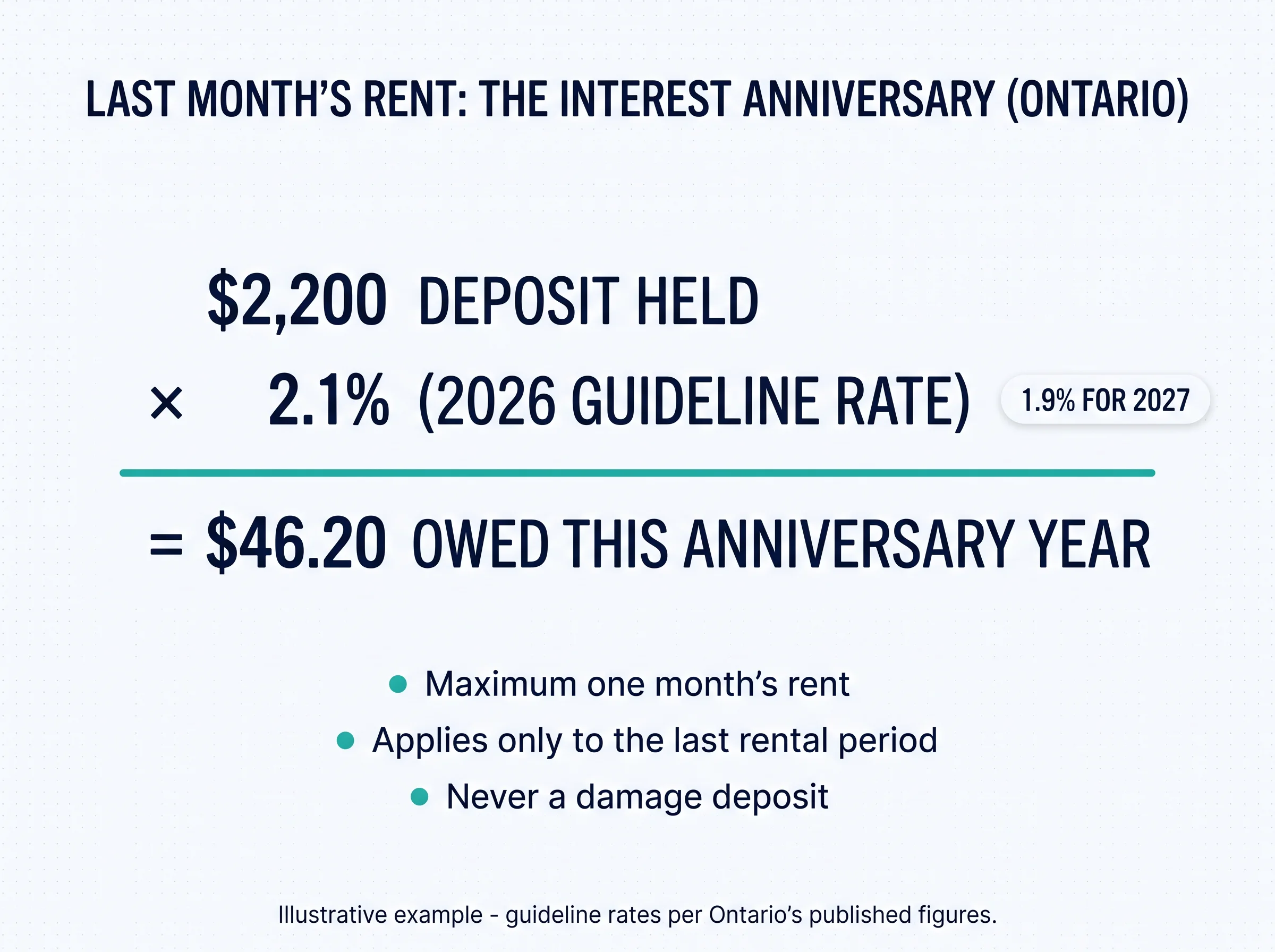
Here's the obligation that quietly separates careful operators from everyone else: the deposit earns interest, payable to the tenant annually, at the provincial guideline rate — the same rate that caps rent increases, which is 2.1 per cent for 2026 and 1.9 per cent for 2027. Worked example, ours: a $2,200 deposit at 2.1 per cent means $46.20 owed for a 2026 anniversary year. When rent rises, the mechanics also let the interest owed be applied toward topping the deposit up to the new rent — a set-off most landlords handle in one line on the anniversary. The amount is small; the habit is everything.
Because here's the composite that plays out at the LTB with regularity: a landlord holds a $2,200 deposit for five years and never pays a cent of interest. Each skipped year was a rounding error; together they're a real number — and when the tenancy ends on bad terms, the tenant's T1 claim arrives with five years of arrears attached, plus the credibility damage of standing before an adjudicator as the landlord who kept the tenant's interest. The fix costs almost nothing: put every deposit's anniversary in the calendar and automate the payment or set-off.
One more thing worth saying with the respect it deserves: the deposit is the tenant's money doing a job. It sits with you for years, working as security for exactly one month of rent, and the interest on it is the tenant's right — not a courtesy, not a goodwill gesture you may skip in a tight month. Paying it on schedule is simultaneously the law, the cheapest goodwill in this business, and a quiet signal to every tenant that your books are the kind that balance. (And if the owner behind the property lives abroad, note that a separate federal withholding calendar applies to their rent — our multi-owner guide covers the non-resident rules in full.)
Where Tenon10 fits: This is the most literal fit in this guide: Tenon10 handles last month's rent the Ontario way — LMR-only, never a damage deposit — with the guideline interest math (2.1% for 2026) built in, alongside rent collection and per-property records. The anniversary stops depending on anyone's memory. See plans
The month-end rhythm and the year ahead
Pull the three tracks into one operating rhythm and it fits in a paragraph. The month: post everything to its ledger, run the three-way reconciliation and initial it, then distribute, then statement — and check which LMR anniversaries fall in the coming weeks. The year, as it looks from July 16, 2026: registrants spend now-to-September on webinar registration and an attestation dry-run; October 1 brings the filing regime and October 30 the first deadlines; 2027 brings the planned monthly trust reporting, with guidance expected before it lands. Meanwhile the market stays tenant-favouring in the major centres (TRREB Q1; CMHC's June 2026 mid-year read), which keeps owners anxious and their custody questions sharp.
And since patterns teach faster than rules, here are the failure modes this whole discipline exists to prevent, each one visible in enforcement patterns wherever client money is regulated: commingling — including the quiet version, earned fees left sitting in client funds long after they're earned; a negative owner ledger, meaning someone else's money is silently covering a gap; reconciliations skipped in busy months, which is precisely when errors happen; deposits treated as damage funds; interest anniversaries missed for years; and, new to the list this October, a filing deadline discovered after it has passed. Not one of these starts as dishonesty. Every one of them starts as a month when the halves weren't rejoined.
The Ontario PM Trust Account Month-End Checklist: Prove It, Every Month
A 19-point checklist for Ontario property managers and landlords — the month-end reconciliation craft, the registrant machinery with RECO's new October 2026 filing dates, the last month's rent file with its interest anniversary, and the owner-facing answer that wins clients. Custody you can prove, on one page.
Get Free PDF →Key takeaways
- Know your track and write it down: RECO registrant, unregistered manager, or a landlord holding last month's rent — different rules bind each, and every management agreement should say which applies.
- Segregated money: required by the machinery if you're registered; covenanted in the agreement if you're not.
- Per-owner and per-tenancy ledgers, never negative — a negative balance means someone else's money is covering the gap.
- Three-way reconciliation monthly, initialled: bank, trust ledger, and the sum of every individual ledger, matching to the dollar.
- LMR discipline: one month maximum, applied only to the last period's rent, with interest at 2.1% on every 2026 anniversary (1.9% in 2027).
- Registrants: fiscal year mapped to the filing deadline, webinar registered, attestation dry-run done — all before October.
- The owner answer written before the owner asks: account, ledger, reconciliation, signature, statement day.
The halves must match
"Held in trust" was always a promise, and 2026 is the year Ontario started asking for proof — annually if you're registered, contractually if you're not, and every anniversary for the humble deposit that every landlord in the province holds. The craft underneath never changes: one owner, one ledger; three numbers that agree to the dollar; a signature on the match; and a written answer ready for the question every owner now asks. Like the old split tally sticks that predate the ledger itself, the record only proves anything when the halves come together and match. Rejoin yours every month, and no October, no audit, and no anxious owner will ever catch your books mid-scramble.
Books that balance, records that prove it
Tenon10 keeps rent collection, expenses, and last month's rent handled the Ontario way — guideline interest math included — in one Canadian-first platform. Managing a larger portfolio? Talk to us about your firm.
Free plan available • Tenants always free • Contact us for firms
Related resources
- Ontario Rent Increases 2026: The Complete N1 Guide — the 2.1% guideline that also sets LMR interest
- Ontario Rent Increases 2027: The Complete N1 Guide — next year's 1.9% rate
- Ontario Standard Lease 2026 — where the deposit gets papered
- CRA Audits of Rental Income — the other reason clean records win
- Property Management Software Ontario: What to Look For in 2026 — the tooling layer under the ledgers
- RECO references: the TRESA Explained and annual financial filing pages at reco.on.ca
Frequently asked questions
Do property managers need a trust account in Ontario?
It depends on your track. A RECO-registered brokerage holding money in connection with a trade — leasing included — must use the TRESA trust machinery: segregated account, monthly reconciliation, and now the annual filing. An unregistered manager isn't in RECO's regime but should covenant equivalent discipline in the management agreement. And anyone holding last month's rent has deposit obligations under the Residential Tenancies Act regardless.
How much interest is owed on last month's rent in Ontario?
Interest is paid annually at the provincial guideline rate — 2.1 per cent for anniversaries falling in 2026, and 1.9 per cent for 2027. A $2,200 deposit earns $46.20 for a 2026 anniversary year. When rent rises, the interest can be applied toward topping the deposit up to the new rent.
Can last month's rent be used for damages?
No. The deposit may be applied only to the rent for the last period of the tenancy — Ontario has no damage deposits. Damage claims run through the LTB's applications instead, and a tenant can use the T1 application to recover deposit money applied to anything else.
What is the RECO annual financial filing?
Effective October 1, 2026, every Ontario brokerage must file annually with RECO: financial-statement information, trust assets and liabilities, unclaimed trust monies, and a compliance attestation signed by the broker of record. The first deadline is October 30, 2026 for fiscal years ending between August 1, 2025 and July 31, 2026, with 90-day windows for later year-ends. Verify current details at reco.on.ca.
What happens to trust money nobody claims?
Under RECO's published guidance, a registered brokerage that has held trust money for two years past entitlement — or where the person entitled can't be located — must pay it to RECO, together with the interest it accrued.