

Here is the sentence that should be taped above every property manager's desk in Canada: the moment your firm collects rent for an owner who is not a tax resident of Canada, you become their federal withholding agent — and if the 25 per cent doesn't reach the CRA, subsection 215(6) of the Income Tax Act makes you personally liable for it. Not the owner. You.
That's the sharpest edge of a bigger truth: growing from one owner-client to twenty changes what property management is. It stops being a service job with bookkeeping attached and becomes a custody discipline — per-owner money that never mixes, per-owner reporting that arrives on a promise, per-title authority that lives in writing, and one category of owner whose file can cost the firm its own money. A quick vocabulary note for readers newer to the trade: a trust account holds money that belongs to your clients, not your company; a ledger is the running per-owner record of every dollar in and out; gross rent is the full amount collected, net is what's left after expenses; and a withholding agent is the person the tax system holds responsible for taking tax off the top before money leaves the country.
This guide covers all three problems hiding inside "multiple owners": Part A, the ledger craft that keeps twenty clients from becoming twenty liabilities; Part B, co-owners sharing one title; and Part C, the non-resident trap — with the CRA's own calendar, which forgives nothing.
The Non-Resident Owner Compliance Checklist: Four Deadlines That Forgive Nothing
A 19-point checklist for property managers with non-resident owner clients — the intake questions, the monthly withholding rhythm, the CRA calendar (the 15th, January 1, March 31, June 30), and the edge cases that catch firms. Know exactly what a withholding agent does, and prove you did it.
Get Free PDF →One firm, many principals: what actually changes
The context first, briefly — our pillar guide to modern property management in Canada covers the market in depth. Canadian property management is a fragmented, $10.7 billion industry of 36,011 mostly small firms (IBISWorld, May 2026), operating in what CMHC's June 2026 mid-year update describes as a supply-heavy, tenant-favouring market in the major cities. Put those together and you get anxious owners: vacancy worries them, concessions worry them, and the manager who reports clearly and on time is the manager they keep. Meanwhile 93 per cent of PM companies reported rising expenses this past year (Buildium's 2026 North American survey) — which means clean per-owner books aren't just compliance, they're how you know whether each door is actually paying its way.
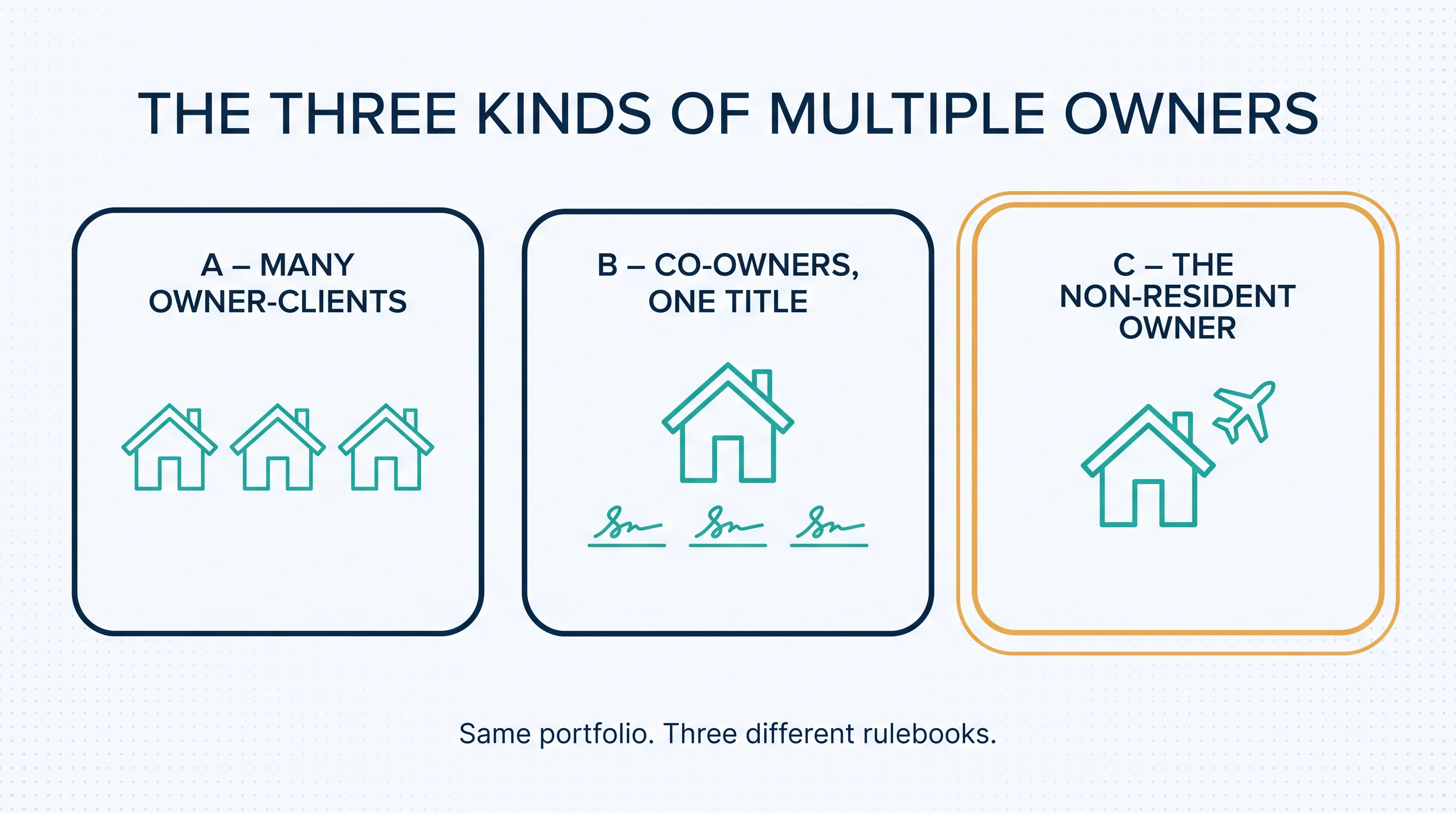
Now the distinction this article is built on, because "managing multiple owners" hides three different relationships that get blurred constantly. First: many owner-clients — twenty separate people, each with their own money, their own statements, and their own file. Second: multiple co-owners of one property — three names on one title, which raises a question most management agreements never answer: who instructs you? Third: the owner the Income Tax Act treats differently — the non-resident, for whom you're not just a manager but a withholding agent. Same portfolio, three different rulebooks.
One principle runs under all three, so let's state it once: it's their money and their asset, running on your systems — nothing mixes, and everything is written down. Every section that follows is that sentence applied.
Part A: The ledger craft — one owner, one ledger, never negative
Anatomy of a per-owner ledger
Every owner gets a ledger, and every dollar that touches your trust account lands on exactly one of them. Money in: rent collected for that owner's properties, and any funds the owner contributes for upcoming work. Money out: repairs on that owner's properties, distributions to that owner, and — for non-resident owners — tax remittances. Then two disciplines that separate professional books from a shoebox. The fee sweep: your earned management fees move out of the trust account to your operating account on a schedule, because in licensed provinces, earned fees left sitting in trust are themselves a quiet form of commingling. And the reserve floor: the management agreement sets a minimum balance each owner maintains — typically enough to cover a routine repair — so ordinary maintenance never has to wait for an e-transfer.
The rule with teeth: never negative
Here is the multi-owner rule that regulators in licensed jurisdictions treat as the canonical red flag: one client's funds never cover another client's expense — and a negative owner ledger means exactly that is happening. If Owner A's ledger sits at zero and you pay A's $3,000 furnace repair out of the trust account anyway, the money physically came from somewhere: it came from every other owner whose funds share that account. Nothing was stolen, nobody meant harm — and in a licensed province, an auditor reading that ledger sees client money converted to another client's use. A composite example of how it happens innocently: a February furnace failure, a tenant with no heat, an owner unreachable overnight, a coordinator who did the humane thing and dispatched. The fix isn't slower emergency response — it's reserve floors sized so the humane thing is also the compliant thing, plus written pre-authorization thresholds so the dispatch decision was made by the owner months ago.
Three-way reconciliation: the third leg
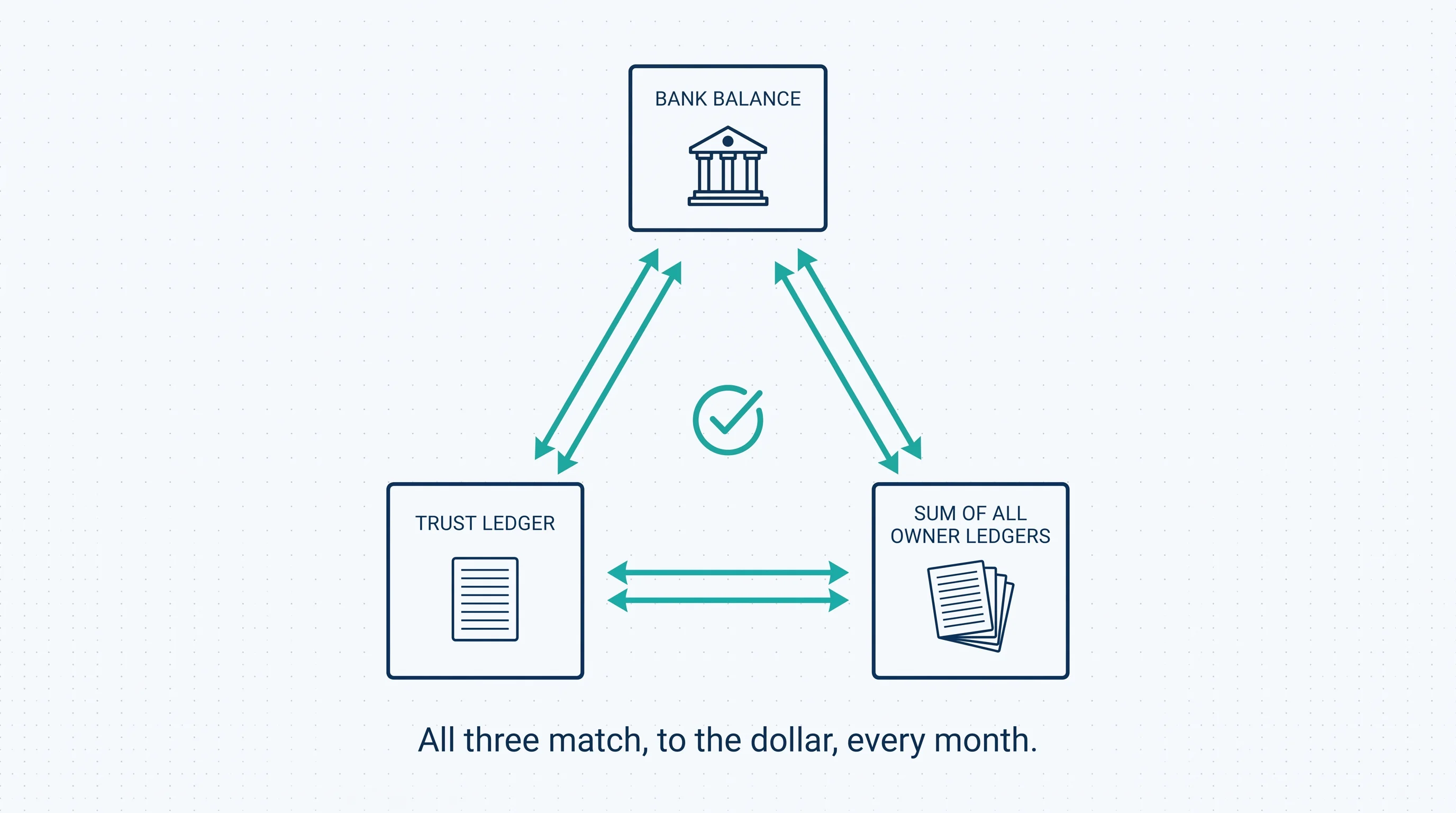
Ordinary bookkeeping matches two numbers: what the bank says and what your books say. Multi-owner custody adds a third, and the third is the whole point: the bank balance, the trust ledger, and the sum of every individual owner ledger must all match — to the dollar, every month. That third leg is what proves the pooled account is really twenty separate piles of money and not one blurred one. When the three numbers disagree by even a small amount, something is misposted somewhere, and it gets found before month-end closes — not explained away. Where your firm is licensed, trust accounting rules with real audit teeth govern this: BCFSA in British Columbia, RECA in Alberta, and RECO's trust rules for Ontario registrants — our Ontario trust accounting deep-dive is next in this series. Where you're not licensed, the management agreement should make the same discipline contractual, because the logic doesn't change with the licence.
The month-end pipeline, in order
Reconcile, then distribute, then statement — always in that order. Distributing owner funds before the three-way reconciliation closes means sending money you haven't proven is theirs; statements before distributions means reporting balances that are about to be wrong. Most firms complete the full cycle within an agreed window of month-end — roughly ten business days is typical practice in 2026 — and the specific promise matters less than keeping it every single month.
Statement design: line items or the rollup
There are two legitimate ways to present the same clean books. Property-based statements give an owner a line-item picture of each individual asset — right for the owner with one rental who wants to see every invoice. Portfolio-based statements consolidate an owner's ten properties into one rolled-up view with per-property detail available underneath — right for the investor who thinks in totals. Neither is more compliant than the other; it's a presentation choice made per owner, on the same underlying ledgers. Then operationalize the reporting promise: statements land the same day every month, anything over the agreed dollar threshold gets flagged to the owner within one business day, and every owner gets one annual review conversation. Owners rarely leave over returns; they leave over surprises.
Where Tenon10 fits: Tenon10 is a Canadian-first platform that keeps rent collection, maintenance tracking, and owner-ready records in one place — every transaction tied to the right property from the day it happens, with Ontario compliance (guideline math, notices, LTB forms) automated in-product today. See plans
Part B: Co-owners on one title — one voice, in writing
The second kind of "multiple owners" is quieter and closer to home: one property, several names on title. Spouses, siblings who inherited together, two friends who bought a rental as partners. At intake, collect every registered owner's name and let their lawyer's paperwork say how title is held — that's their fact to establish, not yours. Your job is narrower and more urgent: know exactly who signs the management agreement (usually everyone on title) and who instructs you day to day (which should be one person, chosen by them, in writing).
The one-voice clause
Here's the question that exposes the gap: the furnace dies and the repair is $6,000. Three people are on title. One of them calls and says go ahead. Do you? Without a written answer, you're guessing — and if the other two didn't agree, you may have just paid for work nobody authorized, with the invoice and the argument landing on your desk. The one-voice clause closes the gap before it opens: the co-owners jointly designate, in writing, a single instructing owner; the agreement sets spend thresholds above which written confirmation is required; distributions are split exactly per their written direction; and any change to any of it is signed by all owners, not phoned in by one. Statements go to all owners, or to whoever their joint written direction names — never through a side channel to just one.
When co-owners disagree
Sometimes the names on title stop agreeing with each other — a divorce, an estate, an investment partnership winding down. Your professional posture in every one of those situations is the same: procedural neutrality. Follow the written agreement exactly. Invite joint written instructions when the existing ones no longer fit. Never referee, never carry messages, never pick the reasonable-sounding side — the moment you do, you've become a participant in someone else's dispute. And if instructions genuinely conflict and can't be reconciled, the agreement's own terms govern: a holding pattern on non-essential spending, funds held until joint direction arrives, or the termination clause. Handled this way, the process itself is the kindness — everyone is treated identically, and nobody can say the manager took sides.
Part C: The non-resident trap — you are the withholding agent

And now the owner category that can cost your firm its own money. The trigger is simpler than most firms realize, which is exactly why it gets missed: tax residency is an intake question, not an assumption. "Where are you a tax resident?" belongs on every owner intake form — and it gets asked again whenever an owner's mailing address, banking, or payment destination moves outside Canada, because owners relocate abroad mid-management all the time and rarely think to tell you what it means. Two clarifications that prevent most of the confusion: residency is a facts test, not a citizenship test — a Canadian citizen living in Dubai can be a non-resident, and a foreign citizen living in Winnipeg can be a resident. And when the answer is genuinely uncertain, many agents withhold from the moment of doubt until status is confirmed — a CRA residency determination process exists, and it's the owner's accountant's territory. Which is the first place this article will say it, and not the last: the specifics of any owner's situation belong with a cross-border CPA.
The default rule: 25 per cent of gross, by the 15th
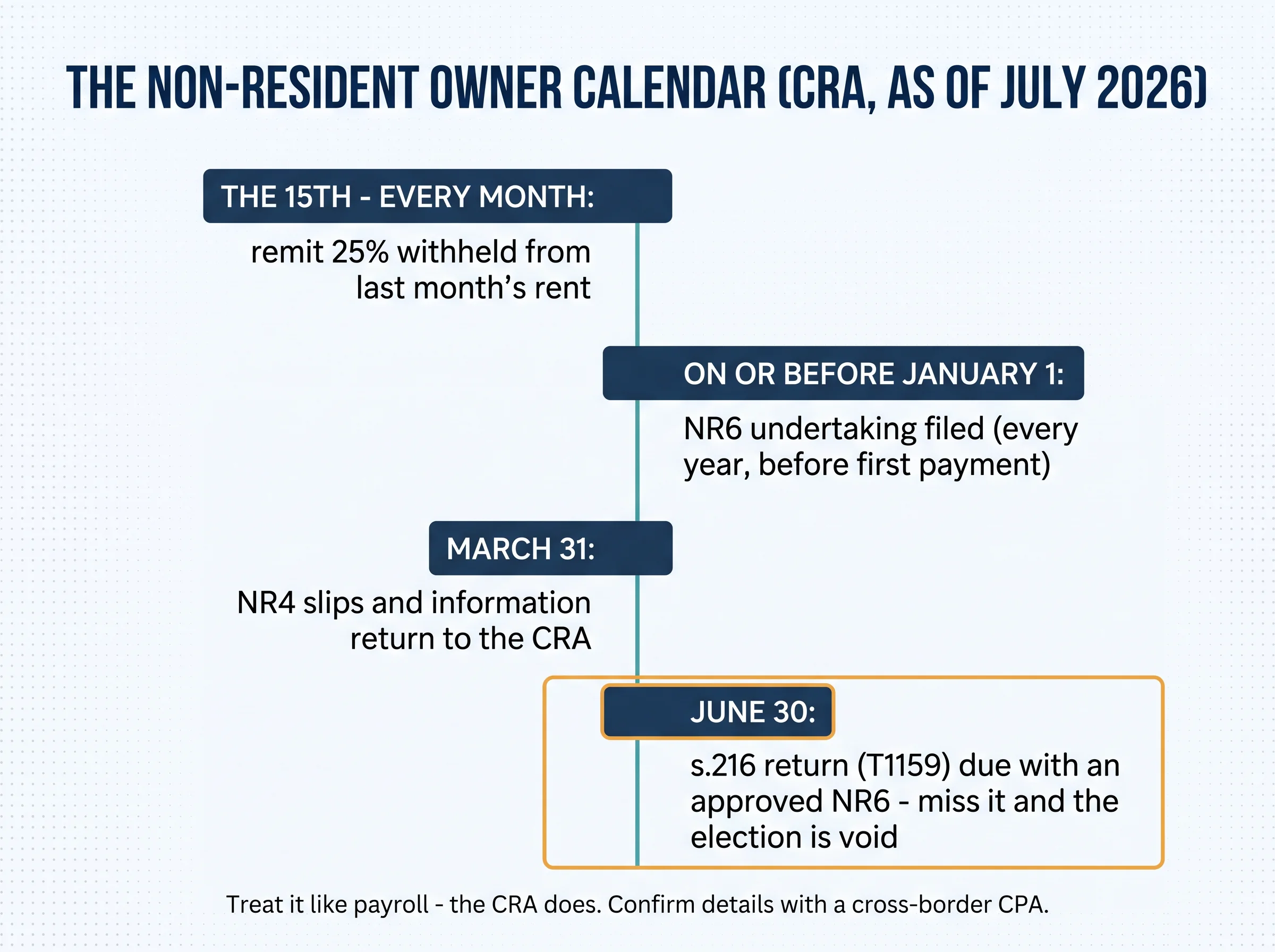
The CRA's own guidance names your role directly: the payer or agent — "such as the property manager" — must withhold non-resident tax of 25 per cent of the gross rental income paid or credited to a non-resident owner (CRA, current as of July 2026). Gross means gross: before the mortgage, before property taxes, before repairs, before your own management fee. The withheld amount must be remitted by the 15th day of the month after the month the rent was paid or credited, through your firm's own CRA non-resident tax account — which you open before the first remittance is due, not after. Miss a remittance and compound daily interest runs from the miss, with penalties possible on top. To make it concrete with our own illustrative numbers: on a $2,000-a-month rental, that's $500 withheld and remitted every single month — $6,000 a year off the top of the owner's cash flow, which is precisely why the relief path below exists.
The paper: NR4 slips and the March 31 return
Withholding is half the job; proving it is the other half. Each year the agent gives the owner two copies of the NR4 slip — think of it as the T4 of non-resident rental income, showing gross rent paid and tax withheld — and files the NR4 information return with the CRA by March 31 of the following year (CRA Guide T4061). One detail that trips up spreadsheets and software alike: when an NR6 is in place and you've been withholding on net all year, the NR4 slip still reports the gross rent for the whole year, under exemption code H. Get that wrong and the owner's return won't tie to the slip.
The NR6 path — and the June 30 trap inside it
Withholding a quarter of gross rent is punishing for owners with mortgages, which is why the Income Tax Act offers a joint undertaking called the NR6: the non-resident owner and their Canadian agent — you — file it together, each year, on or before January 1 or before the first rental payment of the year is due, and once the CRA approves it, you may withhold 25 per cent of estimated net rental income instead of gross. On a thin-cash-flow property that can shrink the monthly withholding dramatically. But the NR6 is a loan of trust with a hook in it: with an approved NR6, the owner's section 216 return (Form T1159) becomes mandatory, due June 30 of the following year — and if that deadline is missed, the election is void. The CRA can reassess at 25 per cent of the year's gross rent with no deductions, plus interest — after a full year of withholding on net. Picture the composite that plays out every year somewhere: NR6 approved, twelve tidy months of small remittances, a busy owner, a return filed in August — and a reassessment that treats the year as if the election never existed. The deadline is the election. One more myth to retire while we're here: the Canada–US tax treaty does not reduce the 25 per cent withholding on rental income — the section 216 election is the relief path, and whether it fits any particular owner is a question for their cross-border CPA, not their property manager.
Subsection 215(6): why this is your problem
Everything above would be the owner's problem except for one subsection. Under ss.215(6) of the Income Tax Act, the agent who fails to withhold is personally liable — jointly with the owner — for the tax, plus interest and penalties. Field guidance from cross-border practitioners puts it plainly: the CRA does not care if the property owner told you not to withhold; the legal obligation sits on the person making the payment. There is recent Tax Court treatment of payer liability on exactly this ground (3792391 Canada Inc. v. The King, 2023 TCC 37). Keep every withholding record, calculation, and remittance confirmation for six years — the file is what stands between an inquiry and an assessment.
One inheritance scenario deserves its own line, because it's where careful firms get caught by other people's history: taking over a portfolio mid-year. If the previous manager was withholding for a non-resident owner — or should have been and wasn't — you want that history in writing before you assume the books are clean. Ask for the remittance confirmations and the NR4 filing history as part of the handover, and if they can't be produced, say so to the owner in writing and start your own file clean from your first collected dollar. What happened before your appointment is not yours to fix; what happens after it is entirely yours to answer for.
Your service level, in writing
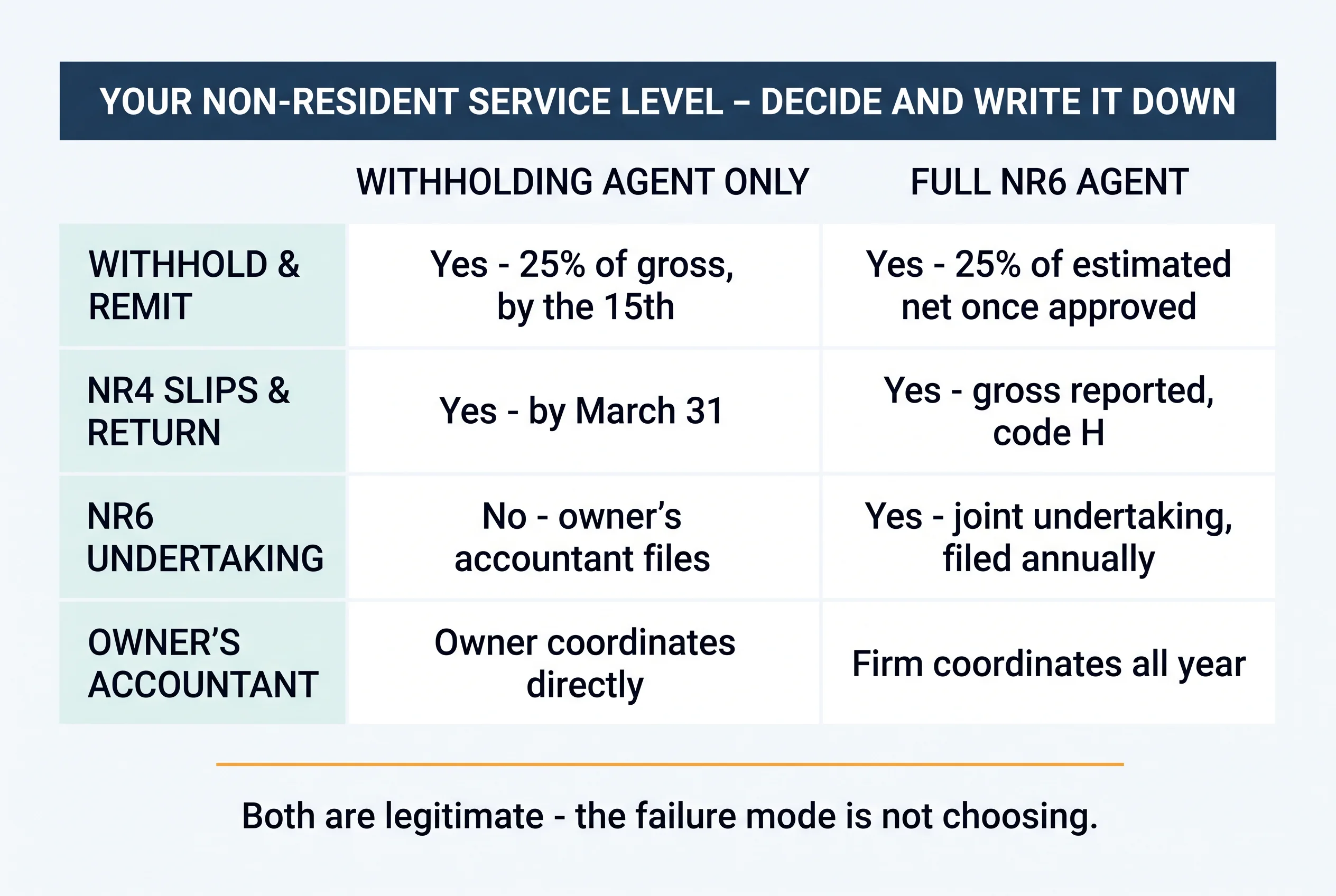
Real firms split into two legitimate camps here, and the split itself is instructive. Some firms act as withholding agents only: they withhold, remit by the 15th, and issue the NR4 slips and return — while the NR6 undertaking and section 216 filing stay with the owner's accountant. Other firms act as full NR6 agents: they co-sign the annual undertaking, manage the net-withholding calculation, and coordinate with the owner's accountant all year. Both designs work. The failure mode is the firm that never chose — that withholds sometimes, assumed the accountant was handling the slips, and discovers at sale time which pieces nobody owned. Because that's where unmanaged files surface: when a non-resident sells Canadian property, the disposition has its own certificate-and-withholding regime, the paperwork asks about rental withholding history, and unfiled years come out of the walls with interest reaching back (a pattern cross-border practitioners describe seeing regularly in 2026). In that story, the property manager who withheld properly, remitted on time, and kept six years of records is the hero — and the one who "left tax to the owner" without writing that down is a co-defendant. Decide which firm you are, and put it in the management agreement.
Putting it together: the multi-owner operating rhythm
Zoom out and the whole discipline fits on one page. The month: reconcile the three ways, distribute, statement — with non-resident remittances hitting the CRA by the 15th. The year: NR6 season closes before January 1; NR4 slips and the return go by March 31; the June 30 watch gets diarized with reminders to the owner and their accountant; and annual owner reviews are staggered across the calendar so they actually happen. The file: every owner's folder holds the signed agreement, the one-voice designation if the title has multiple names, the documented service level if the owner is a non-resident, and the residency answer itself — dated, because answers change.
One trend note, recorded July 16, 2026: CMHC's mid-year picture suggests supply-heavy major markets keep owners vacancy-nervous into 2027, which keeps reporting quality at the centre of retention. And cross-border practitioners report more non-resident ownership surfacing at sale time with unfiled withholding years attached — meaning the compliance-cleanup conversation is arriving at more PM desks. The firm with a written answer to "do you handle non-resident withholding?" wins those clients; the firm with a pause loses them.
Where Tenon10 fits: If your owner records live across spreadsheets and inboxes, Tenon10 keeps rent collection, maintenance costs, and owner-ready records organized per property from day one — Canadian-first, with Ontario compliance automated in-product today. Firms with larger portfolios can talk to us directly. Contact us
The Non-Resident Owner Compliance Checklist: Four Deadlines That Forgive Nothing
A 19-point checklist for property managers with non-resident owner clients — the intake questions, the monthly withholding rhythm, the CRA calendar (the 15th, January 1, March 31, June 30), and the edge cases that catch firms. Know exactly what a withholding agent does, and prove you did it.
Get Free PDF →Key takeaways
- Tax residency is an intake question — asked on every owner file, re-asked whenever an address moves abroad.
- One owner, one ledger — never negative. A negative balance means another client's money is floating the shortfall.
- Three-way reconciliation, monthly, to the dollar: bank, trust ledger, and the sum of every owner ledger.
- Reconcile → distribute → statement, in that order — never distribute unreconciled funds.
- One-voice clause on every co-owned file: one designated instructing owner, thresholds, splits, and changes in writing signed by all.
- The non-resident calendar lives in the firm calendar: the 15th monthly, NR6 before January 1, NR4 by March 31, the June 30 section 216 watch.
- Document your service level in the management agreement — withholding agent only, or full NR6 agent — because the failure mode is not choosing.
The mark says whose
Managing multiple owners is a bookkeeping discipline wearing a relationship suit. The relationships are real — but what protects them is the unglamorous machinery underneath: ledgers that never go negative, a reconciliation that balances three ways to the dollar, statements that land on the promised day, one designated voice per title, and a federal calendar treated with the seriousness of payroll. Twenty owners grazing in one operation, every file marked with exactly whose it is, nothing ever blurred. That's the whole craft. Everything else is a nicer way of saying it.
Every owner's money, tracked to the dollar
Tenon10 keeps rent, maintenance costs, and owner-ready records organized per property in one Canadian-first platform — with Ontario compliance automated in-product today. Managing a larger portfolio? Talk to us about your firm.
Free plan available • Tenants always free • Contact us for firms
Related resources
- CRA Audits of Rental Income — why six years of clean records is the whole game
- Property Management Software Ontario: What to Look For in 2026 — the tooling layer under the ledgers
- Landlord Insurance in Ontario — the other document every owner file needs current
- Becoming a Landlord in Ontario: The Complete First-Timer's Guide — for the newest owners you manage
- Vacancy Rates by Ontario City — the market data behind owner conversations
- CRA references: the non-resident rental income pages at canada.ca, Guide T4061 (NR4 withholding, remitting, and reporting), and Guide T4144 (section 216)
Frequently asked questions
Does a property manager have to withhold tax for a non-resident owner?
Yes. Under the Income Tax Act's non-resident rules, the payer or agent — the CRA's own guidance names the property manager — withholds 25 per cent of gross rental income and remits it by the 15th of the month after the rent was paid or credited. If it isn't done, subsection 215(6) makes the agent personally and jointly liable for the tax, interest, and penalties. Confirm the specifics of any owner's situation with a cross-border CPA.
What happens if the section 216 return is filed late after an NR6?
With an approved NR6, the section 216 return (Form T1159) is due by June 30 of the following year — and missing it voids the election. The CRA can reassess at 25 per cent of the year's gross rent with no deductions, plus interest, even though withholding ran on net all year. The deadline is the election.
What is three-way reconciliation in property management?
It's the monthly proof that a pooled trust account is really many separate owners' money: the bank balance, the trust ledger, and the sum of every individual owner ledger must all match exactly. The third leg — the sum of owner ledgers — is what multi-owner custody adds to ordinary bookkeeping.
Who can give instructions on a co-owned rental property?
Whoever the management agreement designates — which is why every co-owned file needs a one-voice clause: a single instructing owner chosen jointly in writing, spend thresholds, payment splits per written direction, and changes signed by all owners. Without it, any name on title may try to instruct, and the firm wears the conflict.
Does the Canada–US tax treaty reduce the 25 per cent withholding?
No — the treaty does not reduce the 25 per cent withholding on rental income from real property. The section 216 election is the relief path, and whether it makes sense for a particular owner is a question for their cross-border CPA.


