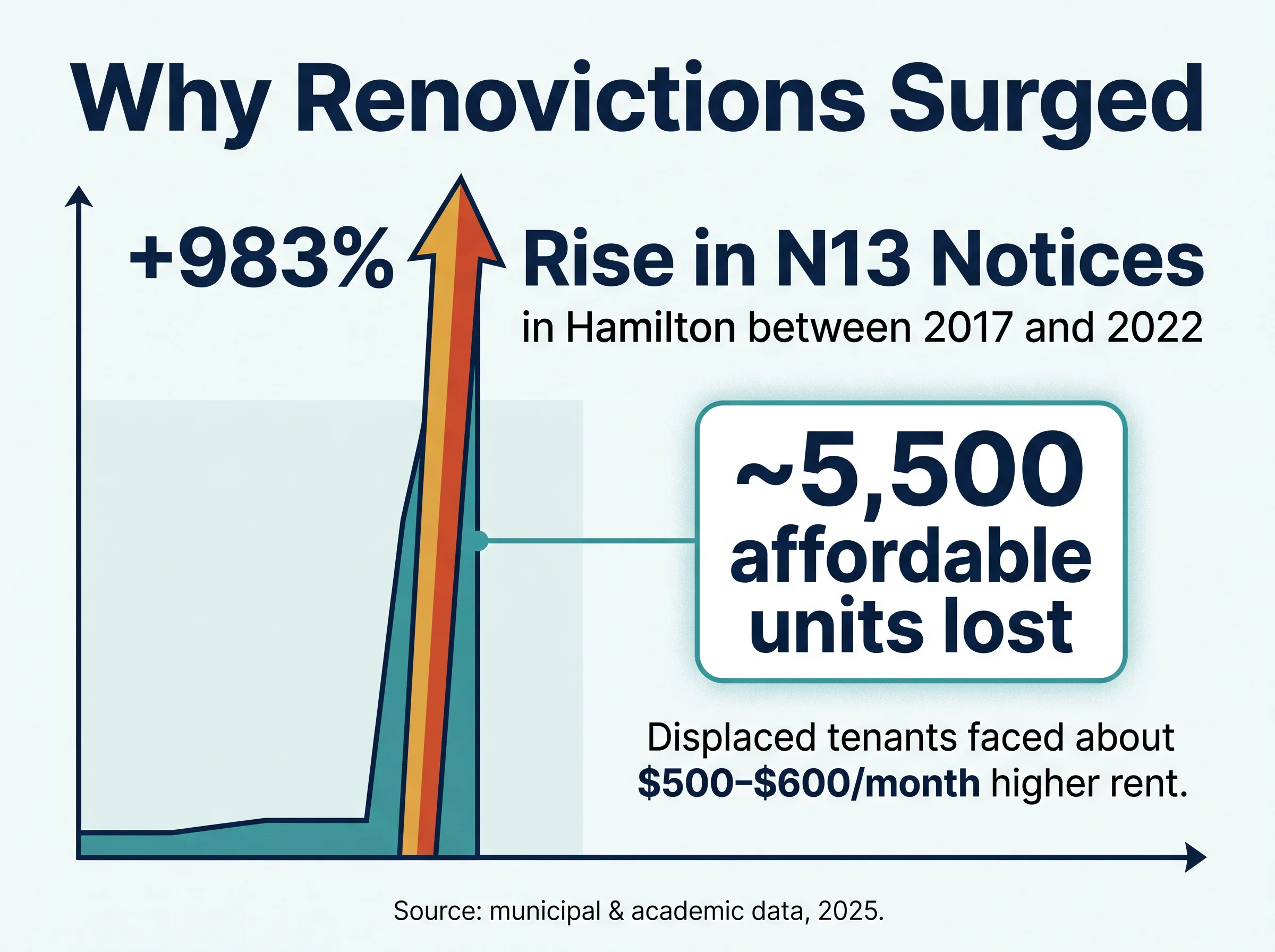
Between 2017 and 2022, one Ontario city saw N13 "renovation eviction" notices jump by a reported 983% — and thousands of affordable units vanished in the process. It's no wonder renoviction has become one of the most charged words in Ontario renting.
But the word hides a real split. Some renovations genuinely need an empty unit, and the law explicitly allows them. Others are a pretext to push out a long-term, rent-controlled tenant and re-rent at a much higher price. Landlords need to know how to do it correctly; tenants need to know their protections; and in 2026 the rules changed in two layers at once — provincial and municipal. This is a balanced, plain-language guide for everyone in the rental relationship: what a renoviction actually is, how the legitimate N13 process works, the compensation and right-to-return rules, how to tell legitimate from bad faith, and what the new 2026 licensing rules require. We'll cover it in five parts.
This is general information, not legal advice. Rules and figures change and vary by city — confirm the details with the LTB, your municipality, or a licensed paralegal, lawyer, or community legal clinic before acting.
The Renoviction Rights Checklist for Ontario Tenants
Got an N13? A free step-by-step checklist to protect your home, claim the compensation you're owed, and keep your right to return at your old rent.
Get Free PDF →What a "Renoviction" Actually Is
"Renoviction" is a blend of renovation and eviction: ending a tenancy — or pressuring a tenant to leave — on the basis of renovations, repairs, demolition, or conversion. The crucial thing to understand is that the word itself is neutral. A renoviction can be entirely legitimate, or it can be bad faith. The law's job is to tell them apart.
The legal vehicle is Form N13, under section 50 of the Residential Tenancies Act (RTA). It's the notice a landlord uses to end a tenancy in order to demolish the unit, convert it to non-residential use, or carry out repairs or renovations extensive enough to require both a building permit and vacant possession.
Why has this become such a flashpoint? The rent-control gap. With the 2026 provincial guideline set at just 2.1%, a long-time tenant may be paying well below what the unit would fetch on the open market. Clearing that tenant and re-renting can mean a large jump in income — which is exactly what tempts a bad-faith renoviction. The numbers show the strain: Hamilton reported a 983% rise in N13 notices between 2017 and 2022, tied to the loss of roughly 5,500 affordable units, and research has linked renovictions to rent increases of about $500 to $600 a month for displaced tenants.
One point of balance, stated plainly: most renovations are legitimate, and the law fully permits work that genuinely needs an empty unit. This guide is meant to help honest landlords comply and help tenants spot abuse — not to treat every renovation as a renoviction.
How the Legitimate N13 Process Works
An N13 only applies in specific situations: the landlord intends to demolish the unit, convert it to non-residential use, or do repairs or renovations so extensive that they require a building permit and vacant possession. Routine work that can be done with the tenant living there does not qualify.
When an N13 is valid, the termination date must be at least 120 days after the notice is given, and it must fall on the last day of a rental period or fixed term. But here is the single most important thing for any tenant to understand: a notice is not an eviction. An N13 by itself doesn't end your tenancy. You only have to move if the Landlord and Tenant Board (LTB) issues an eviction order after a hearing — which happens only if the landlord files an L2 application and wins it. A verbal or emailed "you have to move out for renovations" is likely a defective notice you can challenge.

The building permit matters enormously. The landlord must obtain it where the work requires one, and a missing permit — with no apparent effort to get one — is a classic red flag the LTB weighs against the landlord. So the legitimate sequence runs: serve the N13 (120-plus days), then the landlord may file an L2 (no later than 30 days after the termination date), then a hearing, then an order or a dismissal. A tenant who decides to leave sooner has an option too — they can end the tenancy early by giving 10 days' written notice on an N9.
Compensation and the Right to Return
If the N13 is for repairs or renovations (and the work wasn't ordered by a government body), the tenant is owed compensation. The amount depends on the size of the building and, for renovations, how long the work will take — commonly framed as one to three months' rent, and it must be paid before the termination date on the notice. There's one clear carve-out: no compensation is owed if a government body or another law ordered the work.
The bigger protection — and the one that defuses the whole financial motive behind bad-faith renovictions — is the right of first refusal under section 53 of the RTA. A tenant who wants their unit back after the work is finished can return at their original lawful rent, not the new market rate. That's the rule that makes a renoviction unattractive as a rent-reset tactic.
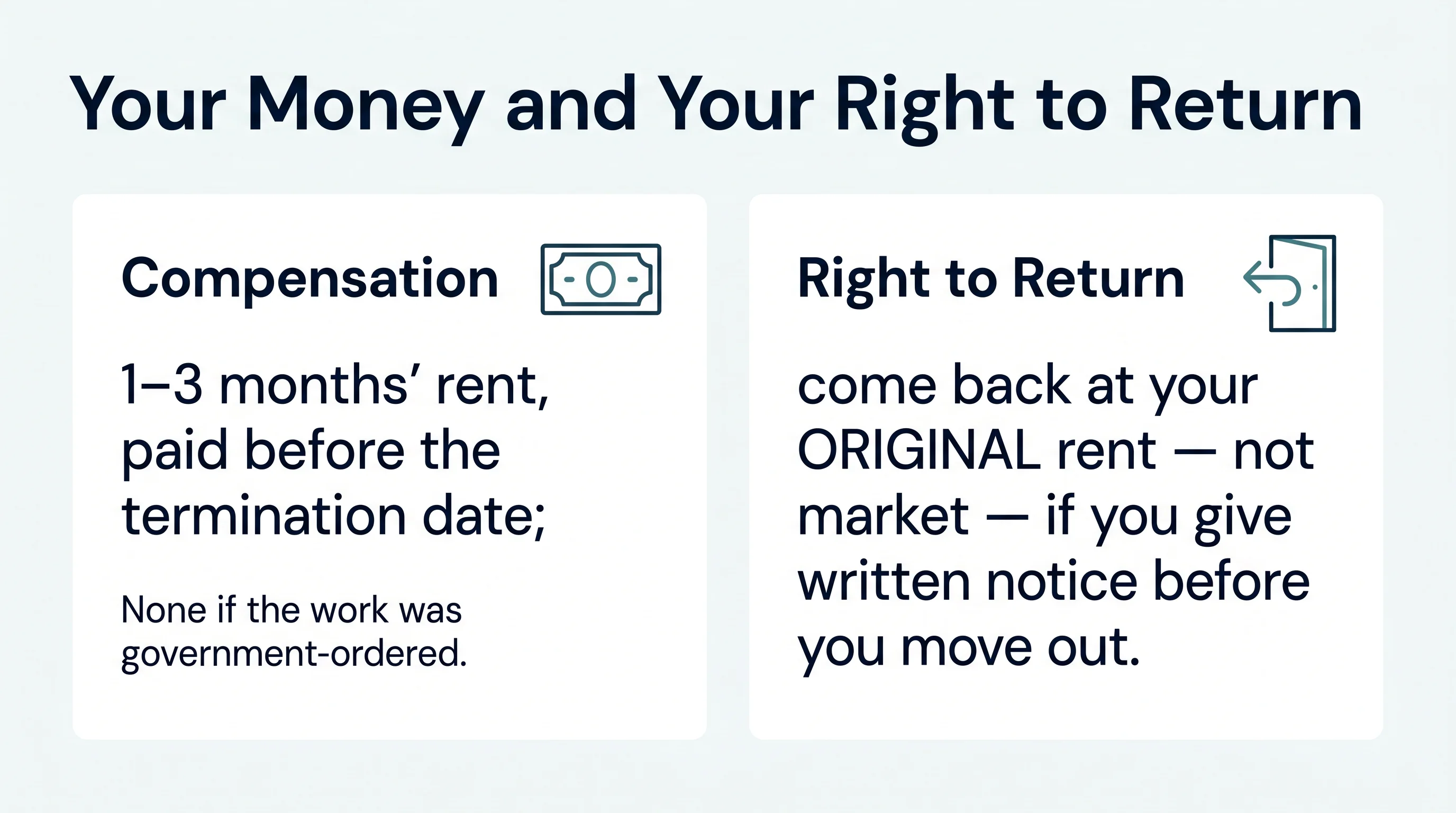
But that right comes with two duties for the tenant. To keep it, you must give the landlord written notice of your intent to return before you move out, and you must keep the landlord updated in writing of any change of address. Miss either, and you can lose the right. Picture a tenant paying $1,600 in a unit that would now rent for $2,400: that written notice is what lets them come back at $1,600 instead of $2,400 — which is precisely why honouring (or refusing) the right matters so much to both sides.
If you're weighing whether to sign anything to leave early, be careful: an N11 mutual agreement to end the tenancy is a different path, and signing one can affect what you're owed. Don't sign without advice.
Legitimate vs Bad Faith: Red Flags and Remedies
Here's the test in one line. A renoviction is legitimate when the work genuinely needs vacant possession, is permit-backed, and the compensation and right-to-return rules are honoured. It's bad faith when the "renovation" is really a smokescreen to clear the tenant and re-rent higher (or to move someone else in).
The red flags are useful to both sides — landlords should avoid them, tenants should watch for them: no building permit (or no effort to get one); pressure to sign an N11 or leave "voluntarily"; a verbal or otherwise defective notice; the unit re-listed at a much higher rent soon after; or a flat refusal to acknowledge the right to return.
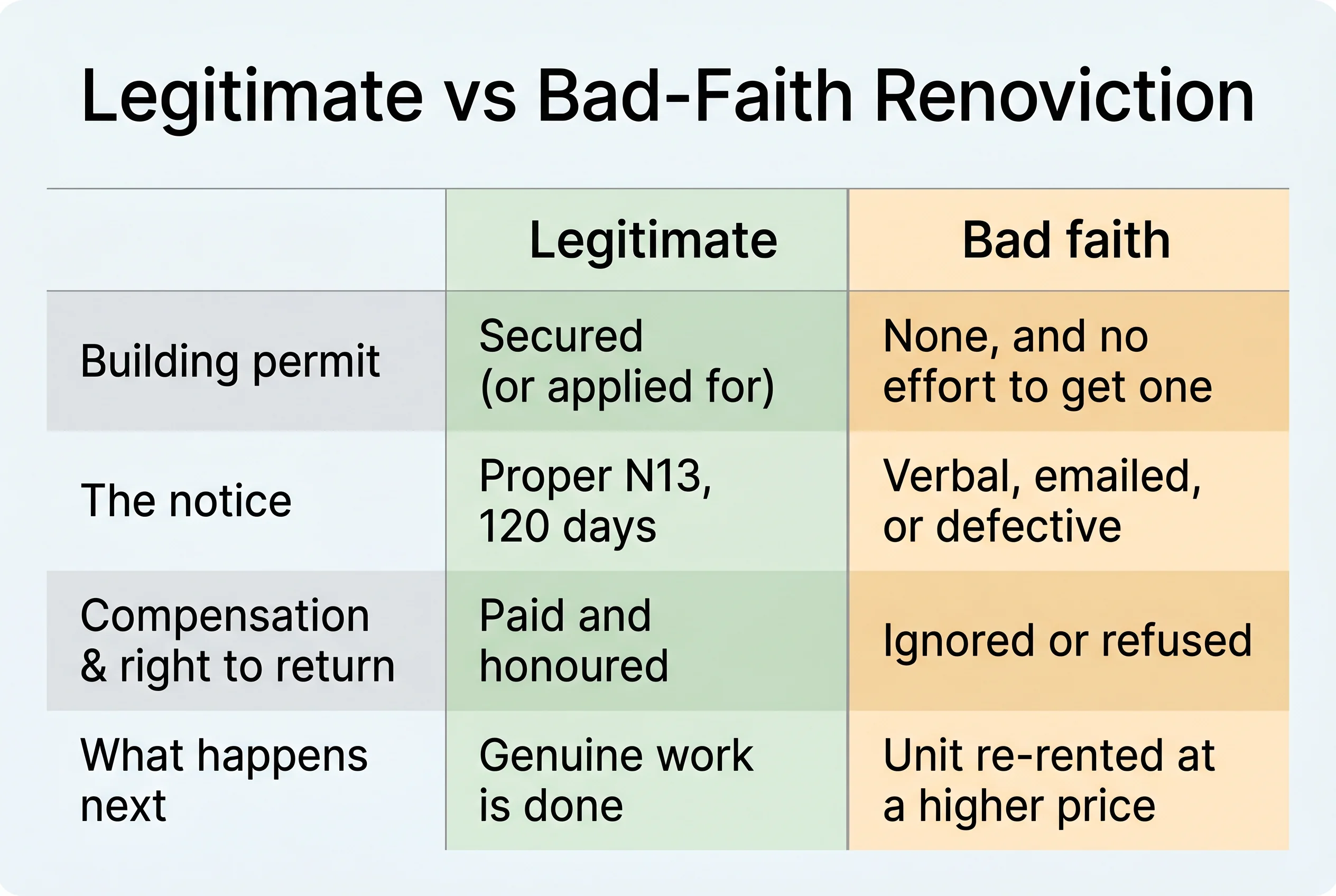
When it is bad faith, the tenant's remedy is a T5 application under section 57 of the RTA. The LTB can order real money: the rent differential between the old and new rent for up to a year, up to 12 months of the former rent, moving and storage costs, general compensation — and, if the unit hasn't already been re-rented, even repossession so the tenant can move back. Timing matters: file the T5 within the applicable window, generally one year for bad faith, and up to two years where the landlord refused the right to return after a renovation.
For tenants, two practical notes: if the work is minor or no permit exists, the LTB may simply refuse the landlord's eviction application, so it's worth attending the hearing. And many tenants have successfully pushed back — collective action and a call to a community legal clinic are documented, effective tools.
The 2026 Rulebook: Provincial Changes and Municipal Licences
The big shift in 2026 is that the rules now sit in two layers that stack on top of each other: provincial (the RTA, amended by Bills 97 and 60) and municipal (new city renovation-licence bylaws). The city rules add to the provincial ones; they don't replace them.
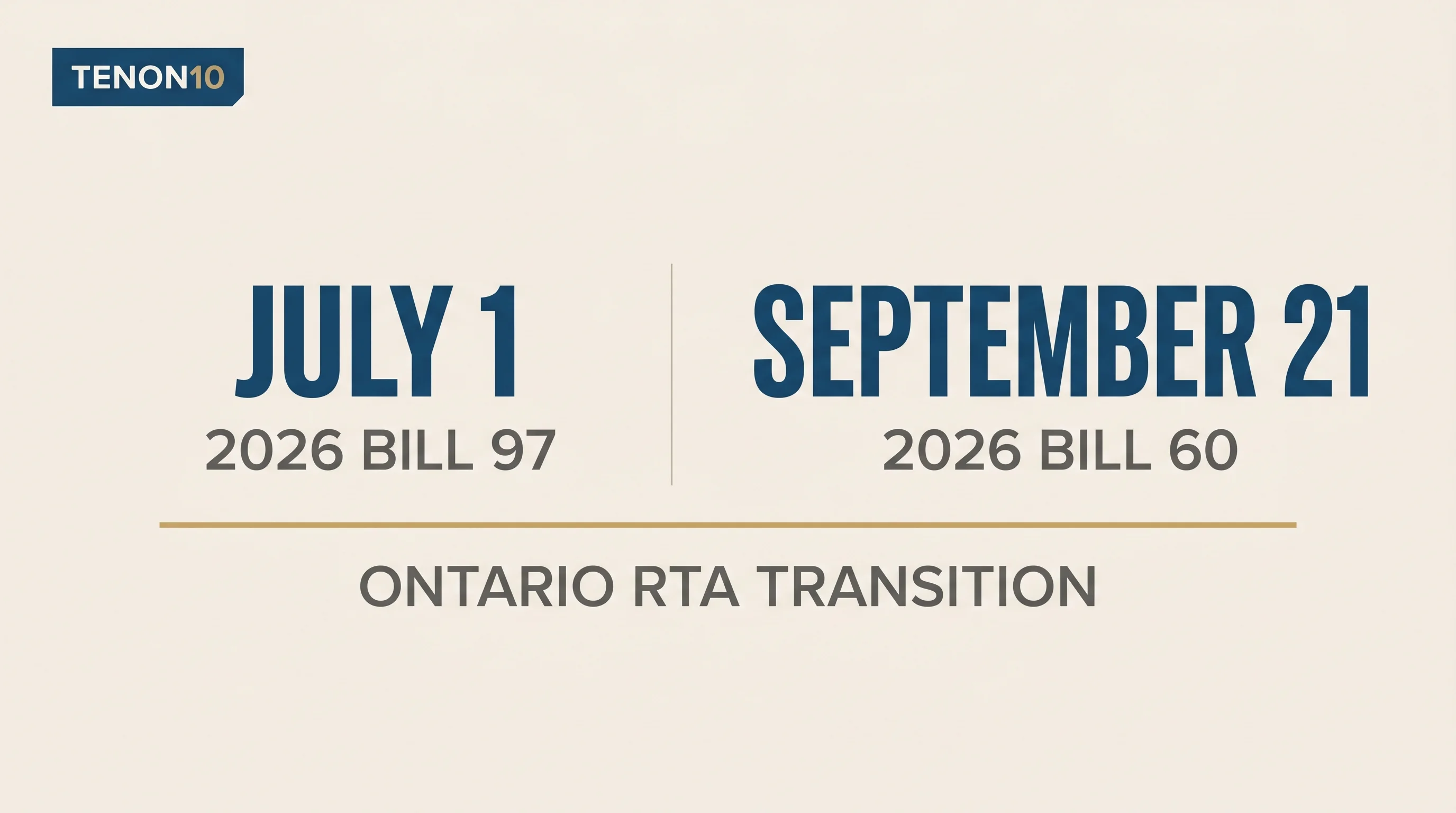
On the provincial side, it's important to separate what's in force from what's pending. Bill 97 amends RTA section 50(3) to require a report from a qualified person confirming the renovation is extensive enough to need vacant possession — but as of mid-2026 this amendment has not yet been proclaimed into force province-wide, and "qualified person" isn't yet defined in the statute. Treat it as coming, not current. Bill 60 (2025) brings broader eviction-system changes phasing in around July 1 and September 21, 2026; for N13 files the practical effect is more written-documentation discipline — tracking estimated completion dates, changes to them, re-occupancy communication, and handling the right of first refusal clearly in writing. (Our Ontario rental law changes 2026 guide tracks Bill 60 and Bill 97 in full.)
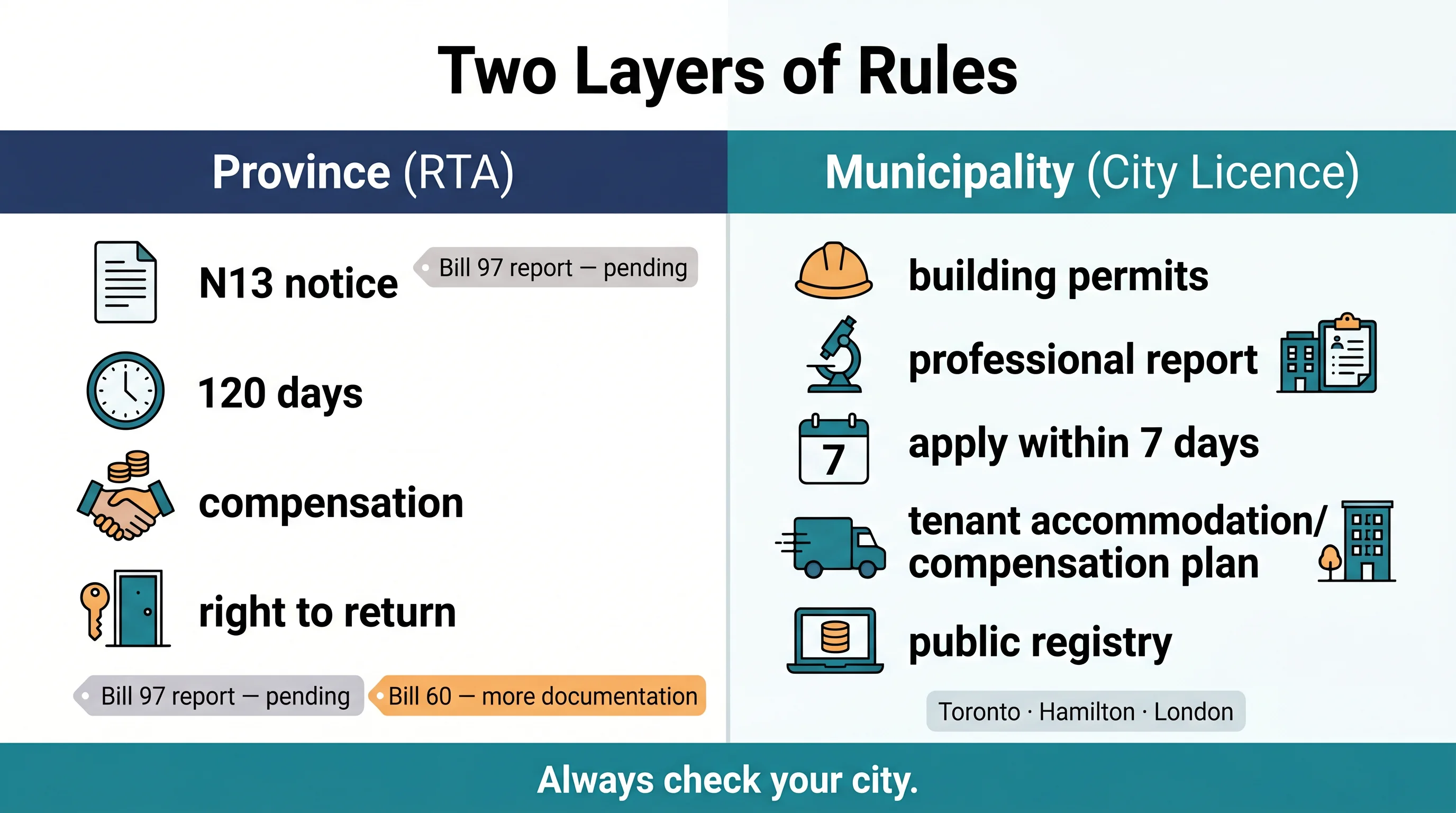
The municipal layer is where the real teeth are right now — and it's city-specific. Hamilton was first (in force January 1, 2025), followed by London (March 2025) and Toronto's Rental Renovation Licence Bylaw 53-2025 (July 31, 2025). Toronto's model is the fullest: a landlord issuing an N13 must get a City licence — building permits already secured, a qualified professional's report that vacant possession is genuinely needed, an application within 7 days of serving the N13 (with a $700-per-unit fee), a posted Tenant Information Notice, and a filed Tenant Accommodation or Compensation Plan offering temporary comparable housing or monthly rent-gap payments, plus moving allowances of $1,500 for a studio or one-bedroom and $2,500 for two or more bedrooms. A public registry lets tenants verify the licence, and penalties for fraudulent or non-compliant renovictions can reach $100,000 plus disgorgement of any financial benefit.
The Renoviction Rights Checklist for Ontario Tenants
Got an N13? A free step-by-step checklist to protect your home, claim the compensation you're owed, and keep your right to return at your old rent.
Get Free PDF →Key Takeaways
The right move depends on which side of the renoviction you're on.
If you're a tenant:
- Don't move out on a notice alone — you only leave on an LTB order after a hearing.
- Get the plan in writing (scope, why vacancy is needed, timeline), and check the building permit and, in licensed cities, the public licence registry.
- Give written notice of your intent to return before vacating, and keep your address updated in writing.
- Collect the compensation you're owed, and don't sign an N11 without legal advice.
- If it's bad faith or your return is refused, file a T5 within the window and contact a community legal clinic.
If you're a landlord or property manager:
- Confirm the work truly needs a permit and vacant possession; secure permits and a professional's report.
- Serve a proper N13 (120-plus days, period or term end); in licensed cities, get the renovation licence within 7 days and file the tenant plan.
- Pay compensation before the termination date (unless the work was government-ordered).
- Honour the right of first refusal at the original rent, keep a written timeline, and disclose past no-fault notices.
The quick win, on both sides, is getting the paperwork and permits right before anything is served. The long-term play is clean documentation and good-faith practices that hold up at a hearing. For the official details, see the LTB's N13 form and Interpretation Guideline 12, ontario.ca's tenant-rights pages, and your municipality's renovation-licence page and registry.
Conclusion
"Renoviction" isn't automatically illegal — it's the abuse of a process that's otherwise legitimate. The law lets a landlord reclaim a unit for genuinely extensive, permit-backed work that needs vacant possession, while protecting tenants with compensation, a right to return at their old rent, and T5 remedies when the process is abused. In 2026, municipal licences in Toronto, Hamilton, and London add real enforcement on top of the provincial rules.
The reassuring truth cuts both ways: landlords who follow the steps can renovate with confidence, and tenants who know their rights can't be pushed out by a notice alone. Work out which side you're on, follow the matching checklist, confirm your municipality's rules, and get advice before you act.
Reminder: this is general information, not legal advice. For your situation, consult a licensed paralegal, lawyer, or community legal clinic.
Renovations done right, on both sides
Tenon10 keeps notices, timelines, permits, compensation records, and right-of-return correspondence organized for landlords and PMs — and points tenants to the right forms and resources.
Free to start • Built for Ontario landlords and tenants
Frequently Asked Questions
Do I have to move out if I get an N13 for renovations?
No. An N13 is a notice, not an eviction. You only have to leave if the Landlord and Tenant Board issues an eviction order after a hearing — and you can challenge a defective or bad-faith notice.
How much compensation do I get for an N13 renoviction?
Generally one to three months' rent, depending on the building size and the length of the work, payable before the termination date. No compensation is owed if the work was ordered by a government body.
Can I move back in after the renovation, and at what rent?
Yes, if you give the landlord written notice of your intent to return before you move out (and keep your address updated). You return at your original lawful rent — not the new market rate.
What makes a renoviction "bad faith"?
When the renovation is a pretext to remove a tenant and re-rent higher — for example, no building permit, a verbal or defective notice, or the unit re-listed at a much higher rent soon after. Tenants can file a T5 for remedies including compensation and even repossession.
Do landlords need a special licence to renovict in 2026?
In some cities, yes. Toronto, Hamilton, and London now require a municipal Rental Renovation Licence — with permits, a professional report, tenant compensation plans, and a public registry — when issuing an N13. These rules are city-specific, so always check your municipality.
Related Resources
- N13 — Notice to End your Tenancy for Demolition, Repairs or Conversion
- Ontario N12 Notices: A Complete Guide to Own-Use Tenancy Endings
- T5 — Landlord Gave a Notice of Termination in Bad Faith
- Ontario Rental Law Changes 2026: Bill 60 and Bill 97
- N11 Mutual Agreements: How Parties Reach Fair End-of-Tenancy Terms