

Your landlord lets themselves in without notice. Or shuts off the heat in January. Or changes the locks after a dispute. In Ontario, you don't have to just live with it — the T2 application is how a tenant takes a rights violation to the Landlord and Tenant Board (LTB) and asks for a real remedy: money back, an order to stop, or in serious cases an end to the tenancy on your terms.
But the T2 is narrow and procedural. File the wrong form, miss the one-year deadline, or show up without dated evidence, and even a strong complaint gets dismissed — costing you months. The good news is that none of it is complicated once you know how the pieces fit.
This guide walks Ontario tenants through exactly how the T2 works: what it covers (and what belongs on a different form), the strict one-year window, the remedies you can ask for and how to justify them, and how to file and hold your own at the hearing. It's general information, not legal advice — for your situation, confirm with the LTB or a legal clinic.
The T2 Evidence & Remedy Checklist
Match the right form, beat the one-year deadline, and build the dated evidence that actually wins at the LTB — on one printable page.
Get Free PDF →What the T2 Covers (and What Belongs on a Different Form)
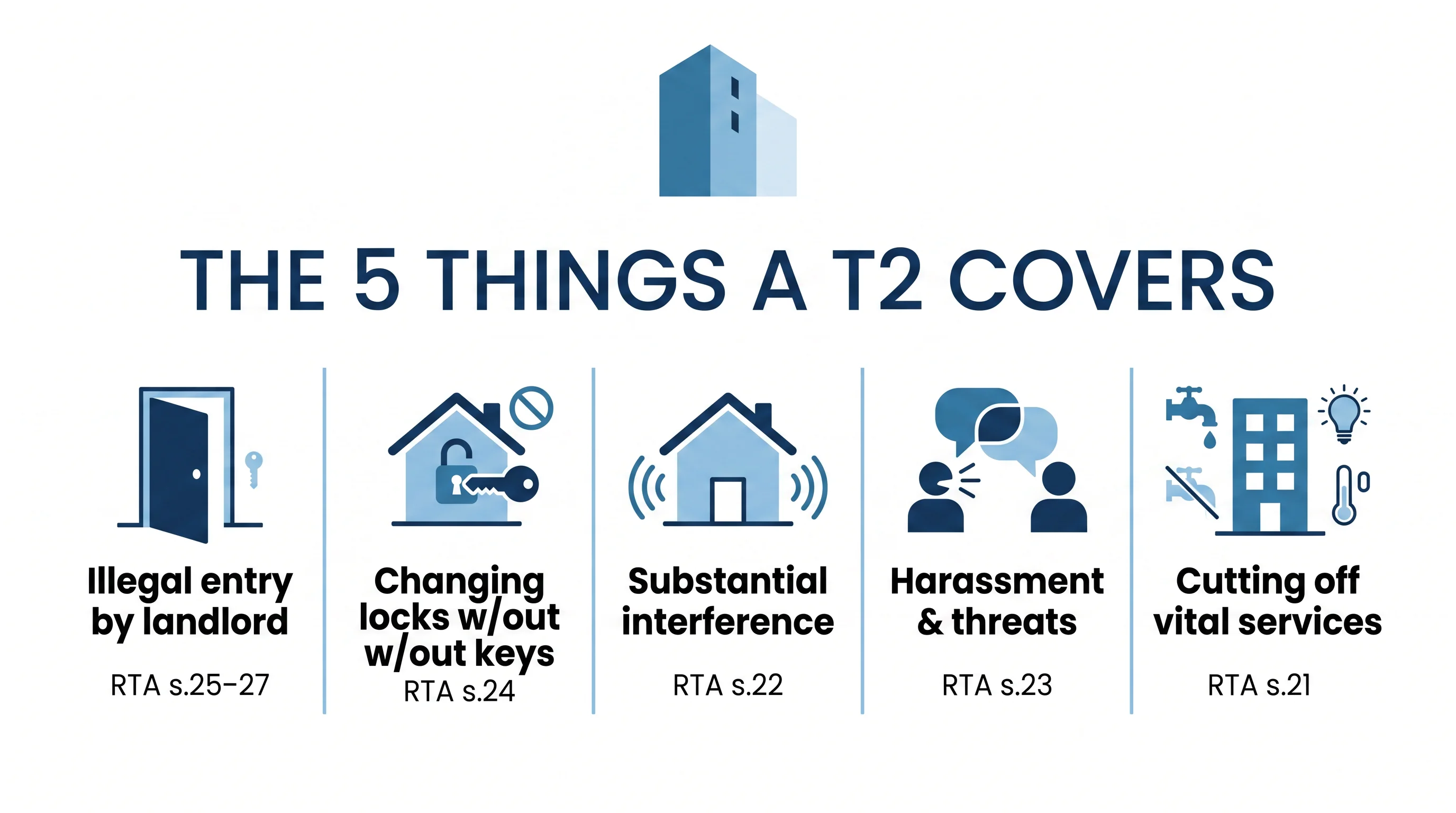
The T2 is officially the "Application about Tenant Rights." A current or former tenant can file it, asking the LTB to order remedies when the landlord, a superintendent, or an agent has violated the tenant's rights. It covers conduct — the things a landlord does to you — and it comes down to five core grounds under the Residential Tenancies Act:
- Illegal entry (s.25–27) — entering without proper 24-hour written notice, outside 8 a.m. to 8 p.m., or without an emergency, your consent, or a narrow agreed reason. Even showing the unit to a buyer needs 24-hour notice.
- Changing the locks (s.24) — altering the locking system without giving you replacement keys.
- Substantial interference with your reasonable enjoyment (s.22) — disruptive construction, or serious disturbances the landlord had a duty to address.
- Harassment, coercion, or threats (s.23) — a pattern of pressure to make you leave. One angry text usually isn't harassment; a pattern is.
- Withholding or interfering with a vital service (s.21) — deliberately cutting heat (required Sept 1–Jun 15), electricity, gas, hot or cold water, or fuel.
There's also a narrower ground: the landlord didn't let you retrieve your belongings during the 72 hours after a Sheriff-enforced eviction.
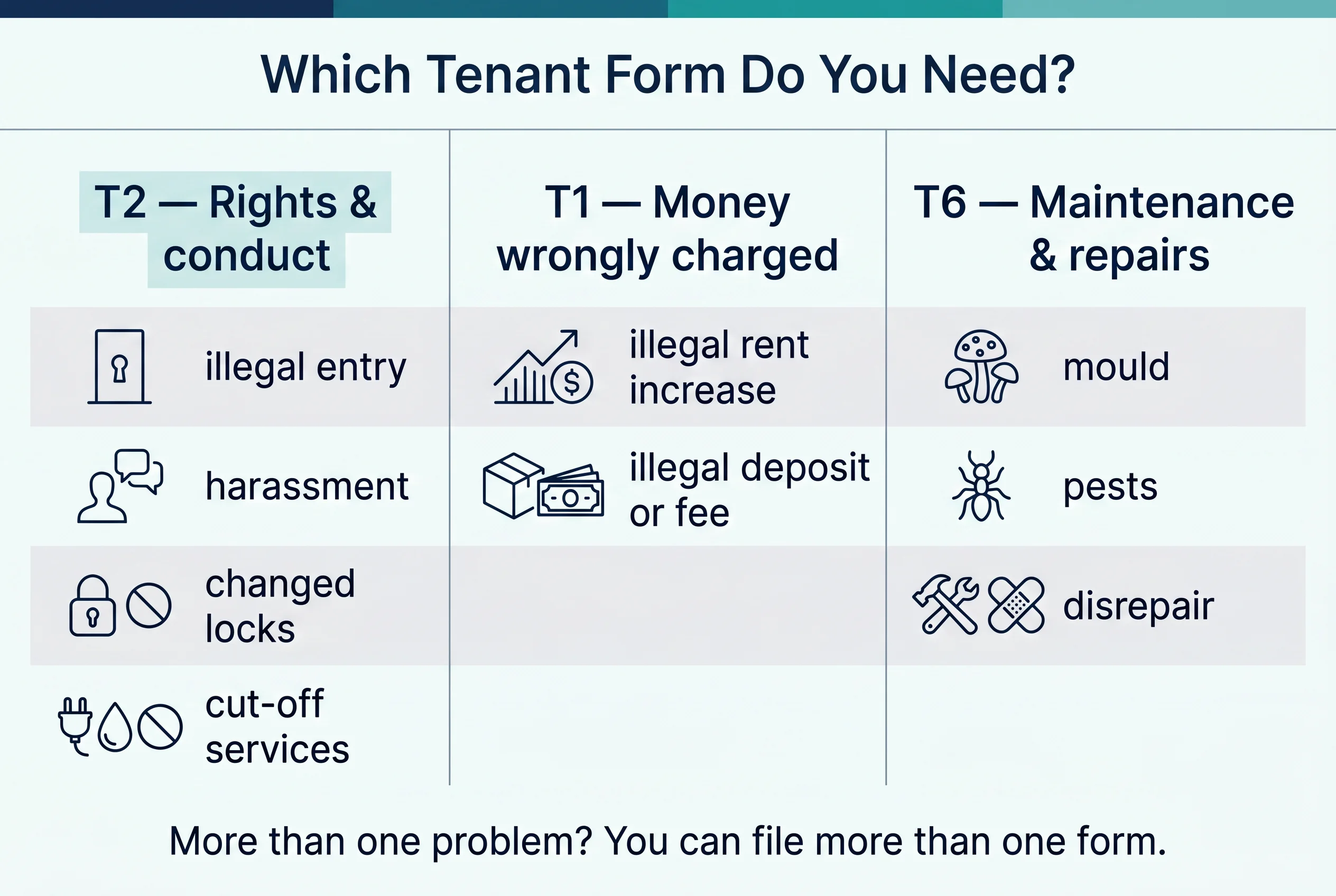
Here's the single most important thing to get right before you file — because filing the wrong form is one of the top reasons applications get dismissed. The T2 is for rights and conduct. If your problem is money the landlord wasn't entitled to — an illegal rent increase, an illegal deposit or fee — that's a T1 application, not a T2. If your problem is maintenance — mould, pests, disrepair, broken heating that's about upkeep rather than a deliberate cut-off — that's a T6. If both a rights violation and a repair problem apply, you can file a T2 and a T6 together.
One more setup point: always name the landlord as the respondent. You can also name a superintendent or agent if they were personally responsible — but the LTB can't order a remedy against someone you didn't name. If you want the broader picture of what landlords can and can't do, see our guide to 5 things your landlord can't do in Ontario.
The One-Year Deadline and the Evidence That Wins
Two things decide most T2 applications before you ever reach a hearing: whether you filed in time, and whether you can prove what happened.
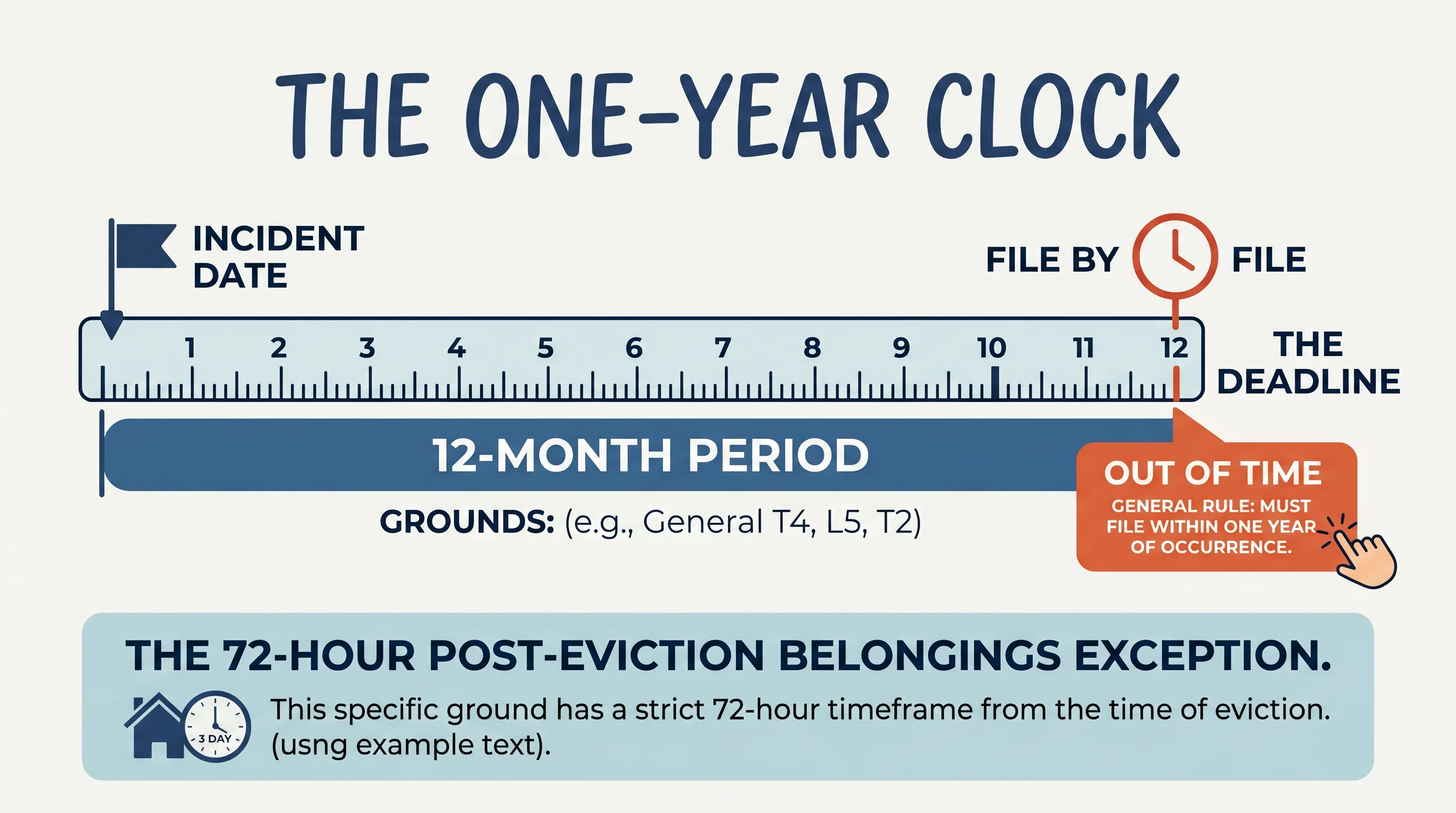
The deadline is strict. You must file within one year of the date the conduct happened. Anything older than a year is out of time — and this bites even in an ongoing situation. If a landlord has been harassing you for 18 months, you can still file, but you can only claim the incidents that fall inside the one-year window. As a concrete example: an illegal entry on March 1, 2025 has to be filed by March 1, 2026. Don't sit on it, either, because the Board itself takes time to process and schedule.
There's one narrow exception — there's no limitation period on the 72-hour post-eviction belongings ground. And if something genuinely can't wait, like a vital service cut off in the middle of winter, you can file a Request to Shorten Time to the hearing along with your T2.
Evidence is the whole game. The single strongest thing you can bring is a dated incident log — for each event, the date, the time, who was involved, and exactly what happened. Back it with photos, texts and emails, and any third-party reports (Property Standards, Public Health, the fire service). Vague applications — "everything is bad, my landlord is terrible" — get dismissed; specific, documented incidents win. If you're not sure of an exact date, say it's approximate rather than dropping the incident entirely.

And to kill a common fear: filing a T2 does not end your tenancy, and a landlord cannot lawfully evict you for asserting your rights. Retaliation for a good-faith complaint is itself a problem the Board takes seriously.
The Remedies You Can Ask For
On the T2 you choose the remedies you want by shading the boxes on the form — and you have to justify each one. Here's what's on the menu:
- Rent abatement — a percentage refund of rent for the period you were affected. There's no fixed tariff; the LTB decides on the facts, but lighter, occasional violations tend to land lower, and serious or ongoing interference higher.
- General damages — compensation for distress, inconvenience, and loss of enjoyment.
- Out-of-pocket costs — concrete money you spent because of the violation: a hotel when you were locked out, replacement groceries when a service was cut, a space heater.
- An order to stop or comply — the LTB can order the landlord to stop the conduct, restore a service, return your keys, or take down a posted notice, and the order is enforceable.
- The heavier remedies — an administrative fine (in egregious cases), and in serious situations an order ending your tenancy on your terms, plus a rent-differential payment if you're pushed into a higher-rent unit.
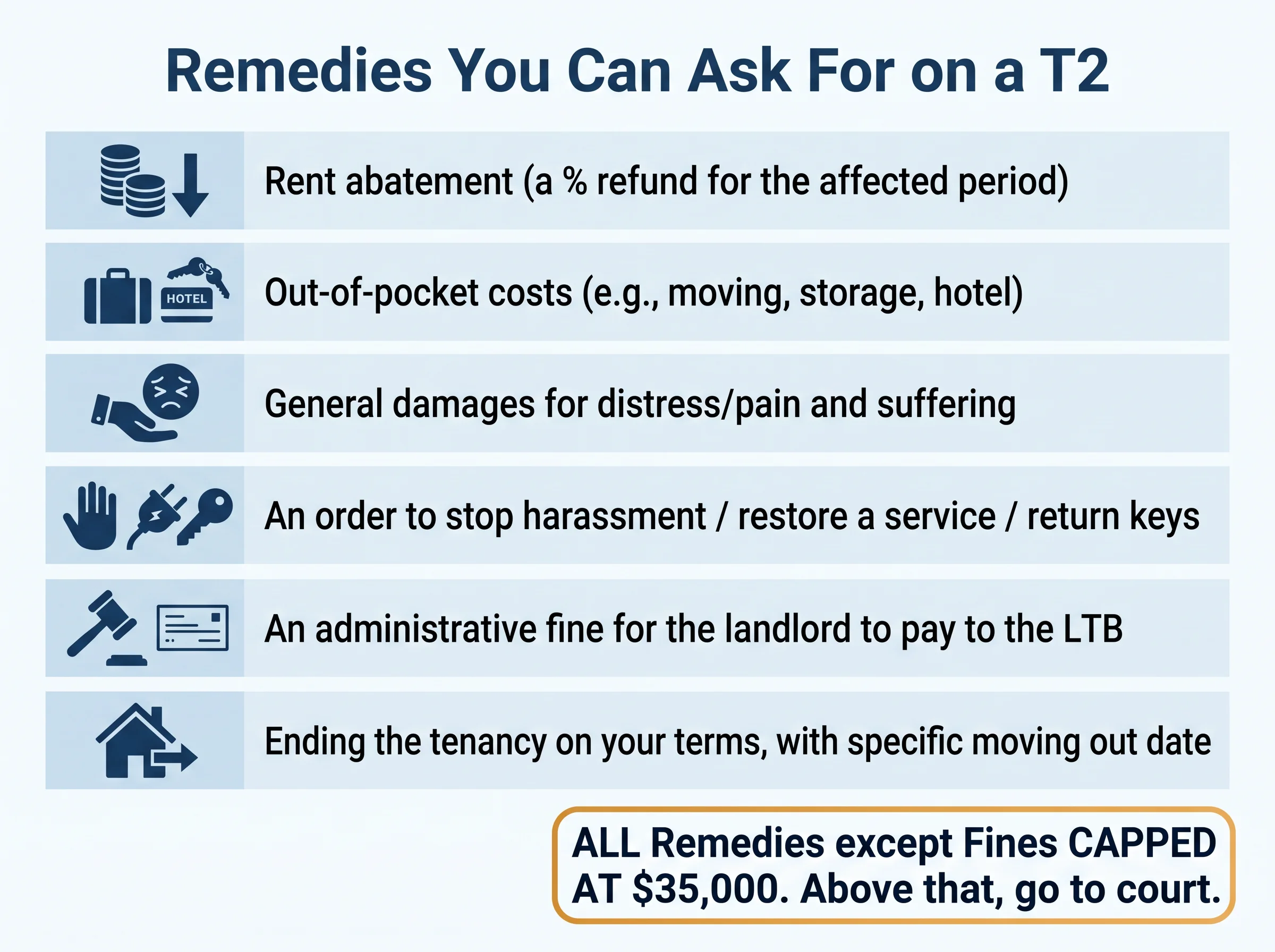
There's a ceiling: the LTB can order up to $35,000 on a T2, which is the Small Claims Court limit. If your claim is genuinely worth more than that, it goes to court instead. For most tenants that cap is well above what's at stake.
Whatever you claim, justify the number. Show your math — which months you were affected, what percentage of rent you're asking to be refunded, why it's reasonable — and attach the calculation and any receipts. A remedy backed by arithmetic and documentation is far more persuasive than a round number pulled from the air.
How to File and What to Expect
You file the T2 through the Tribunals Ontario Portal online (you can also file by mail, courier, or at some ServiceOntario counters, though those routes can be slower). The fee is $48 online or $53 by paper, and it's non-refundable whether you win or lose. If you're on a low income, you can ask for a fee waiver using Form FW.
After you file, the LTB issues a Notice of Hearing, and you must serve the landlord with the application and the notice — then keep your proof of service. Hearings are generally held by video or phone. Upload your evidence to the Portal and share it with the landlord before the hearing, following the Board's rules on timing. And plan to attend: if you don't show up, your application is automatically dismissed.
You don't need a lawyer for any of this. Many tenants represent themselves, Tenant Duty Counsel is available free the morning of your hearing, and Community Legal Clinics help low-income tenants with the whole process. Do expect a wait for the hearing date — regional backlogs vary — which is one more reason not to delay filing.
For landlords reading this: the way to never see a T2 is simple. Give proper 24-hour written notice before entering (with a reason and a time between 8 a.m. and 8 p.m.), never change the locks without handing over new keys, never cut off a vital service, and keep your communication professional — no pattern of pressure to make a tenant leave. Nearly every T2 traces back to one of those lines being crossed.
The T2 Evidence & Remedy Checklist
The whole process on one page — right form, one-year deadline, winning evidence, and your remedies up to $35,000.
Get Free PDF →Key Takeaways
Filing a strong T2 comes down to a short, repeatable process:
- Confirm it's a T2 issue — rights and conduct — not money (T1) or repairs (T6); file more than one form if more than one problem applies.
- Check the one-year window: each incident must be within a year of filing (the 72-hour ground excepted).
- Build a dated incident log — date, time, who, what — plus photos, messages, and third-party reports.
- Name the right respondents (always the landlord; a super or agent only if personally responsible).
- Pick your remedies and justify the numbers — which months, what abatement percentage, receipts for costs.
- File through the Tribunals Ontario Portal ($48 online / $53 paper); ask for a Form FW waiver if eligible.
- Serve the landlord, upload your evidence before the hearing, and attend — non-attendance means dismissal.
The quick win is to start a dated log today, even if you haven't decided whether to file. The long game is keeping every notice, message, and receipt so that if a pattern develops, it's easy to prove.
Conclusion
The T2 is how Ontario tenants enforce their rights — for illegal entry, harassment, changed locks, substantial interference, or a cut-off vital service. Winning comes down to three things: the right form, filed inside the one-year window, backed by dated evidence — and then the right remedy, justified with your own math.
You don't need a lawyer to file, and asserting your rights can't lawfully cost you your tenancy. Free help is there when you need it. If something's happening now, start a dated log today and check your one-year window — those two steps put you ahead of most applications before you've even filed.
This is general information, not legal advice. Fees, forms, and procedures can change; confirm the current details and your situation at tribunalsontario.ca or with the Landlord and Tenant Board.
Keep your evidence organized from day one
Tenon10 helps you keep a clean, dated record of notices, messages, and incidents — so if you ever need a T2, your evidence is already in one place.
Free • No signup required • Built for Ontario tenants
Frequently Asked Questions
What is a T2 application in Ontario?
It's the "Application about Tenant Rights" — the form a current or former tenant files at the LTB when a landlord, superintendent, or agent illegally enters, harasses, changes the locks, substantially interferes with reasonable enjoyment, or cuts off a vital service.
How much does it cost to file a T2?
$48 online through the Tribunals Ontario Portal, or $53 by paper. The fee isn't refunded whether you win or lose, and low-income tenants can request a waiver with Form FW.
How long do I have to file a T2?
Generally one year from the date of the conduct. Incidents older than a year are out of time — the only exception is the 72-hour post-eviction belongings ground.
What can I get from a T2?
A rent abatement, compensation for out-of-pocket costs and general damages, an order making the landlord stop the conduct or restore a service, and in serious cases an end to the tenancy on your terms — up to a $35,000 cap.
Is the T2 the right form for repairs or an illegal charge?
No. Repairs and maintenance go on a T6; money the landlord wasn't entitled to (like an illegal rent increase or deposit) goes on a T1. The T2 is for rights violations — though you can file more than one form if more than one problem applies.


