Ontario has set the 2027 rent increase guideline at 1.9% — the lowest in years, and the maximum most landlords can raise rent on a rent-controlled unit without going to the Landlord and Tenant Board. If you're planning an Ontario rent increase for 2027, that number is the easy part. Where increases quietly go wrong is the notice: the form, the timing, and the amount all have to line up, or the increase can be void.
Miss the 90-day notice, break the 12-month rule, or serve the wrong document, and the increase simply doesn't take effect — the tenant keeps paying the old rent, and if they overpaid, they can claw it back. None of that is hard to avoid once you know the rules.
This complete guide covers the 1.9% figure and how it's set, which year's number applies to which increase (the detail landlords most often get wrong), the exact N1 steps and timing — you can serve as early as October 2026 for a January 2027 increase — who's exempt, when you can go above the guideline, and the mistakes that void an increase. It's general information, not legal advice; confirm your situation at ontario.ca or with the LTB.
N1 Rent Increase Notice Checklist
Follow proper procedures for lawful rent increases in Ontario.
Get Free PDF →The 2027 Guideline: 1.9% and How It's Set
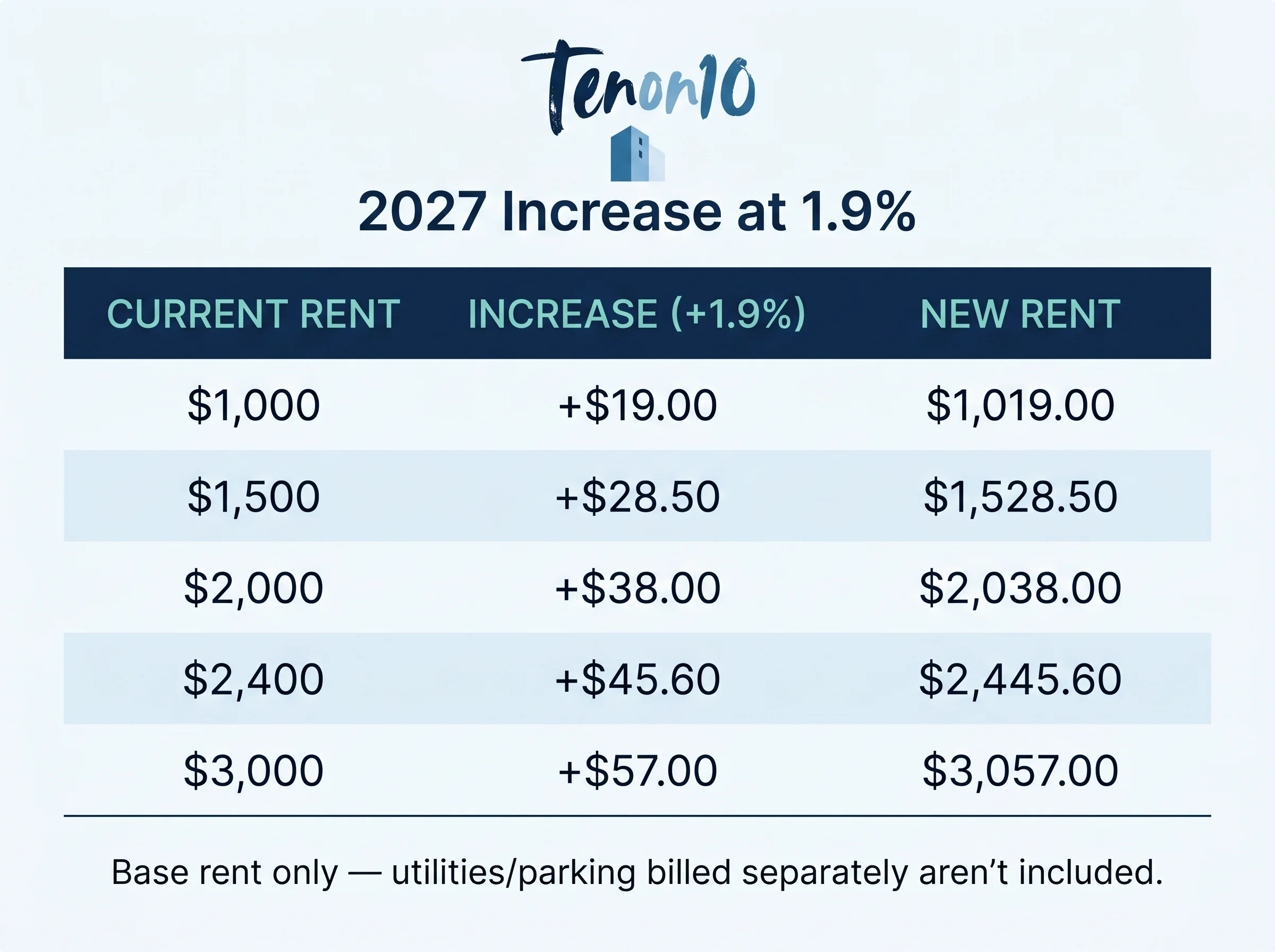
Ontario's 2027 rent increase guideline is 1.9%. That's the maximum most landlords can raise rent on a sitting tenant in a rent-controlled unit without applying to the Landlord and Tenant Board. In real numbers, using the province's own example: a $1,000 rent lawfully increased at 1.9% becomes $1,019.00 a month.
It's the lowest guideline in several years — down from 2.1% in 2026, and from 2.5% in each of 2023, 2024, and 2025. The downward trend reflects cooling Ontario inflation, because the guideline isn't set arbitrarily.
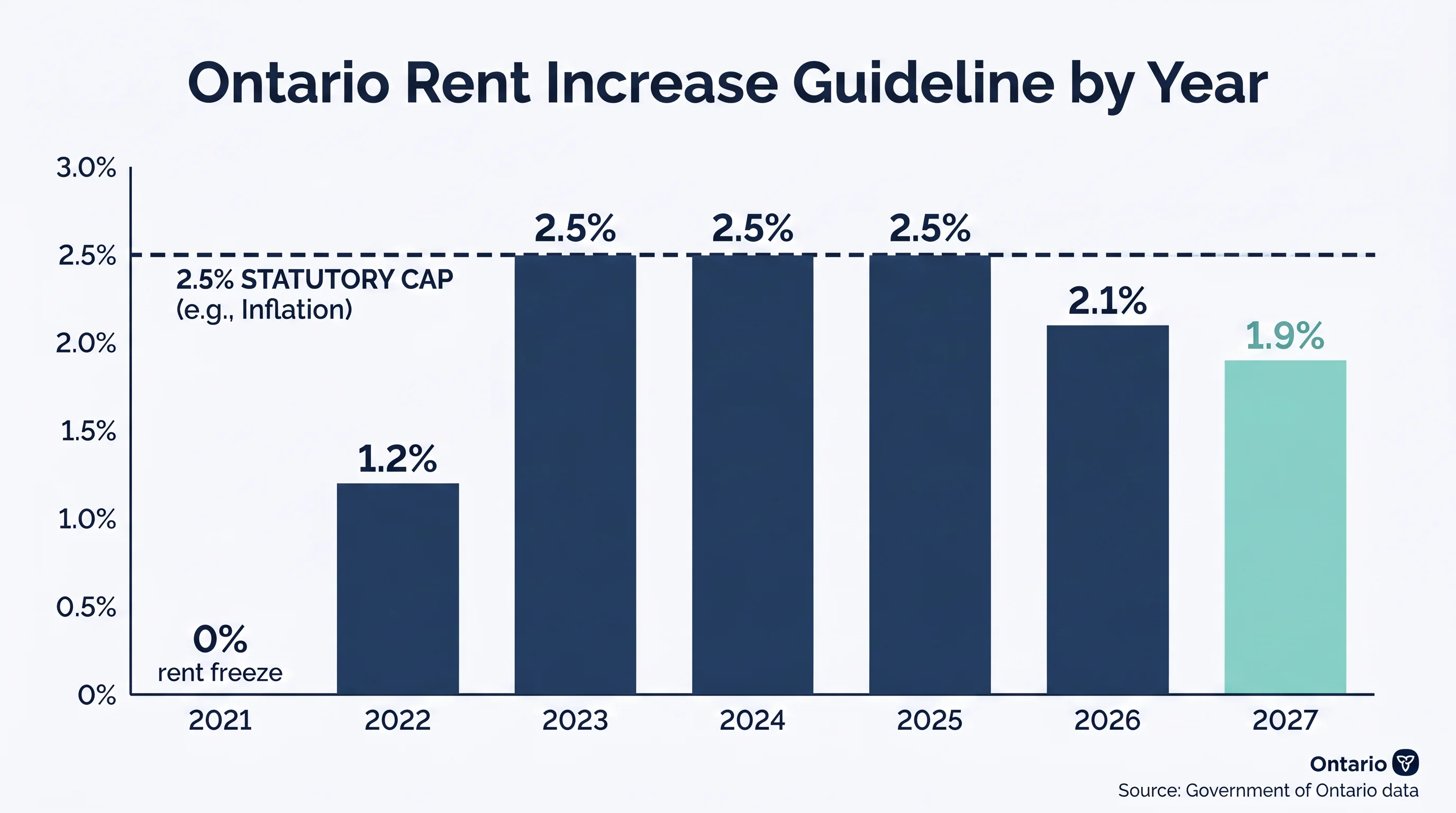
The guideline is calculated from the Ontario Consumer Price Index over a set 12-month window — June 2025 to May 2026 for the 2027 figure — and it's capped by statute at 2.5%. So even in a high-inflation year, the guideline can't exceed 2.5%; it simply stops there. The 1.9% figure applies to most private residential units under the Residential Tenancies Act — houses, apartments, basement apartments, and condos — that were first occupied on or before November 15, 2018. (Units first occupied after that date are a different story, which we'll come to.)
Which Year's Number Applies to Your Increase
This is the detail landlords get wrong most, and it's worth slowing down for. The guideline is set by the increase's effective date — the day the new rent starts — not the date you serve notice, and not the date the number was announced. So 2026's 2.1% governs any increase taking effect during calendar 2026, while 1.9% governs increases taking effect on or after January 1, 2027.
Why does this trip people up? Because a landlord serving notice in, say, November 2026 for a January 2027 increase has been using 2.1% all year — and now has to switch to 1.9%. Get the year wrong and the amount is wrong, which makes the whole notice challengeable.
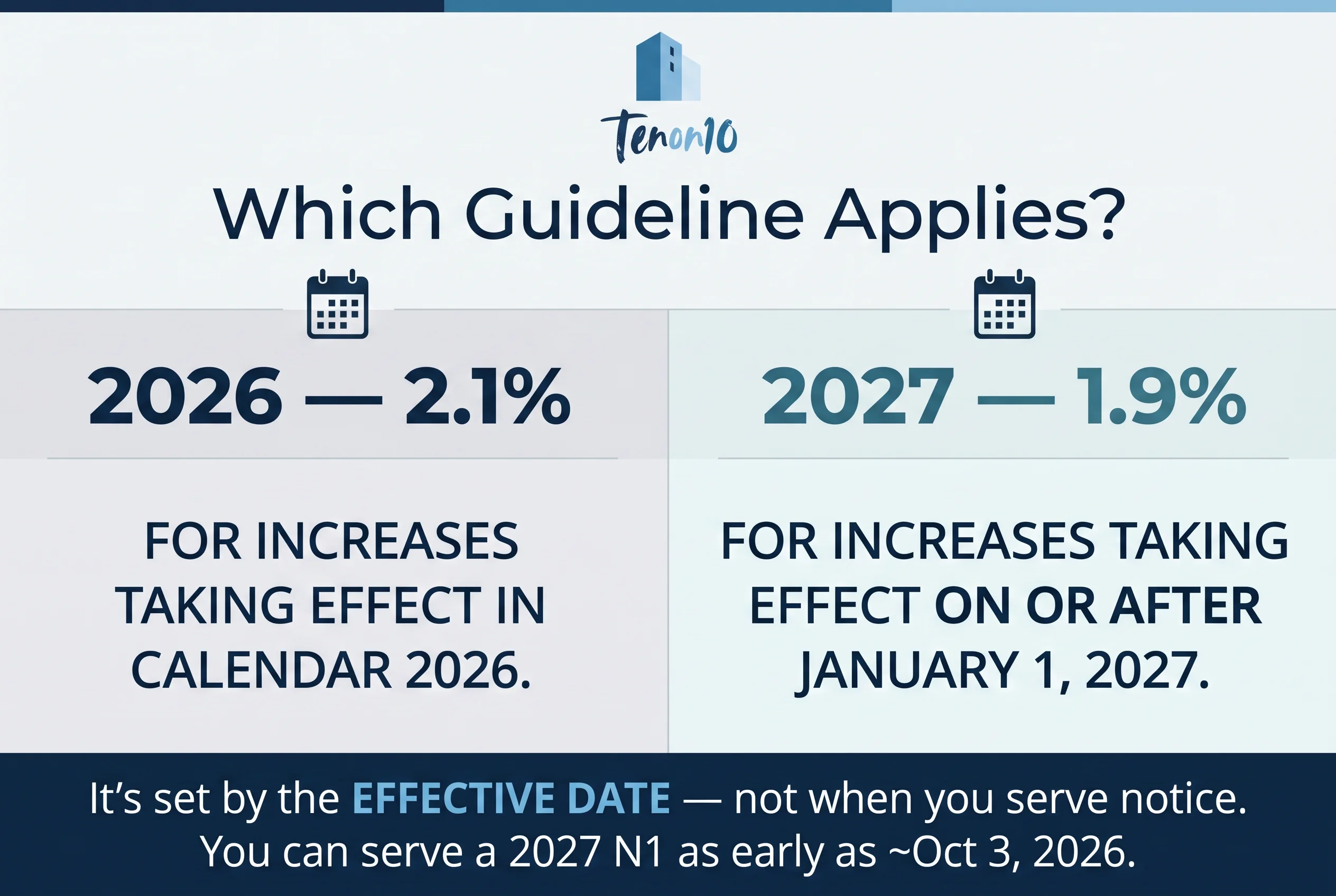
There's a timing opportunity hiding in this rule. Because you must give at least 90 days' notice, you can serve an N1 with the 2027 amount as early as around October 3, 2026 for a January 1, 2027 effective date. That's what makes this guide useful right now, in the second half of 2026, rather than something to file away for next year — if you're planning an early-2027 increase, the paperwork starts this fall.
Picture two landlords, both raising a $2,000 rent effective January 1, 2027. The first serves a proper N1 in October 2026 calculated at 1.9% — a $38.00 increase to $2,038.00 — and it lands clean. The second, working from muscle memory, calculates at 2.1% and asks for $42.00. That extra $4 a month makes the notice defective, and the tenant can challenge it. Same effort, very different outcome — and the only difference is which year's number they used.
The N1 Done Right: Form, Timing, and Service
A lawful guideline increase comes down to three things done in order: the right form, the right timing, and the right amount. Here's the form and timing part.
Use Form N1. Guideline increases require the official LTB Form N1 (Notice of Rent Increase). An email, a text, a letter, or your own printed notice does not satisfy the Residential Tenancies Act — even if the amount is exactly right. The form is what makes it valid.
Give at least 90 full days' notice. Not 89, not "about three months." The 90 days runs to the effective date, so count carefully.
Respect the 12-month rule. Rent can be raised only once every 12 months, and the clock is measured from the tenant's move-in or the last increase — not from a lease-renewal date. This is a common misread: a lease renewing doesn't reset the increase clock. (If you're unclear how renewals work, our guide on fixed-term leases in Ontario explains why the term ending doesn't change the tenancy the way many expect.)

Pick the right effective date and serve it properly. The increase generally takes effect on the first day of a rental period — usually the 1st of the month. Fill in the tenant's name, address, current rent, new rent, and effective date; sign and date it. Then serve it and document how: a Certificate of Service records the method, date, and address. If you serve by regular mail, it's deemed received on the fifth day after mailing (so add those days to your 90); email service only counts if the tenant has given written consent.
Do the math on base rent. Current rent × 1.9% = the maximum increase. Use base rent only — utilities or parking billed separately aren't part of the calculation.
Exemptions and Going Above the Guideline
Not every unit is capped at 1.9%. Units first occupied for residential purposes after November 15, 2018 — new buildings, additions, and most new basement apartments — are generally exempt from the guideline cap, which means the landlord can raise rent by any amount.
But "exempt from the cap" doesn't mean "no rules." Exempt units still need proper written notice, the same 90-day period, and the 12-month rule between increases. And for a rent-control-exempt unit, the correct notice is usually the N2, not the N1. If you're relying on an exemption, keep records that prove the unit's first-occupancy date — you can also note the exemption as an additional term in the lease — because in a dispute the burden is on you to show it applies.
One catch that surprises new landlords: you generally can't raise rent during a fixed-term lease unless the lease specifically allows it and the tenant agreed in writing. Otherwise the increase waits until the term ends, with proper notice.
That proper channel is an above-guideline increase (AGI). To raise rent above 1.9% on a covered unit, you apply to the LTB — the allowed grounds are an extraordinary increase in municipal taxes and charges, eligible capital work, or added security services. There are strict rules: capital work must be completed within an 18-month window ending 90 days before the first requested increase, and fully paid before you file. The LTB then holds a hearing, and affected tenants receive the application and can participate. It's a real process, not a shortcut — but it's the lawful way to recover major costs. (One more point worth knowing: on turnover, when a unit becomes vacant, the guideline doesn't cap the rent you agree with the next tenant.)
The Mistakes That Void an Increase
Most failed increases fail for the same handful of reasons. Any one of these can sink an otherwise reasonable increase:
- An informal notice — email, text, or letter — instead of Form N1.
- Fewer than 90 full days between service and the effective date.
- More than one increase in a 12-month window.
- An amount over 1.9% on a covered unit with no AGI order.
- The wrong effective date — not the first day of the rental period.
The consequence is simple: an invalid notice doesn't raise the rent. The tenant keeps paying the lawful amount until a proper notice is served. And if a tenant overpaid an increase that wasn't lawful, they can file a T1 application to recover the overpayment — generally within one year of when it was first charged.
If you're a tenant reading a notice, this is your checklist too. Before you pay a higher rent, confirm five things: it's on Form N1 (or N2 for an exempt unit), the effective date is at least 90 days out, the amount matches the guideline for the year it takes effect, at least 12 months have passed since your last increase or move-in, and — if it claims an exemption or an AGI — that claim is spelled out. If something's off, you don't have to pay the increase; you can keep paying your current lawful rent and raise it with the landlord or the LTB.
That deposit connection is easy to miss. Because the guideline rate doubles as the deposit-interest rate, a rent increase and the annual deposit interest naturally fall due around the same time — our guide to the last month's rent deposit rules in Ontario covers how the interest and top-up work.
N1 Rent Increase Notice Checklist
The 1.9% math, the 90-day timing, and the serve steps on one printable page — so your 2027 increase is lawful and unchallengeable.
Get Free PDF →Key Takeaways
A lawful 2027 rent increase comes down to a short, repeatable process:
- Confirm the unit is rent-controlled (first occupied on or before Nov 15, 2018). If exempt, the cap may not apply — but notice and timing rules still do.
- Check the 12-month rule: at least 12 months since move-in or the last increase.
- Calculate at 1.9% for an increase effective on or after January 1, 2027 — base rent only.
- Use the current Form N1 (or N2 for rent-control-exempt units) — never email, text, or a letter alone.
- Serve at least 90 full days before the effective date — as early as ~October 3, 2026 for a January 1, 2027 date.
- Set the effective date to the first of the rental period; serve properly and document it.
- Need more than 1.9%? Use the LTB above-guideline route — don't just charge more.
The quick win is to let the calculator get the amount and the 90-day date right. The long game is a diarized system so every N1 goes out on time and every 12-month clock is tracked. For the neighbouring pieces, see the 2026 N1 guide and the Ontario Standard Lease guide.
Conclusion
Ontario's 2027 rent increase guideline is 1.9%, for increases taking effect on or after January 1, 2027. Lawful means the right form (N1), the right timing (90 days, once per 12 months), and the right amount — with an AGI application if you need to go higher, and an exemption only where it genuinely applies. Get those three in order and the increase is clean and unchallengeable.
It's a small set of rules, but the details carry real weight — a few days short on notice or a percentage from the wrong year is all it takes to sink an increase. If you're planning a 2027 increase, calculate at 1.9% now and diarize the serve date about 90 days before the effective date.
This is general information, not legal advice. The 2027 guideline applies to increases effective on or after January 1, 2027; confirm the current figure and your situation at ontario.ca or with the Landlord and Tenant Board.
Get your 2027 increase right the first time
Calculate the exact 1.9% amount and the 90-day serve date in seconds — then keep a clean paper trail with Tenon10.
Free • No signup required • Built for Ontario landlords
Frequently Asked Questions
What is the rent increase guideline for 2027 in Ontario?
It's 1.9% — the maximum most landlords can raise rent on a rent-controlled unit without LTB approval, for increases taking effect on or after January 1, 2027.
How much can a landlord raise rent in Ontario in 2027?
For most rent-controlled units, up to 1.9%. On a $1,500 rent, that's a maximum increase of $28.50, to $1,528.50. Units first occupied after November 15, 2018 may be exempt from the cap.
When can I serve an N1 for a 2027 increase?
Because you must give at least 90 days' notice, you can serve an N1 for a January 1, 2027 increase as early as around October 3, 2026.
Does the 2027 guideline replace the 2026 one?
No. 2.1% still applies to increases taking effect in 2026; 1.9% applies to increases taking effect on or after January 1, 2027. It's set by the effective date, not when you serve notice.
Can a landlord raise rent by more than 1.9%?
Only with an LTB-approved above-guideline increase (for major capital work, extraordinary tax increases, or security costs), or if the unit is exempt from the guideline. Otherwise the excess is an illegal charge.