

As of July 30, 2026. Every January 1 rent increase in Ontario shares one deadline this year: October 3. And here's the correction worth making in the first breath, because the phrase "the window opens" gets it backwards — ninety days is a minimum, not a gate. You can serve an N1 for January 1, 2027 today, in July, perfectly validly. What October 3 is, is the last day: serve later, and January 1 is gone.
The 2027 guideline is 1.9 per cent — published without fanfare on the province's own pages in June, the lowest figure in years — and everything around it is date arithmetic: ninety days at minimum, twelve months since the last increase, and one effective date quietly doing three jobs at once. The mistakes this fall will be calendar mistakes. This piece is the calendar. Our complete N1 guide covers how; this is when.
The N1 Pre-flight Checklist
Nine checks before any rent increase notice — the year-matching rule, the serve-date table, the exact math, and the diary entries that start next year automatically. Updated for the 1.9% year.
Get Free PDF →The number, the pages, and the deadline

The guideline, precisely: 1.9 per cent for increases taking effect January 1 through December 31, 2027 — per the province's guideline pages, updated June 23, 2026. It's down from 2.1 per cent in 2026, sits comfortably below the statutory 2.5 per cent cap, and reflects Ontario CPI over the June 2025–May 2026 window the regulation prescribes.
One detail worth knowing about how it arrived: there was no standalone government news release this year — the guideline pages themselves are the official record. That's not a complaint, just an explanation: awareness runs lower than in announcement years, which is precisely why the wrong-year error below is the season's most predictable mistake. In announcement years, the new number travels through news coverage into general awareness by autumn; this year it travels only as far as the people who check the pages — or read coverage like this. If you manage rentals with anyone else, assume they haven't seen it, and say the number out loud once: 1.9 for 2027 effective dates. That sentence is the cheapest compliance training of the season.
And the deadline, with its direction stated correctly: for a January 1, 2027 increase, the N1 must be served on or before October 3, 2026. Earlier is always fine — there's no such thing as too much notice. Later, and the earliest valid effective date moves past January 1. Nine-plus weeks remain: diarize, then relax. The posture matters because deadline coverage tends to manufacture urgency, and this deadline doesn't need any — nothing about an early N1 is worse than a deadline-day one, the form is unchanged, and the only genuinely time-sensitive object in the whole season is the diary entry itself. Make it today; everything else schedules itself.
The effective date — one date, three consequences
If this piece teaches one habit, it's this: the effective date is the master variable. It does three jobs at once. First, it picks the year's percentage — an increase effective in 2026 runs at 2.1 per cent even if served after the 1.9 announcement; an increase effective January 1, 2027 or later runs at 1.9. Not the serve date. Not the announcement date. The effective date. Second, it sets the service deadline — effective date minus 90 days. Third, it starts the twelve-month clock the next increase inherits.
The twelve-month rule runs as a date check beside the ninety days: the effective date must land on or after the last increase's anniversary — or the tenancy's start plus twelve months. Two rails, both pure arithmetic.
And the third job is where portfolios quietly leak: anniversary drift. Serve late once — an April 1 effective where March 1 was available — and every subsequent increase inherits the drift, because next year's twelve-month clock now starts a month later. The cost isn't one month's delta; it's the delta forever, compounding for the life of the tenancy. The unit that keeps its cycle compounds on schedule; the unit that drifts never gets the month back. Concretely: on a $2,000 rent, one month's drift forgoes $38 this year — and because the anniversary itself moved, it forgoes the compounding position of that month every year the tenancy runs. Five years on, the drifted unit trails the disciplined one by a widening gap that no later diligence recovers, because the twelve-month rule only ever counts forward from wherever you last stood.
💡 For landlords: Two diary entries per unit — the anniversary, and the anniversary-minus-90 — and October's work becomes an afternoon. For a January-anniversary book, late September is the plan; October 3 is the fail-safe, not the schedule.
The serve-date table — every 2027 date's last day
The rule once, then the table: the last day to serve is the effective date minus 90 days — and the effective date must clear the twelve-month anniversary. So: January 1 → October 3, 2026. February 1 → November 3. March 1 → December 1. April 1 → January 1, 2027. May 1 → January 31. June 1 → March 3. Serving well before the last day isn't just allowed — it's the plan.
The worked January book: twelve units, all January 1 anniversaries. One late-September afternoon serves the entire year — notices dated the same day, ninety-plus days of runway, and next October the diary repeats itself. The table's whole job is making that afternoon obvious. It reads in both directions, too: a tenant served October 20 knows at a glance that January 1 isn't available to that notice — the earliest lawful effective date is 90 days out, in late January — which is exactly the kind of check the four-question panel below runs in seconds.
And the drift case, worked: a unit last increased March 1, 2026 can't take a new increase effective before March 1, 2027. January service targeting March 1 keeps the cycle. Let it slip to an April 1 effective, and the anniversary moves — this year, next year, every year after.
The wrong-year trap — the season's most predictable invalid notice
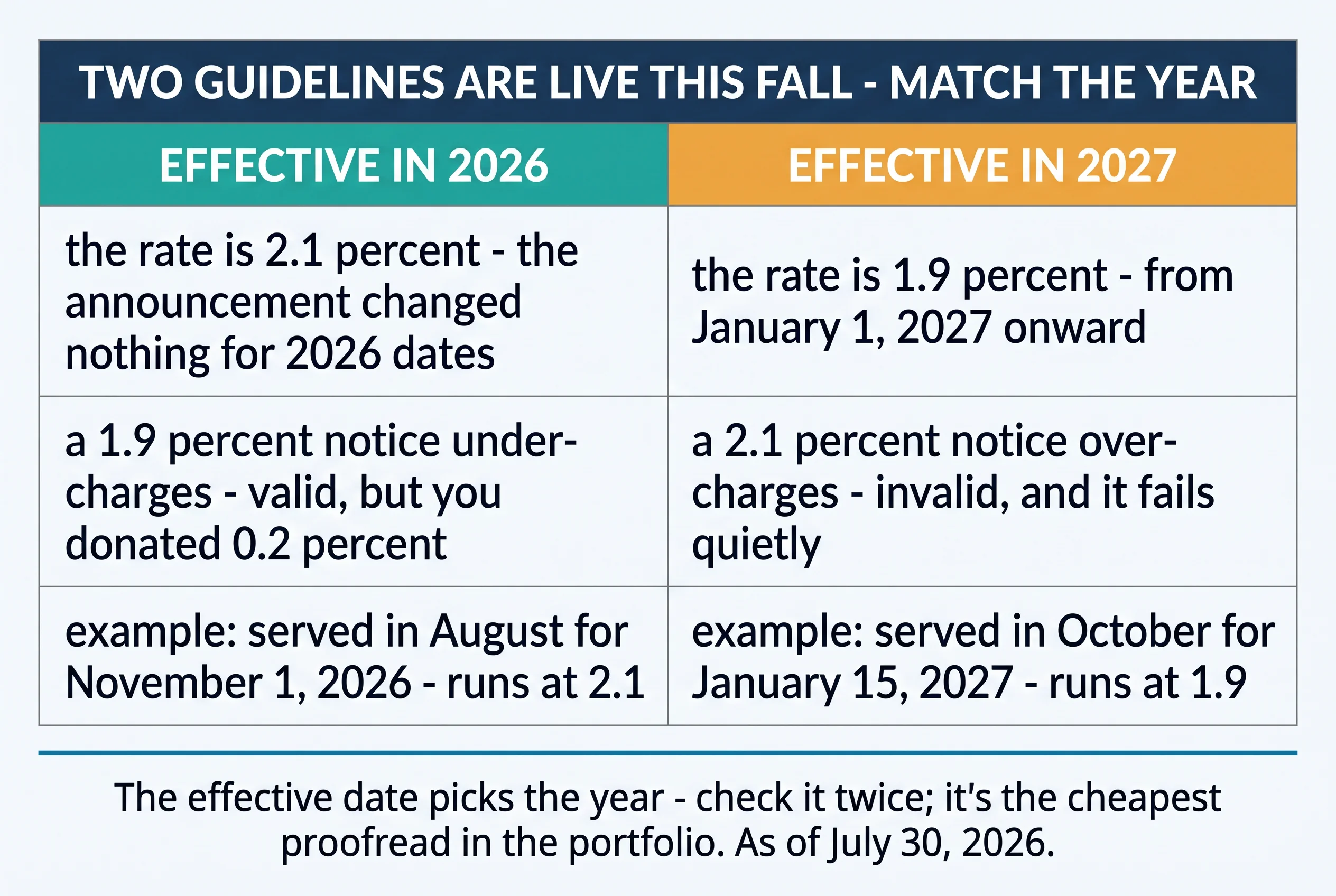
Two guidelines are live at once this fall, and the straddle dates are where errors breed. Direction one — the void risk: a 2027 effective date at 2.1 per cent over-charges, and a notice above the guideline for its year is invalid. Direction two — the self-shortchange: a 2026 effective date at 1.9 per cent under-charges; the notice stands, and the landlord simply donated 0.2 per cent for the year.
The worked pair: an N1 served in August for a November 1, 2026 effective date runs at 2.1 per cent — the June announcement changed nothing for 2026 dates. An N1 served in October for a January 15, 2027 date runs at 1.9 — and at 2.1 it's void territory, not a rounding error. In a no-news-release year, landlords who never saw an announcement default to the number they remember — and the fix costs one glance: match the percentage to the effective date's year, every time. The trap catches careful people precisely because both numbers are *correct* — 2.1 is genuinely the law for 2026 dates, 1.9 genuinely the law for 2027 — so no amount of double-checking the number helps; only checking the pairing does. It's not a math error. It's a matching error, and matching errors survive proofreads that would catch arithmetic.
The serve-or-retain evening — 1.9% in a soft market
The context in one paragraph, with the link doing the heavy lifting: Toronto asking rents turned up in June for the first time in two years but remain below last year, incentives still run months-deep, and sitting rents move by the guideline — our mid-2026 market check carries the full read, including the two-track logic this decision lives on.

The arithmetic, printed plainly: a $2,000 rent at 1.9 per cent gains $38 a month — $456 a year, landing the rent at $2,038.00. One month's vacancy costs $2,000-plus before turnover expenses, before the risk of re-letting lower into a soft asking market. On those numbers, the guideline increase on a good tenancy is the most reliable revenue in the portfolio. And skipping it — for tenant-relations reasons, on a below-market unit you want kept — is also a legitimate call some landlords make every year. The math is the same either way; the call is yours. That's the whole point of printing it. One variant worth naming: on cap-exempt units (post-November 2018 first occupancy), the fall decision is genuinely different — there's no guideline ceiling, but the same 90-day and 12-month rails apply, and the same soft-market logic cuts harder, because an aggressive increase on an exempt unit is an invitation to compare listings. Exempt doesn't mean immune from the market; it means the market is the only ceiling left.
This is the market piece's asking-versus-sitting logic at decision scale, and it cuts both ways at once: the sitting track is the stable one right now, which means the increase is safe to take and the tenancy is valuable to keep. One clarifying line while we're here: September 21's second wave doesn't touch the N1 — guideline increases run on the same rails all fall.
💡 For property managers: The October decision is per-unit, not per-portfolio. Flag the units where in-place rent sits far below asking — that's where anniversary drift costs most and the increase is nearly automatic — separately from the units near market, where $38 may be worth less than the relationship. A one-column spreadsheet sorts the book in an hour, and the cohort-service habit executes whatever it decides.
For tenants: the five-minute check
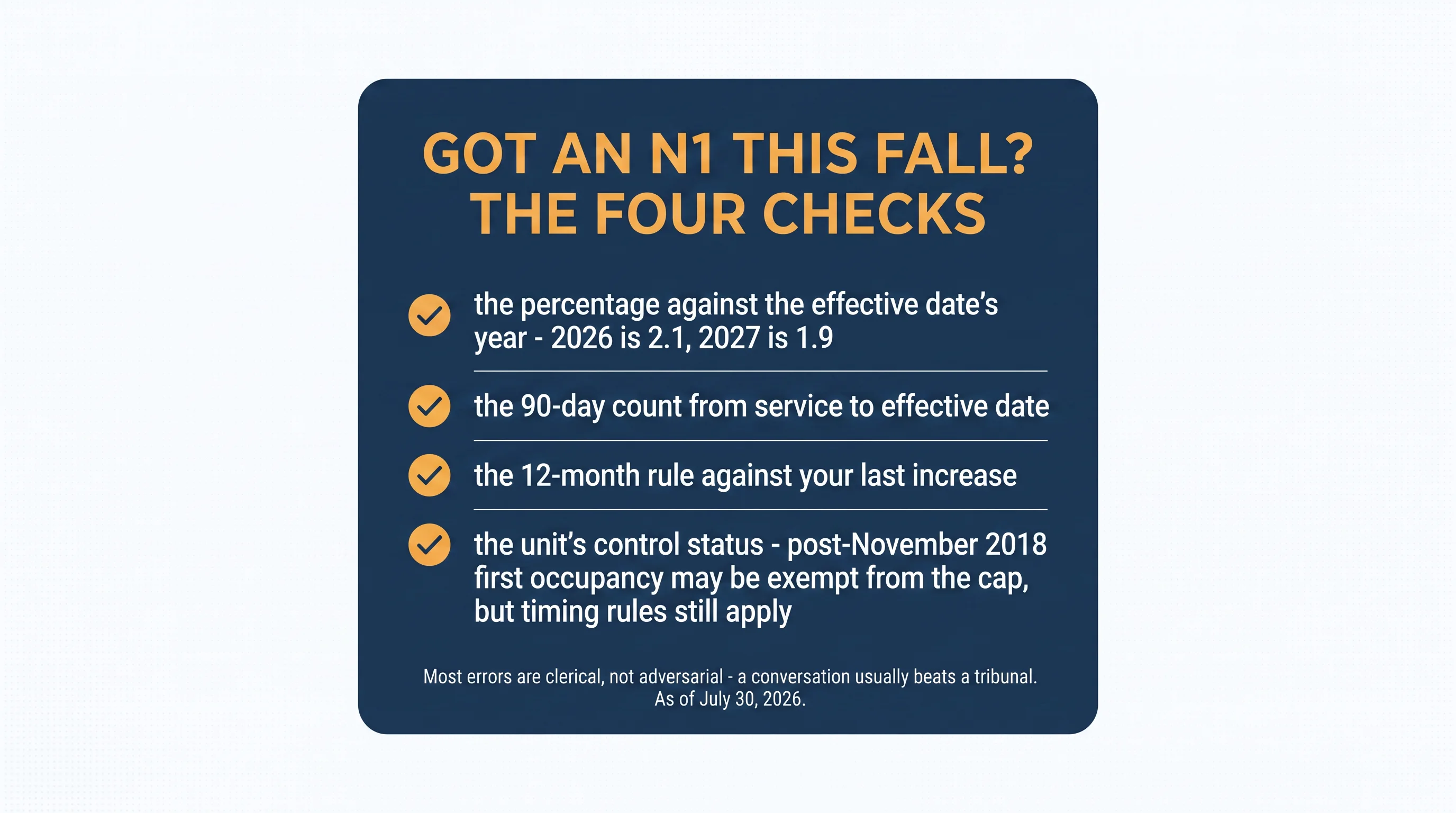
An N1 arriving this fall is checkable in five minutes with four questions. One: does the percentage match the effective date's year — 2.1 for a 2026 date, 1.9 for 2027? Two: is there at least 90 days between service and the effective date? Three: is the effective date at least twelve months after your last increase (or your tenancy's start)? Four: what's the unit's control status — first residential occupancy after November 15, 2018 generally means the cap doesn't apply, but the notice and timing rules still do, so checks two and three run regardless.
The temperature worth keeping: an invalid notice is void, not negotiable-down — but most errors are clerical, not adversarial, and a conversation usually beats a tribunal. What writing buys you in that conversation: a dated record that you flagged the defect while the notice was live, which matters later regardless of how amicably it resolves — the file remembers what the phone call forgets. The complete guide covers the escalation path if it doesn't.
💡 For tenants: If the four checks pass, the increase is lawful and budgeting beats disputing — $38 on $2,000 is real but plannable. If they don't pass, put your question in writing, keep the notice, and know that paying your current (correct) rent while an invalid notice stands is not arrears. Get the details in writing before anything escalates.
Diarize, then relax — and what's next
The whole piece compresses to two diary entries and one glance: the anniversary, the anniversary-minus-90, and the percentage matched to the effective date's year. The 2028 guideline announces around next June — this piece revs then; the complete guide is the standing method; and the crowded autumn runs on — July 1 and July 24 behind us, September 21 ahead, October 3 on the diary, and Ottawa's licence at January 1 — one checklist per date, all linked from each other. October 3 is the gentlest of the five — the only one where early action is fully available all summer, which makes it the date least worth missing.
💡 Two diary entries and one percentage check — which is to say, a ledger problem: Tenon10 tracks the anniversaries, computes the serve dates, and builds the N1 as a wizard with the year's rate already matched to your effective date. October becomes an afternoon; the file keeps itself. Free for up to 3 units, tenants free on every tier. Create a free account or see current plans.
The N1 Pre-flight Checklist
Nine checks before any rent increase notice — the year-matching rule, the serve-date table, the exact math, and the diary entries that start next year automatically. Updated for the 1.9% year.
Get Free PDF →Key takeaways
- The 2027 guideline is 1.9 per cent — for effective dates January 1 through December 31, 2027, published on the province's pages June 23 with no news release.
- October 3 is the last day to serve for January 1 — early service is always allowed; the 90 days is a minimum, not a gate.
- The effective date does three jobs: picks the year's percentage, sets the deadline, starts the next twelve-month clock.
- The wrong-year percentage is the season's most predictable invalid notice — match the rate to the effective date's year, both directions.
- Anniversary drift compounds forever — serve the cohort on one day and the cycle keeps itself.
- The serve-or-retain math: $38 a month at $2,000 versus a $2,000-plus vacancy — the arithmetic is universal; the call is yours.
The calendar is the compliance
A 1.9 per cent year asks almost nothing sophisticated of anyone — no new forms, no new law, no September complications. It asks for a percentage matched to a year, ninety days counted honestly, twelve months respected, and a diary that remembers so October doesn't have to. Two entries per unit and one glance at the effective date's year: that's the entire compliance burden of Ontario's rent increase season, and the entire content of the mistakes that will fill tribunal dockets anyway. Be the file that checked. As of July 30, 2026 — revised when the 2028 guideline lands.
October in an afternoon
Anniversaries tracked, serve dates computed, and the N1 built with the right year's rate — the whole season as two diary entries. Free for up to 3 units.
Free for up to 3 units • Tenants always free • See current plans
Related resources
- Ontario Rent Increases 2027: The Complete N1 Guide — the method this piece deliberately doesn't repeat.
- Are Toronto Rents Bottoming Out? — the market the serve-or-retain decision lives in.
- The September 21 Checklist — the wave that lands eighteen days before this deadline, and doesn't touch it.
Frequently asked questions
When is the last day to serve an N1 for a January 1, 2027 increase?
October 3, 2026 — the N1 requires at least 90 days' notice before the effective date. Serving earlier is always allowed; serving later means the earliest valid effective date moves past January 1.
Does 1.9% or 2.1% apply to my increase?
The effective date decides: increases taking effect in 2026 use 2.1 per cent, increases taking effect on or after January 1, 2027 use 1.9 — regardless of when the notice is served or when the number was announced.
Can I serve an N1 early?
Yes — 90 days is a minimum, not a window. An N1 for January 1, 2027 can be served months ahead, and many landlords serve a whole portfolio's notices on one day to keep anniversaries aligned.
What happens if the N1 has the wrong percentage?
Above the guideline for its effective year, the notice is invalid — and it fails quietly: the tenant may rightly keep paying the old rent, and the error surfaces later as apparent arrears. Below the guideline, the notice stands and the landlord simply collects less. Check the year against the effective date before serving.
Is my unit exempt from the guideline?
Units first occupied for residential purposes after November 15, 2018 are generally exempt from the cap — but the notice and its 90-day and 12-month timing rules still apply. Our complete N1 guide covers the exemption in depth; this is general information, not legal advice.


