

A homeowner policy does not cover a rental. Most Ontario landlords learn that sentence one of two ways: from a broker before the first tenant moves in, or from an adjuster after the first claim gets denied. The difference between those two conversations is the entire subject of this guide.
Here's the uncomfortable truth about landlord insurance: it's sold on the covers and lost on the clauses. The brochure talks about fire and liability; the denial letter talks about the vacancy rule that stripped coverage at day 31, the loss-of-rent line that was never going to pay for arrears, the intent test that separates a covered accident from an excluded act, and the short-term-rental exclusion that cancels a policy retroactively. This guide maps all of it: what a standard Ontario landlord policy actually includes (six categories), what it honestly costs, where claims actually die, and the tenant-insurance layer that protects a landlord without costing a dollar. One caveat up front, and it's not boilerplate: this is general information, not insurance or financial advice. Policies vary by carrier — a licensed broker prices your building, your tenants, and your postal code.
The Coverage-Audit Kit: Landlord Insurance in Ontario — Six Categories, Four Gaps, and the Clauses That Decide Every Claim
A homeowner policy does not cover a rental — and even the right policy is sold on the covers and lost on the clauses. This free kit walks Ontario landlords through a full coverage audit: the six categories on your declarations page, the honest price range, the vacancy protocol that saves the #1 denied claim, the tenant-damage intent line, the tenant-insurance lease clause, and the disclosure rules that keep coverage real. Two printable pages to audit your policy before an adjuster does.
Get Free PDF →The Founding Rule — and What "Standard" Actually Includes
Start with the rule everything else hangs on: occupancy, not ownership, drives coverage. A homeowner policy is underwritten for a property the named insured lives in. The moment a tenant moves in, the risk profile changes — and an insurer who discovers undisclosed rental activity can deny the claim on the table and cancel the policy outright, sometimes retroactively. The conversion to a landlord policy (sometimes marketed as "rented dwelling" or "rental property" insurance) has to happen before the tenant moves in — or at the moment of occupancy change for owners who moved out and kept a former residence as a rental. The duty extends to partial rentals: renting out a basement suite or a single room changes the risk too, so tell the insurer in writing and keep the reply. Picture the conversion missed: an owner moves out, keeps the house as a rental, never updates the policy. Kitchen fire at month fourteen. Claim denied for non-disclosure — every premium paid, coverage that never existed. (If you're just starting out, our first-timer's guide to becoming a landlord puts this step in sequence.)
One more layer worth knowing: the RTA requires nothing; the lender requires everything. No Ontario law forces a landlord to carry insurance — but almost every mortgage requires it as a loan condition, and a cancelled policy on a financed property triggers the lender's force-placed clause: coverage bought on your behalf at two to three times market rate, added straight to the mortgage balance.
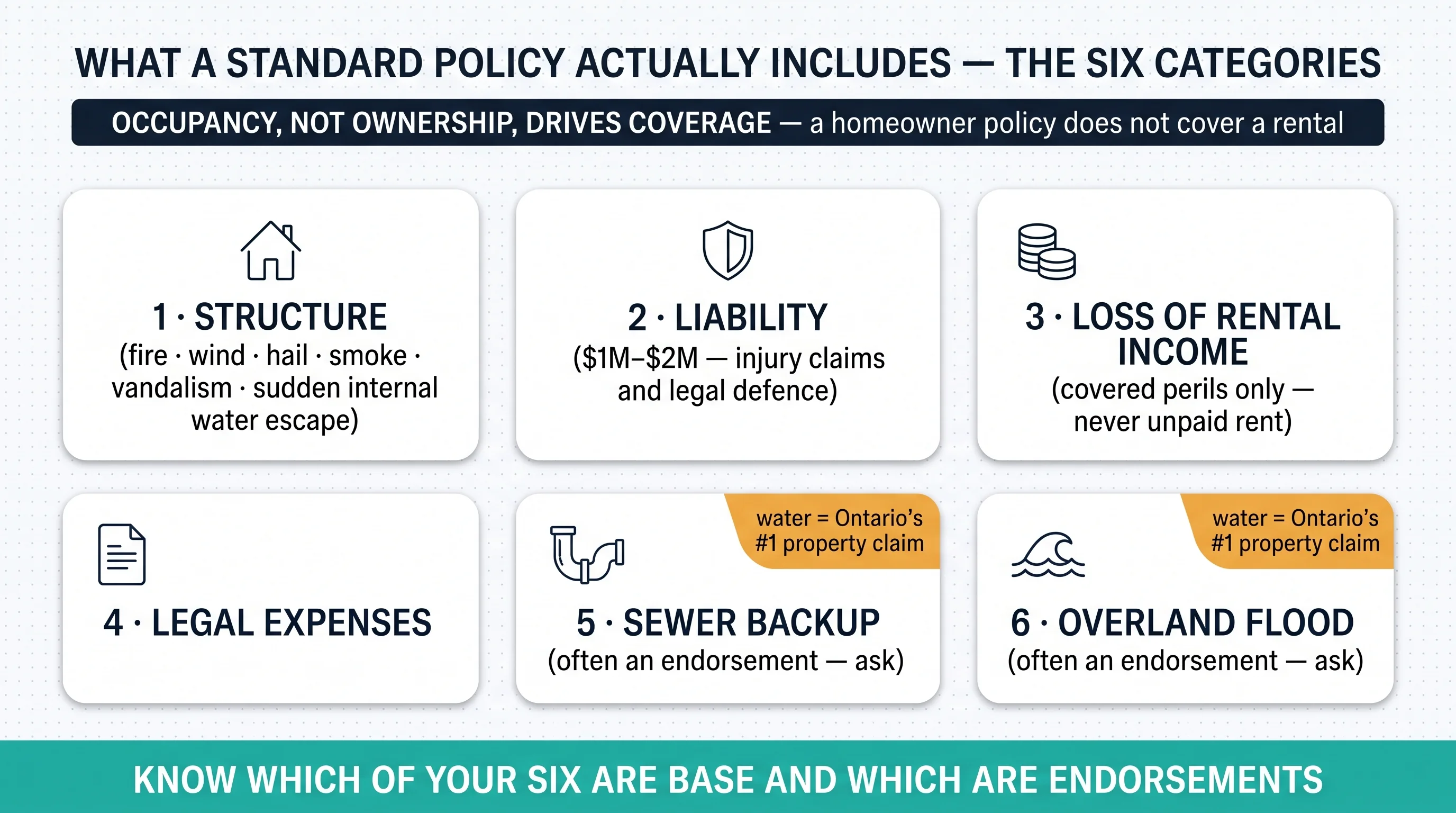
So what does "standard" mean? A well-built Ontario landlord policy covers six risk categories — though carriers bundle them differently, and some sit as optional endorsements rather than base coverage: structure (fire, wind, hail, smoke, vandalism, and sudden water escape from internal plumbing); liability, typically $1 million to $2 million, for tenant or visitor injury and legal defence; loss of rental income, which reimburses rent when a covered event makes the unit uninhabitable; legal expenses; sewer backup; and overland flood. The last two are most often endorsements — and they're the ones to ask about first, because water is currently Ontario's #1 property claim. One contents nuance: your own appliances and any furnishings you supply need declared coverage; the tenant's belongings are never covered under your policy — that's their insurance, which we'll come back to.
What It Costs — Honestly
Typical Ontario premiums run roughly $800 to $2,500 per year. GTA condo rentals sit at the low end — often a few hundred dollars annually — while single-family homes trend toward $2,000 and beyond. What moves the number: rebuild cost, property size and age, location and its peril history, tenant profile and your claims history, the deductible you choose, and which endorsements you add. The direction of travel is up — rebuild material costs and weather-related claims have been pushing premiums higher across the province.

The levers are ordinary but they work: a deliberately higher deductible (chosen with eyes open, not discovered at claim time); paying annually instead of monthly; security upgrades; bundling; and re-shopping at renewal — loyalty rarely pays in this market. And the line too many landlords miss at tax time: premiums are fully deductible against rental income on Form T776, endorsements included. If your records are clean, that deduction is free money; if they aren't, our guide to CRA audits of rental income explains why cleanliness matters more than most owners think.
Where the Gaps Are — the Clauses That Deny Claims
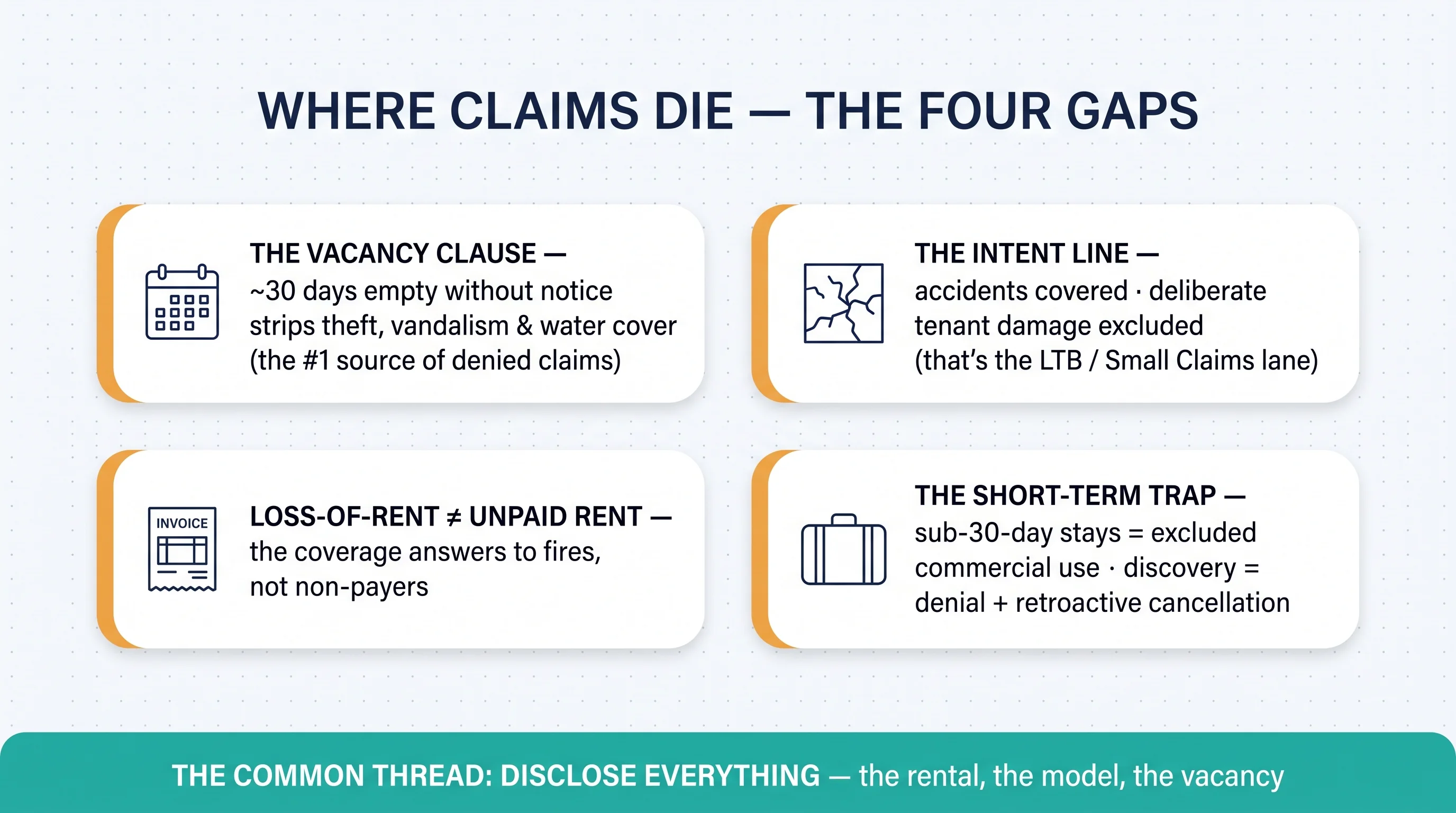
Now the heart of it. Four clauses decide more claim outcomes than everything else on the policy combined.
Gap 1 — the vacancy clause. Most policies strip coverage if the property sits empty beyond roughly 30 consecutive days without notifying the insurer — and it is the single largest source of denied claims for Ontario owners. What day 31 looks like: theft, vandalism, and water damage typically removed entirely; fire reduced to named-peril coverage. The clock starts when the unit empties, not when you remember to call. And the risk is real, not theoretical: vacant homes are about three times more likely to be broken into. The fixes are cheap and boring: notify the insurer the day a longer gap opens; ask about a vacancy permit for short gaps (weekly documented inspections are often a condition); get a standalone vacant-property policy for long ones. The 30-day trap in practice: a clean move-out at month's end, a renovation that runs long, a break-in at day 45 — theft excluded, full loss out of pocket, when a modest vacancy permit would have held the coverage.
Gap 2 — the tenant-damage intent line. Accidental damage is usually covered, subject to your deductible: the overflowing bathtub, the kitchen mishap that water-damages the ceiling below. The insurer pays and may then subrogate — pursue the tenant's own insurance for reimbursement. Deliberate damage is excluded: holes punched in walls, fixtures destroyed on the way out. That's not an insurance file at all — it's an L10 application against a former tenant, or the LTB and Small Claims lanes against a current one. The grey zone is neglect — damage from something a tenant ignored — and it generates more claim-time frustration than any other category. The intent line in one unit: the bathtub overflow (tenant's kid, pure accident) covered with the deductible paid and subrogation following; the punched doors at move-out excluded and pursued through the L10 instead.
Gap 3 — loss-of-rent is not unpaid rent. Loss-of-rental-income coverage answers to covered perils: the fire that makes the unit uninhabitable, with rent reimbursed during repairs. It never answers to a tenant who stops paying. Arrears are an LTB matter — the L1 or L9 application — full stop. (Rent-guarantee products exist as a separate niche market, priced for exactly the risk they take on; know they exist, and read the terms twice.)
Gap 4 — the short-term-rental exclusion. Stays under 30 days are commercial activity, and standard landlord policies exclude them. The dangerous version isn't the exclusion — it's the discovery: an undisclosed listing found at claim time means the claim is denied and the policy can be cancelled retroactively, with every future insurance application asking about prior cancellations forever. The STR discovery in practice: an owner quietly lists the unit between tenants, a guest starts a fire, the adjuster finds the listing in minutes. If short or mid-term stays are part of your model, disclose it and carry the right endorsement — platform host protections are not substitutes.
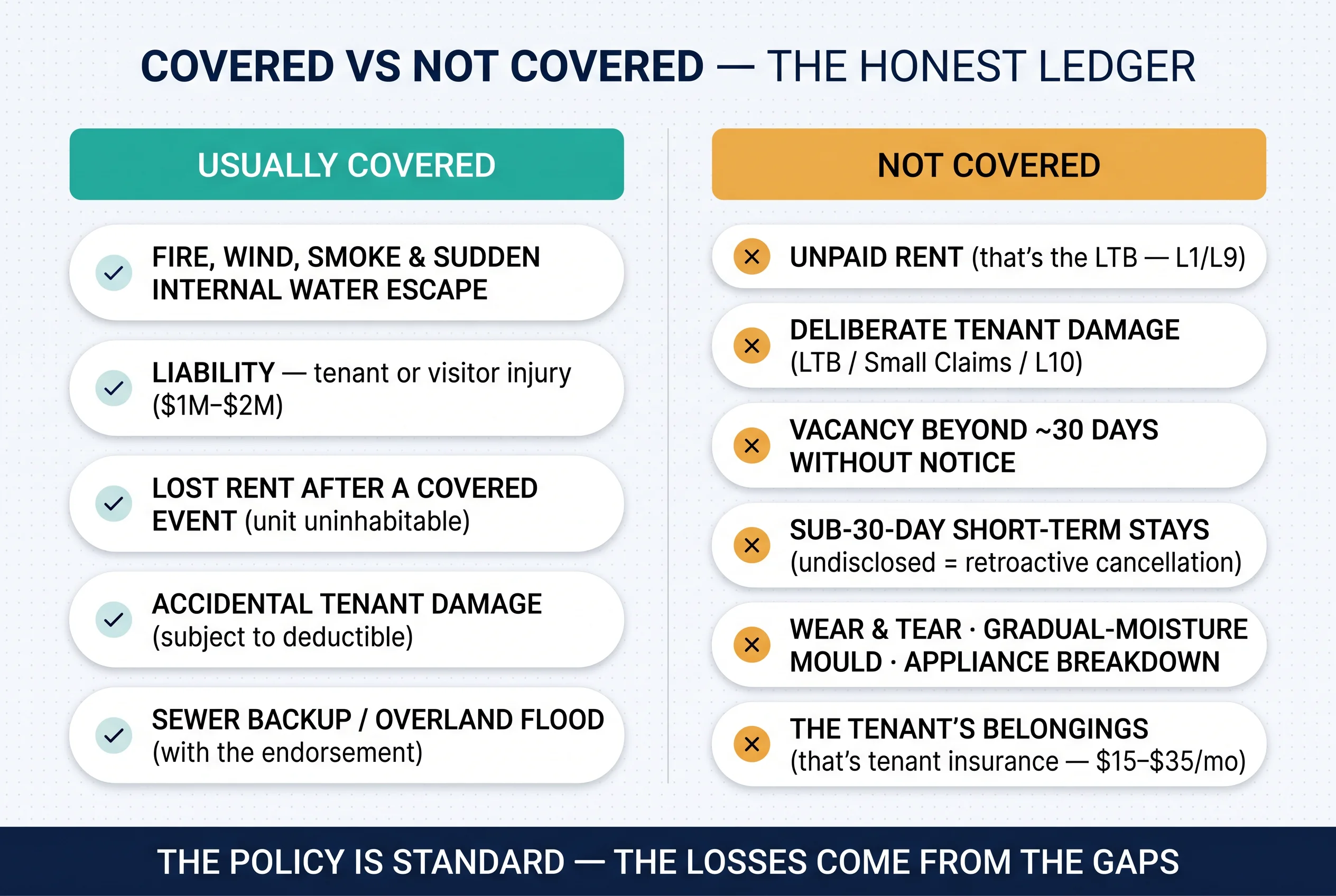
The rest of the exclusion map is smaller but worth knowing: wear and tear and gradual aging are never covered; mould from gradual moisture or ventilation problems is excluded (remediation after a covered burst pipe usually isn't — the suddenness is the difference, and the repair duty is yours either way); appliance breakdown is warranty territory; and your own intentional acts or gross negligence void everything.
The Tenant-Insurance Layer — and Where the Market Is Heading

There's one protection layer in this whole stack that costs a landlord nothing: the tenant's own insurance. Ontario law doesn't require tenants to carry it — but a lease can require it as a condition, and a properly drafted additional term in the standard lease is the right vehicle. The clause's power is preventive, not punitive: collect proof at move-in and at every renewal, and treat the requirement as routine. For the tenant, it's roughly $15–$35 per month for around $1 million in liability plus their contents and living expenses. For you, it matters twice: the tenant's liability coverage is the subrogation target when a tenant-caused accident damages your building — the difference between your insurer eating the loss and recovering it — and being listed as an "additional interested party" on their policy gives you automatic lapse notifications without any claim rights. It's the cheapest early-warning system in the business.
As for where the market is heading: premiums keep climbing on weather-related claims; underwriting keeps tightening on disclosure; and the newest wrinkle hits absentee owners — most Canadian insurers now require a locally based property manager as a condition to issue or renew coverage for out-of-province or non-resident owners of Ontario rentals. It's the vacancy-and-occupancy logic again (an uninspected property is an underwriter's nightmare), and it typically surfaces without warning at renewal. The preparation is the same regardless of where you live: an annual policy review taken as seriously as a rent review — limits, endorsements, deductible, and whether every disclosure is still accurate. If your records live in decent property-management software, that review takes twenty minutes.
Practical Takeaways
- The right policy, before the first tenant: a landlord policy, not a homeowner policy — and partial rentals disclosed in writing.
- Audit the six categories annually: structure, liability, loss of rental income, legal expenses, sewer backup, overland flood — and know which of yours are base versus endorsements.
- Disclose the rental model accurately: any sub-30-day use needs its own endorsement, not silence.
- Build a standing vacancy plan: the insurer is notified the day any unit will sit empty past 30 days — permit or vacant-property policy, inspections documented.
- Paper the tenant-insurance clause: required in the lease, proof collected, additional-interested-party listing in place.
- Choose the deductible deliberately, claim the premium on the T776, and re-shop every renewal or two.
- Claims discipline: sudden events documented same-day; deliberate tenant damage routed to the LTB or Small Claims, not the adjuster.
The Coverage-Audit Kit: Landlord Insurance in Ontario — Six Categories, Four Gaps, and the Clauses That Decide Every Claim
A homeowner policy does not cover a rental — and even the right policy is sold on the covers and lost on the clauses. This free kit walks Ontario landlords through a full coverage audit: the six categories on your declarations page, the honest price range, the vacancy protocol that saves the #1 denied claim, the tenant-damage intent line, the tenant-insurance lease clause, and the disclosure rules that keep coverage real. Two printable pages to audit your policy before an adjuster does.
Get Free PDF →The Bottom Line
Landlord insurance in Ontario is six coverages, one honest price range, and four clauses that decide whether any of it pays. The policy itself is standard; the losses come from the gaps — the empty month nobody reported, the arrears the policy was never going to cover, the weekend listing that cancelled everything retroactively. Landlords who disclose fully, plan vacancies before they happen, paper the tenant-insurance clause, and actually read their own declarations page get exactly what they paid for. The rest find out what they didn't buy at the worst possible moment. And the standing caveat, one last time because it's true: this is general information, not insurance advice — a licensed broker prices your building, your tenants, and your postal code, and the figures on this page deserve a fresh check against the market before you rely on them.
Coverage Is the Policy. Protection Is the Paperwork.
The lease clause that requires tenant insurance, the tenancy files that make disclosure painless, the records that turn a claim into a formality — Tenon10 keeps the operational side airtight.
Free • No signup required • Updated for the Bill 60 changes in force 21 Sep 2026
Related Resources
- Becoming a Landlord in Ontario: The Complete First-Timer's Guide — where the insurance conversion fits in the launch sequence
- What You Can and Can't Add to the Ontario Standard Lease — drafting the tenant-insurance clause properly
- The L10 Application — the lane for deliberate damage the policy won't touch
- Mold in an Ontario Rental · Maintenance Standards in Ontario — the exclusion's other half: the repair duty
- CRA Audits of Rental Income — where the T776 premium deduction lives
- Removing a Tenant Without Eviction — the clean-exit playbook (and why vacancy planning starts before move-out day)
- Ontario LTB Forms Hub · Ontario Standard Lease
Frequently Asked Questions
How much is landlord insurance in Ontario?
Typical premiums run roughly $800–$2,500 per year — GTA condo rentals from a few hundred dollars, single-family homes toward $2,000 or more. The drivers are rebuild cost, property size and age, location and peril history, tenant profile, claims history, your deductible, and endorsements like sewer backup and overland flood. Premiums have been rising with construction costs and weather-related claims, so re-shopping at renewal often pays. Premiums are fully deductible against rental income on Form T776.
Is landlord insurance required in Ontario?
Not by the Residential Tenancies Act — no law forces a landlord to carry it. But almost every mortgage lender requires it as a loan condition, and if a policy is cancelled on a mortgaged property, the lender can buy force-placed coverage at two to three times market rate and add it to your mortgage balance. Practically, any financed rental needs a landlord policy.
Does landlord insurance cover tenant damage?
It depends on intent. Accidental damage — an overflowing bathtub, a kitchen mishap — is usually covered subject to your deductible, and the insurer may pursue the tenant's own insurance afterward. Deliberate damage is excluded; the recourse is the Landlord and Tenant Board or Small Claims Court (the L10 lane for former tenants). Damage from neglect sits in a grey zone that generates the most disputes at claim time.
Does landlord insurance cover unpaid rent?
No. Loss-of-rental-income coverage reimburses rent only when a covered event — like a fire — makes the unit uninhabitable. A tenant who simply stops paying is an LTB matter (the L1 or L9 application), not an insurance claim. Separate rent-guarantee products exist but are a niche market priced for the risk.
What happens to my insurance if the rental sits empty?
Most policies contain a vacancy clause: beyond roughly 30 consecutive days empty without notifying the insurer, coverage is stripped — theft, vandalism, and water damage typically removed, fire reduced — and it's the single largest source of denied claims for Ontario owners. The clock starts when the unit empties. If a gap will run past 30 days, notify your insurer immediately and ask about a vacancy permit or vacant-property policy.


