Search Ontario's rental laws for the word "mold" and you won't find it. That doesn't let a landlord off the hook — because mold caused by a building problem is just a repair problem with a scarier name, and repairs are the landlord's duty. When it comes to mold in a rental, Ontario landlord responsibility flows from the same section of the law that governs every other repair.
Mold sparks some of the tensest disputes in a rental, largely because both sides misread the rules. Landlords blame the tenant's showers; tenants think there's no law to lean on, or that they can withhold rent until it's gone. And a lot of "fixed" mold is simply painted over.
This guide draws the responsibility line clearly — what the landlord must remediate and pay for, the narrow cases where a tenant is on the hook, why normal living is never the tenant's fault, how to tell real remediation from a cover-up, and exactly how to enforce a fix with a T6. It's general information, not legal or medical advice; see a doctor for health concerns and a qualified professional for testing and remediation.
The Mold Response & Evidence Kit
Whose fault mold is, how to document it, and how to get a proper fix — both sides on one page.
Get Free PDF →There's No "Mold Law" — But Section 20 Covers It
The Residential Tenancies Act never mentions mold. It doesn't need to. Visible mold caused by a building defect — a leaking roof, a plumbing failure, poor ventilation, water getting in from outside — is a breach of section 20, the landlord's duty to keep the unit in a good state of repair and fit for habitation. Whether a given situation crosses the "fit for habitation" line is decided case by case at the Landlord and Tenant Board, but significant mold is consistently treated as a section 20 breach.

That duty doesn't stand alone. The provincial Maintenance Standards (O. Reg. 517/06) require buildings to be structurally sound, weathertight, and damp-proofed, and municipal property-standards bylaws layer on top — Toronto's code, for instance, explicitly requires buildings be free of dampness and mold. It's the same standards stack that anchors our guide to maintenance standards. And like every other repair obligation, this one can't be signed away: an "as-is" or "tenant responsible for repairs" clause doesn't survive contact with section 20.
Whose Fault Is It? (It Turns on the Cause)

The whole question of responsibility comes down to one thing: what caused the mold. If a building problem caused it, it's the landlord's to fix and pay for. If the tenant genuinely, negligently caused it, it's theirs.
On the landlord's side, that means fixing the cause — the leak, the plumbing, the roofing, the ventilation, the moisture getting in — and arranging and paying for the professional remediation that follows. The tenant's side is ordinary care: keep the unit reasonably clean, run the fan when showering, wipe up obvious condensation, and report problems promptly in writing.
Here's the line that resolves most arguments: normal residential use — cooking, showering, breathing — is never the tenant's fault. If the building's ventilation can't handle a shower, the building is the problem, not the tenant. A landlord who says "you should have opened a window" is describing a ventilation defect, not a tenant failing. The tenant is only on the hook in genuinely narrow cases — deliberately blocking vents, never ventilating at all, or an unreported spill or overflow they caused, which falls under their section 34 duty not to cause damage.
Getting It Fixed Properly (Not Painted Over)
Once mold is reported, two questions matter: how fast, and how well.
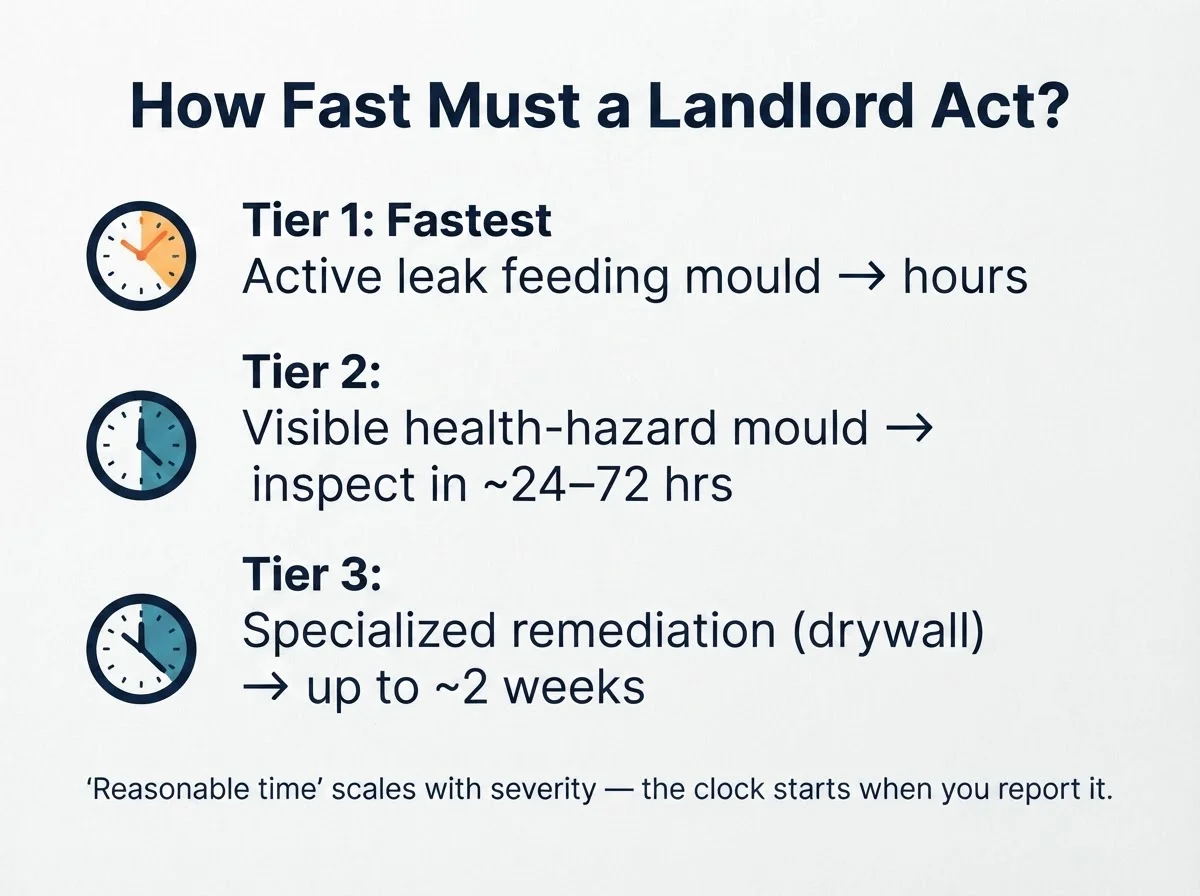
On speed, the standard is "reasonable time," scaled to severity. An active leak feeding mold demands action in hours. Visible, health-relevant mold should be acknowledged and inspected within roughly 24 to 72 hours. Specialized remediation — the kind that involves removing drywall — can reasonably take up to about two weeks if it's diligently pursued. The clock starts the moment the tenant reports the problem, which is exactly why prompt written reporting matters. (To inspect, the landlord still needs to give 24 hours' written notice unless it's a true emergency.)
On quality, there's a bright line between remediation and a cover-up. Bleach can clean a non-porous surface like tile or glass, but it doesn't penetrate drywall or wood. Mold inside drywall has to be removed with the drywall — not painted over, not merely sprayed. And crucially, the moisture source has to be fixed, or the mold simply grows back. So the tenant's test for whether a repair actually happened is simple: was the source repaired, and were the porous materials removed rather than painted? If not, it isn't done.

One more practical question: who pays to test? A landlord has no duty to test where nothing has been found. But once mold is discovered, or reasonably suspected on the circumstances — a persistent musty smell together with health symptoms, say — testing and remediation become the landlord's responsibility, at their expense. A tenant who pays out of pocket for a test that finds mold can seek reimbursement. On health, keep it in perspective: mold can affect indoor air quality and trigger respiratory or allergy-type symptoms, with higher risk for people who have asthma or weakened immune systems — but that's a matter for a doctor, not a landlord-tenant argument.
The Enforcement Playbook: Document, Escalate, File
For tenants, the path is a documentation game, and you win it by starting early. Photograph and video the mold — the location, the spread, any water line — and take dated shots over time. Keep a symptom log if anyone's unwell, and save everything: your written notice, the landlord's replies, contractor quotes, any public-health report. Evidence quality is the single biggest factor in how a T6 turns out.
Report the problem to the landlord in writing and give a reasonable time to fix it. If it's ignored, escalate in parallel — call municipal property standards or your local public-health unit (in Toronto, Toronto Public Health), both of which can inspect and order remediation, sometimes faster than the LTB moves. If it's still not resolved, file a T6 (Application About Maintenance) — $48 online through the Tribunals Ontario Portal, or $53 by mail or in person, with fee waivers available on low income — within one year, remembering that for ongoing mold that one-year clock runs from when the repair is completed. The Board can order remediation, grant a rent abatement (multi-month mold commonly lands somewhere around 20–40% per month, though that's illustrative, not guaranteed), award compensation for damaged belongings, or end the tenancy if the unit is uninhabitable. Two firm don'ts: don't withhold rent (keep paying and let the LTB order the reduction), and don't tear out drywall yourself expecting to be reimbursed.
For landlords and property managers, the playbook is the mirror image, and it's cheaper than the alternative. Respond in writing immediately and scale your speed to severity. Fix the source, remediate properly, and once mold is found or suspected, arrange and pay for the work rather than pushing it onto the tenant. Enter with proper 24-hour notice, log every step (that log is your reasonable-time defence), and never retaliate against a tenant for reporting mold — a bad-faith eviction attempt carries its own penalties. Best of all, prevent it: working exhaust fans, prompt leak repair, and seasonal moisture checks stop most claims before they start.
Turn a mold problem into a documented paper trail
From the first written report to photos, responses, and the repair record, Tenon10 keeps the documentation that gets mold fixed — and proves it was.
Free • No signup required • Built for Ontario
Key Takeaways
For tenants:
- Building-caused mold is the landlord's to fix and pay for under section 20 — there's no separate "mold law" needed.
- Normal use — cooking, showering, breathing — is never your fault; you're only liable if you negligently caused it.
- Painting over mold isn't a fix — the source must be repaired and porous materials removed.
- Report in writing to start the clock, document heavily, and escalate to bylaw or public health.
- File a T6 within a year (ongoing runs from completion), and don't withhold rent.
For landlords and property managers:
- Respond fast, scaled to severity; fix the source and remediate properly, not cosmetically.
- Pay for testing and remediation once mold is found or suspected; never retaliate for a report.
- Prevention — fans, prompt leak repair, seasonal checks — beats an abatement every time.
Conclusion
There's no "mold law" in Ontario, but there doesn't need to be — mold caused by a building problem is a section 20 breach, and it's the landlord's to fix and pay for. Responsibility turns on the cause, and normal living is never the tenant's fault. Real remediation means fixing the source and removing porous materials, not painting over the patch. And when a landlord won't act, the route is to document, escalate to bylaw or public health, and file a T6 — never to withhold rent.
Mold can feel overwhelming, but it's ultimately a documentation game: report early, keep the record, and the law is firmly on the side of a healthy home. This is general information, not legal or medical advice — confirm the current details and your situation at ontario.ca, the LTB, or your municipality.
Frequently Asked Questions
Is mold the landlord's responsibility in Ontario?
Usually yes. There's no specific "mold law," but mold caused by a building problem — a leak, poor ventilation, water getting in — is a breach of the landlord's duty under section 20 to keep the unit in a good state of repair and fit for habitation, so the landlord must fix the cause and remediate.
Can my landlord blame me for mold from showering or cooking?
No. Normal residential use includes cooking, showering, and breathing. If the building's ventilation can't handle normal use, that's the building's problem — not yours. You're only on the hook if you negligently caused it, like blocking vents or not reporting a spill you caused.
How long does a landlord have to fix mold in Ontario?
A reasonable time, scaled to severity — hours for an active leak feeding mold, roughly 24 to 72 hours to respond to and inspect visible mold, and up to about two weeks for specialized remediation done diligently. The clock starts when you report it.
Can I withhold rent because of mold?
No. You must keep paying rent. The lawful way to get a rent reduction is a T6 application to the LTB, which can order remediation and a rent abatement.
Does painting over mold count as fixing it?
No. Bleach and paint don't remediate porous materials — mold in drywall has to be removed with the drywall, and the moisture source has to be fixed, or it comes back. Painting over it isn't a repair.
Who pays for mold testing in Ontario?
Once mold is found or reasonably suspected, testing and remediation are generally the landlord's responsibility at their expense. If you paid for a test that found mold, you can seek reimbursement.