Owning the building doesn't mean walking into it whenever they like. In Ontario, your landlord almost always needs to give 24 hour notice of entry in writing before coming into your unit — and the Landlord and Tenant Board enforces that to the minute.
The rule sounds simple, but it trips up both sides. Landlords lose illegal-entry cases over a 20-hour notice, a texted "heads up," or a vague time window. Tenants assume a landlord can never enter, or that they can refuse any entry that's inconvenient — both wrong.
This guide lays out exactly when a landlord can enter and when they can't: the 24-hour rule, the closed list of valid reasons, the narrow no-notice exceptions, what actually counts as written notice, and what to do when the rules are broken. It's general information, not legal advice; confirm your situation at ontario.ca or with the LTB.
The Notice of Entry Rules Cheat-Sheet
When a landlord can enter, when they can't, and what to do when the rules break — both sides on one page.
Get Free PDF →The Rule: 24 Hours, 8 to 8, In Writing
Under section 27 of the Residential Tenancies Act, a landlord must give at least 24 hours' written notice before entering, and may only enter between 8:00 a.m. and 8:00 p.m. The notice has to state the reason for entry, the date, and a time — or, where a precise time isn't possible, a reasonable window within those hours. Naming the whole 8-to-8 stretch isn't good enough; the window has to be reasonable.
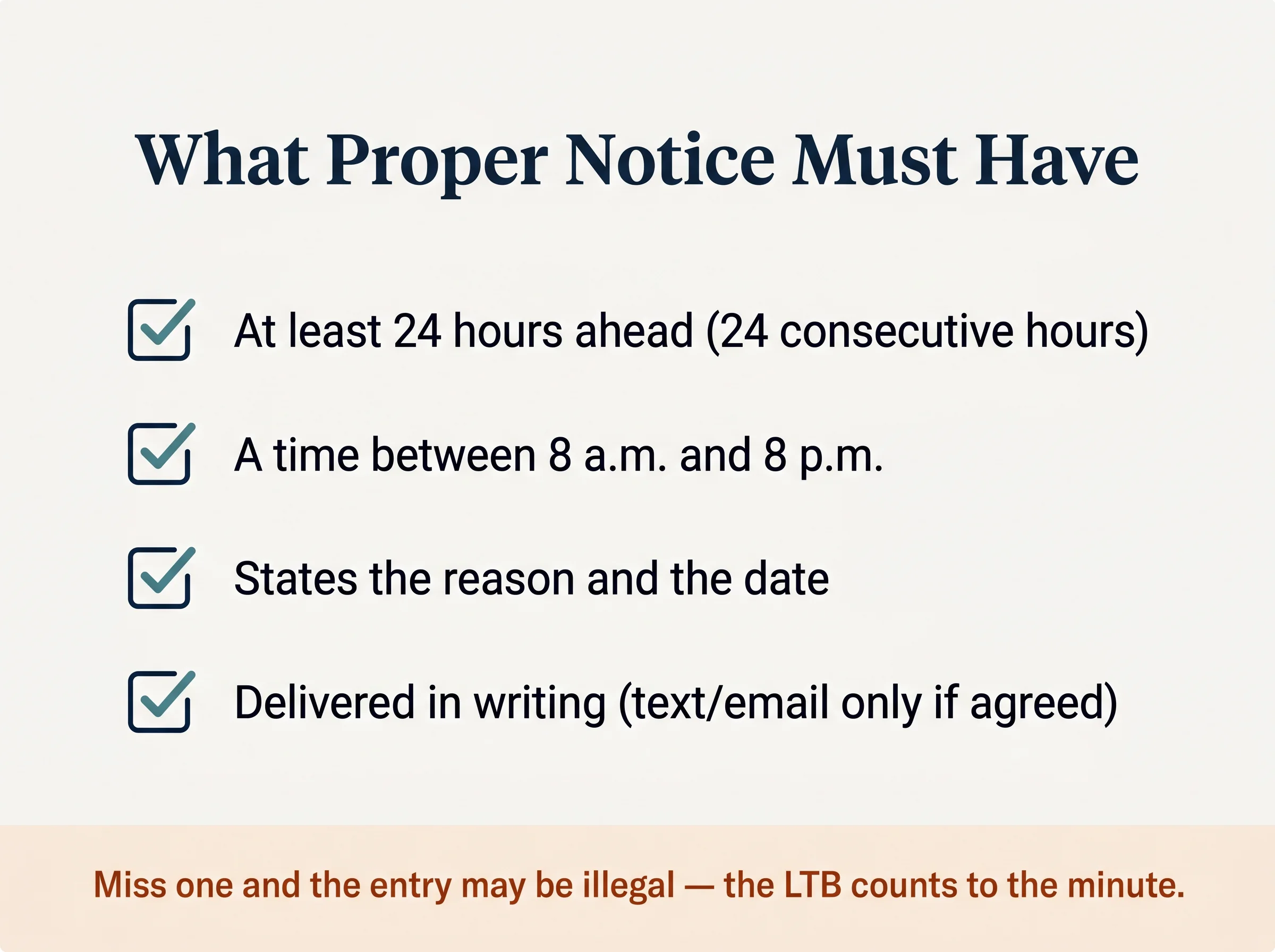
Here's the part that surprises people: 24 hours means 24 consecutive clock hours — not "the next business day," not "about a day." A notice delivered at 3 p.m. Tuesday permits entry no earlier than 3 p.m. Wednesday. And the LTB enforces this with genuine precision. In real cases, a 20-hour notice for a plumber's visit was ruled illegal entry; a landlord who served notice for one date but entered the next day was found to have entered illegally; and a notice giving an 8-hour window was found too broad, drawing a $500 rent abatement and a $2,000 administrative fine. The reason the rule is this strict is simple — the unit is the tenant's home for the term, and the RTA protects their right to reasonable enjoyment and privacy even though someone else owns it.
The Reasons a Landlord Can Enter
Proper notice isn't a free pass to enter for any reason. Section 27 sets out a closed list — these are the only grounds for a noticed entry:
- To carry out a repair, replacement, or work in the unit.
- To inspect whether repairs are needed — a repair-related inspection, not a search of your belongings or a check on your lifestyle.
- To show the unit to prospective tenants — but only after a notice of termination has been given, or in the last month of the tenancy.
- To let a prospective purchaser, mortgagee, or insurer view it — a registered realtor may enter with the landlord's written authorization, but still needs the 24-hour notice and the 8-to-8 window.
- For another reasonable reason written into the tenancy agreement.
"I wanted to check on something" is not on the list. A general wellness or lifestyle check isn't a valid ground for entry. And even for valid reasons, a landlord is expected to limit how often they enter — repeated or unnecessary entries can themselves amount to harassment or substantial interference with the tenant's reasonable enjoyment, which is its own violation.
When No Notice Is Needed — and What Counts as "Written"
Section 26 carves out a few situations where a landlord can enter without notice, and they're narrow. There are really only four: a genuine emergency (immediate risk to health, safety, or property — a fire, a burst pipe, a gas leak); your consent at the door when they arrive; abandonment, where the landlord reasonably believes you've moved out; and regular cleaning, but only if your lease specifically provides for it (and still within 8-to-8).
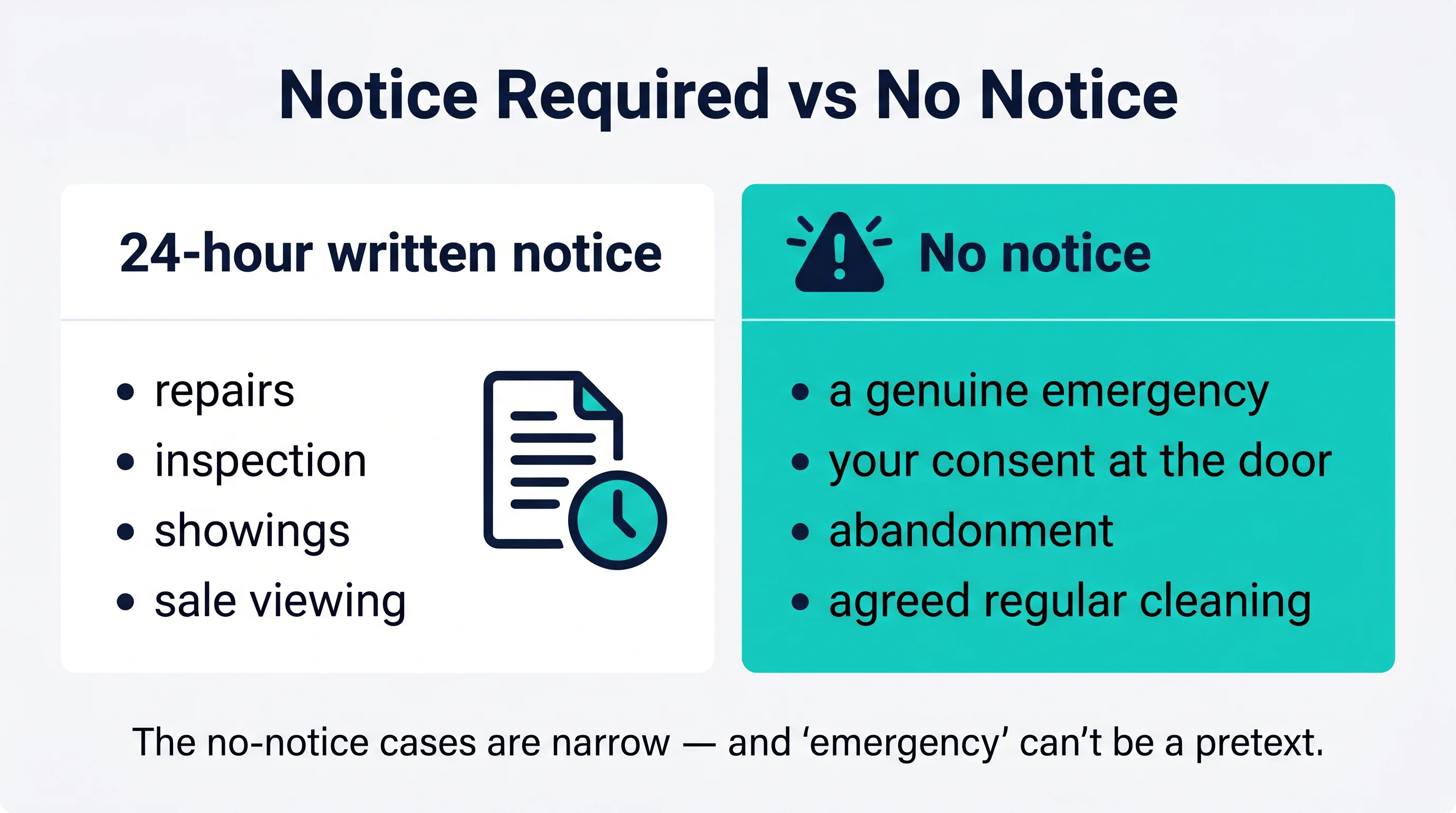
Two things to watch. First, "emergency" means an immediate risk — it can't be a pretext. A smoke-detector battery you mentioned needing replaced isn't an emergency; a reported gas smell is. If a landlord enters on an "emergency" that turns out not to be one, they risk an illegal-entry finding. Second, the lease-ending myth: once your tenancy is ending, showings still require 24-hour notice and the 8-to-8 window. "Ending" doesn't mean open access.
Then there's the gotcha that resolves a huge share of real disputes — what counts as "written" notice. Proper written notice is hand-delivered, placed under your door, or given by another permitted method. A text or email does not count unless you previously agreed to electronic communication in writing. A verbal "I'll come by tomorrow" never counts. The clean fix for both sides is to agree an email or text notice method in a signed addendum at move-in — which is exactly the kind of term covered in our guide to what you can and can't add to the standard lease.
The Playbook: Refuse, Comply, or File
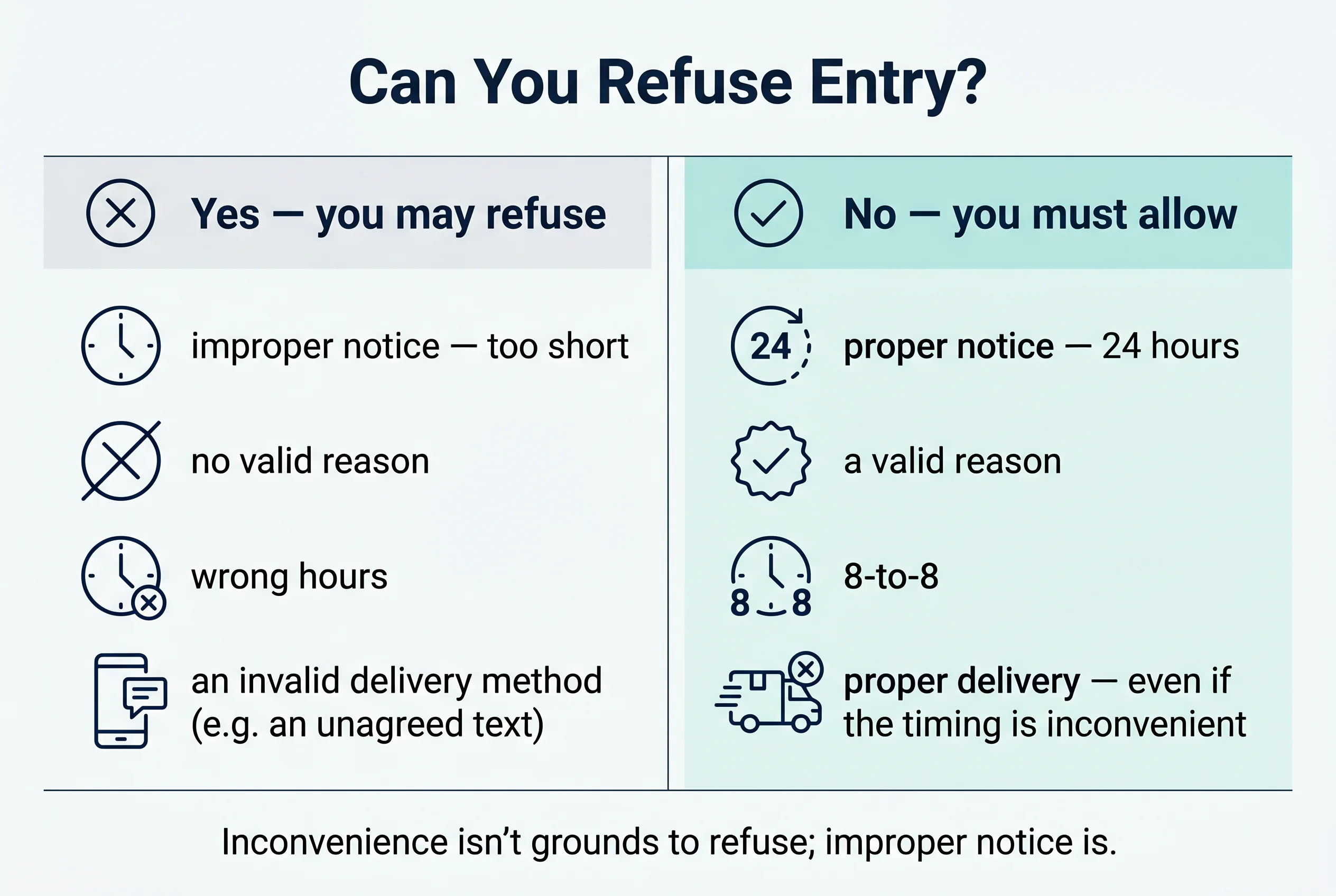
For tenants, the decision comes down to whether the notice is proper. If it is — 24 hours ahead, a valid reason, within 8-to-8, delivered properly — you provide access. Restrain any pets, and note that you don't have to be home; the landlord can enter when you're out if notice was proper. You can't refuse just because the timing is inconvenient. But if the notice is improper — too short, no valid reason, the wrong hours, or an invalid delivery method like an unagreed text — you can refuse, calmly and in writing.
Whatever happens, document it. Keep a dated log of every entry and attempt, save every notice and message, and take time-stamped photos. If your landlord enters illegally, or a pattern of intrusions builds up, that's a T2 (Application About Tenant Rights) under section 29 — the LTB can order a rent abatement, an administrative fine, or an order to stop. A landlord is liable for an illegal entry committed by their agent or realtor, too, and even a former tenant can file a T2 for an illegal entry that happened during the tenancy.
For landlords and property managers, staying clean is mostly procedure. Serve written notice at least 24 consecutive hours ahead, stating the reason, the date, and a reasonable time or window within 8-to-8. Use a valid section 27 reason — never a general "check-in." Get electronic-notice consent in writing at move-in, or deliver proper written notice every time. Don't reach for "emergency" without a genuine immediate risk, and document it if you do. Limit how often you enter, brief your realtor and contractors (you're liable for their illegal entry), and never self-help on locks — you can change them only if you give the tenant a key at no cost. Proper notice protects everyone: it keeps a routine repair from turning into an LTB application.
The Notice of Entry Rules Cheat-Sheet
The 24-hour rule, the valid reasons, the exceptions, and the T2 remedy — everything both sides need on one page.
Get Free PDF →Key Takeaways
For tenants:
- A landlord needs 24 hours' written notice, a valid reason, and a time within 8 a.m.–8 p.m. — 24 consecutive hours, enforced strictly.
- A text or email only counts as notice if you agreed to electronic notice in writing.
- No-notice entry is limited to a genuine emergency, your consent, abandonment, or agreed cleaning.
- You can refuse improper notice, but not a properly-noticed entry that's merely inconvenient.
- Log everything, and file a T2 under section 29 for illegal entry.
For landlords and property managers:
- Serve written notice at least 24 consecutive hours ahead with reason, date, and a reasonable window; use a valid section 27 reason.
- Get e-notice consent in writing at move-in; don't misuse "emergency."
- You're liable for your agent's illegal entry, and you can't self-help on locks.
Conclusion
In Ontario, a landlord almost always needs 24 hours' written notice to enter, only between 8 a.m. and 8 p.m., and only for a reason on the closed section 27 list. The exceptions — a genuine emergency, your consent, abandonment, agreed cleaning — are narrow, and a text or email doesn't count as notice unless you agreed to it in writing. The LTB enforces the timing strictly, and illegal entry is a T2 away from an abatement or a fine.
None of this is adversarial. Proper notice protects both sides and keeps a routine entry routine. This is general information, not legal advice — confirm the current details and your situation at ontario.ca or with the Landlord and Tenant Board.
Keep every entry notice on the record
From compliant entry notices to an agreed communication method and the full tenancy record, Tenon10 keeps your documentation organized and dispute-proof.
Free • No signup required • Built for Ontario
Frequently Asked Questions
How much notice does a landlord need to enter in Ontario?
At least 24 hours' written notice, and entry only between 8 a.m. and 8 p.m. The notice must state the reason, the date, and a time (or a reasonable window). The 24 hours means 24 consecutive clock hours — the LTB enforces it strictly.
Can my landlord enter without notice in Ontario?
Only in narrow cases: a genuine emergency (fire, burst pipe, gas leak), if you consent at the door, if they reasonably believe you've abandoned the unit, or for regular cleaning your lease specifically provides for. Otherwise, 24 hours' written notice is required.
Does a text or email count as notice of entry?
Not unless you previously agreed to electronic communication in writing. Otherwise the notice must be delivered as proper written notice — for example by hand or under your door. Verbal notice never counts.
Can I refuse to let my landlord in?
You can refuse if the notice is improper — short notice, no valid reason, the wrong hours, or an invalid delivery method. You can't refuse a properly-noticed entry just because the timing is inconvenient.
What can I do if my landlord enters illegally?
Keep a dated log and save the notices, then file a T2 (Application About Tenant Rights) with the LTB under section 29. The Board can order a rent abatement, an administrative fine, or an order to stop — and a landlord is liable for an agent's or realtor's illegal entry.