There are a handful of things a landlord in Ontario can never cut off — not for unpaid rent, not for a damaged unit, not until an eviction is actually enforced. Heat, water, electricity, and gas are vital services, and for any Ontario landlord the obligation to supply them is close to absolute.
Both sides get this wrong. Some landlords think unpaid rent lets them shut off the hydro (it never does). Some tenants think anything essential — the air conditioning, the stove, the internet — counts as a vital service (it doesn't). And most people don't know the landlord is on the hook even when they simply forgot to pay the bill.
This guide covers exactly what a vital service is, what a landlord can never do with one, the minimum heat standard (and the stricter city rules), and what to do when a service fails. It's general information, not legal advice; confirm your situation at ontario.ca, the LTB, or your municipality.
Vital Services & No-Heat Action Plan
What a landlord can never cut off, the heat standard, and exactly what to do when a service fails — both sides on one page.
Get Free PDF →What Counts as a Vital Service (and What Doesn't)
The Residential Tenancies Act defines a vital service narrowly: hot or cold water, fuel, electricity, gas, and — during the colder months — heat. That's the whole list.
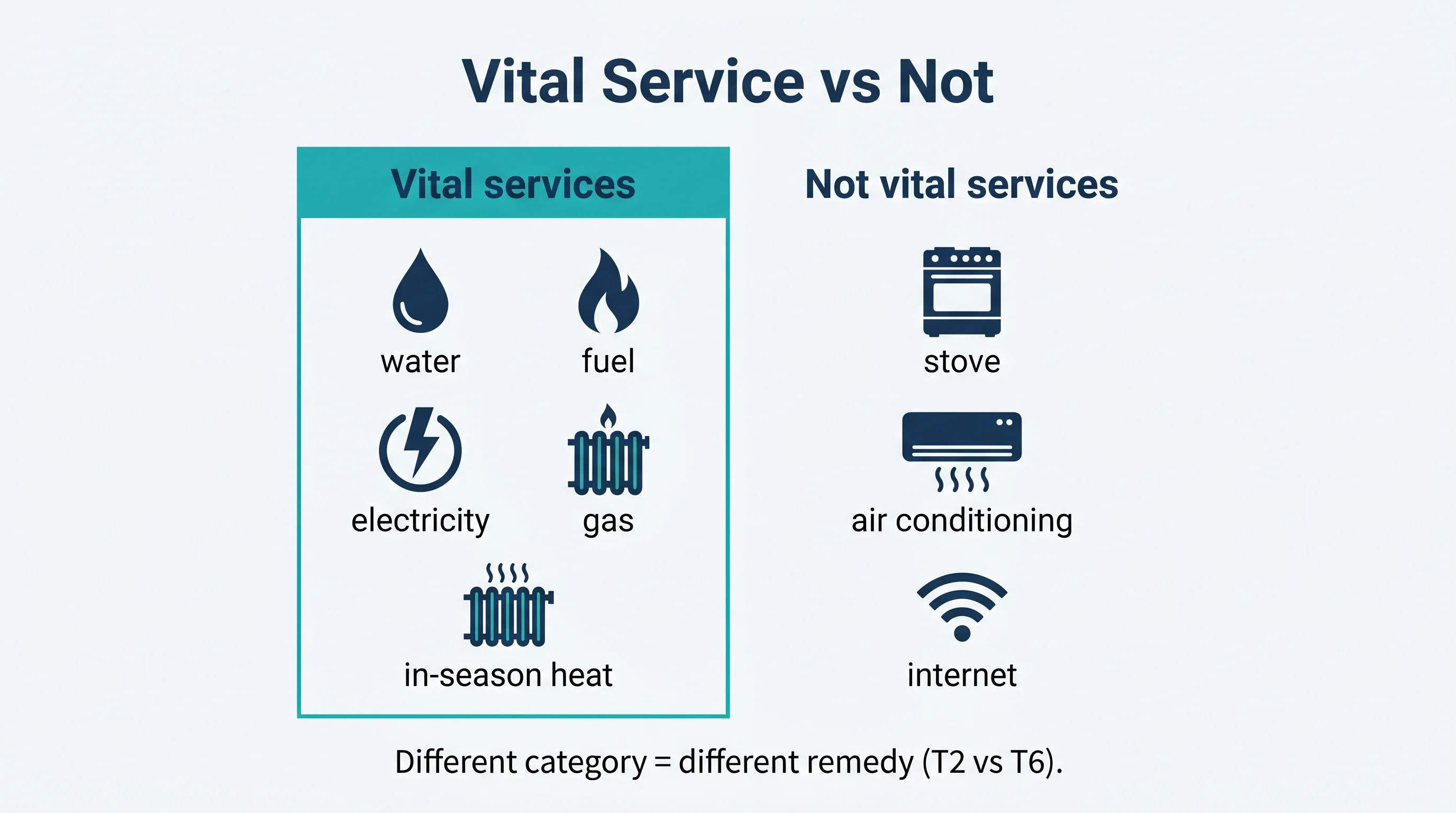
What's not on the list is the useful part. A stove, air conditioning, and internet are not vital services — the LTB has ruled that a stove, however important, doesn't qualify, and air conditioning and internet fall outside the vital-services protection too. This distinction matters because it changes the remedy. A cut-off vital service is a section 21 issue, enforced through a T2. A broken stove is an ordinary repair issue under section 20, enforced through a T6. Same building, different law. (Section 21 also protects "care services" and meals a landlord must supply, which is mostly relevant in care homes.)
The Rule a Landlord Can Never Break
Here's the core of it. Under section 21, a landlord shall not withhold or deliberately interfere with the reasonable supply of a vital service they're obligated to supply — at any time during the tenancy, until the eviction order is actually executed. Not issued. Executed. Right up until the sheriff enforces the order, the heat, water, and power stay on.
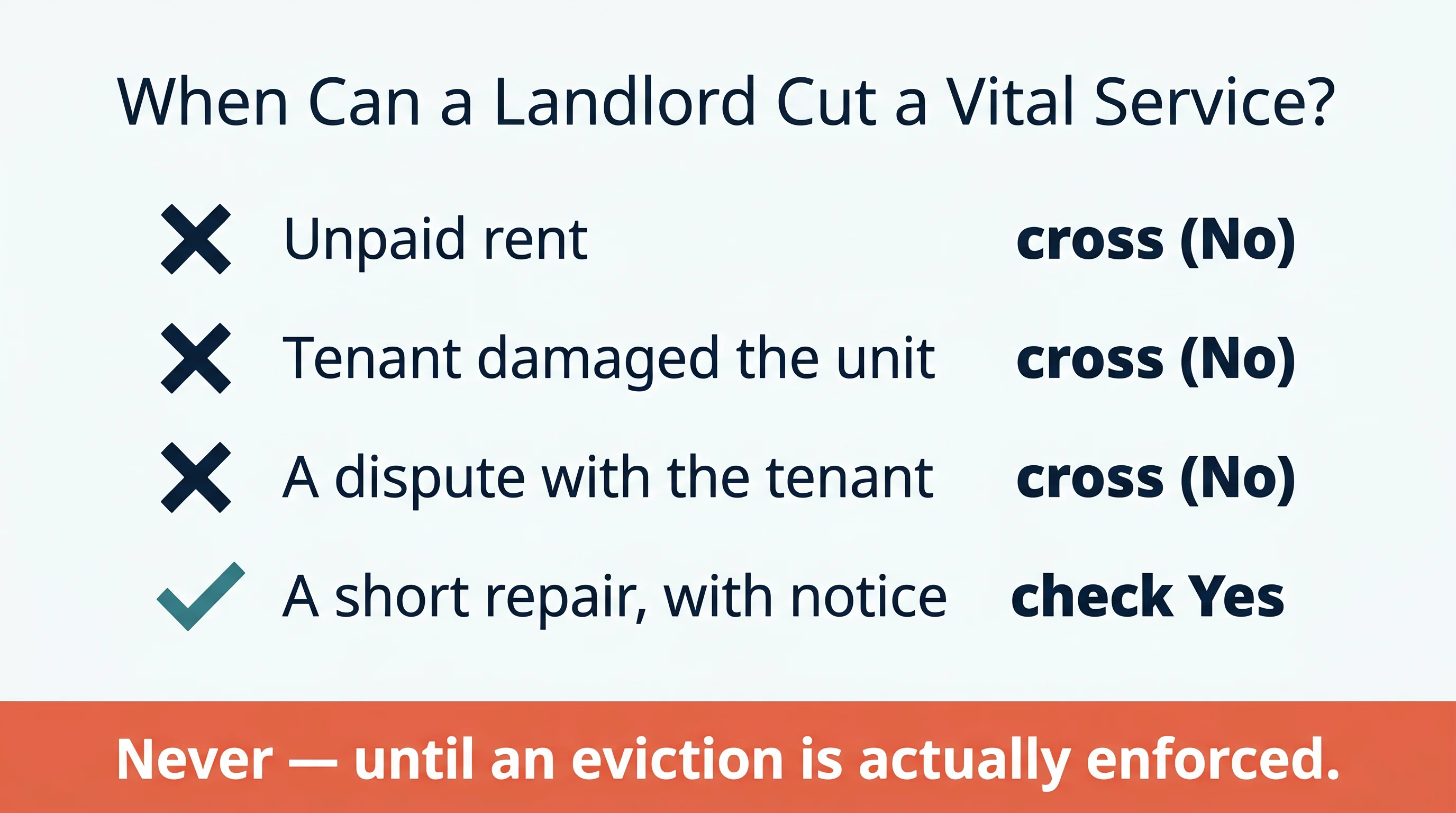
And it's absolute even in a dispute. It doesn't matter if the tenant owes rent or damaged the unit — under no circumstance can a vital service be cut as leverage. The protection applies even to an oral or implied tenancy, so there's no "but we never signed a lease" loophole. There's also a trap most landlords don't see coming: if the landlord is responsible for the utility bill, doesn't pay it, and the service gets cut off as a result, the law deems them to have withheld it. "I forgot" is not a defence. On top of all this, using a shut-off to pressure a tenant out is separately a form of harassment under section 23 — a second violation stacked on the first.
Heat, Hot Water, and the Metering Nuance
Heat gets its own standard. If the landlord provides heat, the provincial minimum is 20°C from September 1 to June 15. But municipalities can — and many do — require more, and their stricter bylaw governs.
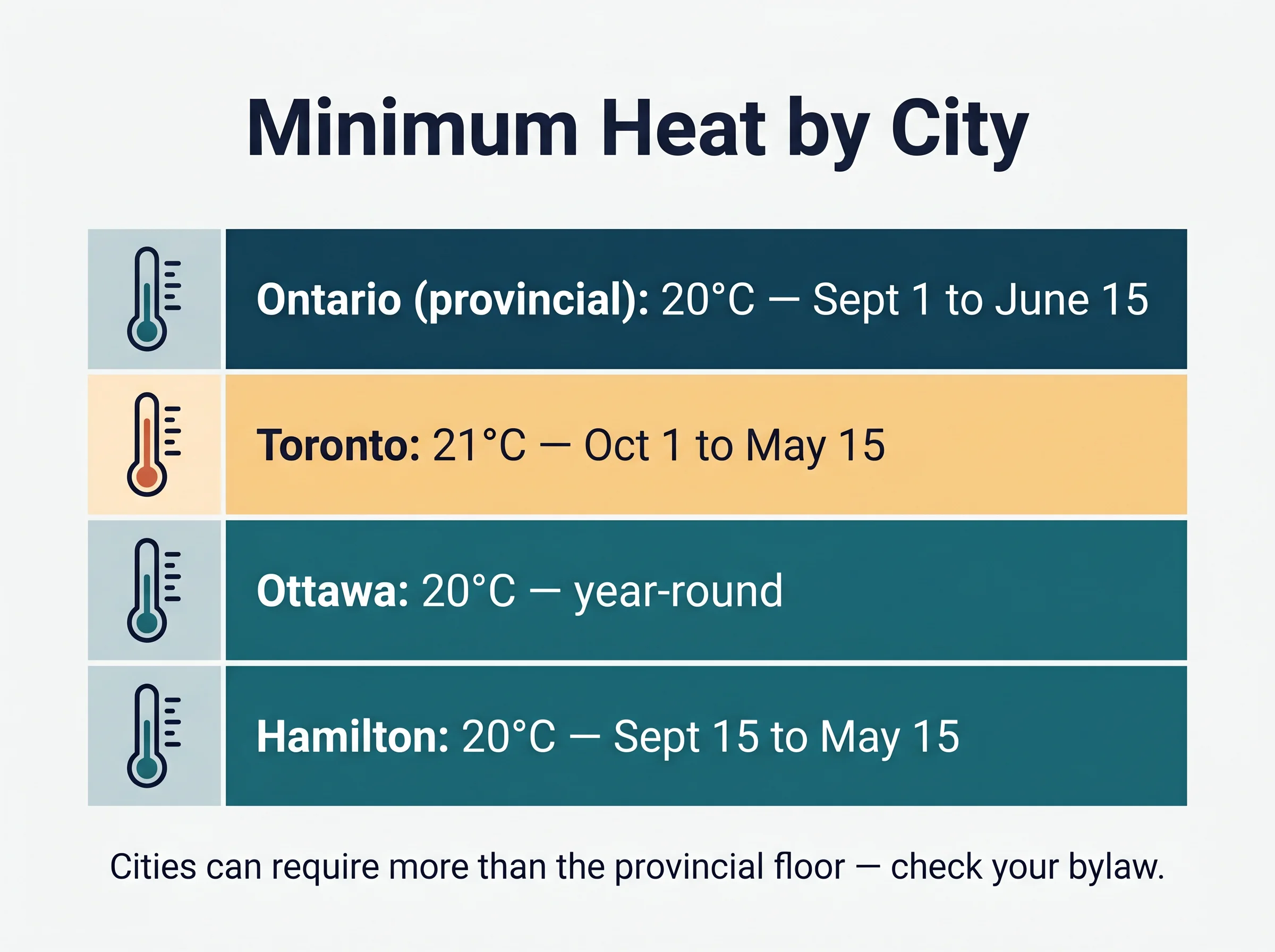
Toronto requires 21°C from October 1 to May 15; Ottawa requires 20°C year-round; Hamilton requires 20°C from September 15 to May 15. There's a common-sense shoulder-season allowance — if the weather keeps the unit warm enough without heat, the landlord can turn it off — but the floor applies whenever it's cold. (The city-by-city detail, including how to complain, gets its own guide later in this series.)
Then there's the metering nuance that trips people up. Where a suite meter was installed with the tenant's consent, the tenant pays for their own electricity, and that electricity isn't a section 21 vital service — a suite-meter dispute runs through a T7, not a T2. But if electricity is the primary source of heat for the unit, the landlord still can't cut the electric heat. And to be clear on the contrast with a related topic: air conditioning is not a vital service — though, separately, since July 1, 2026 tenants can install their own window or portable AC under section 36.1 if the conditions are met, which we cover in our guide to the new AC rules.
When a Service Fails: The Playbook
First, separate a real interruption from a violation. Reasonable, temporary interruptions for repairs or upgrades are fine if the landlord restores service promptly and ideally gives notice, and a utility-wide outage isn't the landlord's fault — though they must restore service once it's resolved. A deliberate shut-off, or a "repair" that drags on unreasonably, is the violation.
For tenants, the path is straightforward. Tell the landlord in writing right away — describe the problem, give a short deadline, and keep a dated copy along with photos and temperature readings. For anything urgent, like no heat in winter or no water, call municipal bylaw or property standards; they can inspect and order repairs, and their report is evidence. If a vital service is shut off or interfered with, that's a T2 — the LTB can order it restored by a deadline, grant a rent abatement, impose a fine, and bar rent increases until it's fixed. If instead the landlord simply won't repair the equipment behind it — a dead furnace, say — that's a T6, where you can also ask to pay rent to the LTB pending the hearing.
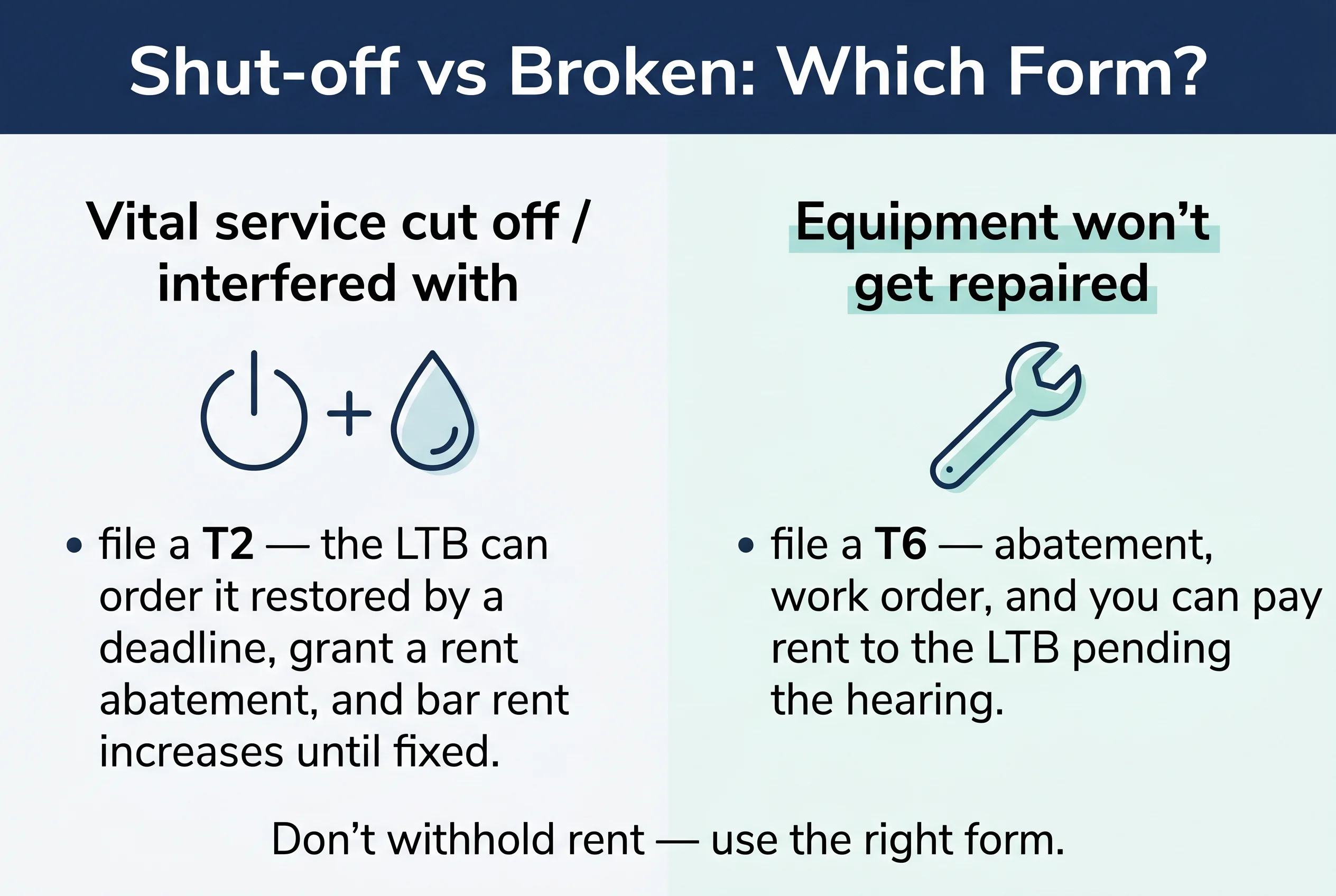
One warning for tenants: don't withhold rent to force the issue. It isn't a recognized remedy, and you'll end up defending an arrears eviction. The one narrow exception is that if the landlord failed to pay a utility bill they were responsible for, you may pay it yourself and deduct it from rent — but do that carefully and keep records.
For landlords and property managers, staying clean is simple in principle. Never cut a vital service — not for arrears, not for damage — until an eviction is actually enforced. Pay any utility bill you're responsible for (autopay removes the "I forgot" risk entirely). Meet your city's heat standard and keep the heating and HVAC serviced. Keep any repair interruptions short, noticed, and promptly restored, and answer written repair requests fast — a slow response is exactly how a small issue becomes a T6 and an abatement. And remember the stakes: withholding a vital service is an offence, and municipal fines run up to $100,000 (or as much as $10,000 a day) plus a special fine for any economic gain.
Handle maintenance fast — and on the record
From written repair requests to responses and the full tenancy record, Tenon10 keeps vital-service issues moving and documented — so small problems never become LTB applications.
Free • No signup required • Built for Ontario
Key Takeaways
For tenants:
- Vital services are water, fuel, electricity, gas, and in-season heat — a stove, AC, and internet are not.
- A landlord can never cut a vital service — not for unpaid rent, not for damage — until an eviction is enforced.
- Minimum heat is 20°C provincially (more in many cities, e.g. Toronto 21°C).
- Shut-off or interference is a T2; failure to repair the equipment is a T6.
- Don't withhold rent — document everything and use the right form.
For landlords and property managers:
- Never cut a vital service; pay any bill you're responsible for (an unpaid bill counts as withholding).
- Meet your city's heat standard and service the HVAC; keep repair interruptions short and restored promptly.
- Answer repair requests fast — and know the suite-meter nuance (electric heat still can't be cut).
Conclusion
In Ontario, heat, water, electricity, and gas are vital services, and a landlord can't withhold or deliberately interfere with them — not for unpaid rent, not for damage, not until an eviction is actually enforced. A stove, AC, and internet aren't vital services, so they follow the ordinary repair rules. There's a minimum heat standard (20°C provincially, more in many cities), the landlord is on the hook even for an unpaid bill, and the remedies are a T2 for a shut-off and a T6 for a failure to repair.
The system works when it's documented — write it down, use the right form, and involve the municipality for urgent heat or water. This is general information, not legal advice — confirm the current details and your situation at ontario.ca, the LTB, or your municipality.
Frequently Asked Questions
Can my landlord shut off my utilities for not paying rent in Ontario?
No. Heat, water, electricity, and gas are vital services, and a landlord can't withhold or deliberately interfere with them — even if you owe rent — until an eviction order is actually enforced.
What counts as a vital service in Ontario?
Hot or cold water, fuel, electricity, gas, and — during the colder months — heat. A stove, air conditioning, and internet are not vital services, though a broken stove is still a repair issue under section 20.
What temperature does a landlord have to keep the heat at in Ontario?
If the landlord provides heat, at least 20°C from September 1 to June 15 under provincial rules. Many cities require more — Toronto, for example, requires 21°C from October 1 to May 15.
What if my landlord doesn't pay the utility bill and the service gets cut off?
The landlord is deemed to have withheld the service and is responsible. You can file a T2 with the LTB, and in some cases pay the bill yourself and deduct it from rent — carefully and with records.
What should I do if I have no heat or water?
Tell your landlord in writing right away, give a short deadline, and contact municipal bylaw or property standards for urgent issues. If it isn't fixed, file a T2 (for a shut-off) or a T6 (for a failure to repair) with the LTB — and don't withhold rent.