

In Ontario, keeping a rental in good repair isn't a favour or a negotiation — it's a legal duty a landlord can't sign away. The landlord duty to repair in Ontario is one of the strongest tenant protections in the Act, and here's the part that surprises both sides: it applies even if the tenant knew about the problem before they moved in.
Maintenance is the single most common source of landlord-tenant friction, and it's riddled with myths. Tenants think an "as-is" clause binds them, or that they can withhold rent until a repair is done. Landlords think a known defect at move-in becomes the tenant's problem, or that any interruption automatically means an abatement. All of that is wrong.
This is the complete guide to the duty to repair — what "good state of repair and fit for habitation" actually means, the provincial and municipal standards that apply, who's responsible for what, and exactly how a tenant enforces it with a T6, including the rent abatements real cases produce. It's general information, not legal advice; confirm your situation at ontario.ca, the LTB, or your municipality.
The Repair Request & T6 Toolkit
The duty to repair, how to report a defect so it sticks, and how to enforce it with a T6 — both sides on one page.
Get Free PDF →The Duty You Can't Sign Away
The core of it is section 20 of the Residential Tenancies Act: a landlord is responsible for providing and maintaining the residential complex, and every unit in it, in a good state of repair and fit for habitation, and for complying with health, safety, housing, and maintenance standards. In plain terms, that covers the structure (walls, roof, foundation), the essential systems (plumbing, electrical, heating), any appliances the landlord provides, and the common areas. Everything the landlord supplies has to be kept in working order.
If something can't be fixed, the landlord has to replace it — but not necessarily with a newer or better model. If a supplied stove dies and can't be repaired, a working used stove is a perfectly acceptable replacement; the duty is to restore working order, not to upgrade.
Now the part that catches people out. The duty applies even if the tenant was aware of the disrepair before signing the lease (section 20(2)), and a clause saying the tenant "accepts the unit as-is" does not waive it — section 16 of the Act prohibits contracting out of these protections. A landlord can't rent a substandard unit cheaply and disclaim responsibility for it. The obligation is ongoing, and it's independent of what the place looked like on move-in day.
The Standards That Layer On
"Good state of repair" isn't left entirely to interpretation — there are concrete standards underneath it, and they stack.
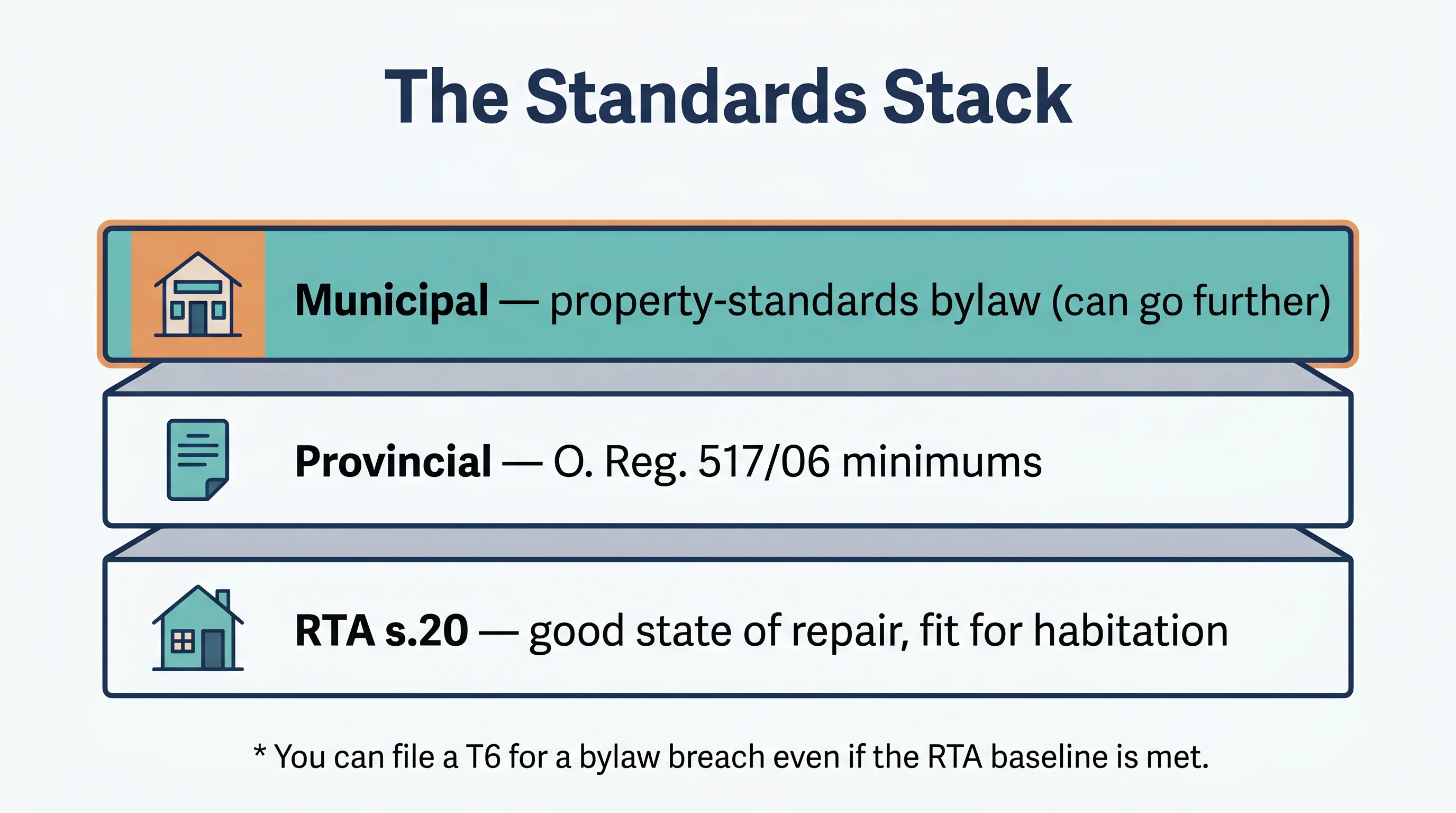
At the provincial level, the Maintenance Standards regulation (O. Reg. 517/06) sets minimums: repairs done to good workmanship with proper materials, structural soundness (weathertight, damp-proofed, protected against rot and vermin), plumbing free of leaks, safe electrical, heat that's capable of and maintained at least 20°C, pest protection, and working fixtures, locks, and security. On top of that, municipal property-standards bylaws layer on and can go further than the provincial floor — a higher heat standard, for example. Treat the provincial regulation as the baseline and your local bylaw as the governing standard where one exists.
One consequence is worth stating plainly: a tenant can file a T6 for a municipal bylaw breach even if the landlord technically meets the RTA baseline. And some things are simply non-negotiable — working smoke and carbon monoxide alarms, safe wiring, and secure locks are part of the floor, not extras.
Not Automatic: Reasonableness and Who Fixes What
Here's the nuance that thin guides miss: a defect or an interruption isn't an automatic breach. When a tenant applies, the LTB weighs the whole factual context — how severe the problem was, how long it lasted, and whether the landlord ran a genuine preventive-maintenance program and responded reasonably.
The case that proves the point involved an elevator that was out of service for 96 days in a single year. The tenants sought an abatement; the Board said no — because the landlord had a preventive-maintenance program, fixed the breakdowns as they happened, and ultimately replaced the elevator. It had acted reasonably throughout. The flip side, from the LTB's own guidance, is that a good maintenance program is "not a release" from fixing a real problem: every legitimate request still has to be answered within a reasonable time, worst problems first (a water leak comes before a loose tile).
Responsibility also splits cleanly between the two sides.
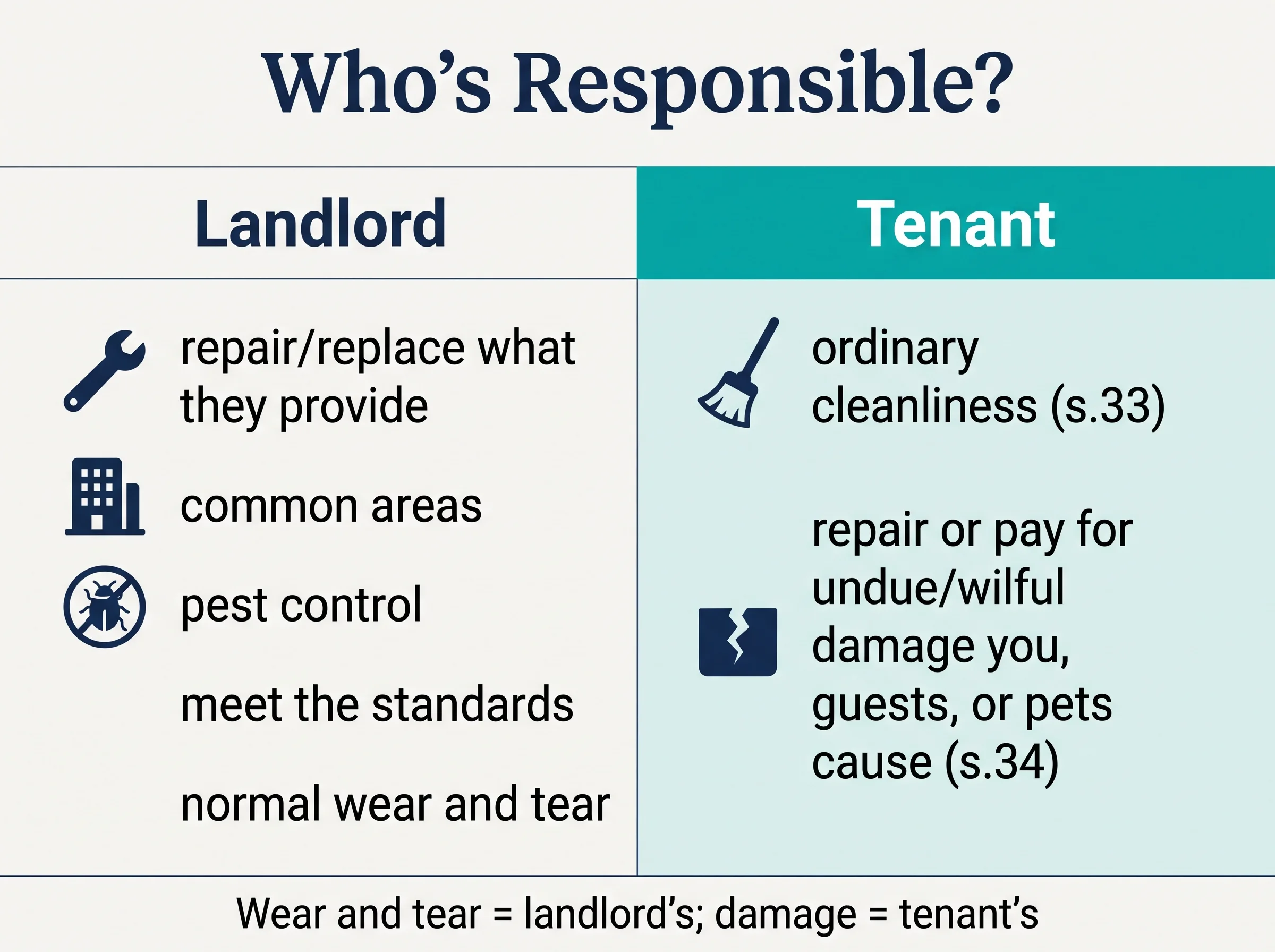
The landlord repairs and replaces what they provide, keeps common areas clean and in repair, controls pests, meets the standards, and keeps the vital services on. The tenant keeps the unit to ordinary cleanliness (section 33) and repairs — or pays for — undue or wilful damage they, their guests, or their pets cause (section 34). The line that drives most end-of-tenancy disputes is the one between the two: normal wear and tear is the landlord's to absorb, while damage is the tenant's. Good move-in and move-out inspections are what separate the two when it matters.
How Tenants Enforce It: The T6 Path
When repairs don't happen, there's a clear route — and it starts long before the LTB.
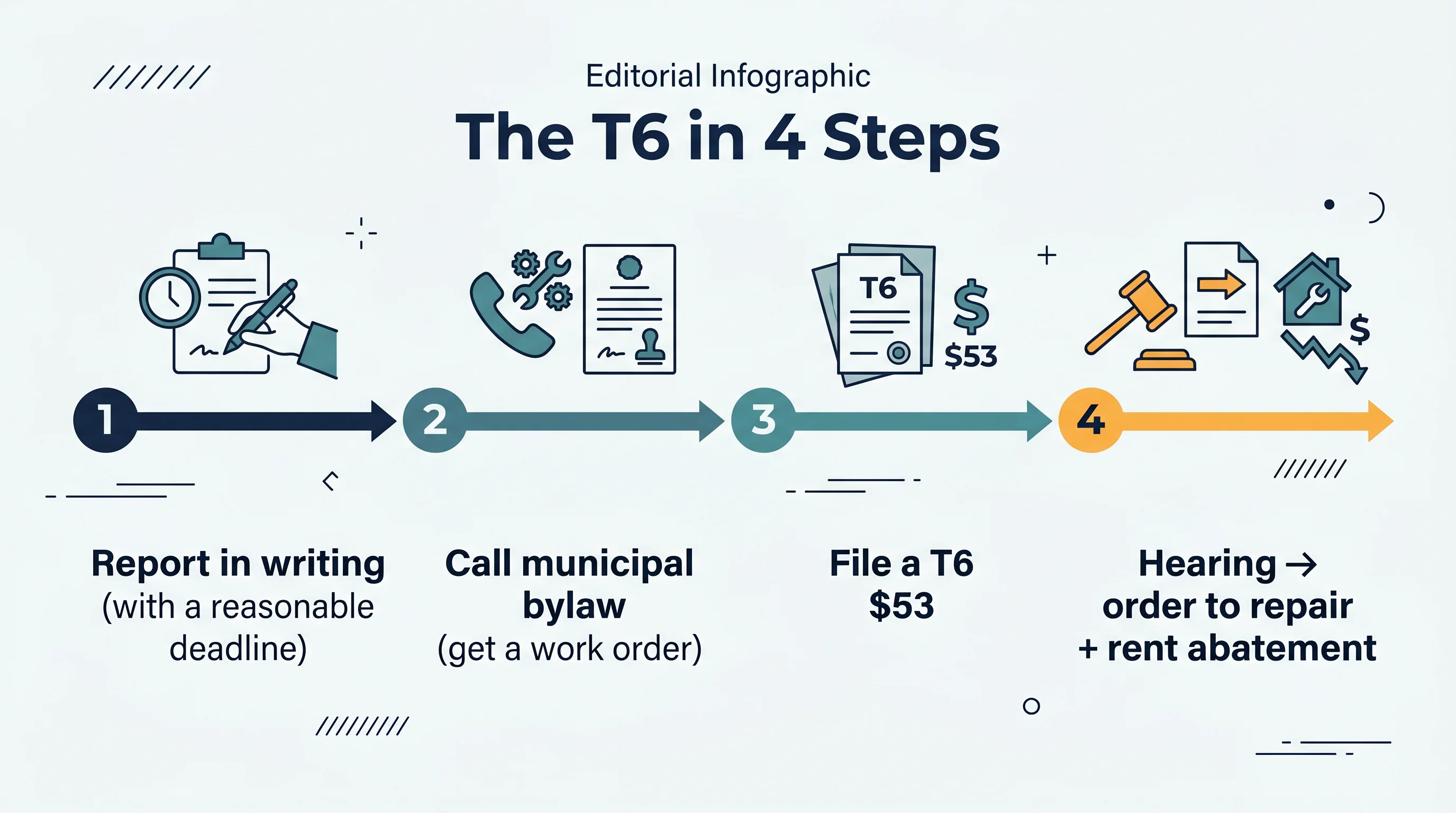
Step one is to write it down. Report the defect to the landlord in writing — email or text is fine — with a clear description and a reasonable timeline. Roughly 24 hours for an emergency like no heat, a burst pipe, or a gas leak; one to two weeks for something non-urgent. This matters because the Board looks at whether the landlord had a reasonable opportunity to fix the problem, so keep the copy or the screenshot — otherwise the landlord argues "I didn't know." Step two, in parallel, is to call municipal property standards for an inspection; the work order and report they produce are strong evidence. Step three is to file a T6 (Application About Maintenance) — it's $53 and filed online — within one year. For an ongoing problem, that one-year clock runs from when the repair is completed, not when it started, so a long-running issue isn't time-barred.
A useful lever while you wait: a T6 tenant can ask to pay rent to the LTB, rather than the landlord, pending the hearing. And the Board's powers are broad — under section 30 it can order the work done by a deadline, grant a rent abatement, bar a rent increase until the problem is fixed, or in serious cases terminate the tenancy.
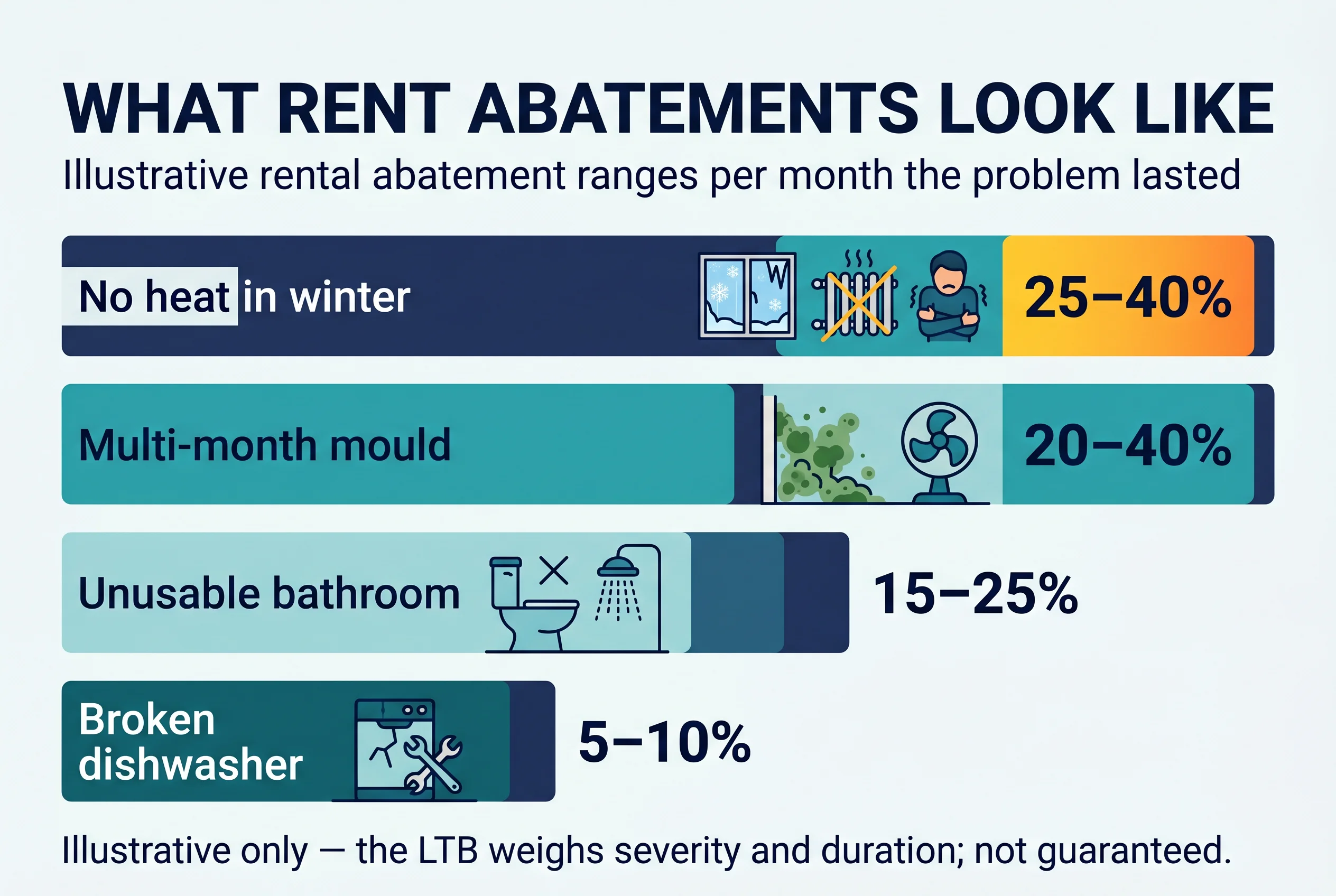
Abatements scale to how bad the problem was and how long it lasted. As a rough guide from decided cases — illustrative, not guaranteed — no heat in winter tends to draw around 25–40% per month, multi-month mould around 20–40%, an unusable bathroom around 15–25%, and a broken dishwasher around 5–10%, applied to each month the defect persisted. Two firm don'ts round this out: don't withhold rent (a landlord can evict you for arrears even while they're in breach, and the only lawful abatement route is an LTB order), and don't fix it yourself and deduct the cost expecting reimbursement.
The Landlord's Playbook: Preventive Maintenance Is the Defence
If you own or manage the property, the takeaway from all of the above is liberating rather than daunting: since you can't waive section 20 and a known defect doesn't shift it, the goal isn't a clever clause — it's a documented system.
Run a genuine preventive-maintenance program and a complaint-response process, and log both. That's not just good service; it's literally your best legal defence, as the elevator case shows — reasonableness is what the Board measures, and you can only prove it if you recorded it. Answer written requests quickly and worst-first, and note your response times. Meet both the provincial standards and your municipal bylaw (confirm the local one), keep common areas clean, control pests, and keep everything you supply in working order. And document the wear-versus-damage line with solid move-in and move-out inspections, so a tenant-caused problem under section 34 doesn't land on you.
The payoff is real: fewer applications, lower abatement risk, and better retention. Maintenance done right is simply cheaper than maintenance litigated — and it never involves self-help like cutting a service or changing a lock, which are violations in their own right.
Turn maintenance into a paper trail that protects you
From written repair requests to responses and inspection records, Tenon10 keeps the documentation that proves reasonableness — for landlords and tenants alike.
Free • No signup required • Built for Ontario
Key Takeaways
For tenants:
- The duty to repair is broad and non-waivable — it applies even if you knew about the problem at move-in.
- Standards stack: the RTA duty, provincial minimums, and any stricter municipal bylaw.
- Report every defect in writing with a reasonable deadline, and build evidence.
- File a T6 ($53) within a year — for an ongoing issue, the clock runs from completion.
- Don't withhold rent; abatements come from the LTB and scale to severity and duration.
For landlords and property managers:
- You can't waive section 20 — a documented preventive-maintenance program is your real protection.
- Meet both provincial standards and your municipal bylaw; answer requests fast, worst-first.
- Document the wear-vs-damage line with inspections, and never self-help on services or locks.
Conclusion
A landlord's duty to repair in Ontario is broad, ongoing, and non-waivable. It applies even if the tenant knew about the problem, and it's measured against provincial standards plus any stricter municipal bylaw. It isn't an automatic breach every time something goes wrong — the LTB weighs reasonableness and the landlord's maintenance program — but when repairs genuinely don't happen, the tenant's route is a written request and then a T6, with abatements that scale to how bad and how long the problem was. And withholding rent is never the answer.
The whole system rewards documentation: a paper trail for tenants, a maintenance program for landlords. Do it right and most disputes never reach the LTB. This is general information, not legal advice — confirm the current details and your situation at ontario.ca, the LTB, or your municipality.
Frequently Asked Questions
What is a landlord required to repair in Ontario?
Under section 20 of the RTA, the landlord must keep the unit and building in a good state of repair and fit for habitation — structure, plumbing, electrical, heating, provided appliances, and common areas — and meet all health, safety, housing, and maintenance standards.
Can a landlord make me accept a unit "as-is" in Ontario?
No. The duty to repair applies even if you knew about the problem before signing, and an "as-is" clause can't waive it — the RTA prohibits contracting out of these protections.
How long does a landlord have to make a repair?
A reasonable time, judged by urgency — roughly 24 hours for emergencies like no heat or a burst pipe, and one to two weeks for non-urgent issues. The LTB looks at whether the landlord had a fair opportunity to fix it.
What can I do if my landlord won't make repairs?
Report it in writing, give a reasonable deadline, and contact municipal property standards. If it's still not fixed, file a T6 (Application About Maintenance) with the LTB — the Board can order the work done and grant a rent abatement.
How much rent abatement can I get for a repair problem?
It depends on severity and duration. As a rough guide from decided cases: no heat in winter around 25–40%, multi-month mould around 20–40%, an unusable bathroom around 15–25%, and a broken dishwasher around 5–10% — applied to each month the problem lasted. These aren't guaranteed.
Can I withhold rent until repairs are done?
No. Withholding rent isn't a recognized remedy and can lead to an eviction for arrears. The only lawful way to get a rent reduction for disrepair is an order from the LTB.


