Can your Ontario landlord actually make you get tenant insurance? There's no law that says you must — but that doesn't mean the answer is no. When it comes to the tenant insurance Ontario landlord requirement question, the real answer is simple: if it's written into your lease, you're bound by it.
The confusion runs both ways. Tenants assume the landlord's insurance covers their belongings (it doesn't), or that a casual "you should get insurance" is binding (it isn't). Landlords assume they can require it without writing it down (they can't), or evict the moment a tenant lacks it (usually they can't). Getting the details right matters on both sides of the lease.
This guide clears it up — whether a landlord can require it and how, what tenant insurance actually covers versus what the landlord's policy covers, whether you can be evicted for not having it, and what a landlord can reasonably demand as proof. It's general information, not legal or insurance advice; confirm your situation at ontario.ca or with a licensed broker.
Tenant Insurance in Ontario: The Cheat-Sheet
What a landlord can require, what it covers, and how to get it right — both sides on one page.
Get Free PDF →No Law Requires It — But Your Lease Can
Start with the headline: no Ontario law requires a tenant to carry insurance. But a landlord can make it a condition of the tenancy — and it's enforceable only if it's explicitly written into the signed lease. A verbal "you should really get insurance" carries no weight; if it isn't in the document you signed, it isn't binding.
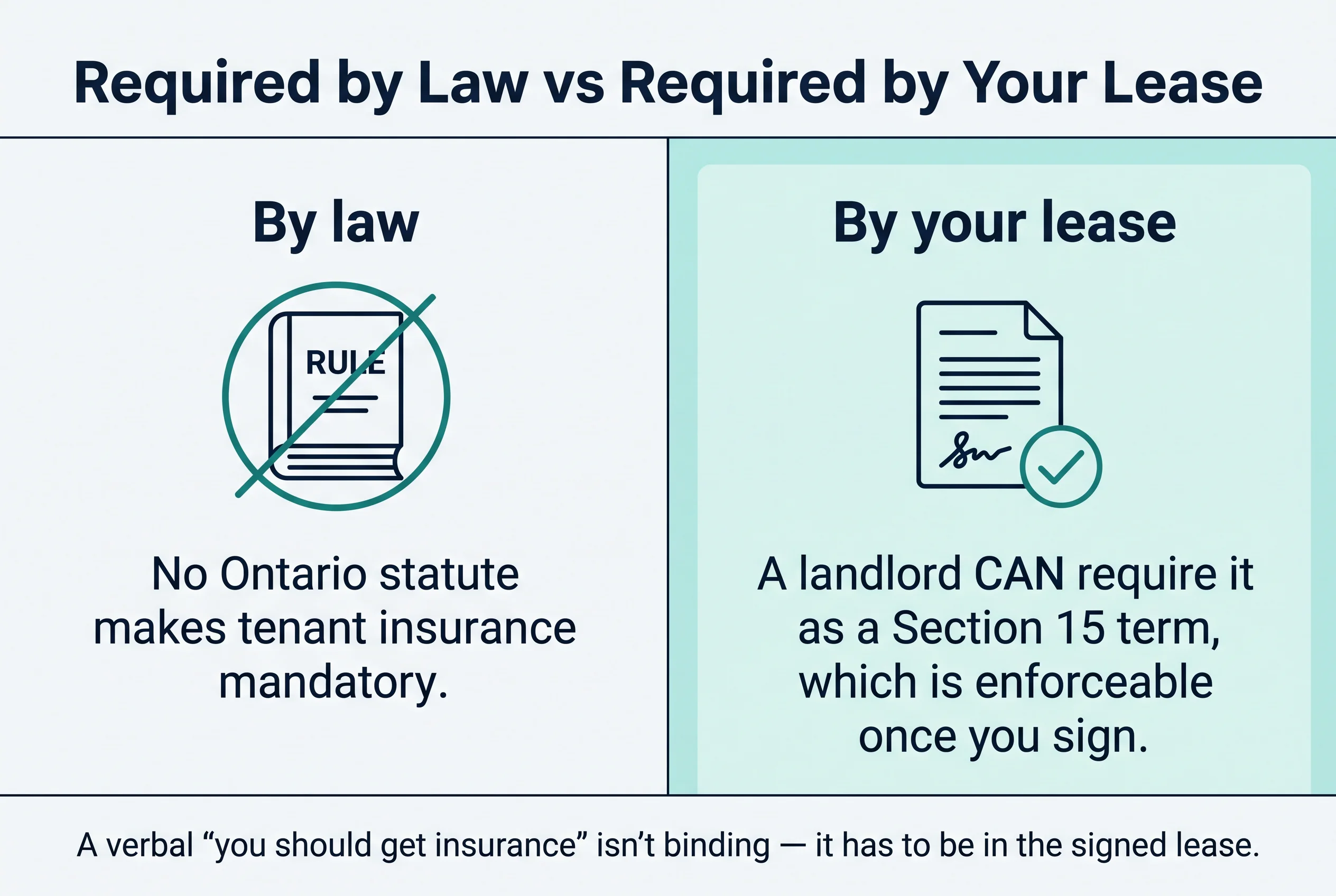
Here's the mechanism. The Ontario Standard Lease (Form 2229E) contains no tenant-insurance clause at all. To require it, a landlord adds it as an additional term referenced in Section 15, signed together with the lease. This is the same mechanic as the pet and smoking clauses: it has to be in the lease from the start. Adding it mid-tenancy needs the tenant's agreement and a re-signing. A prospective tenant can refuse to sign added terms before signing — but if you sign a lease that includes the requirement, you're bound by it. One limit worth knowing: the clause can't strip an RTA right, so it can't make you liable for the landlord's own obligations or for normal wear and tear.
What It Covers (and What the Landlord's Policy Covers)
This is the single most misunderstood part, so let's be blunt about it: your landlord's insurance does not cover your belongings or your liability. It covers the building. Full stop. If you want your things and your liability protected, you need your own tenant insurance.
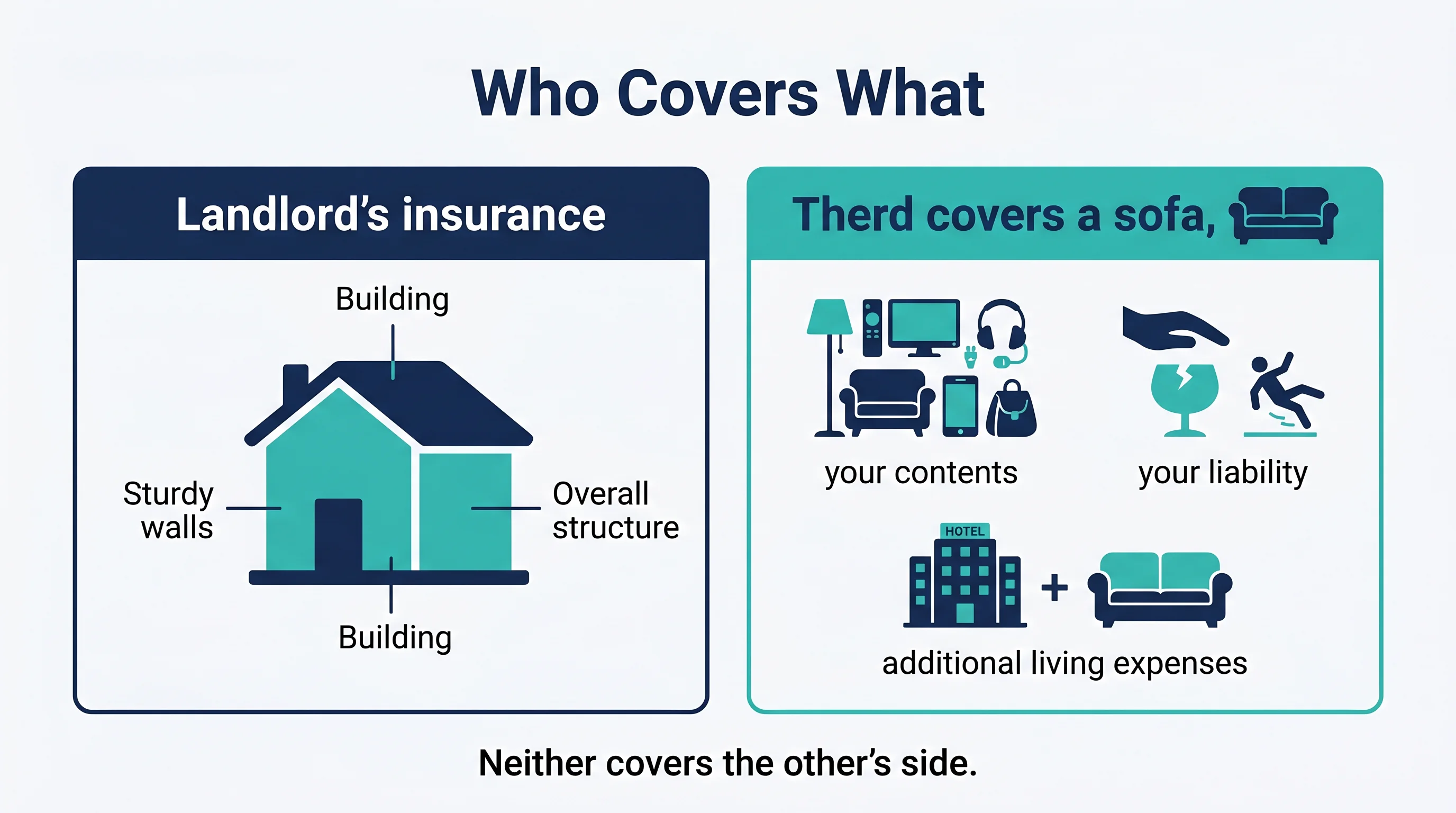
Tenant insurance does three things. It covers your contents — furniture, electronics, clothing, valuables — against fire, theft, water damage, and similar losses. It covers your personal liability — if you accidentally injure a visitor, or cause damage that reaches the building or a neighbour's unit (a kitchen fire, an overflowing tub). And it covers additional living expenses — temporary housing if a covered loss makes your unit uninhabitable. What it doesn't cover is the building itself; that's the landlord's own policy.
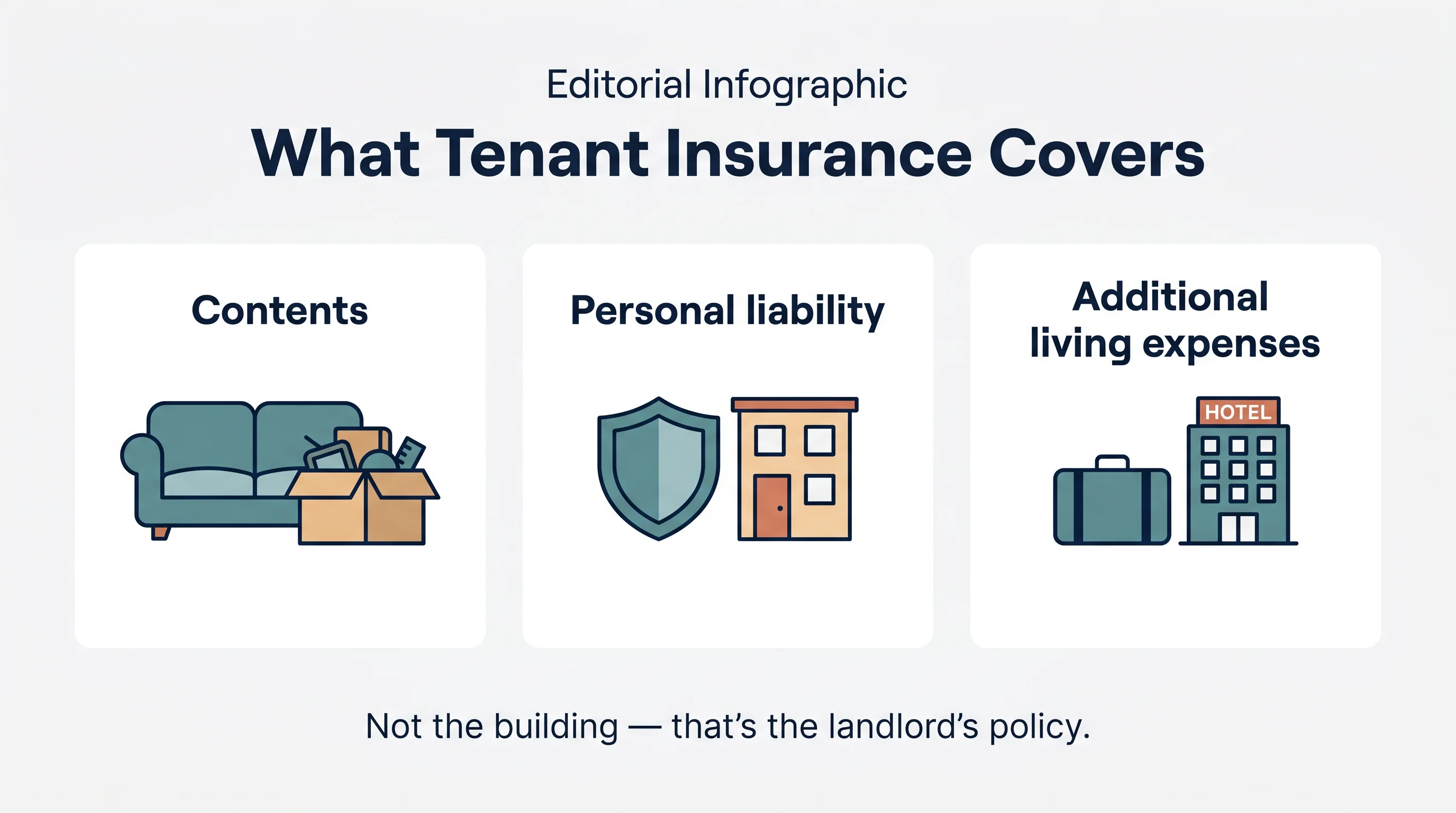
Contents coverage gets all the attention, but liability is the underrated part — and often the most financially dangerous scenario. If you flood the unit below yours, or a fire you accidentally start spreads to a neighbour, that liability coverage is what stands between you and a very large bill. It's also exactly why landlords care: if a tenant damages a neighbouring unit, it's the tenant's liability coverage — not the landlord's — that responds.
Can You Be Evicted? And What a Landlord Can Demand
The eviction question needs a careful answer. A landlord generally cannot evict a tenant solely for lacking insurance — unless the tenant agreed to carry it in writing (in the lease) and then failed to get or keep it. In that case it can be a breach of a material term the landlord pursues at the LTB (typically an N5; if unremedied, an L2). But it's a possible breach the Board decides on the facts, not an automatic eviction — and a lease can't override your statutory rights. Practically, given the low cost, complying is almost always the smarter move.
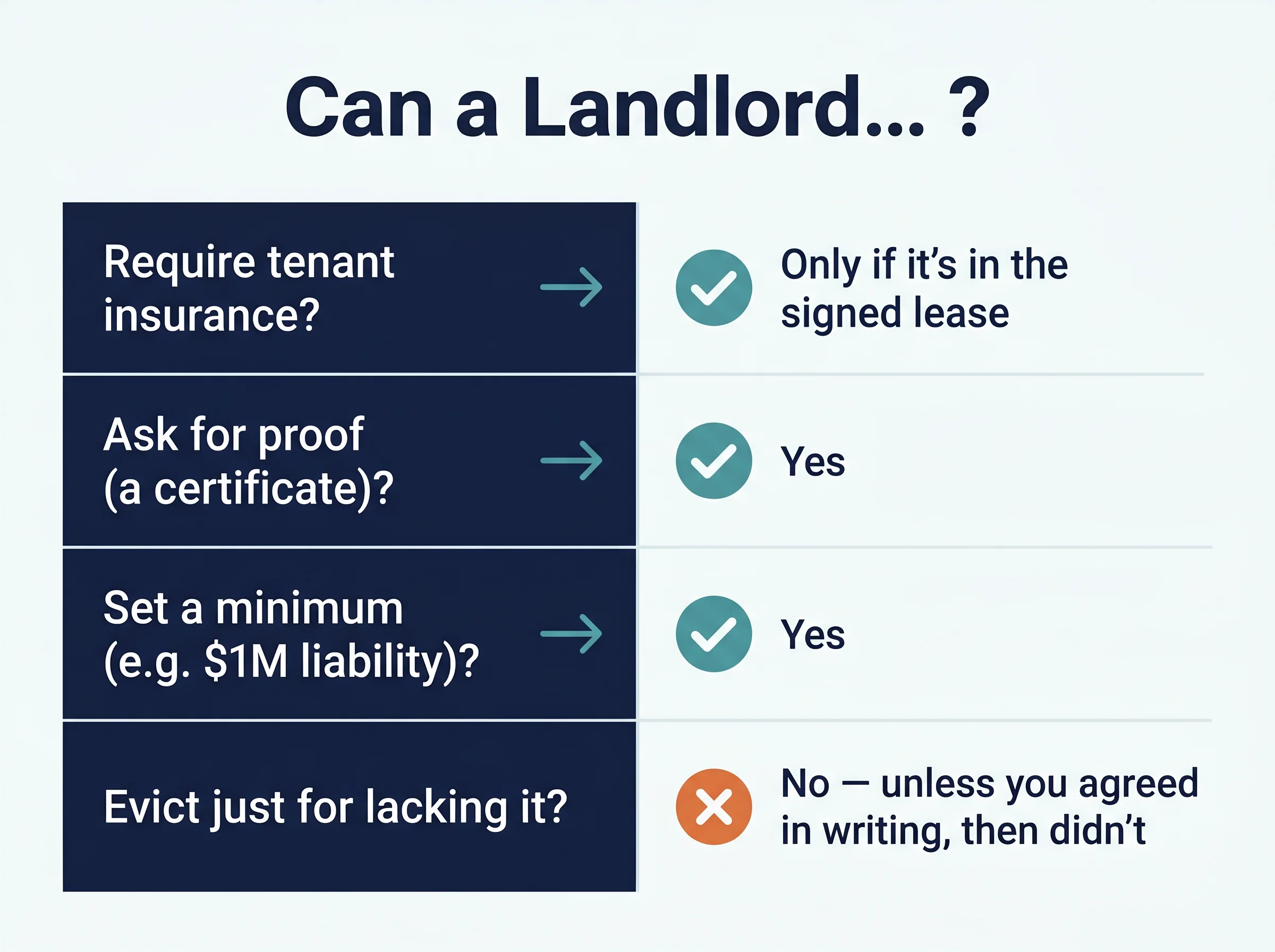
Within those limits, a landlord can reasonably demand a fair amount. They can set a minimum liability amount — commonly $1,000,000. They can require proof: a certificate of insurance, a declaration page, or a broker letter showing the named insured, the coverage limits, and the effective dates. They can require that proof before handing over keys, and that the policy be maintained throughout the tenancy. And they can sometimes ask to be named as an "additional insured," which insurers can issue. Where a landlord over-reaches — trying to make you cover their obligations or normal wear and tear — the clause isn't enforceable, and you can raise an unfair clause with the LTB.
The Playbook: Cost, Proof & Roommates
For tenants, the practical picture is reassuring. Tenant insurance typically runs about $15–35 a month — the Ontario average is roughly $302 a year, around $313 in Toronto — with deductibles usually $500–$1,000. For $15,000–30,000 of belongings plus personal liability, it's often less than a streaming bundle. A few things to get right:
- Read the lease for the actual requirement and minimum — it's only binding if it's written in.
- Get the right coverage — contents, liability, and living expenses; consider $1M liability, and in Toronto or a basement unit, add sewer-backup and overland-water coverage (~$5–15/month), since aging sewer systems make backups a real risk.
- Provide proof and keep a dated copy of the certificate, and maintain the policy — letting it lapse can breach your lease.
- Roommates: get your own policy. Unless you're related or married, separate policies are usually better — a shared policy blends claims histories and splits limits, and only named people are covered in a loss.
For landlords and property managers, the playbook is short: put the requirement in a Section 15 term signed with the lease; set a reasonable minimum (commonly $1M liability) and state the proof and maintenance requirements; require a certificate before keys; don't over-reach; and treat a lapse as a possible breach through the N5 route, not self-help. Done cleanly, it's one of the simplest ways to reduce your liability exposure — which is exactly why insurance clauses have become standard in condos and larger-city rentals.
Tenant Insurance in Ontario: The Cheat-Sheet
Coverage, proof, minimums, roommates, and the eviction nuance — everything both sides need on one page.
Get Free PDF →Key Takeaways
For tenants:
- No law requires tenant insurance, but your lease can — and once it's in a signed lease, you're bound.
- Your landlord's policy covers the building, not your belongings or your liability.
- It covers your contents, your liability, and additional living expenses — for about $15–35/month.
- You generally can't be evicted just for lacking it, unless you agreed in writing and then didn't get it.
- Roommates should each carry their own policy.
For landlords and property managers:
- Put the requirement in a Section 15 term, signed with the lease; set a reasonable minimum (commonly $1M).
- Require a certificate before keys; don't strip RTA rights.
- Treat a lapse as a possible breach (N5 → LTB), not self-help — and remember the tenant's liability coverage, not yours, responds to neighbour damage.
Conclusion
In Ontario, no law forces you to carry tenant insurance — but your lease can require it, and once it's in a signed lease, it's enforceable. Tenant insurance covers your belongings, your liability, and your living expenses; the landlord's policy covers the building and none of your stuff. You generally can't be evicted just for lacking it, unless you agreed in writing and then didn't get it. And a landlord can reasonably ask for a minimum coverage level and a certificate as proof.
At roughly $15–30 a month for $15,000–30,000 of protection — plus liability cover if you damage a neighbour's unit — it's rarely worth the fight, and for landlords, a clean Section 15 clause beats an argument later. This is general information, not legal or insurance advice — confirm the current details and your situation at ontario.ca or with a licensed broker.
Keep the lease clause and the certificate together
From the Section 15 insurance term to the tenant's certificate and the rest of the tenancy record, Tenon10 keeps your documentation organized and easy to prove.
Free • No signup required • Built for Ontario
Frequently Asked Questions
Is tenant insurance mandatory in Ontario?
No law requires it. But a landlord can make it a condition of your tenancy, and if it's written into your signed lease, you're bound to carry it.
Does my landlord's insurance cover my belongings?
No. The landlord's policy covers the building, not your possessions or your liability. If you want your things and your liability covered, you need your own tenant insurance.
Can a landlord evict me for not having tenant insurance in Ontario?
Generally not for that alone — unless you agreed in writing to carry it and then failed to. That can be a breach of a lease term the landlord takes to the LTB (usually via an N5), which the Board decides; it isn't automatic.
What can a landlord ask for as proof of insurance?
Commonly a certificate of insurance, a declaration page, or a broker letter showing the named insured, the coverage limits, and the dates — often a minimum liability amount (frequently $1,000,000), and sometimes being named as an additional insured.
How much does tenant insurance cost in Ontario?
Typically about $15–35 a month. The Ontario average is roughly $302 a year (around $313 in Toronto), with deductibles usually $500–$1,000 — modest cover for $15,000–30,000 of belongings plus personal liability.