"Subletting" and "assigning" get thrown around like they're the same thing. They're not — and in Ontario, mixing them up can leave you paying rent on an apartment you've already moved out of, or hand you an escape hatch you didn't know you had. Understanding subletting vs assignment in Ontario comes down to one question, and the answer changes everything that follows.
The two are legally distinct under the Residential Tenancies Act, and the rules on what a landlord can refuse are different for each. Pick the wrong one, or misunderstand the consent rules, and it costs you — whichever side of the lease you're on.
This guide gives you the one-question test that tells them apart, the asymmetric consent rules, the 30-day exit most tenants don't know about, who stays on the hook for what, and how landlords should handle a request. It's general information, not legal advice; for a specific situation, confirm at ontario.ca or with the Landlord and Tenant Board (LTB).
Sublet vs Assignment: The Ontario Decision Guide
Which route to take, how to get consent, and who stays liable — both sides on one page.
Get Free PDF →The Core Distinction: Are You Coming Back?
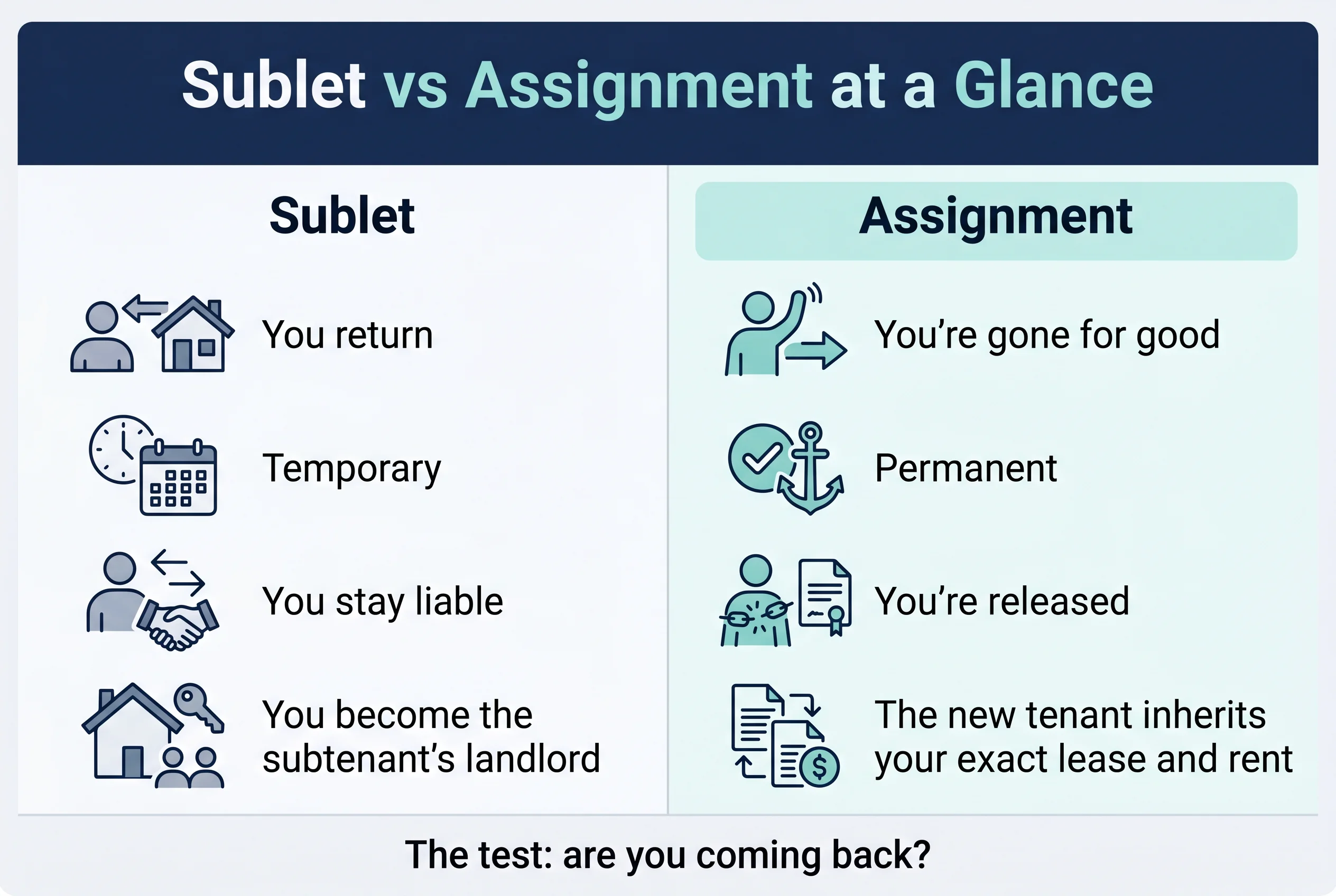
Everything starts with one question: am I coming back? If yes, you want a sublet. If no, you want an assignment. Get this right and the rest of the rules fall into place; get it wrong and you can end up liable for a unit you've left.
An assignment is a permanent transfer. You hand the tenancy to a new tenant — the assignee — who steps into your exact lease, at your exact rent, on your exact terms. From the effective date, you're released, and you can't move back in later. A sublet is temporary. You give someone exclusive occupancy for a defined period and then return before the lease ends, and you stay fully responsible the entire time.
One thing that trips people up: a roommate is not a sublet. If you're still living in the unit and sharing it with someone, that's not a sublet at all — the Act doesn't restrict roommates. A sublet or assignment only happens when you give up occupancy of the whole unit. Because the label determines the consent rules, who's liable, and how you get out, it's worth naming correctly before you do anything else.
The Consent Rules (and the 30-Day Escape Hatch)
Here's the part almost everyone gets wrong: a landlord's power to say no depends on which route you take and how you ask.
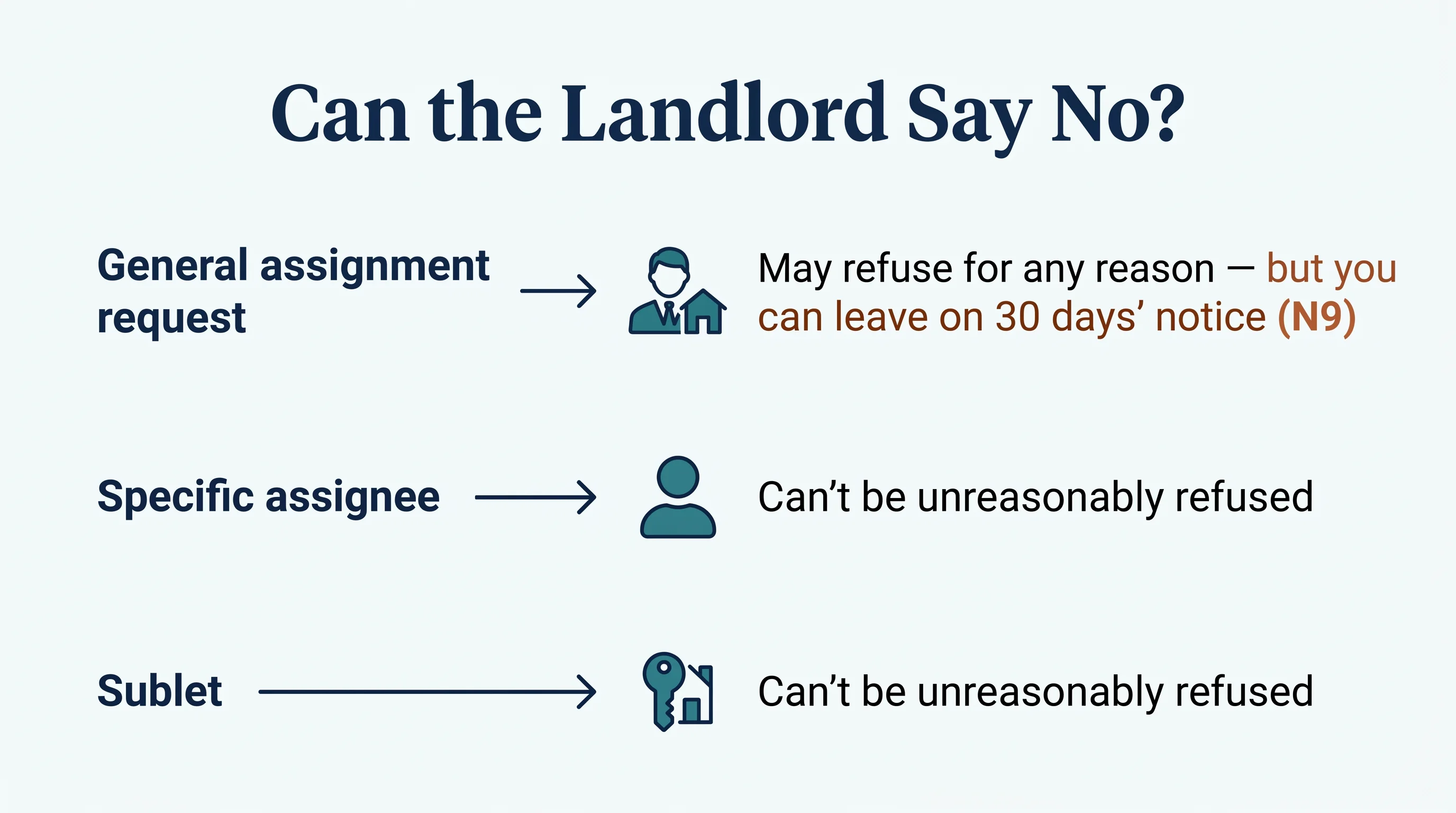
If you make a general assignment request — asking to assign without naming a specific person — the landlord can refuse for any reason at all. But that refusal comes with a catch in your favour: if the landlord refuses, or simply doesn't respond within 7 days, you can end the tenancy on 30 days' notice by serving an N9. Once you propose a specific assignee, or you request a sublet, the rules flip: the landlord cannot arbitrarily or unreasonably withhold consent. They can screen the person on reasonable criteria — income, credit, references — but they can't reject a perfectly good candidate just to hold out for higher rent or install their own tenant.
That general-assignment route is the escape hatch, and it's the single most useful thing for a tenant to know. If a landlord unreasonably refuses a specific person, your formal remedy is to apply to the LTB on Form A2 (within one year), where the Board can authorize the transfer, authorize an alternative, terminate the tenancy, or grant a rent abatement. But an A2 can take eight to twelve months to reach a hearing given the backlog — so the 30-day N9 after an ignored or refused general request is usually the faster, more reliable way out.
Who's Liable, and What It Can Cost
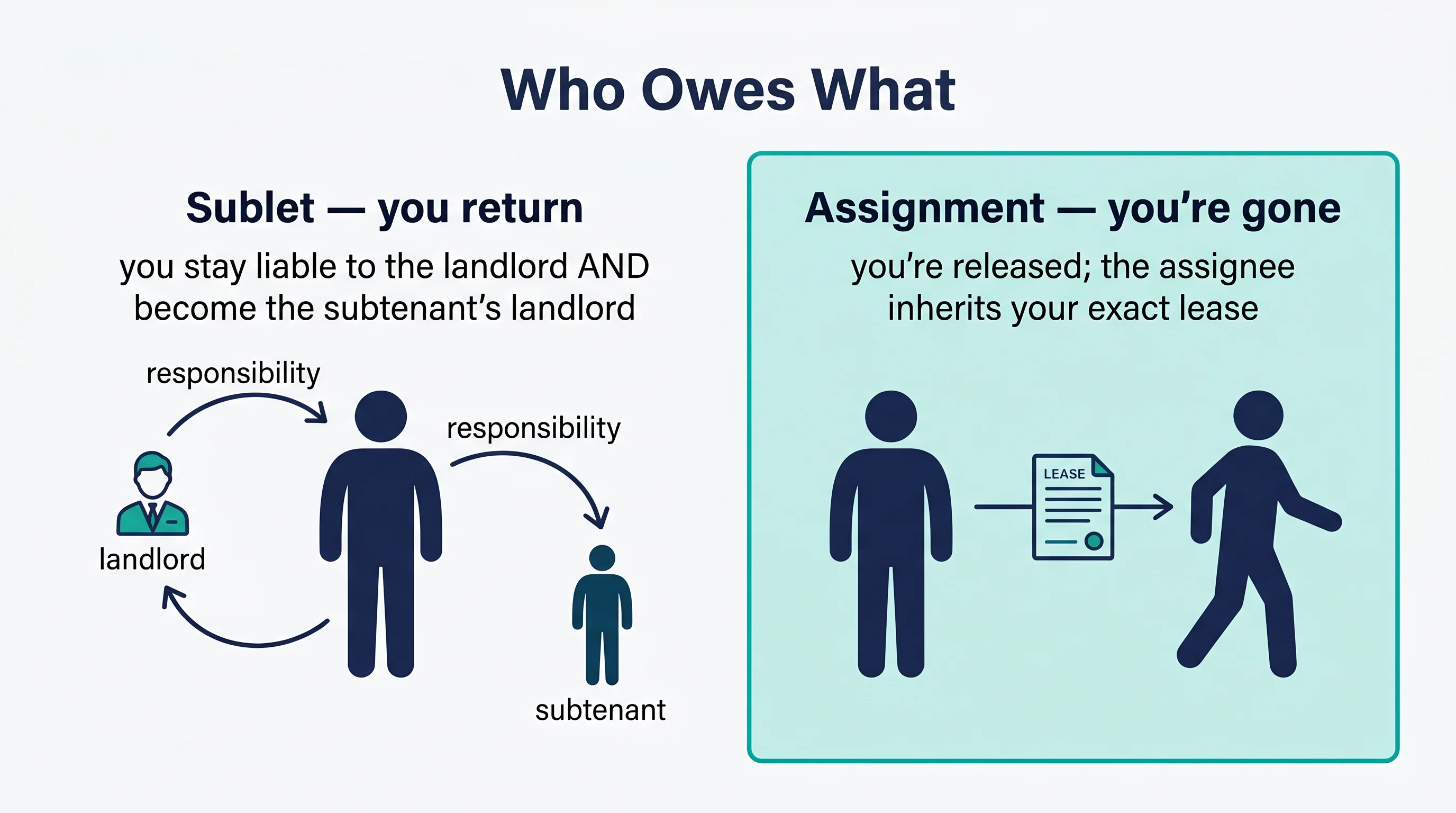
The liability split is where the sublet-versus-assignment choice really bites. In a sublet, you stay fully liable to your landlord for rent and damage — and you also become the subtenant's landlord. If the subtenant doesn't pay, you still owe the rent; if they refuse to leave at the end, it's on you to apply to the LTB to evict them (never change the locks). In an assignment, the assignee takes over on the effective date and you're released — and they aren't liable for anything that happened before the assignment.
The money rules matter just as much, and they protect both sides:
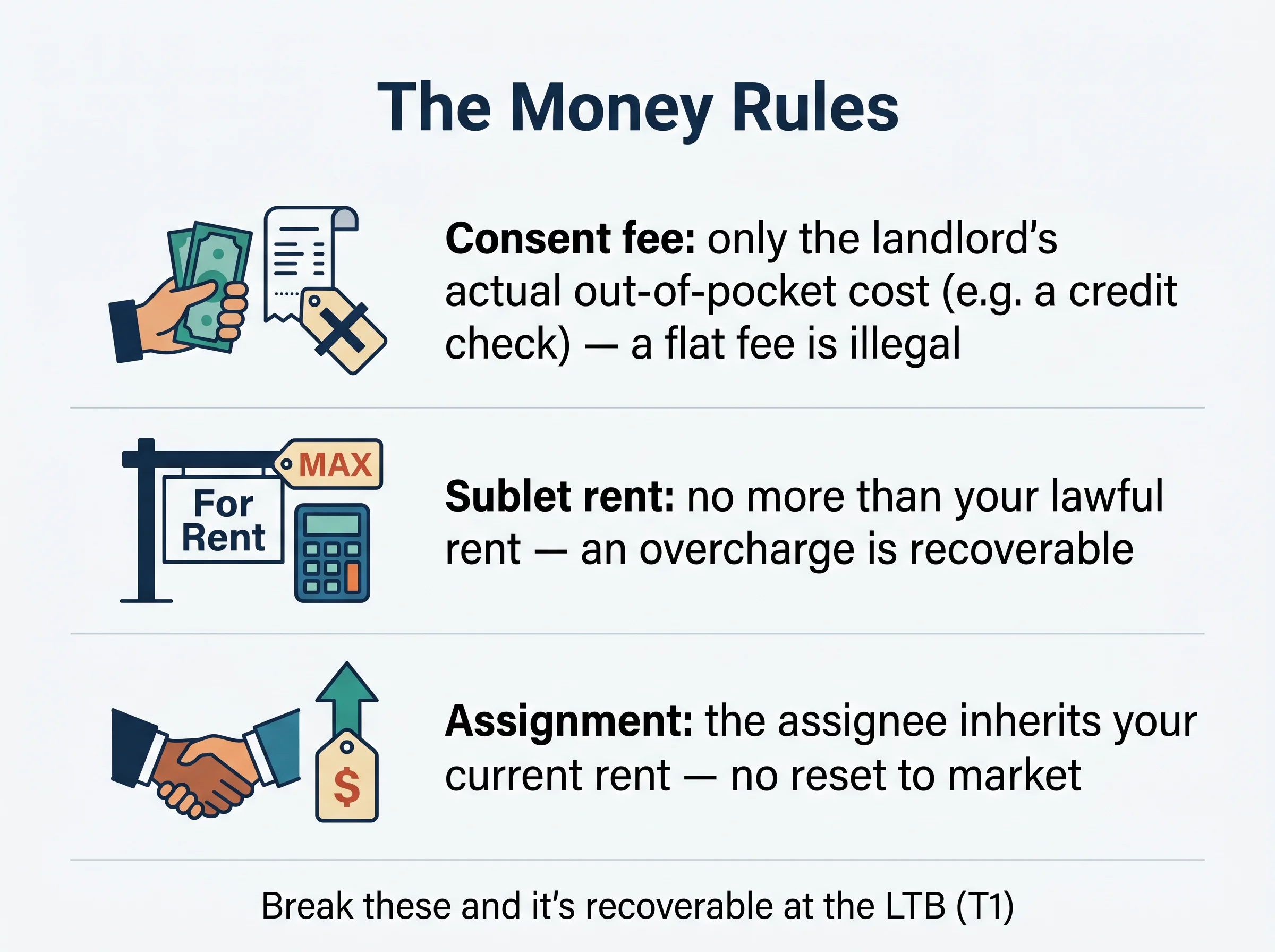
- No consent fees. A landlord can only recover their actual out-of-pocket cost, like a credit check. A flat "assignment fee" (say, $500) is illegal, and you can recover it with a T1.
- No overcharging a subtenant. You can't sublet for more than your lawful rent, barring clearly documented extra services. An overcharge is recoverable at the LTB.
- No rent reset on assignment. The assignee inherits your current rent — a landlord can't use the transfer to jump to market.
And beware the expensive mistake: handing over the whole unit without consent. Do that and the occupant isn't a valid subtenant or assignee at all — they can be evicted, and unauthorized occupants can be ordered to pay compensation for the entire period. Whichever route you take, protect yourself with a written agreement, screen the person, confirm insurance, and complete a dated move-in and move-out condition report.
The Landlord Playbook
If you own or manage the unit, the key is knowing exactly what you can and can't refuse. You may turn down a general assignment request — but remember that doing so hands the tenant a 30-day N9 exit. You cannot unreasonably refuse a sublet or a specific assignee, so the smart move is to screen, not stonewall: assess the proposed person on reasonable criteria and document your reasons. Refusing to hold out for higher rent or to install your own tenant is exactly what the Board calls unreasonable.
Mind the money rules on your side too — charge no consent fee beyond your actual costs, and don't try to reset the rent on an assignment. And watch the clock on unauthorized transfers: if you discover a tenant has handed over the unit without consent, you have 60 days from discovering it to apply under section 100, or you lose the remedy. Keep every consent decision Human Rights Code-compliant, get requests in writing, and give your responses in writing.
Sublet vs Assignment: The Ontario Decision Guide
The one-question test, the consent rules, the 30-day N9 exit, and the money limits — everything both sides need on one page.
Get Free PDF →Key Takeaways
For tenants:
- Name it right: coming back is a sublet; gone for good is an assignment.
- Put every request in writing — a general assignment request starts the 7-day clock.
- No yes within 7 days on a general request? Serve an N9 and leave in 30 days.
- A landlord can't unreasonably refuse a sublet or a specific assignee; if they do, file an A2 within a year (but weigh the wait against the N9).
- Subletting keeps you liable and makes you the subtenant's landlord — use a written agreement and don't overcharge.
For landlords and property managers:
- You can refuse a general assignment (but the 30-day N9 follows); you can't unreasonably refuse a sublet or a specific assignee.
- Screen on reasonable criteria and document your reasons; charge no fees beyond actual cost and don't reset rent.
- Suspect an unauthorized transfer? Apply under section 100 within 60 days of discovering it.
Conclusion
In Ontario, subletting and assigning aren't interchangeable. A sublet is temporary — you return and stay on the hook; an assignment is permanent — you're released and the new tenant inherits your exact lease. The consent rules are asymmetric: a landlord can refuse a general assignment, but that hands you a 30-day exit, and they can't unreasonably refuse a sublet or a specific assignee. And the money rules — no consent fees, no subletting above your rent, no rent reset on assignment — protect both sides.
Name the right tool, put it in writing, and both sides usually avoid the LTB entirely. This is general information, not legal advice — confirm the current details and your situation at ontario.ca or with the Landlord and Tenant Board.
Keep the request and the paperwork in one place
From the written request to the sublet or assignment agreement and the condition report, Tenon10 keeps a transfer clean, documented, and easy to prove.
Free • No signup required • Built for Ontario
Frequently Asked Questions
What's the difference between subletting and assigning in Ontario?
A sublet is temporary — you let someone occupy the unit for a set period and then return, and you stay responsible for the lease. An assignment is permanent — you transfer the tenancy to a new tenant who inherits your exact lease, and you're released going forward.
Can my landlord refuse to let me sublet or assign?
For a sublet or a specific assignee, no — a landlord can't arbitrarily or unreasonably refuse. For a general assignment request (no named person), they can refuse for any reason, but that lets you end the tenancy on 30 days' notice.
How do I get out of my lease if my landlord won't let me assign?
Make a written general request to assign. If the landlord refuses or doesn't respond within 7 days, you can serve an N9 and end the tenancy on 30 days' notice — often faster than waiting months for an LTB hearing.
Am I still responsible if I sublet my apartment?
Yes. In a sublet you remain fully liable to your landlord for rent and damage, and you become the subtenant's landlord. If they don't pay or overstay, it's on you to deal with it through the LTB.
Can a landlord charge a fee to assign or sublet?
Only their actual out-of-pocket costs, like a credit check. A flat "assignment fee" is illegal and recoverable through a T1, and a landlord can't use an assignment to raise the rent.