That "no pets" line in your Ontario lease? It's not worth the paper it's printed on. Section 14 of the Residential Tenancies Act makes a no pets clause in Ontario void — so once you're a tenant, a landlord can't evict you simply for having a cat or a dog.
But that headline is where most people stop reading, and it's where they get into trouble. The rule has real limits: it only protects you once you've signed, a condo can still ban pets, and a pet's behaviour can absolutely lead to eviction. Overstate the rule and a tenant gets blindsided; ignore it and a landlord leans on a clause that does nothing.
This guide gives you the satisfying part — your no-pets clause is void — and the four things that actually matter around it: the before-and-after gap, the condo exception, the behaviour-based grounds for eviction, and the money rules. It's general information, not legal advice; for a specific situation, confirm at ontario.ca or with the Landlord and Tenant Board (LTB).
Renting With Pets in Ontario Cheat-Sheet
Your rights, the real limits, and the service-animal rules — both sides on one page.
Get Free PDF →The Void Clause, and the Before/After Gap
Start with the rule itself. Section 14 of the RTA says a provision in a tenancy agreement prohibiting the presence of animals is void. A no-pets clause — even one you signed, even a "pet waiver" — is simply unenforceable. A landlord can't evict you just for having a pet, and it doesn't matter whether you got the pet before or after you signed. Ontario is an outlier here: unlike British Columbia (which allows pet clauses and capped pet deposits) or the Atlantic provinces (which allow outright pet bans), Ontario protects responsible pet owners once a tenancy begins.
Now the part that trips people up. The RTA governs the relationship after a tenancy is formed. Before you sign, a landlord can legally refuse to rent to a pet owner, advertise "no pets preferred," and simply decline your application. A prospective tenant has no section 14 protection at all.
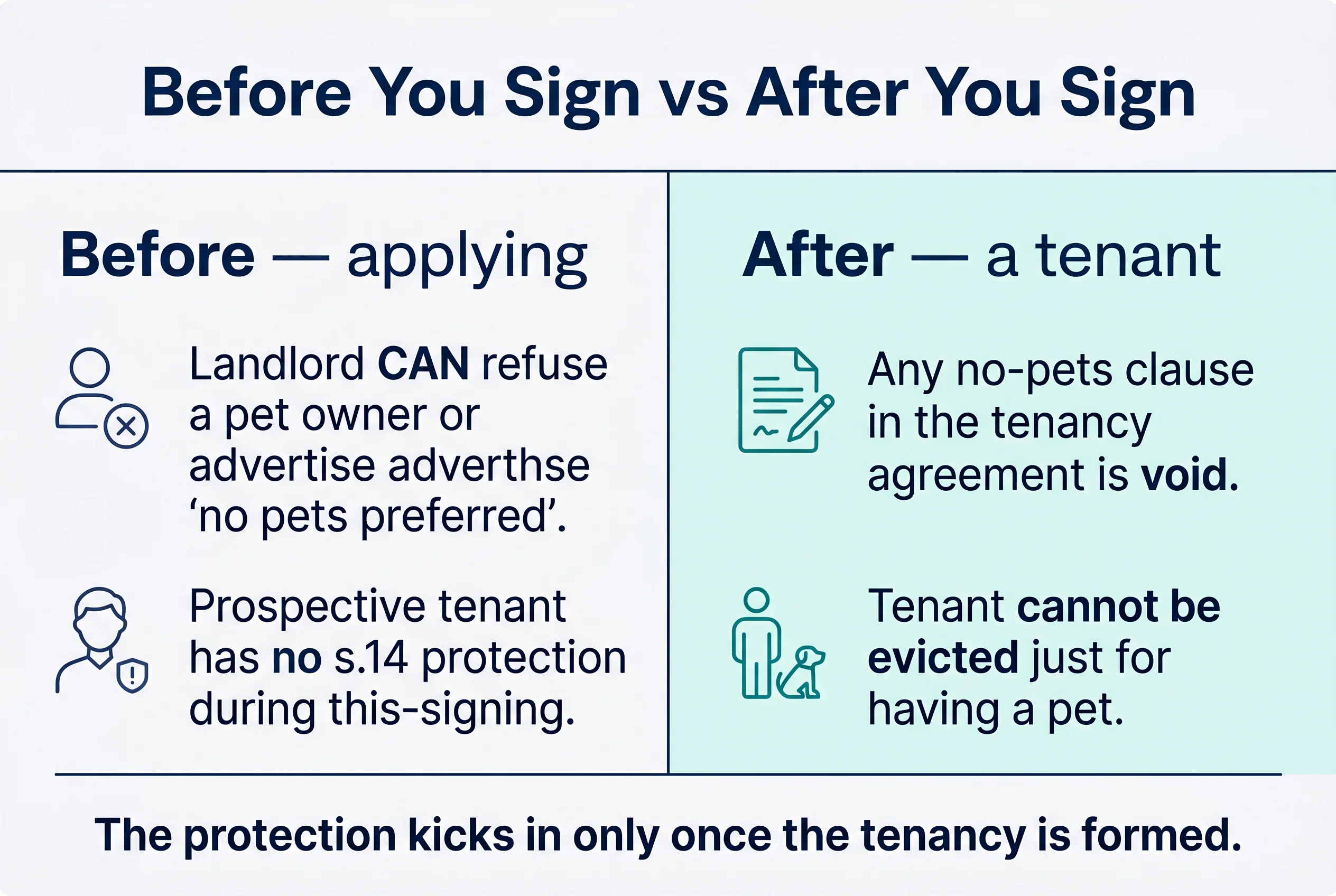
So the advice splits by stage. If you're applying with a pet, expect scrutiny — and while it isn't legally required, a "pet resume" (vet records, spay/neuter proof, training notes, a prior-landlord reference) can ease it. If you're already a tenant, the clause can't be used against you, full stop. Why do landlords still write it? Some don't know it's void; others use it to thin the applicant pool. Either way, once the lease is signed, the clause does nothing.
When a Landlord CAN Act
The clause is dead — but a pet's behaviour is a different matter. Under section 76, a landlord can pursue eviction over an animal only if the LTB is satisfied that it: substantially interferes with the reasonable enjoyment of the building (serious noise, aggression), causes a serious allergic reaction to the landlord or another tenant, or is inherently dangerous.
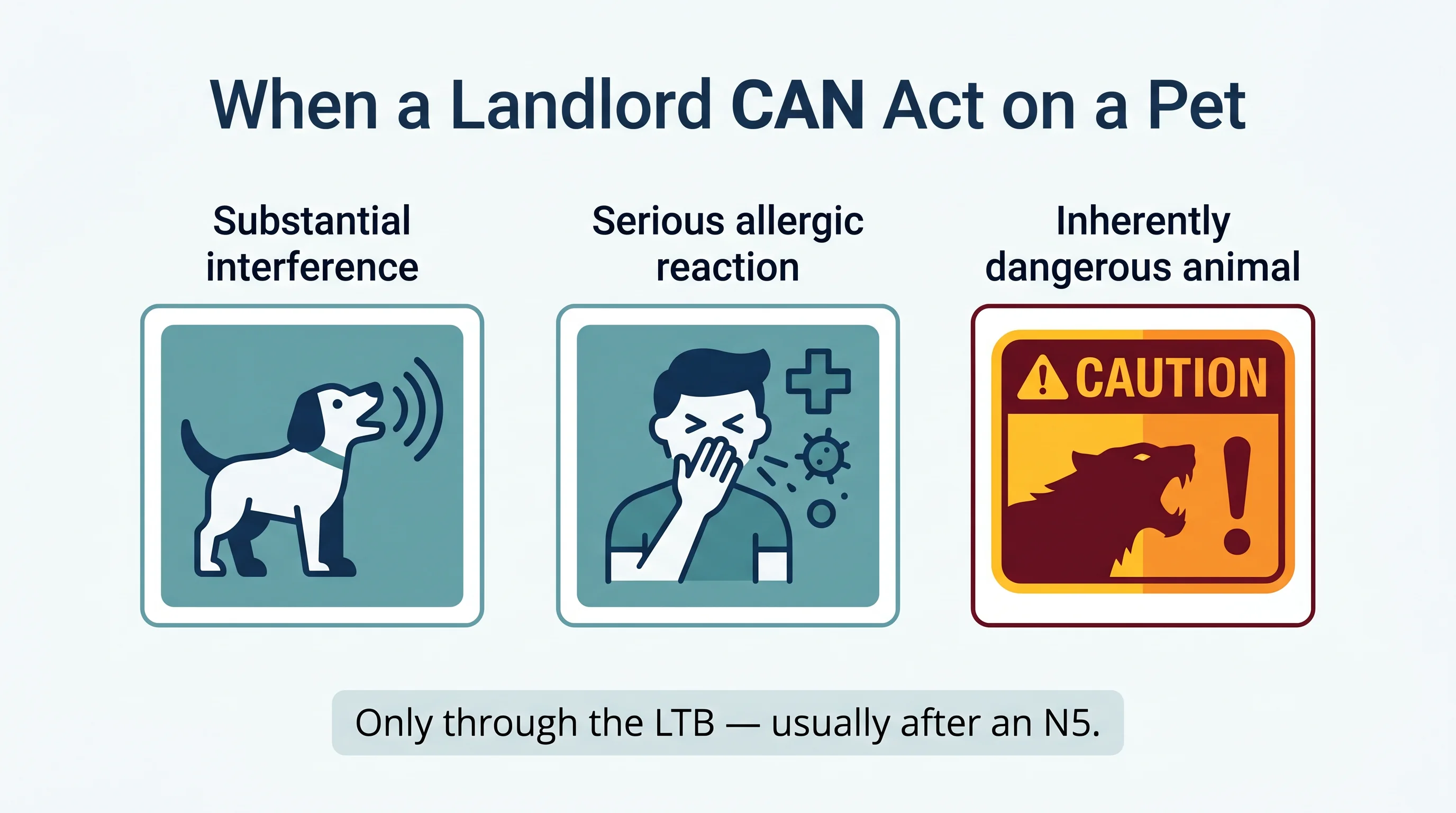
Crucially, this runs through the LTB — there's no self-help. The landlord serves notice (usually an N5 for interference or damage, or an N7 for a serious safety issue) and applies to the Board, which won't terminate a tenancy unless those section 76 criteria are actually met. And there's a lifeline for tenants: a first N5 tied to a pet can often be voided if you correct the behaviour or repair the damage within seven days, so act quickly.
Then there's the one genuine exception to the whole "no-pets clauses are void" rule: condominiums. A condo corporation's declaration can restrict or prohibit pets under the Condominium Act, and that binds everyone in the building — including tenants. A void lease clause won't save you from a valid condo ban; it's enforced through the Condominium Authority Tribunal, and tenants generally work through their landlord (the unit owner) to sort out condo pet disputes. Since a large share of Ontario rentals are condos, check the declaration before you sign.
Money, Breeds, and Service Animals
A few more rules round out the picture — and the money one surprises people. There are no pet deposits, pet fees, or "pet rent" in Ontario. The only deposits a landlord can legally collect are a last month's rent deposit and a refundable key deposit. If a pet causes damage, the landlord has to claim through the LTB — not through a pre-charged fee. A landlord also can't charge pet owners a higher rent than non-pet owners; a court struck exactly that down in Drewlo Holdings v. Weber (2011). And some animals are off the table entirely: Ontario restricts pit-bull-type dogs (under the Dog Owners' Liability Act and O. Reg. 157/05), so keeping a prohibited breed is an illegal act with tenancy consequences. Municipal by-laws add their own limits on pet numbers, licensing, and exotic animals.
Service and support animals sit on a completely separate — and stronger — footing. They aren't "pets" for this analysis at all.
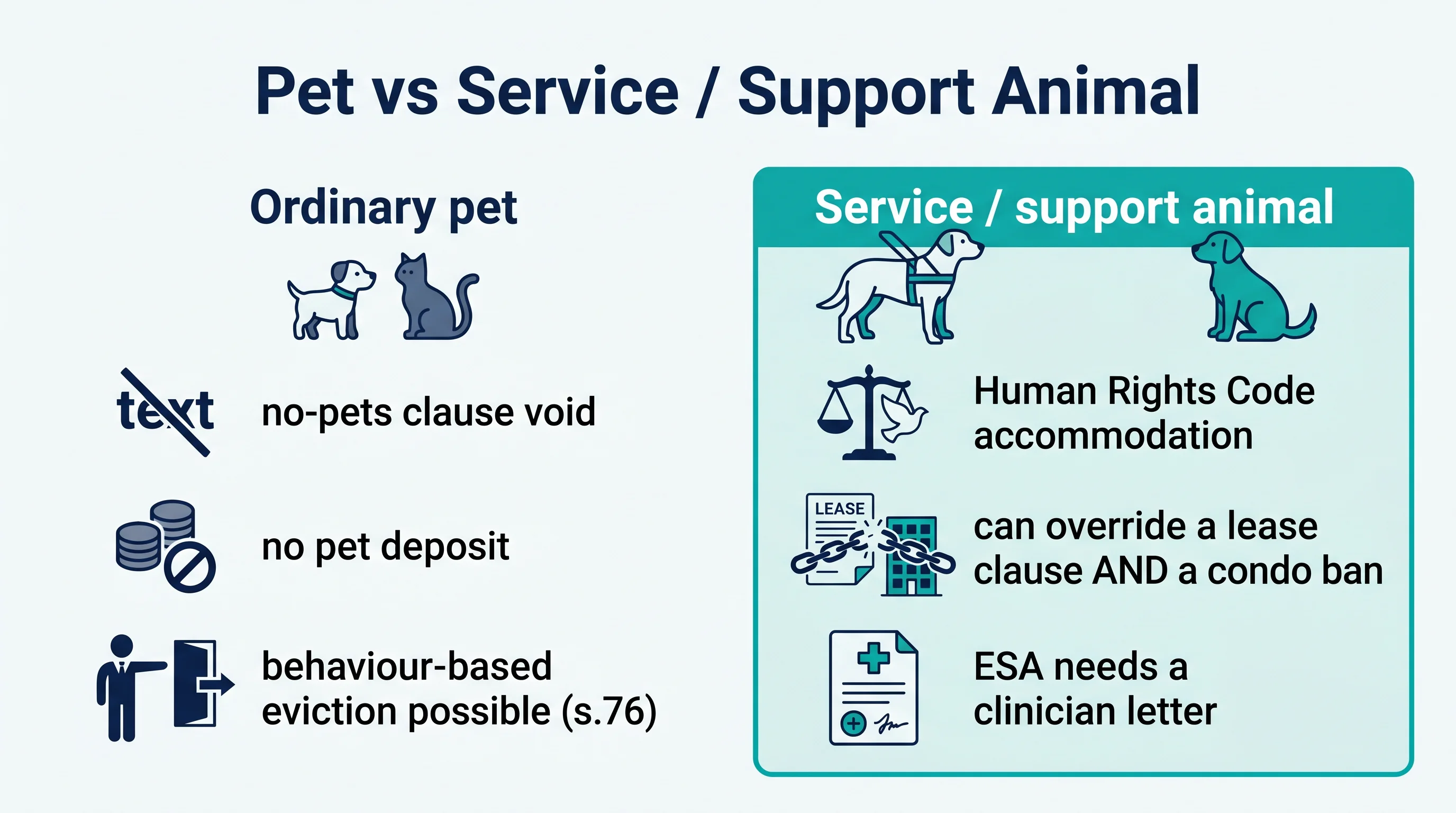
Service and guide dogs have statutory access rights. Emotional-support animals are protected through the Ontario Human Rights Code's duty to accommodate a disability — usually established with a letter from a regulated health professional (you don't have to disclose your diagnosis, only the disability-related need). This protection can override both a no-pets clause and a condo pet ban, up to the point of "undue hardship." That's a high bar: a landlord's mere preference for a "no-pets building" doesn't count — they'd need to show serious cost or an unmanageable health or safety risk. Where an accommodation collides with another tenant's serious, documented allergy, the landlord must work toward a solution rather than automatically deny; neither side wins by default. If a genuine accommodation is refused, the tenant can file a T2 at the LTB or a complaint with the Human Rights Tribunal of Ontario.
The Landlord's Real Toolkit (and How to Be a Low-Risk Pet Tenant)
Here's the constructive part, because a void ban helps no one. If you're a landlord or property manager, the tools that actually work look nothing like a blanket clause:
- Screen at the application stage — you can decline a pet owner before a lease is signed, where a genuine concern exists.
- Use a Section 15 addendum to the standard lease for pet-damage liability, end-of-tenancy professional cleaning or flea treatment, and breed or size limits tied to insurance or building rules — anything short of a blanket ban.
- Require tenant insurance (renters' liability), but only if it's written into the signed lease.
- Act on real problems through section 76 — an N5 to the LTB, backed by dated evidence — never self-help.
- Stay value-neutral on rent, and accommodate disability-related animals to the point of undue hardship.
What can you actually add to the lease, and what's off-limits? Our guide to what you can and can't add to the Ontario standard lease covers the Section 15 rules in full.
And if you're a tenant, being low-risk is mostly common sense: check the condo rules before you sign, build that pet resume when applying, prevent noise and damage, follow your city's by-laws on licensing and numbers, and avoid prohibited breeds. Most pet disputes are really behaviour disputes — keep the relationship cooperative and you'll rarely see the inside of a hearing room.
Renting With Pets in Ontario Cheat-Sheet
The void clause, the before/after gap, the condo exception, and the service-animal rules — everything both sides need on one page.
Get Free PDF →Key Takeaways
For tenants:
- A "no pets" clause is void once you're a tenant — you can't be evicted just for having a pet.
- But before you sign, a landlord can refuse a pet owner; the protection only kicks in after the tenancy is formed.
- Renting a condo? A condo declaration can validly ban pets — check it first.
- Behaviour (danger, a serious allergy, substantial disturbance) can still ground an eviction through the LTB — and a first N5 can often be voided within seven days.
- Need a service or support animal? It's a Human Rights Code accommodation — put the request in writing with a clinician's letter.
For landlords and property managers:
- Don't rely on a blanket ban — screen before signing and use a Section 15 addendum instead.
- Never charge a pet deposit, pet fee, or higher rent for pet owners.
- Act on genuine problems via section 76 with dated evidence, and accommodate disability-related animals to undue hardship.
Conclusion
In Ontario, a "no pets" clause is void — once you're a tenant, you generally can't be evicted just for having a pet. But the rule has edges worth knowing: it doesn't protect you before you sign, a condo declaration can still ban pets, a pet's behaviour can ground an eviction, and there are no pet deposits. Service and support animals sit on a stronger, separate footing under the Human Rights Code.
None of this is landlord-versus-tenant. The practical path is the same for both sides: a clear, lawful pet approach beats an unenforceable ban every time. This is general information, not legal advice — confirm the current details and your situation at ontario.ca or with the Landlord and Tenant Board.
Build a lease that actually holds
From a compliant pet addendum to tenant-insurance terms and the tenancy record, Tenon10 keeps your lease and documentation organized — no unenforceable clauses required.
Free • No signup required • Built for Ontario
Frequently Asked Questions
Is a "no pets" clause enforceable in Ontario?
No. Section 14 of the Residential Tenancies Act makes any clause prohibiting pets in a tenancy agreement void — even if you signed it. Once you're a tenant, a landlord can't evict you simply for having a pet.
Can a landlord refuse to rent to me because I have a pet?
Yes — before you sign. The RTA only protects you once a tenancy is formed, so at the application stage a landlord can legally decline a pet owner or advertise "no pets preferred."
Can I be evicted for a pet in Ontario?
Only for behaviour, not for the pet itself. Under section 76, a landlord can apply to the LTB if the animal substantially interferes with others' reasonable enjoyment, causes a serious allergic reaction, or is inherently dangerous — and the Board must be satisfied on those grounds.
Can a landlord charge a pet deposit or extra "pet rent" in Ontario?
No. The only legal deposits are last month's rent and a refundable key deposit, and a landlord can't charge pet owners higher rent. If a pet causes damage, the landlord claims through the LTB.
Do "no pets" rules apply to service or emotional-support animals?
No — they're a separate track. Disability-related animals are protected by the Human Rights Code duty to accommodate, which can override both a no-pets clause and a condo pet ban, up to the point of undue hardship (usually with a health professional's letter).