Bed bugs, cockroaches, mice — the first question in a rental is always the same: whose problem is this? In Ontario, the answer is usually simple. When it comes to pest control, Ontario rental responsibility falls on the landlord — to treat, and to pay for.
But pests are where good tenants and good landlords still end up at the Landlord and Tenant Board, because both sides misread the rules. Landlords think a lease clause or a tenant's housekeeping shifts the cost; it usually doesn't. Tenants think it's entirely hands-off for them; it isn't — refuse to cooperate with treatment and you can be the one who ends up liable.
This guide draws the line clearly — the regulation that actually applies, who pays (and the narrow exception), the tenant duties that matter, the cooperation trap on both sides, and exactly what to document. It's general information, not legal advice; confirm your situation at ontario.ca, the LTB, or your municipality, and use a licensed professional for treatment.
The Pest Response & Prep Checklist
Whose job pest control is, how to prep and document, and how to enforce a proper fix — both sides on one page.
Get Free PDF →The Law: There's an Actual Pest Regulation
Unlike mold, pests get a named standard. Ontario Regulation 517/06 says a residential complex must be kept "reasonably free of rodents, vermin and insects," that extermination has to be done lawfully, and — the part landlords often overlook — that openings and holes must be screened or sealed to keep pests out in the first place.
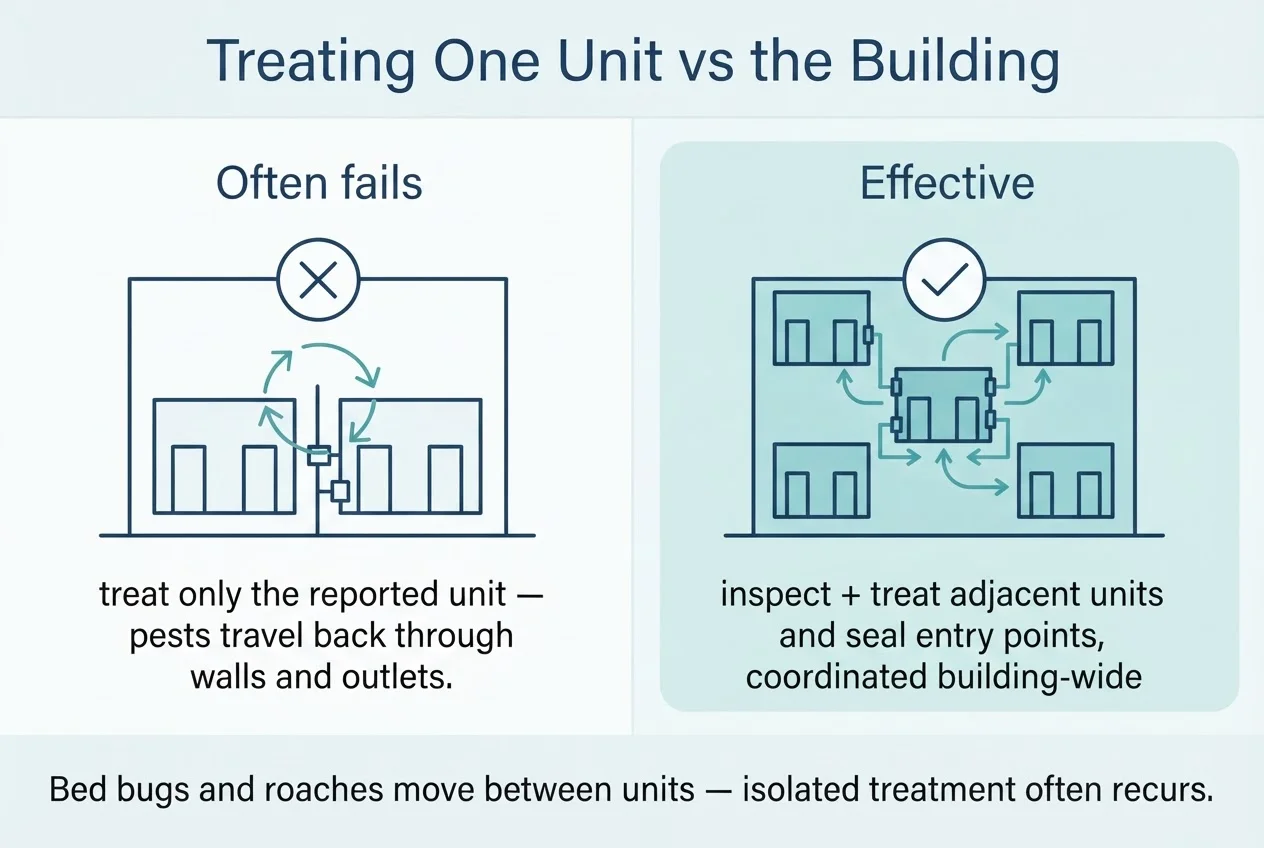
That regulation sits on top of the landlord's core duty under section 20 of the Residential Tenancies Act — to keep the units and the common areas (halls, laundry rooms, stairwells) in a good state of repair and fit for habitation. Together they make addressing an infestation, and paying for it, the landlord's job, and that covers bed bugs, cockroaches, mice, and rats alike. Municipal property-standards bylaws in cities like Hamilton and Toronto layer on further, letting officers issue enforceable work orders. It's the same standards stack that anchors our guide to maintenance standards. And there's a structural reality worth naming early: in a multi-unit building, pests travel between units through walls and outlets, so even perfect housekeeping can't guarantee prevention, and one complaint can quickly become a building-wide issue.
Who Pays? (Almost Always the Landlord)

The default is straightforward: the landlord arranges and pays for professional treatment. And because pests travel, that often means inspecting and treating adjacent units too — treating a single unit in isolation frequently fails, and the infestation simply comes back from next door.
There's one narrow exception, and it comes with a high bar. A landlord can only pass the cost to a tenant if the infestation was directly caused by the tenant's negligence — extreme unsanitary or hoarding conditions, or bringing in infested furniture — and the burden of proof sits squarely on the landlord. A general assumption that "it must be their mess" isn't enough. Just as important: a lease clause that makes the tenant "responsible for pest control" is void, because you can't contract out of section 20. And meeting the duty means more than hiring a company and walking away — the landlord has to stay involved, seal entry points, and coordinate treatment across the building, the kind of integrated approach that actually eradicates an infestation rather than chasing it around.
The Tenant's Duties (and the Cooperation Trap)
None of that makes tenants hands-off. They carry four real duties: keep the unit to ordinary cleanliness, report a problem promptly (early reporting is genuinely easier and cheaper to treat), cooperate with treatment preparation, and allow access on proper notice.
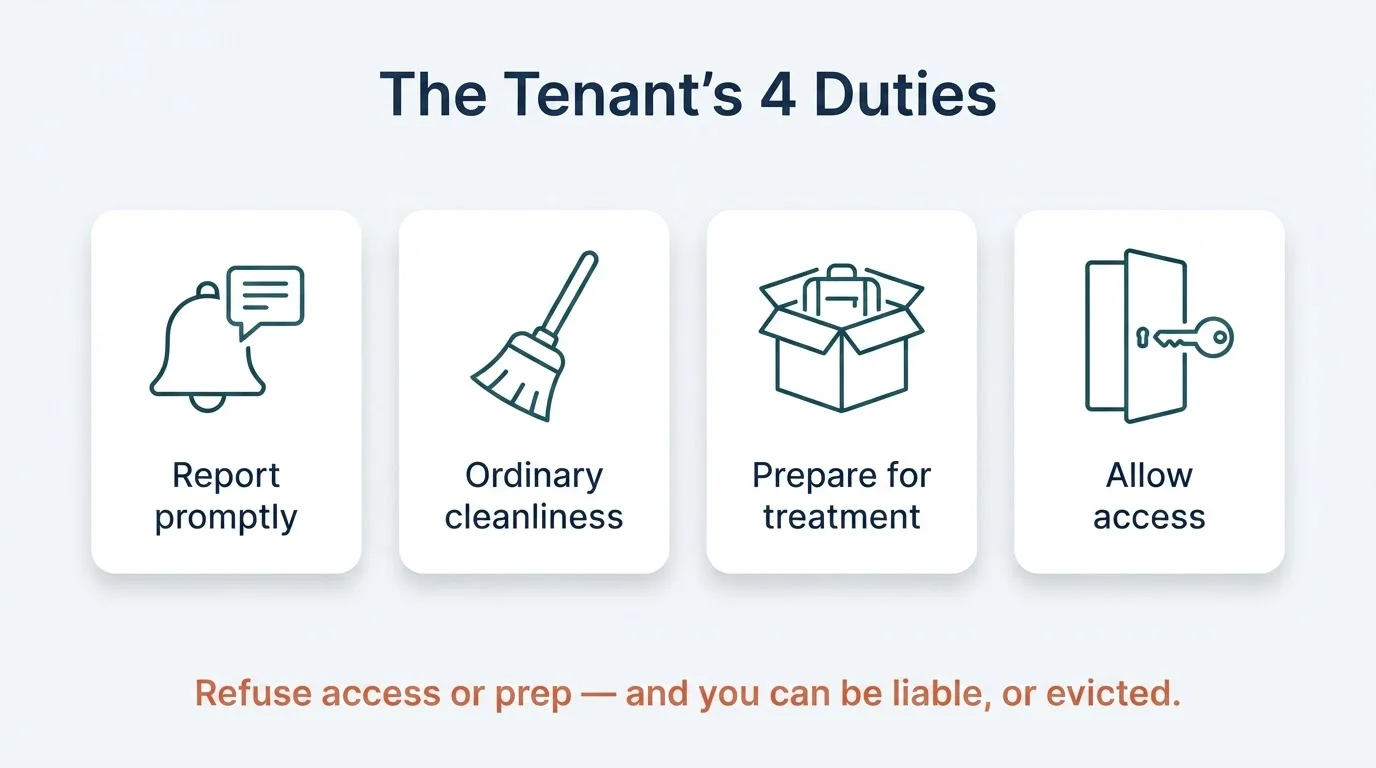
That last cluster is where the trap lies, and it cuts against tenants who assume they can simply say no. If a tenant refuses access or fails to prepare the unit — the decluttering, laundering and bagging, and moving furniture that treatment requires — the landlord can apply to the LTB for an entry order or even eviction, and can recover the extra cost of wasted or repeat exterminator visits. The Board has treated non-cooperation as undermining the whole building's habitability. There's an important guardrail, though: prep instructions have to be reasonable, not unsafe to perform without tools or training, and not beyond what the tenant can realistically do. And a tenant who genuinely can't prepare the unit because of a disability can request help or extra time as an accommodation under the Human Rights Code, which the landlord must provide up to the point of undue hardship. Through all of this, the standard on the landlord's side stays the same one that runs through the whole maintenance cluster — act reasonably, not perfectly. The mere presence of a pest isn't automatic liability; what matters is a prompt, reasonable response.
The Playbook: Document, Escalate, File
For tenants, the path mirrors the mold playbook. Report the problem to the landlord in writing right away — describe it, date it, keep a copy — because that starts the reasonable-time clock. Document everything: dated photos and video, a sightings log, all communications, and any exterminator reports, plus a record of the prep you actually did. Cooperate fully and allow access, and if a disability makes prep impossible, put the accommodation request in writing. If it isn't handled in a reasonable time, escalate in parallel by calling municipal property standards or public health for an inspection and work order.
If the landlord still won't act reasonably, file a T6 (Application About Maintenance) within one year — and for an ongoing infestation, that one-year clock runs from when the treatment is completed. The Board can order treatment, grant a rent abatement, and award compensation for belongings you had to discard, such as a mattress or couch lost to bed bugs. Two firm don'ts: don't withhold rent (you can't legally withhold over pests, and it risks eviction), and only pay for treatment yourself if the landlord actually proves you caused the problem.
For landlords and property managers, staying clean is mostly diligence. Treat promptly and pay, using a licensed professional and an integrated pest-management approach; inspect and treat adjacent units where pests travel; and seal the openings the regulation requires. Give reasonable prep instructions with proper 24-hour entry notice, and document every step — that record is your reasonableness defence if it ever reaches the LTB. Only charge a tenant back with real proof they caused it, or for the extra cost of documented non-cooperation. Accommodate disability-related prep requests, never lean on a void "tenant pays" clause, and don't retaliate against a tenant for reporting. Best of all, prevent: sealed entry points, routine inspections, and a licensed partner stop most building-wide outbreaks before they start.
Keep the report, the prep, and the paper trail together
From the first written report to prep records, photos, and treatment history, Tenon10 keeps a pest issue documented — the record that resolves it and proves it.
Free • No signup required • Built for Ontario
Key Takeaways
For tenants:
- Pest control is almost always the landlord's to treat and pay for — there's an actual regulation requiring a pest-free unit.
- A "tenant pays for pests" lease clause is void; costs only shift with proof you caused it.
- You still must report promptly, keep ordinary cleanliness, prepare for treatment, and allow access.
- Refuse access or prep and you can be liable or evicted — but prep instructions must be reasonable, and disability accommodations apply.
- Don't withhold rent; document everything and file a T6 if the landlord won't act.
For landlords and property managers:
- Treat promptly and pay; do adjacent units and seal entry points; act reasonably, not perfectly.
- Give reasonable prep instructions and proper notice; document every step.
- Only charge back with proof; accommodate disability requests; never rely on a void clause.
Conclusion
In Ontario, pest control is almost always the landlord's — there's an actual regulation requiring units be kept reasonably free of pests, the landlord treats and pays (often across adjacent units), and a "tenant pays" lease clause is void. Costs only shift to a tenant with proof the tenant caused it. But tenants aren't off the hook: keep the unit reasonably clean, report fast, cooperate with treatment, and allow access — refuse, and you can end up liable or even evicted. When a landlord won't act reasonably, the route is to document, escalate to bylaw or public health, and file a T6.
Pests are stressful, but the split is clear and the paper trail wins — report early, cooperate, and keep the record. This is general information, not legal advice — confirm the current details and your situation at ontario.ca, the LTB, or your municipality.
Frequently Asked Questions
Who is responsible for pest control in an Ontario rental?
Almost always the landlord. Under the RTA and O. Reg. 517/06, the landlord must keep the unit reasonably free of rodents, vermin, and insects, and must arrange and pay for professional treatment — including bed bugs, cockroaches, mice, and rats.
Can my landlord make me pay for pest control?
Only if they can prove the infestation was directly caused by your negligence — for example, extreme unsanitary conditions or bringing in infested furniture. The burden of proof is on the landlord, and a lease clause that shifts pest control to the tenant is void.
Are bed bugs the landlord's responsibility in Ontario?
Yes. Bed-bug treatment is a landlord maintenance duty under section 20, and because bed bugs travel between units, the landlord often has to treat neighbouring units too — all at their cost.
Do I have to prepare my apartment for pest treatment?
Yes. Tenants must cooperate with reasonable prep instructions (decluttering, laundering and bagging items, moving furniture) and allow access. Refusing can lead to an entry order, cost recovery, or even eviction. If a disability makes prep impossible, you can request accommodation.
Can I withhold rent because of pests?
No. You can't legally withhold rent over pests. Keep paying and, if the landlord won't act reasonably, apply to the LTB with a T6 for an order to treat, a rent abatement, and compensation.
What can I do if my landlord won't deal with the infestation?
Report it in writing, contact municipal property standards or public health for an inspection, and file a T6 with the LTB. The Board can order treatment, grant a rent abatement, and award compensation for belongings you had to discard.