

If your apartment is freezing in January, the first thing to know is that there's no single "Ontario heating law" that sets how warm it has to be. The minimum heat temperature in Ontario is set by city — the number, the dates it applies, and the fines all come from your municipality's bylaw, and they change at the city line.
That trips up both sides. Tenants quote a provincial "20°C" that their city may have raised; landlords with buildings in two cities run one standard when they owe two; and almost everyone assumes the rule is about the weather when it's actually about the calendar.
This guide lays out the exact minimum-temperature rules for Toronto, Hamilton, and Ottawa, the provincial floor underneath them, the "calendar, not weather" trap that catches landlords every spring, how to complain when your unit is too cold, and the maximum-heat rules now emerging. It's general information, not legal advice; confirm the current figures with your city, ontario.ca, or the LTB, because bylaws change.
Too Cold? The Heat Bylaw Complaint Kit
Your city's minimum-temperature rules, how to complain, and how to use the LTB — both sides on one page.
Get Free PDF →Why There's No Single "Ontario Number"
Heating requirements come from each municipality's property-standards or heat bylaw, which means the minimum temperature, the season dates, and the fines all vary by city. You can't Google "Ontario heating law" and stop there — you have to look up your city's bylaw.

Underneath the city rules sits a provincial floor: where the landlord provides heat, O. Reg. 516/06 sets a minimum of 20°C from September 1 to June 15. That's the number people often quote as if it were the whole story, but a stricter municipal bylaw — like Toronto's 21°C — governs locally. Heat also isn't only a bylaw matter: it's a vital service and part of the landlord's duty to repair under the Residential Tenancies Act, so the city bylaw sits on top of those provincial obligations rather than replacing them. The practical catch is for anyone who owns in more than one city: two buildings can owe two different standards.
The Three Cities, Side by Side

Here's where the numbers actually differ. Toronto is the strictest on temperature; Ottawa is the most nuanced, with a day/night split; and the season dates are different in every city.
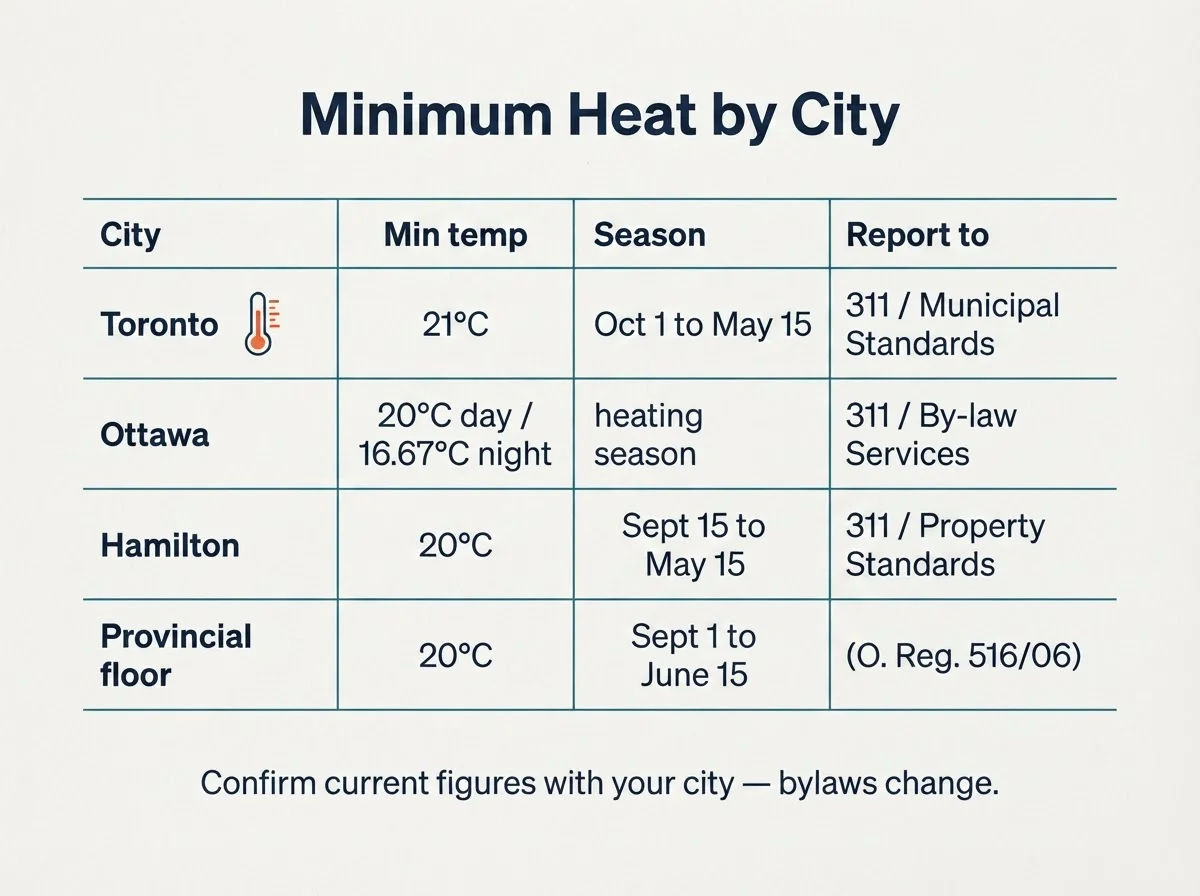
Toronto requires a minimum of 21°C from October 1 to May 15 — the rule long known as the Heating Bylaw, renamed the Indoor Temperature Standards Bylaw as of June 1, 2026. Hot water at fixtures has to run 45–49°C, and complaints go to 311 and Municipal Licensing & Standards. The fines are serious: up to $100,000, or a daily penalty as high as $10,000 for each day a violation continues, plus a special fine to claw back any economic gain. Ottawa, under By-law 2010-210, defines "adequate and suitable heat" as at least 20°C during the day (6 a.m. to 11 p.m.) and about 16.67°C overnight — a day/night standard, not a flat number — reported to 311 and By-law & Regulatory Services. Hamilton, under Heat By-law 04-091, requires at least 20°C from September 15 to May 15, supplied by a safe, permanent appliance capable of holding it, reported to 311 and Property Standards.
The Calendar, Not the Weather
This is the rule that catches landlords out. During heating season, the system has to stay operational and capable of the minimum — even on a warm day. The bylaw runs on the calendar, not the forecast.

The classic violation looks like this: it's a warm week in April, the landlord shuts the boiler down to save gas, a cold snap hits, and the building drops below the minimum overnight. That's a breach, because heating season isn't over. It cuts the other way too — to comply with an early start date, a Hamilton landlord might run the heat during a 30°C week in September and get complaints that the unit is sweltering. Compliance is about capability across the whole season. There is room for judgment in the shoulder season (Toronto, for instance, allows it around September 15 to October 15 and May 1 to June 1): the landlord can turn the heat down or off, but only if the unit naturally holds the minimum without it, and the system still has to be ready to fire back up. And one nuance that surprises tenants: the duty is to maintain the minimum, not to run the heat — so on a genuinely warm day, a unit that's already above the minimum can have the heat off and still be compliant.
Too Cold? How to Complain (and the RTA Overlay)
If your unit is below the line, the process is straightforward and worth doing in order. Start by measuring the temperature in the centre of the room and keeping a dated log. Tell the landlord in writing first, describe the problem, and give a reasonable time to fix it. If it's still cold, call 311 to reach municipal standards — Toronto's Municipal Licensing & Standards, Ottawa's By-law & Regulatory Services, or Hamilton's Property Standards — who can inspect and issue a work order. That work order is strong evidence if the matter goes further.
And it can go further in parallel, because inadequate heat is also an RTA problem, not just a bylaw one. It's a section 20 repair issue, and if a landlord deliberately shuts heat off, a section 21 vital-service issue. So alongside the city complaint, a tenant can file a T6 at the LTB to order the heat restored and claim a rent abatement, or a T2 for a vital-service shutoff or interference. The two tracks reinforce each other — the municipal work order becomes evidence at the LTB. What you should not do is withhold rent; that isn't a remedy and it risks an eviction for arrears.
For landlords and property managers, staying clean comes down to knowing your exact bylaw — the temperature, the dates, and any day/night split — and tracking each city separately if you own in more than one. Keep the heating system operational and capable all season rather than shutting it down for a warm spell, use shoulder-season judgment only when the unit holds temperature on its own, and respond fast and in writing when a cold complaint comes in, because the fines are steep and it's simultaneously a T6/T2 risk.
One last shift worth watching, because it runs the other direction. The frontier now is maximum-temperature rules. Toronto already caps units at 26°C from June 1 to September 30 where cooling is provided, and as of June 1, 2026 requires RentSafeTO buildings without in-unit cooling to keep an indoor amenity space at or below 26°C. Whole-unit maximum bylaws in Toronto and Hamilton are still in development, not yet in force. And separately, from July 1, 2026, tenants have a right to install their own air conditioner under the RTA, subject to conditions. Air conditioning still isn't a vital service the way heat is — but the rules are clearly shifting toward cooling.
Keep your temperature log and complaint trail together
From dated readings to the written report and the city or LTB paper trail, Tenon10 keeps the record that gets heat restored — and proves the case.
Free • No signup required • Built for Ontario
Key Takeaways
For tenants:
- There's no single Ontario number — Toronto is 21°C, Ottawa and Hamilton 20°C, on different calendars, over a 20°C provincial floor.
- The bylaw runs on the calendar, not the weather — the system must stay ready all season.
- Measure in the centre of the room, keep a dated log, and report in writing then to 311.
- Use a T6 or T2 at the LTB in parallel with the bylaw complaint.
- Don't withhold rent, no matter how cold it gets.
For landlords and property managers:
- Know your exact bylaw — temperature, dates, and any day/night split; track each city separately.
- Keep the system operational and capable all season; use shoulder-season judgment only if the unit holds temp.
- Where you provide cooling, meet the 26°C maximum too — the rules are shifting toward cooling.
Conclusion
There's no single Ontario heating temperature — it's set by your city. Toronto requires 21°C from October 1 to May 15; Ottawa 20°C by day and about 16.67°C overnight; Hamilton 20°C from September 15 to May 15; all over a 20°C provincial floor. During the season the system has to stay ready even on a warm day, because the bylaw runs on the calendar, not the weather. If your unit is too cold, measure it, report it to 311, and use a T6 or T2 in parallel — never withhold rent.
The rules look scattered, but they come down to one move: look up your city's number and dates, and keep a record. This is general information, not legal advice — and because bylaws and dates change, confirm the current figures with your city, ontario.ca, or the LTB.
Frequently Asked Questions
What temperature does a landlord have to keep an apartment in Ontario?
It depends on your city. Toronto requires at least 21°C from October 1 to May 15; Ottawa requires 20°C during the day and about 16.67°C overnight; Hamilton requires 20°C from September 15 to May 15. The provincial floor is 20°C from September 1 to June 15.
Does the landlord have to turn the heat on?
No — the duty is to maintain the minimum temperature, not to run the heat. On a warm day, a unit that's already at or above the minimum can have the heat off. But the system has to stay available throughout heating season.
Can my landlord turn off the heat in spring?
Only if the unit holds the minimum without it. During the shoulder season the landlord can use judgment, but the heating system has to stay operational until the season's end date — shutting it down before a cold snap is a bylaw violation.
How do I report no heat in Toronto, Ottawa, or Hamilton?
Tell your landlord in writing first, then call 311 to reach municipal standards (Toronto's Municipal Licensing & Standards, Ottawa's By-law & Regulatory Services, Hamilton's Property Standards). They can inspect and issue a work order.
Can I withhold rent if my apartment is too cold?
No. Report it to 311 and, if needed, file a T6 (to order heat restored and a rent abatement) or a T2 (for a vital-service shutoff) at the LTB. Withholding rent can lead to an eviction for arrears.
Is there a maximum temperature bylaw in Ontario?
Mostly not yet. Toronto caps units at 26°C from June 1 to September 30 only where cooling is provided, and has new cooled-amenity-space rules; whole-unit maximum bylaws in Toronto and Hamilton are still in development. Separately, from July 1, 2026, tenants can install their own air conditioner under the RTA.


