

A rental audit almost never starts with a knock at the door. It starts with a letter — and it's usually about one of a short list of things you can get ahead of. Understanding CRA rental income audit triggers is less about fear and more about knowing what the agency's systems look for, because the same handful of patterns get flagged every year.
Real estate is the CRA's single biggest audit focus, and rental returns get looked at more than most. That sounds alarming, but it cuts the other way: rental audits are predictable, and the defence for nearly all of them is the same — records. Get the six common triggers right and keep your paperwork, and a letter becomes a quick reply rather than a crisis.
This guide explains how the CRA actually selects returns (and why a letter is usually a routine review, not a full audit), the six red flags that draw attention, what survives a closer look, and exactly what to do if a letter lands. It's general information, not tax advice — for anything specific, talk to a CPA, or a tax lawyer for a live audit, and verify with the CRA.
The Rental Audit-Ready Checklist
The six red flags and their fixes, the records defence, and what to do if a letter lands — on one page.
Get Free PDF →How the CRA Actually Picks Returns
The first thing to know is that selection isn't random. The CRA runs returns through risk-scoring models, compares them against industry benchmarks, and matches them to third-party data — your tenants' information, land-registry records, bank data, and more. It also weighs lifestyle against reported income, and it accepts tips through its Leads Program, so a disgruntled tenant, ex-partner, or neighbour can put a file on the radar. Its 2025-26 plan leans further into machine learning to flag high-risk returns faster.
The second thing is a distinction most people conflate. A review is routine — the CRA cross-references your return against slips or asks you to support a specific line, like "send your repair receipts." An audit is a formal examination of your books and records. A reassessment is the formal change the CRA makes after either, and an audit may or may not lead to one. Most rental letters are reviews, and most reviews end the moment you send clean documentation. As for the odds, rental returns are audited more often than employment returns — one commonly cited estimate puts the risk for a single-property landlord at roughly one in thirty over five years, higher for larger portfolios — though those figures are illustrative, not official CRA numbers.
The Six Red Flags (and How to Get Ahead of Each)

Almost every rental audit traces back to one of six patterns. Here's each, with the fix.
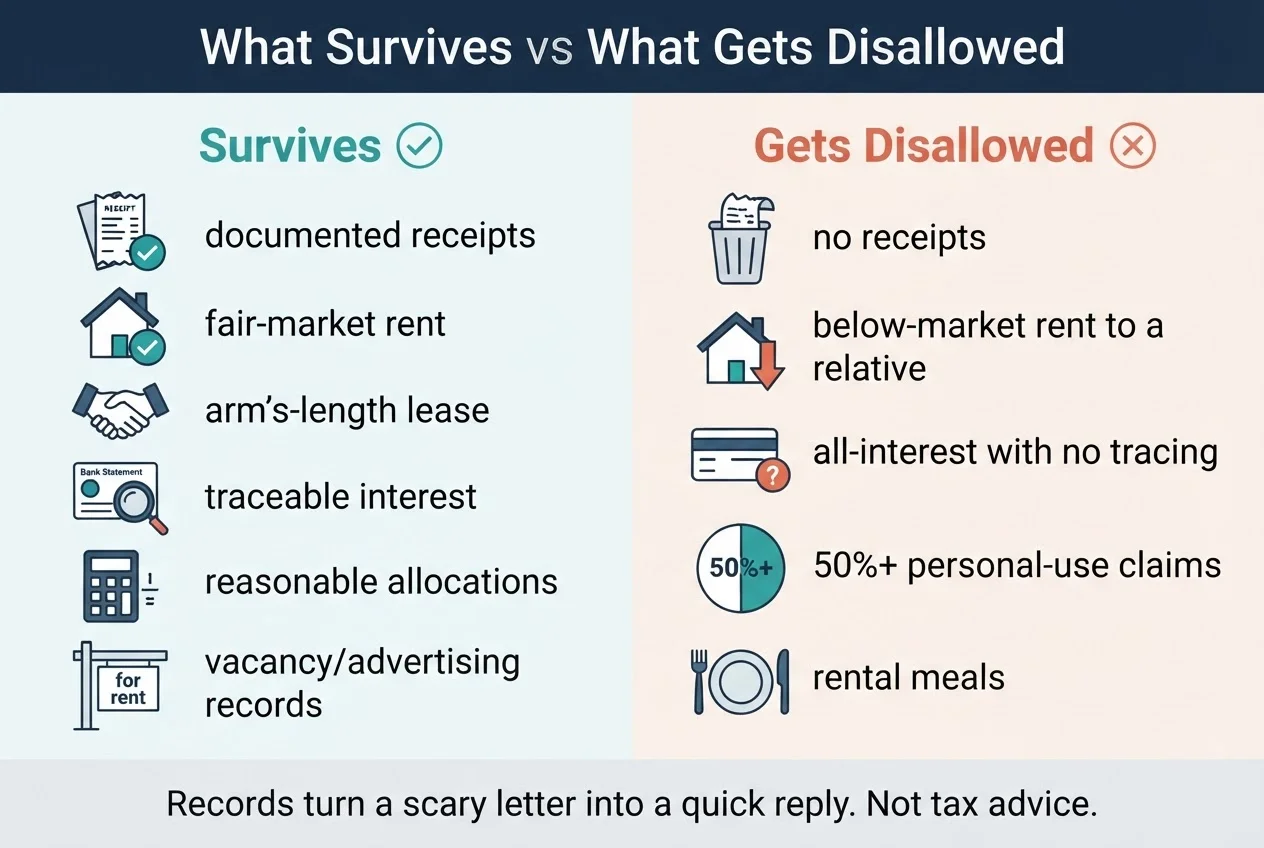
Under-reported income is the big one — cash, rent paid in services, parking and laundry, applied deposits, or short-term-rental income left off, or a slip that doesn't match. The fix is to report everything on the accrual basis, as the year-end routine lays out. Repeated rental losses invite a "reasonable expectation of profit" challenge; the risk is highest when you rent below market to a relative, and the defence is fair market rent, arm's-length tenants, advertising when vacant, and a demonstrable path to profit. Outsized repairs — or an improvement claimed as a current repair — draw a look and get reclassified, especially right after a purchase; sorting current versus capital correctly is exactly what the deductions deep-dive is for. Mis-split mortgage interest — claiming all the interest when only part of the loan funded the rental — gets disallowed without traceable records of how the funds were used. Over-claimed personal use — an outsized home-office or vehicle share, or rental meal claims that are almost never allowed — needs a reasonable, proportional allocation. And year-over-year swings or sale issues — a big change from prior years, an improper Principal Residence Exemption on a rented property, or an ACB or recapture error — are avoided with consistency and getting the numbers right on sale, which ties back to the CCA guide.
What Survives an Audit: The Records Defence
Notice that every fix above ends in the same place: documentation. That's the whole game. Receipts, invoices, bank and mortgage statements, and leases are the baseline — no receipt, no deduction. On top of that, a few specific records do specific jobs. Fair-market-rent evidence and an arm's-length lease defend the "is this a real rental?" test. Bank records tracing your borrowed funds to rental use preserve the interest deduction — without that tracing, the CRA can disallow the whole claim. Reasonable, documented allocations keep your home-office and vehicle shares intact where a 50% or 100% claim wouldn't survive. And advertising and viewing records prove a vacancy was a genuine attempt to re-rent, which keeps those vacancy-period expenses deductible.
Keep all of it for six years from the end of the tax year; you don't file the records, but you produce them on request. The mindset that helps is this: you're not trying to prove you did nothing wrong, you're making it fast and easy for the CRA to confirm your numbers. Clean records usually end a review in one exchange.
If a Letter Lands: Process, Rights, and the Playbook
If a CRA letter does arrive, the process is more structured — and more in your favour — than most people expect. The letter names the tax years, the documents it wants, and a deadline, usually around 30 days; that scope is what you respond to. Before making any change, the CRA often issues a proposal letter setting out its proposed adjustments and reasons, which is your last and best chance to resolve things before they're formalized. If a reassessment is issued anyway, you generally have 90 days to file a Notice of Objection, and Tax Court after that if needed. The standard reassessment window is generally three years from your Notice of Assessment, longer where there's misrepresentation or neglect.
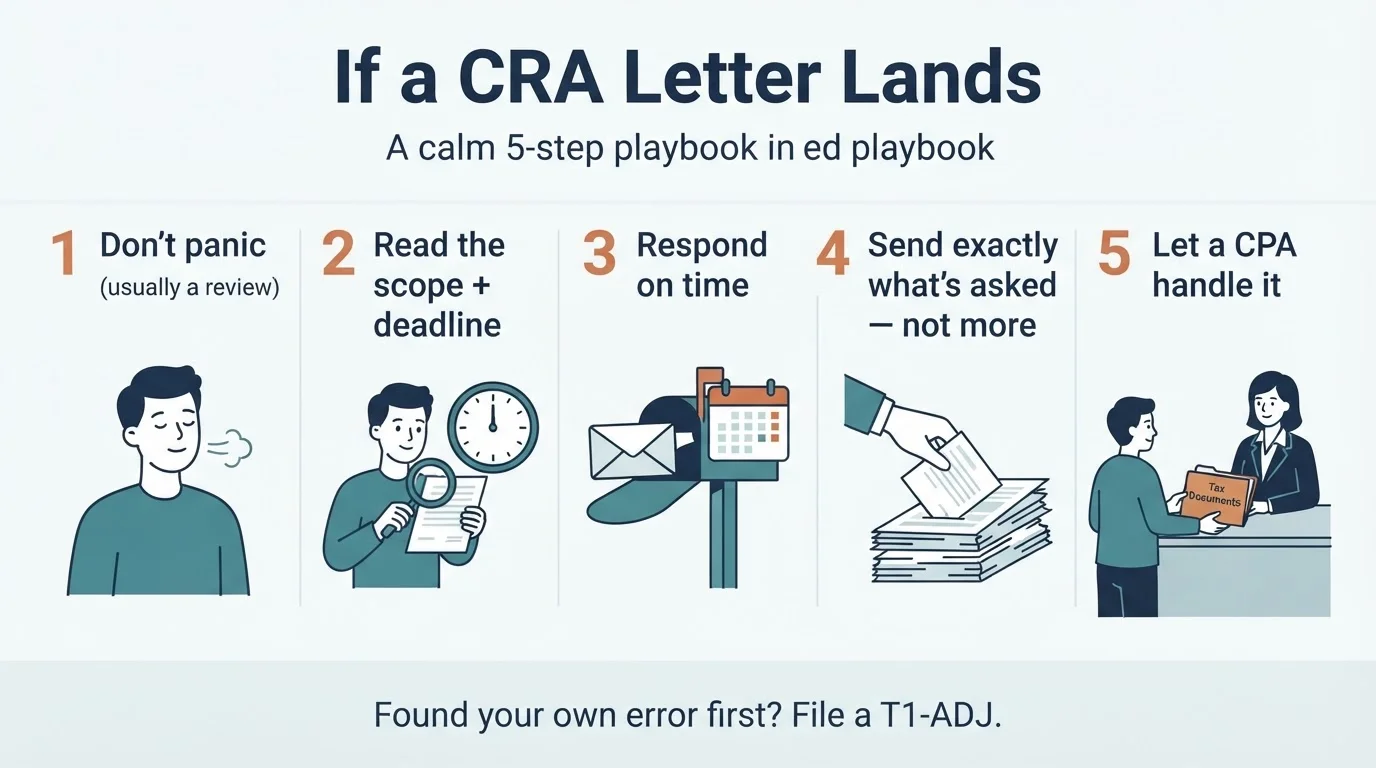
The playbook itself is simple. Don't panic — a document request is usually a review. Read the scope and the deadline, and respond on time, because missing the deadline is itself an escalation. Send exactly what's asked and not more, since extra information can widen the audit. Keep it factual, and let a CPA — or a tax lawyer for a full audit or dispute — handle the communication. And if you spot your own error first, a T1-ADJ ("Change My Return") is a good-faith correction that can reduce penalties. One thing worth watching: the CRA has been rolling out stronger powers, including proposed penalties before reassessment and the ability to question taxpayers under oath, which only raises the value of clean records and professional help. This is general information, not tax advice — confirm the current rules with a CPA and the CRA.
Be audit-ready by default
Keep income, expenses, receipts, and leases together all year — so if a letter ever lands, your answer is already organized and one export away.
Free • No signup required • Built for Ontario
Key Takeaways
- Rental audits are predictable — the CRA flags the same six patterns, and records defend all of them.
- A letter is usually a routine review, not a full audit; clean documentation usually ends it.
- The six triggers: under-reported income, repeated losses, outsized repairs, mis-split interest, over-claimed personal use, and sale/ACB errors.
- Keep six years of receipts, fair-market-rent evidence, traceable interest, and vacancy records.
- If a letter lands: respond on time, send exactly what's asked, let a CPA handle it — and you have 90 days to object to a reassessment.
Conclusion
Real estate is the CRA's biggest audit focus, but rental audits are predictable. They start with a letter, usually about one of six things: under-reported income, repeated losses, outsized repairs, mis-split interest, over-claimed personal use, or sale and ACB issues. The defence for every one is the same — complete records, fair-market rent, traceable interest, and reasonable allocations — and most letters are routine reviews, not full audits.
You don't beat an audit by hoping to avoid one; you make your numbers easy to confirm. Do that, keep six years of records, and line up a CPA before you ever need one, and a scary-looking envelope turns into a short reply. This is general information, not tax advice — take anything specific to a CPA or tax lawyer, and verify the current rules with the CRA at canada.ca.
Frequently Asked Questions
What triggers a CRA audit on rental income?
The common triggers are under-reported income, repeated rental losses, unusually high repairs, misclassified capital improvements, mis-allocated mortgage interest, and over-claimed personal-use expenses. Selection uses risk-scoring, data-matching, and public tips.
What's the difference between a CRA review and an audit?
A review is routine — the CRA cross-references your return against slips or asks you to support a specific line. An audit is a formal examination of your books and records. Most rental letters are reviews, not audits.
Can the CRA deny my rental losses?
Yes. If you report losses year after year — especially renting below market to a relative — the CRA can challenge whether there's a reasonable expectation of profit and deny the losses. Fair-market rent, arm's-length tenants, and advertising when vacant are the main defences.
How far back can the CRA audit my rental income?
The standard reassessment period is generally three years from your Notice of Assessment, but it can go further where there's misrepresentation or neglect. Keep your records for six years.
What should I do if I get a CRA letter about my rental?
Read the scope and deadline, respond on time, and provide exactly what's requested — not more. Keep it factual, and let a CPA or tax professional handle the communication.
What records do I need to survive a rental audit?
Receipts, invoices, bank and mortgage statements, leases, fair-market-rent evidence, vacancy and advertising records, and bank records tracing borrowed funds to rental use. Keep everything six years.


