Every dollar of rent you collect in Canada is taxable income — and the Canada Revenue Agency (CRA) now sees more of it than ever, since platforms like Airbnb and VRBO report host earnings directly. So the real question for a landlord isn't whether to report your rental income; it's how to report it correctly on the T776 form while claiming every deduction you're legitimately owed.
The T776 looks simple, but it hides a few costly traps: the capital cost allowance (CCA) "deferral that comes due," the difference between repairs and improvements, the co-owner rule that trips up couples, and brand-new 2026 rules that change the math. Get them wrong and you either overpay or invite a reassessment. This is a plain-language walkthrough of the form — what counts as rental income, which expenses you can deduct, how CCA really works (and when to skip it), and the 2026 changes that matter. We'll cover it in four parts: what the T776 is and who files it, how to fill it in line by line, the mistakes that cost landlords money, and the 2026 outlook.
This article is general information, not tax advice. Tax rules change and every situation is different — confirm details with the CRA or a CPA before you file.
What the T776 Is and Who Has to File It
Form T776, the "Statement of Real Estate Rentals," is the CRA form where you report your gross rental income, your deductible expenses, any capital cost allowance, and the resulting net rental income or loss. The numbers from your T776 then flow onto your T1 personal tax return. If you own and rent out property, this is your annual point of contact with the CRA.
Who has to file one? Any owner or co-owner who earns rental income from property — in Canada or abroad. Each co-owner or partner completes their own T776. If you live in Quebec, you also file the provincial TP-128-V. The form applies whether you rent out a single basement suite or a portfolio of units.
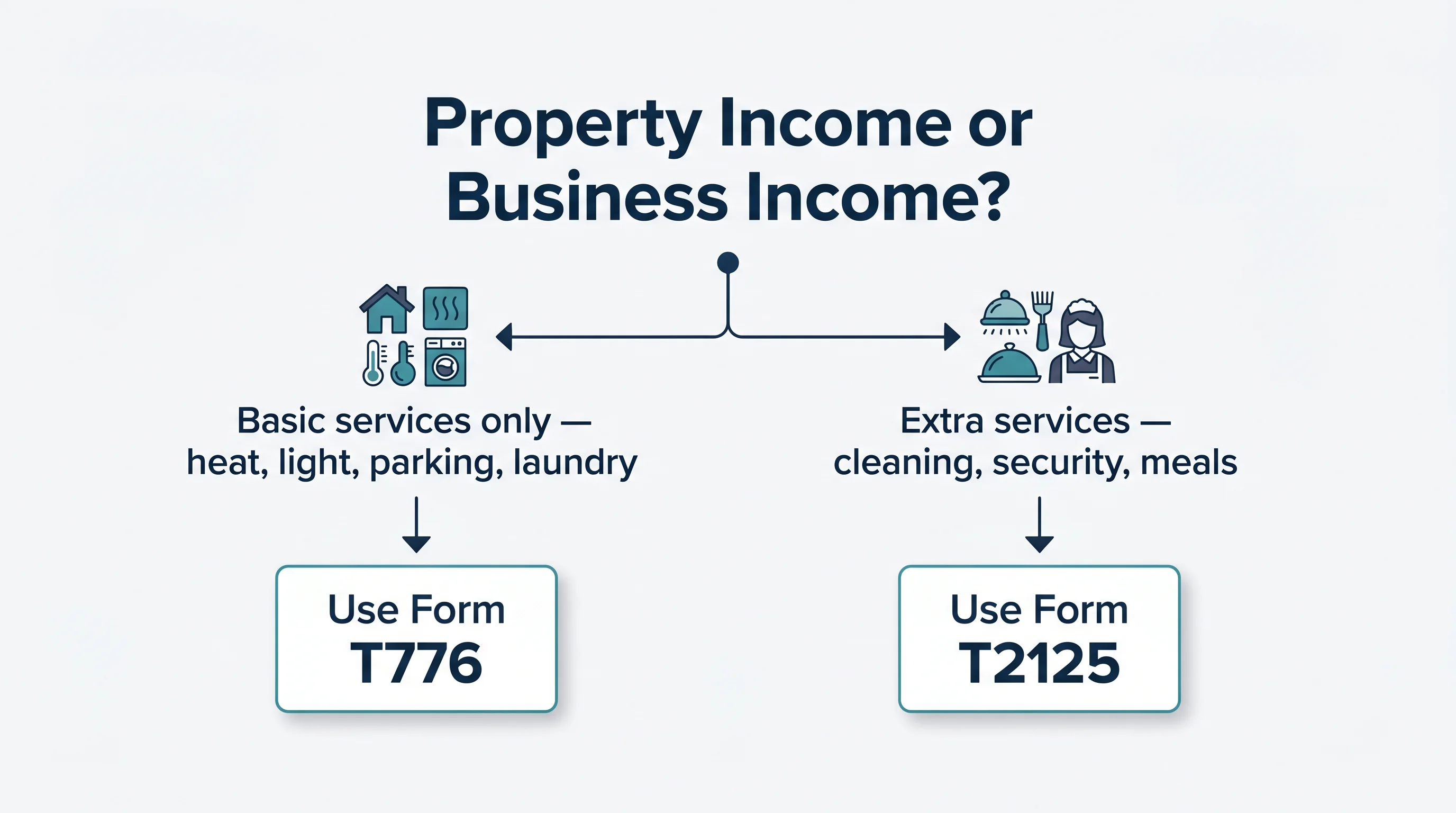
Property income or business income?
There's an important threshold to settle first, because it decides which form you use. If you rent out space and provide only basic services — heat, light, parking, laundry — your earnings are property income, and the T776 is correct. If you add services more typical of a business — regular cleaning, security, or meals — the CRA may treat it as business income, which goes on Form T2125 instead. The test is the number and type of services you provide, not the size of the property.
Why does precision matter so much in 2026? Because the market has softened. National average asking rents have slipped to around $2,123 after roughly a year of decline, and vacancy is forecast near 3–5% in many markets. Thinner cash flow makes capturing every legitimate deduction more valuable, not less. And with digital platforms now feeding host data to the CRA, under-reporting carries far more risk than it used to. If you're newer to all this, our guide on becoming a landlord in Ontario covers the wider setup; this piece focuses on the tax filing itself.
How to Fill Out the T776, Line by Line
Start with the income side. You report your total gross rents on line 8141, any other related income (such as certain premiums or lease amounts) on line 8230, and the combined total on line 8299. On your T1 return, gross rental income carries to line 12599 and your net rental income to line 12600.
One rule trips up couples constantly: if you co-own a property, you report the full gross income for the property on line 12599 — not just your share. Only the net income is split according to ownership percentage. So two spouses who own 50/50 each file a T776, each shows the full property gross, and each reports half the net.
The deductions that save you money
You can deduct any reasonable expense incurred to earn rental income, including advertising, insurance, property taxes, utilities, repairs and maintenance, management and professional fees, office costs, travel, and wages. One critical detail: you can deduct your mortgage interest, but never the principal portion of the payment. If you rent out part of a home you also live in, you prorate shared costs by the rented portion.
The CRA's own example makes this concrete: a landlord who rents out 25% of his home (three of twelve rooms) deducts 25% of property tax, electricity, and insurance — but 100% of an advertising cost that relates only to the rented unit, using the form's "Total" versus "Personal portion" columns.

Repairs vs improvements
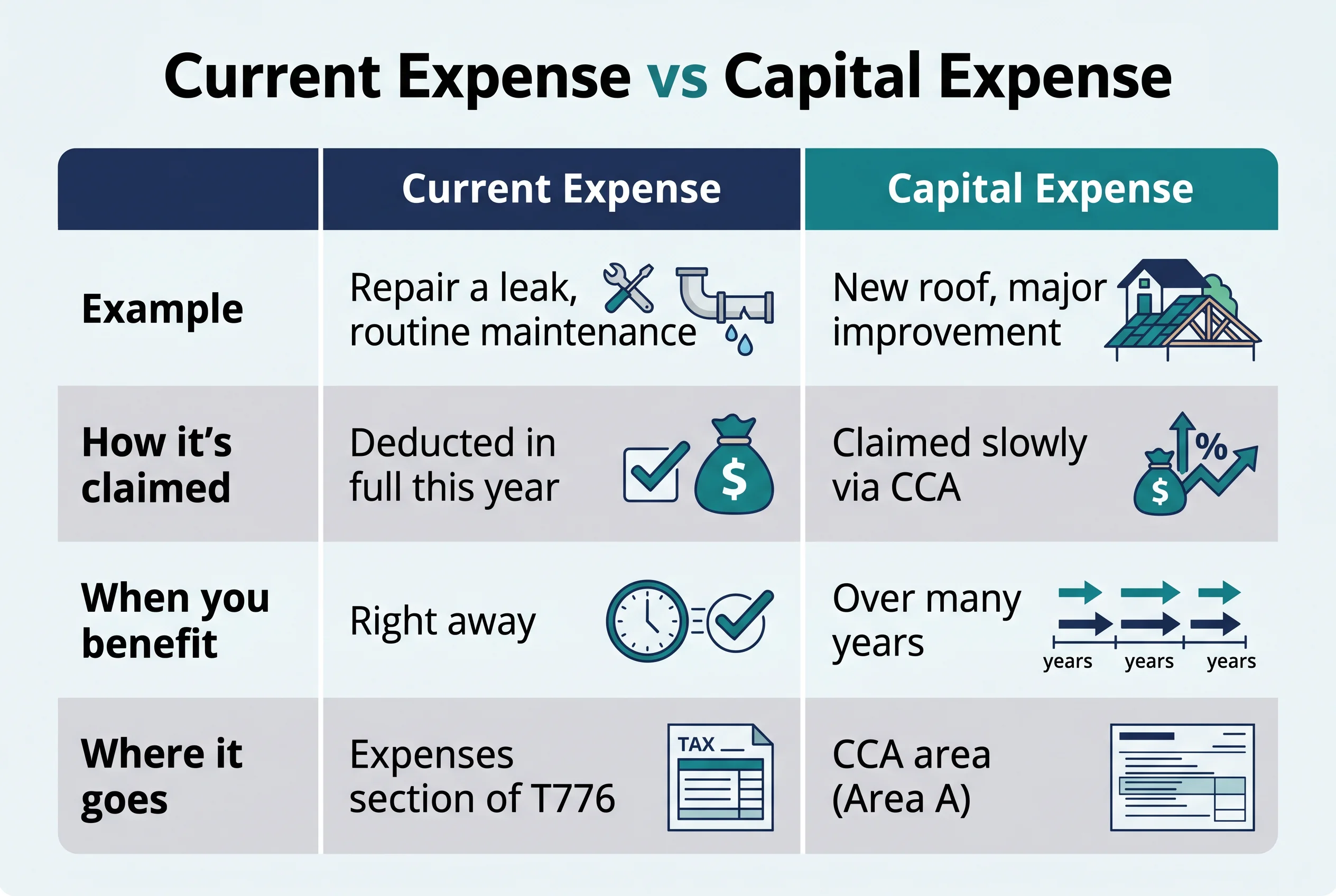
This is one of the most common — and expensive — mix-ups. A current expense (a repair, like fixing a leak or patching drywall) is fully deductible in the year you incur it. A capital expense (an improvement that betters the property, like a new roof or a kitchen renovation) isn't deducted all at once; it's written off slowly through CCA. Treating an improvement as a repair to grab a faster deduction is exactly the kind of thing a CRA review looks for.
CCA and the Mistakes That Cost Landlords Money
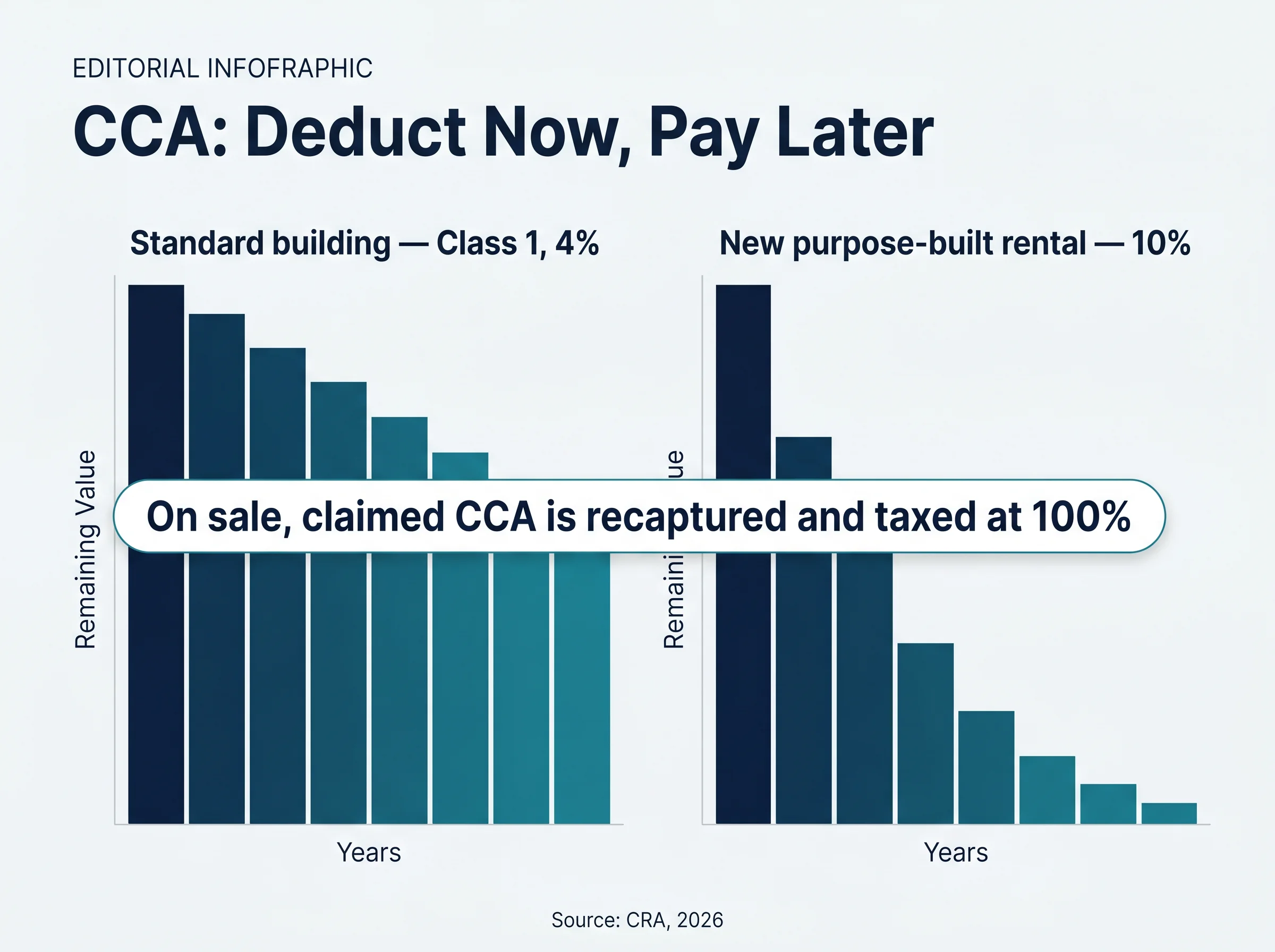
Capital cost allowance lets you depreciate capital assets over time instead of deducting them at once. The building goes in Class 1 (a 4% rate); furniture, appliances, and equipment typically sit in Class 8 (20%). Land is never depreciable. A "half-year rule" generally limits your claim in the first year to half the normal amount.
Two rules deserve emphasis. First, CCA can't create or increase a rental loss — if you're already at a loss before CCA, your allowable claim that year is zero. Second, and more importantly, CCA is a deferral, not a saving. When you sell the property for a gain, the CCA you claimed over the years is "recaptured" and taxed as ordinary income at 100% — not at the lower capital-gains rate. A useful way to think about it: CCA works like an RRSP, giving you a deduction now in exchange for taxable income later.
As Canadian real-estate tax specialists often put it, CCA isn't free money — it can reduce a cash-flow-positive rental to zero taxable income for years, but the recapture bill, taxed at 100%, comes due on sale. Claiming it should be a deliberate decision, not a default.
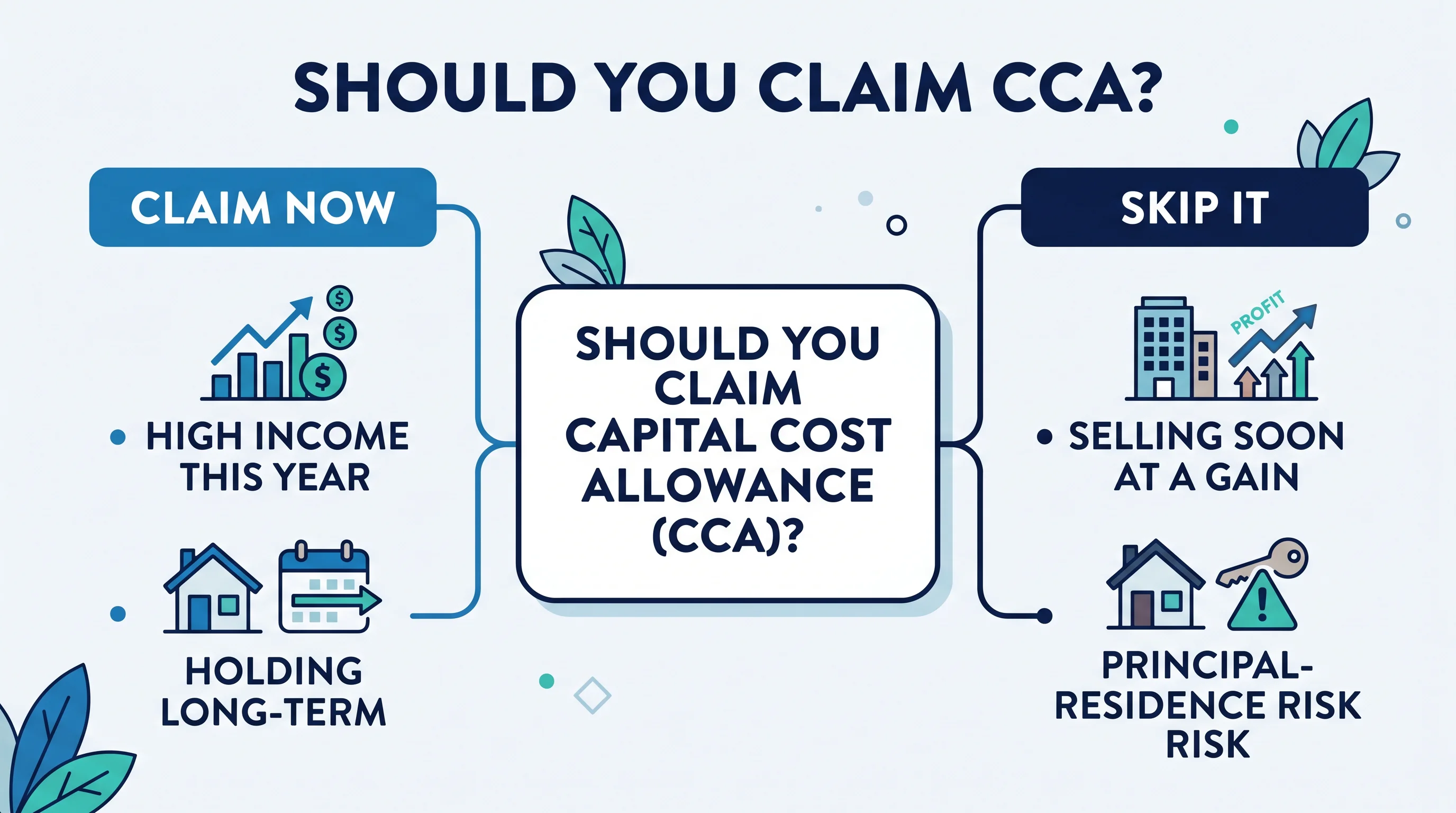
There's a further catch: claiming CCA on a property that's also your principal residence can undermine your principal-residence exemption. So the real question isn't "how do I claim CCA?" but "should I?" It tends to help when your income is high now and you plan to hold the property long-term (or expect to eventually sell at a loss). It's often better skipped when you might sell soon at a gain, or where principal-residence status is in play.
A few other mistakes round out the list: deducting the whole mortgage payment instead of just the interest; the co-owner gross-income error covered above; and misclassifying improvements as repairs. None is complicated once you know it's there — but each is easy to get wrong on autopilot.
2026 Changes Every Landlord Should Know
Three shifts make a 2026 rental-tax picture different from a few years ago.
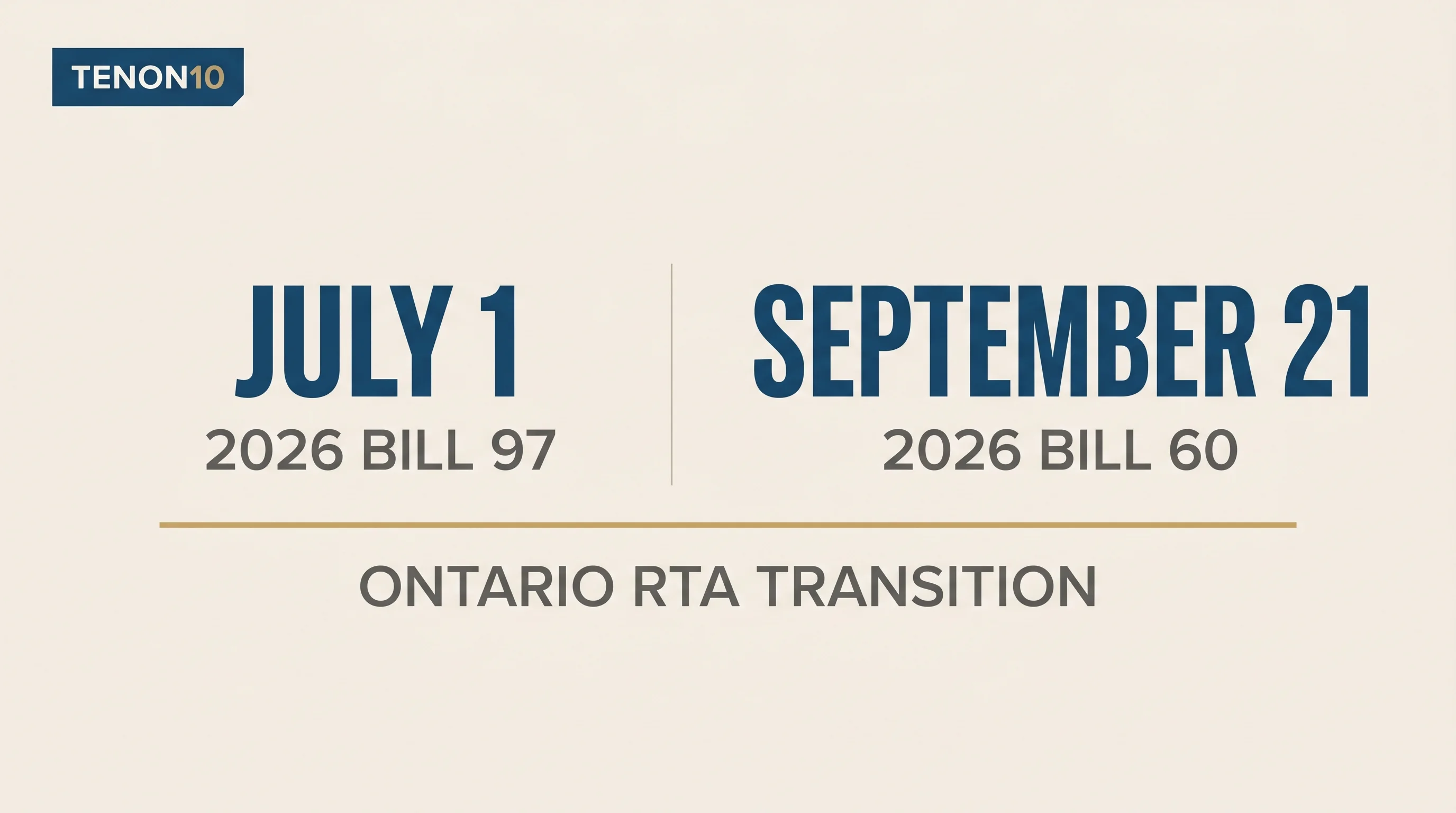
Accelerated CCA for purpose-built rentals. Eligible new purpose-built rental buildings can now be depreciated at 10% instead of 4%. To qualify, a building needs at least four private apartment units (or 10 private rooms), with at least 90% held for long-term rental, and construction must have begun after April 15, 2024 and before 2031, with the property available for use before 2036. It covers conversions of non-residential buildings and new additions, but not renovations of existing rentals. This was implemented through Bill C-15, which became substantively enacted on February 26, 2026. The Parliamentary Budget Officer frames it as a deferral rather than a permanent cut and projected roughly 241,000 eligible new units.
The capital-gains hike is off. The proposed increase in the capital-gains inclusion rate from one-half to two-thirds was cancelled, and the CRA is administering the 50% rate for gains realized before January 1, 2026. (The Lifetime Capital Gains Exemption increase to $1.25M still stands.) For a landlord, that means selling a rental still triggers a capital gain at the 50% inclusion rate — plus that 100% CCA recapture — which is exactly why the "should I claim CCA?" call matters.
To prepare for all three, the playbook is simple: confirm any short-term-rental compliance, keep six years of records, and decide your CCA strategy on purpose rather than by habit.
Key Takeaways: Your T776 Filing Checklist
Before you file, run through this:
- Confirm your income is property income (T776), not business income (T2125).
- Report gross on lines 8141 / 8230 / 8299; carry gross to T1 line 12599 and net to line 12600.
- Deduct only reasonable expenses — and only mortgage interest, never principal.
- Separate current expenses (repairs, deducted now) from capital expenses (improvements, claimed via CCA).
- Decide on CCA deliberately, weighing the deferral against 100% recapture and any principal-residence risk.
- Co-owners: report the full property gross on line 12599; split only the net.
- Short-term-rental owners: confirm local licensing compliance, keep six years of records, and file by April 30.
Think quick wins versus long game. The quick win is capturing every deductible expense and filing on time. The long game is a clean bookkeeping habit, a deliberate CCA plan, and a relationship with a CPA who knows your situation. The official CRA resources — Form T776 and Guide T4036, Rental Income — are worth bookmarking for the details.
Keep next year easier: The hardest part of the T776 is reconstructing a year of income and receipts in April. Tenon10 keeps your rent records and expenses organized as they happen — see our guide to property management software for what to look for.
Conclusion
The T776 is where your rental income becomes net taxable income. The fundamentals — report all your income, deduct the right expenses, and treat repairs and improvements correctly — protect you from overpaying and from reassessment. The strategic calls, especially on CCA, and the 2026 rules (accelerated CCA, the held 50% capital-gains rate, and the short-term-rental expense rules) decide how much of your rent you actually keep.
None of it is hard once you know where the traps are, and good records turn filing season from a scramble into a routine. Gather your income and expense records, decide your CCA approach, confirm any short-term-rental compliance, and you're ready to file with confidence.
Reminder: this is general information, not tax advice. For guidance on your specific situation, consult a CPA.
Make next tax season a download, not a scramble
Tenon10 keeps your rental income, expenses, and receipts organized all year — so your T776 numbers are ready when you are.
Free to start • Built for Canadian landlords
Frequently Asked Questions
Do I have to file a T776 if I only made a little rental income?
Yes. All rental income is taxable and must be reported, regardless of the amount — and platforms now report host earnings to the CRA, so small amounts don't go unnoticed.
Can I deduct my mortgage payment on the T776?
Only the interest portion of the payment is deductible. The principal repayment is not an eligible rental expense.
Should I claim CCA on my rental property?
Not always. CCA defers tax, but it's recaptured and taxed at 100% when you sell at a gain, and it can affect your principal-residence exemption. Treat it as a deliberate decision based on your income and your plans for the property.
How do co-owners report rental income?
Each co-owner files their own T776 and reports the full property gross on line 12599. Only the net income is split according to each owner's percentage of ownership.
Are short-term rental expenses still deductible in 2026?
Only if the rental complies with local licensing and permit rules. Under section 67.7, a non-compliant short-term rental can have all its expenses denied, with no time limit on CRA reassessment.