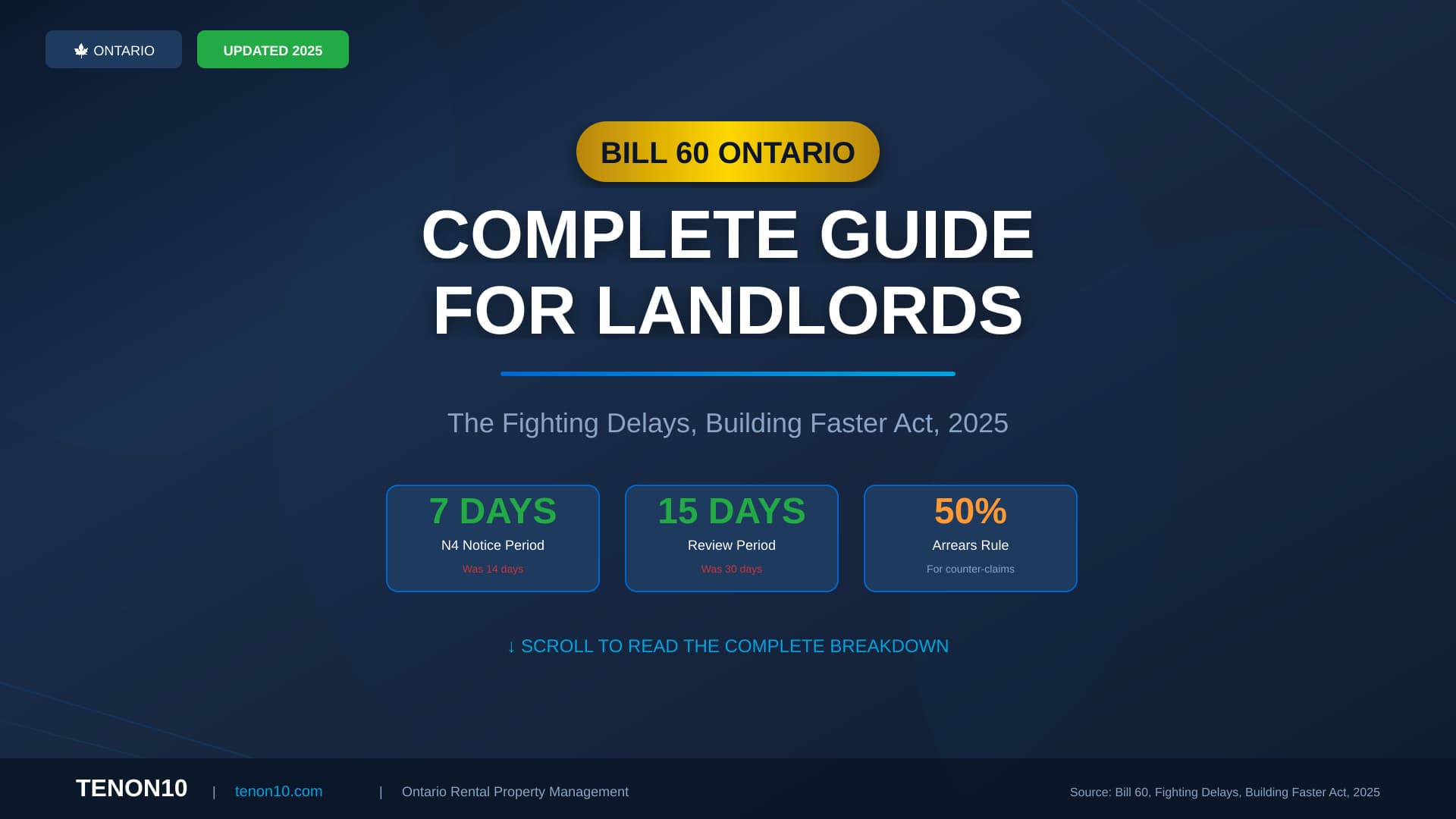
Update, 26 Sep 2026: Both waves described in this guide are now in force (see the LTB's September 21, 2026 operational update). Three changes listed below as still to be determined are also in force: a tenant who wants to raise other issues at the hearing of an L1 filed on or after September 21, 2026 must pay the landlord half the arrears claimed at least seven days before the hearing; rent received more than seven days after the due date at least three times in six months now counts as persistent late payment (the LTB can still find persistent late payment in other circumstances); and the window to request an LTB review has been 15 days since July 1, 2026. Since September 21, 2026, bad faith is also presumed on a tenant's T5 application if the person named in an own-use N12 (the landlord or a specified family member or caregiver) does not move in within 60 days of the termination date in the notice; the landlord can rebut the presumption, and it does not apply to a purchaser's own use. The new renoviction duties turn on when the tenant gives written notice of intent to move back (on or after September 21, 2026) and the 60-day re-occupancy period on when the work is completed (on or after that date), not on the date of the N13. Use the current (2026/09) N4, N12 and N13 forms: the LTB will no longer accept previous versions of the N12, N13 and its other updated forms as of November 30, 2026.
On April 27, 2026, the Ontario Ministry of Municipal Affairs and Housing issued a stakeholder memorandum confirming that the Lieutenant Governor in Council has approved an Order bringing into effect a set of amendments to the Residential Tenancies Act, 2006 (RTA) made through Bill 97 (Helping Homebuyers, Protecting Tenants Act, 2023) and Bill 60 (Fighting Delays, Building Faster Act, 2025). The changes arrived in two waves: the first wave took effect July 1, 2026, and the second wave took effect September 21, 2026.
These are the most substantive changes to Ontario rental law in years. Landlords face a five-month transition window with split effective dates, dual-bill complexity, and operational implications spanning the N4 eviction timeline, the N12 own-use compensation rule, mandatory new forms, doubled penalty maximums, and new tenant AC installation rights. Most landlords haven't yet absorbed what's coming — or what they need to do to prepare.
This guide explains every confirmed RTA change coming in 2026, organized by effective date so landlords can plan operationally. It covers what's changing under Bill 60 and Bill 97, what to do before July 1 and before September 21, and where the strategic opportunities and compliance risks sit. Five sections cover the news and confirmed legislative path, the July 1 first wave, the September 21 second wave, the strategic implications for landlord operations, and how to prepare across the transition.
Ontario 2026 RTA Changes: Landlord Compliance Calendar
Bill 60 and Bill 97 RTA changes hit July 1 and September 21, 2026. This free compliance calendar gives Ontario landlords every action item, organized by effective date — so you're ready before each deadline.
Get Free PDF →The News and the Legislative Path
What just happened
On April 27, 2026, the Ministry of Municipal Affairs and Housing issued a memorandum to housing-sector stakeholders confirming that the Lieutenant Governor in Council has approved an Order bringing into effect specific amendments to the RTA passed through Bill 97 (Royal Assent June 8, 2023) and Bill 60 (Royal Assent November 27, 2025). The Order sets two effective dates and is the first authoritative confirmation Ontario landlords have received of when the long-pending RTA changes will take force.
The memo identifies which RTA sections are affected, lists the changes, and confirms that "the in-effect date(s) for the remaining changes made to the RTA through Bill 97 and Bill 60 are still to be determined." In other words, this Order brings some changes into effect; others remain pending future proclamation.
The two-wave transition
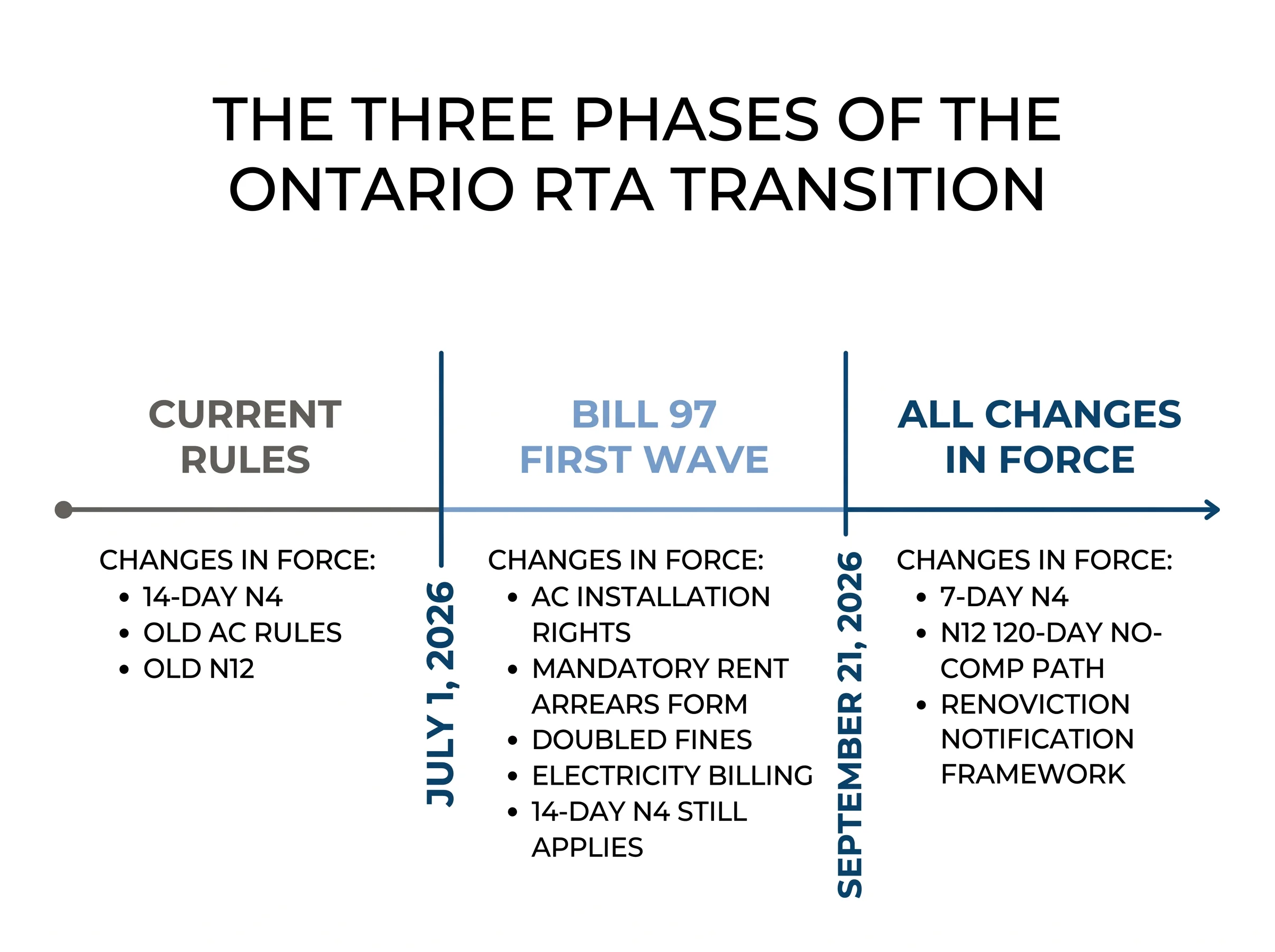
The two effective dates create a 5-month transition with three distinct operational regimes:
- Until July 1, 2026: All current rules apply. New AC framework, doubled fines, and mandatory rent arrears form not yet in force. N4 14-day rule still in place.
- July 1, 2026 to September 20, 2026: Bill 97 first wave in force. AC framework, doubled fines, and the mandatory rent arrears form active. N4 14-day rule still in force for any notice given in this window. N12 compensation (or an alternative unit) still required for any N12 served in this window, whatever the length of notice.
- September 21, 2026 onward: Confirmed second-wave changes in force. N4 7-day rule active. N12 120-day no-compensation path available for landlord's-own-use notices (not a purchaser's own use). Renoviction notification framework live.
This staggered rollout matters operationally. A landlord who gave an N4 on September 20 was still under the 14-day rule. The same landlord serving an N4 on September 22 operates under the 7-day rule. Templates, training, and procedures need to update twice.

How we got here
Bill 97 (Helping Homebuyers, Protecting Tenants Act, 2023): Introduced by the Ministry of Municipal Affairs and Housing on April 6, 2023. Royal Assent on June 8, 2023. RTA elements (Schedule 7) held back for proclamation. Now proclaimed for July 1, 2026 (most elements) and September 21, 2026 (right-of-first-refusal extensions). The full statutory text is published at Schedule 7 of Bill 97 on the Legislative Assembly of Ontario site.
Bill 60 (Fighting Delays, Building Faster Act, 2025): Introduced fall 2025. Passed third reading November 24, 2025. Royal Assent on November 27, 2025. RTA elements (Schedule 12) held back for proclamation. The Order proclaimed September 21, 2026 as the effective date for specific Bill 60 RTA changes — but not all of them. The full statutory text is published at Schedule 12 of Bill 60 on the Legislative Assembly of Ontario site.
What stays the same (for now)
Until each effective date arrives, existing legislation and existing LTB procedures continue to apply. Matters already in progress proceed under the current system. The 2.1% statutory rent increase guideline for 2026 (covered in our ontario rent increase 2026 guide) remains unchanged. Core tenant protections — maintenance obligations, vital services, privacy, security of tenure — remain in place. Fixed-term leases continue to convert to month-to-month at the end of the term.
The dual-bill, split-effective-date structure is unusual in Ontario. It reflects the political reality that Bill 60 was the government's priority package while Bill 97 had been waiting for years for its proclamation moment.
What Changes July 1, 2026 — Bill 97 First Wave
Tenant AC installation rights (new section 36.1)
Effective July 1, 2026, tenants gain the explicit right to install window or portable AC units in their rental units, subject to specific conditions. The right applies when the landlord does not supply air conditioning. The relevant statutory provisions are RTA section 36.1 and section 241(1)(12.1).
The conditions on tenant installation:
- The tenant must notify the landlord in writing before installing the unit
- The unit must not damage the rental unit or the residential complex
- The installation must be safe and secure
- The installation must comply with applicable law (municipal by-laws and the Ontario Building Code)
What this changes for landlords: Lease addenda need updating to reflect the new framework. AC denial clauses in existing leases become unenforceable to the extent they contradict section 36.1. Landlords with bulk-metered buildings face calculation challenges for the seasonal rent increase mechanism described below.
Seasonal rent increases for landlord-supplied electricity
Where the landlord is obligated under the tenancy agreement to supply electricity, and the tenant installs an AC unit under section 36.1, the landlord may charge a seasonal rent increase to cover the additional electricity cost, subject to certain rules.
The specific rules will be set out in regulations. The "reasonable amount" standard requires consideration of unit type, set temperature, building position, and other factors. Bulk-metered buildings face implementation complexity — calculating per-unit electricity consumption from a single building meter is genuinely difficult.
Mandatory LTB-approved form for rent arrears repayment agreements (s. 206(1))
Where a landlord and tenant reach an agreement regarding the repayment of rent arrears, that agreement must now use a form approved by the LTB. The voluntary nature of the agreement doesn't change. What changes is that the agreement must be on the official form to be legally enforceable as a rent arrears repayment agreement under the RTA.
The form will be published by Tribunals Ontario before July 1, 2026. Landlords and PMs handling rent arrears must adopt the new form going forward.
Doubled RTA penalty maximums (s. 238(1) and (2))
Effective July 1, 2026, maximum fines for offences under the RTA double:
- Maximum fine for an individual: increased from $50,000 to $100,000
- Maximum fine for a corporation: increased from $250,000 to $500,000
This is the first doubling of these penalties since the RTA took effect in 2007. The change applies to all RTA offences — bad-faith N12 evictions, illegal harassment, charging illegal rent, refusing required compensation, failing to comply with LTB orders. Higher penalty maximums make compliance auditing materially more important. Landlords with historical practices that may no longer be defensible — illegal "key deposit" fees, unauthorized charges, intimidation patterns — face significantly higher exposure under the new framework.
What this means in aggregate
July 1 brings four changes that together create new operational obligations: AC framework, electricity billing, mandatory rent arrears form, doubled fines. None of these are minor. Each requires landlord action ahead of July 1 — lease addendum updates, template replacement, compliance review, staff training. The lease language updates connect to broader principles in our guide on ontario standard lease additional terms.
💡 What to expect from Tenon10 by July 1, 2026: Tenon10's forms wizards and tenancy agreement templates will be fully updated to reflect Bill 97's first-wave changes ahead of the effective date. The new LTB-approved rent arrears repayment form will be live in the wizard. Lease addenda will include updated AC installation policy language compliant with section 36.1. The Ontario Standard Lease tool will reflect all required updates. Start free →
What Changes September 21, 2026 — Confirmed Second Wave
The 7-day N4 window (Bill 60, s. 59(1))
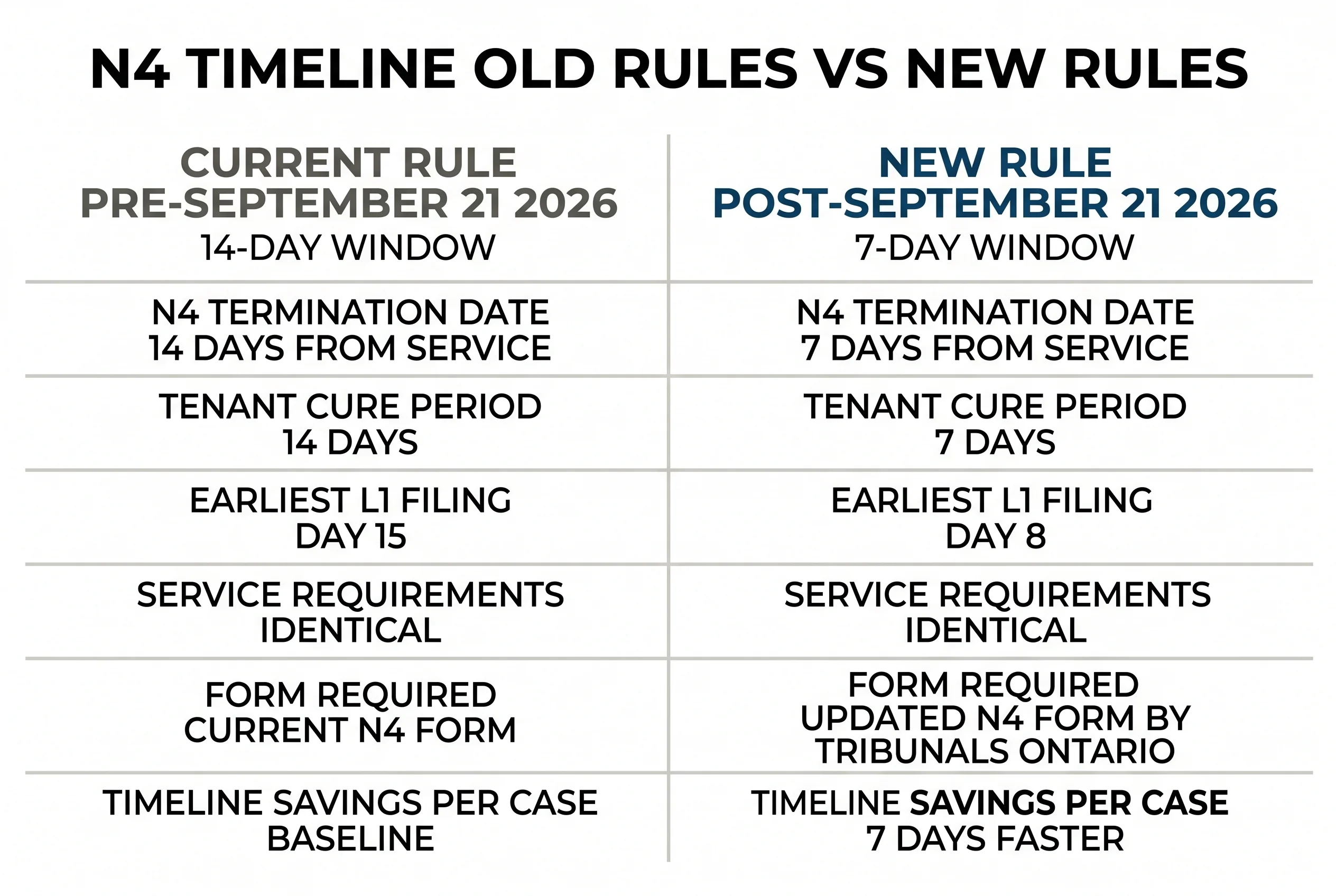
Effective September 21, 2026, the notice period for evictions due to non-payment of rent for fixed-term or month-to-month tenancies is shortened from 14 days to 7 days. Section 59(1) of the RTA is amended to give effect to the change.
The mechanics of the new timeline:
- N4 served on the tenant. Day 1 starts the next day.
- Tenant has 7 days to pay arrears in full (down from 14 days)
- If unpaid by Day 7, landlord can file L1 starting Day 8
- L1 hearing wait remains subject to LTB capacity
What this means operationally: A landlord recovers an additional 7 days of front-end timeline per non-payment scenario. Across the volume of N4 notices served annually in Ontario, the cumulative effect on portfolios is meaningful.
What stays the same: The fundamental N4 procedure — proper service, certificate of service, accurate rent calculation — remains identical. For step-by-step procedure, see our N4 Notice Ontario guide. Form changes will be issued by Tribunals Ontario before September 21.
No compensation for N12 own-use with 120+ day notice (Bill 60, s. 48.1)
For an N12 served on or after September 21, 2026 for the landlord's own use — or for the landlord's spouse, a child or parent of either of them, or a caregiver for one of these people — a landlord who gives at least 120 days' notice (instead of the minimum 60 days' notice) is no longer required to compensate the tenant or to offer the tenant another acceptable rental unit. The exemption does not apply to an N12 served for a purchaser's own use, where the existing compensation rules still apply.
The new strategic choice for landlords:
- 60-day notice path: Compensation of one month's rent (or alternative unit) still required
- 120-day notice path: No compensation required
For a Toronto detached house at $3,400/month, the 120-day path saves the landlord $3,400 per N12. For a Hamilton apartment at $1,800/month, the savings are $1,800. The tradeoff is timing — landlords gain 60 additional days of waiting in exchange for the avoided compensation.
What stays the same: The good-faith requirement under section 48 remains. Bad-faith N12s remain subject to T5 application by the tenant. Doubled fines (effective July 1) increase the penalty exposure for bad-faith evictions. For a comprehensive overview of the N12, see our n12 notice ontario guide.
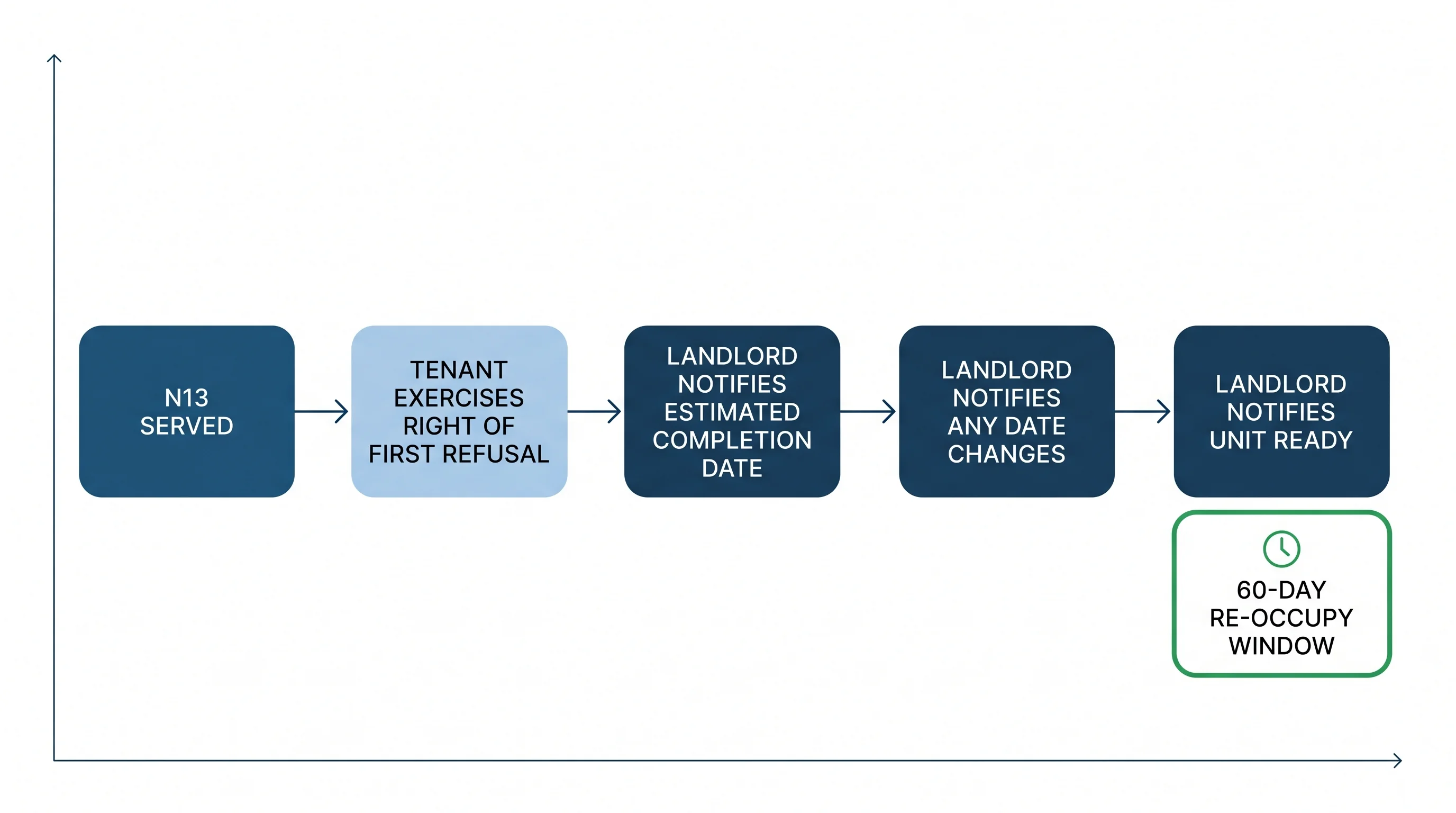
Strengthened renoviction framework (Bill 97 second wave, s. 53(2.1)–(2.2) and s. 57.1(1.1)–(4))
Effective September 21, 2026, landlords seeking to end a tenancy due to repairs or renovations must:
- Provide written notifications to the tenant regarding the estimated completion date of the renovations, any changes to the estimated completion date, and the final date that the unit is ready for re-occupancy
- Provide the tenant a period of at least 60 days to re-occupy the unit following completion of renovations
Tenants will be able to apply to the LTB for a remedy for "failure to afford a right of first refusal" if the landlord does not provide the required notifications and/or does not give the tenant 60 days to re-occupy the unit.
Extended limitation period: The timeline for a tenant to apply to the LTB for a remedy if they are denied their "right of first refusal" is extended to the later of two years from the date they vacated the unit, or six months after renovations are completed. This significantly extends the existing one-year window, materially expanding landlord liability for renoviction projects gone wrong.
Other Bill 60 RTA changes — effective dates still to be determined
The April 27, 2026 ministerial memorandum confirms only some of the Bill 60 RTA amendments as proclaimed. Several additional Bill 60 provisions affecting RTA procedure remain pending future proclamation, with effective dates not yet set:
- Section 82 (issues raised at non-payment hearings): Bill 60 contemplates a prepayment requirement before a tenant may raise their own issues at a non-payment hearing. Effective date not yet proclaimed.
- Section 58(1.1) (persistent failure to pay rent): Bill 60 delegates the definition of "persistent failure" to regulation. Both the regulation and the in-effect date are pending.
- Tenant appeal window: Bill 60 contemplates shortening the review window for LTB orders. Effective date not yet proclaimed.
- Section 43(1) (form approval): Bill 60 clarifies form approval requirements for RTA notices. Effective date not yet proclaimed.
Landlords should monitor for additional proclamation announcements through Ontario.ca and Tribunals Ontario in coming months. For now, planning around these specific changes should remain provisional.
💡 What to expect from Tenon10 by September 21, 2026: The N4 wizard will support the new 7-day termination date with automatic calculation. The N12 wizard will offer both the 60-day-with-compensation path and the 120-day-without path with strategic guidance built in; by law, the 120-day path covers only landlord's-own-use notices served on or after September 21, 2026, never a purchaser's own use. The N13 wizard will include the new written notification framework — estimated completion date, change notifications, and ready-for-occupancy notification. The Ontario Termination Date Calculator will be updated for both new notice periods. Start free →
The Strategic Implications for Landlord Operations
Bill 60 changes are landlord-favorable; Bill 97 changes are mostly tenant-protective
The two bills pull in different directions. Bill 60 tightens tenant procedural timelines (the 7-day N4, the N12 no-compensation path) — landlord-favorable. Bill 97 strengthens tenant rights (AC installation, right of first refusal, mandatory rent arrears form, doubled fines for landlord misconduct) — mostly tenant-protective. The exception is the seasonal electricity rent increase, which provides a landlord cost-recovery mechanism for AC-related electricity consumption — but this is a pass-through cost, not a windfall.
The combined effect varies meaningfully by landlord profile:
| Landlord Profile | Net Effect | Why |
|---|---|---|
| Smaller landlords (1–3 units) | Roughly neutral | Bill 60 helps with non-payment situations; Bill 97 imposes new operational obligations |
| Mid-sized PMs (50–500 units) | Modestly positive | Bill 60 streamlines a recurring problem; Bill 97 requires significant procedural updates after transition |
| Large institutional (1,000+ units) | Positive | Bill 60 streamlines; Bill 97 imposes manageable compliance overhead |
| Renoviction-heavy | Negative | Bill 97 significantly increases compliance burden and tenant remedy potential |
| N12 own-use focused | Positive | Bill 60 provides real cost saving for landlords with timing flexibility on the 120-day path |
The N12 strategic decision in detail
The 120-day no-compensation path is the most consequential strategic question for any landlord planning a future own-use eviction. The 120-day path makes sense when move-in timing has flexibility (4 months out vs 2 months out), the avoided compensation is meaningful (one month's rent), the tenant's continued occupancy doesn't create operational issues, and the landlord wants to minimize bad-faith T5 risk by demonstrating extended notice.
The 60-day-with-compensation path still makes sense for time-pressured family or owner situations where immediate move-in is needed, when the landlord wants to clear the unit quickly for sale or refinance, or when compensation is simply the cost of speed. For most landlords with normal planning lead times, the 120-day path will become the new default after September 21.
To compute correct termination dates under either path, use the Ontario Termination Date Calculator — it will be updated for both Bill 60 timing rules ahead of the September 21 effective date.
The doubled fines reality check
The first doubling of RTA fines since 2007 reflects the government's increased enforcement priority on landlord misconduct. This isn't theoretical. Conduct that previously carried "manageable" penalty exposure now carries materially higher exposure: bad-faith N12 up to $100,000, illegal lease clauses up to $100,000, failure to provide N12 compensation when required up to $100,000, harassment or interference with tenant rights up to $100,000 — and for corporations, up to $500,000 per offence.
Insurance and indemnity providers are likely to revisit coverage limits and underwriting practices in light of the doubled penalty maximums.
The renoviction documentation upgrade
Renoviction-heavy portfolios face the most significant compliance burden under the new framework. The combination of new written notification requirements, the 60-day re-occupy window, and the extended limitation period (later of 2 years or 6 months post-completion) creates real liability for landlords without proper procedural systems.
For landlords with active renoviction projects, the question is timing. Projects with N13s issued before September 21 fall under the old rules; projects with N13s issued after fall under the new rules. Landlords should review pipelines now to understand which framework applies to which project.
How to Prepare Across the Transition
Before July 1, 2026 — Bill 97 first wave compliance
- Review and update lease addenda for AC installation policy under section 36.1
- Adopt the new LTB-approved form for rent arrears repayment agreements (replaces internal templates)
- Conduct a historical compliance audit (doubled fines coming into effect)
- Train staff on the new section 36.1 framework
- Update tenant communication templates for AC installation requests
- If electricity is supplied by the landlord, design a seasonal rent increase calculation methodology
- Review insurance and indemnification coverage in light of doubled fines
- Update the internal forms library
Before September 21, 2026 — confirmed second wave compliance
- Update N4 procedures and templates for the 7-day termination date
- Update L1 filing templates and timelines
- Decide your default N12 strategy (60-day-with-compensation or 120-day-without)
- Update N12 templates for both strategic paths
- Update N13 procedures for new written notification requirements
- Build a renoviction notification system (estimated completion date, change notifications, ready-for-occupancy notification, 60-day window)
- Update file-retention policies for the extended limitation period for tenant LTB remedy applications
- Train staff on new procedures
- Update Standard Lease language to reflect cumulative new tenant rights
Quick wins and longer-term strategies
Quick wins: Adopt the LTB rent arrears form as soon as it's published (avoid running parallel templates). Run the compliance audit while the doubled fines are still ahead — fixing issues now is far cheaper than penalties later. Map your current renoviction pipeline by N13 service date to identify which projects are old-rules vs new-rules.
Longer-term strategies: Build a default N12 procedure that uses the 120-day path as the standard, with exceptions documented. Establish a renoviction documentation system that exceeds the legal minimum (creates margin for error). Update tenant onboarding to introduce the AC framework upfront.
Ontario 2026 RTA Changes: Landlord Compliance Calendar
Bill 60 and Bill 97 RTA changes hit July 1 and September 21, 2026. This free compliance calendar gives Ontario landlords every action item, organized by effective date — so you're ready before each deadline.
Get Free PDF →Final Word
The Ontario rental law changes coming July 1 and September 21, 2026 are the most substantive RTA amendments in years. For Ontario landlords, the practical upshot is a 5-month transition window during which forms, templates, procedures, and lease language all need updating — twice, at staggered effective dates.
The Bill 60 changes are operationally favorable to landlords. The 7-day N4 window compresses non-payment timelines. The 120-day no-compensation N12 path provides real cost savings for landlords with timing flexibility.
The Bill 97 changes are mostly tenant-protective. The new AC installation framework creates landlord obligations. The mandatory rent arrears form formalizes a previously informal area. The doubled fines materially raise the cost of any landlord misconduct. The strengthened renoviction framework creates new procedural requirements with extended tenant remedies.
The landlords who fare best across the transition will be the ones who treat these changes as an operational refresh — updating forms, retraining staff, auditing historical practices, and building procedures that exceed the legal minimum.
Sources: April 27, 2026 stakeholder memorandum from the Ministry of Municipal Affairs and Housing; Schedule 7 of Bill 97; Schedule 12 of Bill 60. This article is general information, not legal advice. For specific situations, consult a licensed Ontario paralegal or lawyer.
Ready for Bill 60 and Bill 97? Tenon10 will be.
All forms wizards, lease templates, and the termination date calculator will be updated for both effective dates — July 1, 2026 (Bill 97) and September 21, 2026 (Bill 60). Updates deploy automatically.
Free to start • Updated for the Bill 60 and Bill 97 changes in force 21 Sep 2026 • Built for Ontario
Frequently Asked Questions
When did the Bill 60 changes take effect?
The Bill 60 RTA amendments proclaimed for September 21, 2026 took effect that day, including the 7-day N4 for notices given on or after that date, the 120-day no-compensation path for landlord's-own-use N12s served on or after that date, the half-the-arrears rule for tenants raising other issues at hearings of L1 applications filed on or after that date, and the new test for persistent late payment. The 15-day window to request an LTB review has applied since July 1, 2026. Royal Assent on November 27, 2025 was a separate milestone — the changes were held back for proclamation, which was confirmed by the Ministry of Municipal Affairs and Housing on April 27, 2026. Note that some Bill 60 RTA amendments remain pending future proclamation.
When did the Bill 97 changes take effect?
Bill 97 RTA amendments took effect in two waves. Most changes — AC installation rights, mandatory rent arrears form, doubled fines, electricity billing — took effect July 1, 2026. The right-of-first-refusal extensions took effect September 21, 2026: the new notification duties apply where the tenant gives written notice of intent to move back on or after that date, and the 60-day re-occupancy period where the work is completed on or after that date.
Will the new 7-day N4 rule apply to existing N4 notices?
No. The 7-day rule applies to N4 notices given on or after September 21, 2026. N4 notices given before that date keep the former 14-day period for monthly and yearly tenancies. Matters already in progress at the LTB proceed under the rules in effect when filed.
Do I have to give 120 days notice on every N12, or is the 60-day option still available?
The 60-day option is still available — it just retains the compensation requirement (one month's rent or an alternative unit). The 120-day option is the new path that eliminates the compensation requirement. Landlords now choose strategically based on timing flexibility and compensation cost.
What happens to renoviction projects already in progress?
Renoviction projects with N13 notices given before September 21, 2026 fall under the old rules. Projects with N13 notices given after that date fall under the new written notification framework, including the 60-day re-occupy window and extended limitation period for tenant LTB remedy applications. Landlords with active renoviction pipelines should map projects by N13 service date to identify which framework applies.