In 2026, filing the wrong LTB application costs an Ontario landlord an average of 6-9 months of additional wait time, plus accumulated arrears that can exceed $20,000 on a $2,000-per-month tenancy — and that's assuming the landlord eventually files the correct application. L1 and L2 applications sound similar, cost the same filing fee ($186 each), and both end at the same administrative tribunal. But the rules governing when and how to file them are completely different, and one of the most common reasons tenancy cases get dismissed at the LTB is a landlord filing the wrong form.
The distinction between L1 and L2 is among the most confusing aspects of Ontario tenancy law for self-managing landlords, property managers handling their first LTB matter, and tenants trying to understand what they've just been served with. The names suggest they're closely related; the procedural rules suggest otherwise.
This guide walks through the L1/L2 distinction in practical, side-by-side terms — which notices feed which application, filing deadlines that catch landlords off guard, documentation requirements that differ in important ways, hearing dynamics that play out very differently in each application, and what happens in combo cases where a tenancy has both payment and non-payment issues. Tri-audience throughout: landlord filing, property manager filing on behalf of a client, and tenant receiving notice.
The L1 vs L2 Quick Reference Guide for Ontario Landlords, Property Managers, and Tenants
Confused about L1 vs L2 LTB applications in Ontario? This free quick-reference guide lays out the key differences, filing deadlines, and what each audience — landlord, PM, or tenant — should do at every stage.
Get Free PDF →The landscape: why this distinction matters
L1 and L2 are the two most common landlord applications at Ontario's Landlord and Tenant Board. Both ask the LTB to order an eviction or end a tenancy. Both come after an N-series notice to the tenant. Both cost $186 to file in 2026. Both go to the same tribunal. The similarities end there.
- L1 = Application to Evict a Tenant for Non-payment of Rent and to Collect Rent the Tenant Owes. Used exclusively when the issue is rent not being paid.
- L2 = Application to End a Tenancy and Evict a Tenant. Used for every other ground.
Why the stakes are high for getting this right
LTB wait times in 2026 commonly run 6-9 months for L1 hearings and 7-12 months for L2 hearings, with Toronto and the GTA at the upper end. A fully contested L1 on a $2,000/month tenancy carries a total cost to the landlord of roughly $20,000-$22,000 in lost rent, filing fees, and enforcement costs — before factoring in landlord time. Filing the wrong application means dismissal, restart, and more months of delay. A defective underlying notice (N4, N5, N12, etc.) means the application cannot succeed at all — a mistake often discovered at month 9 of waiting, when the hearing finally happens.

Why each audience needs to understand this
- Landlords filing directly need to match the application to the notice they served, file within the correct window, and show up with the right documentation. Most first-time L1/L2 filers find the process confusing because the form names are similar and the official Tribunals Ontario instructions don't explain the distinction in plain language.
- Property managers filing on behalf of clients bear operational responsibility — the client's lost months fall on the PM's performance record. PM differentiation often comes down to documentation discipline.
- Tenants receiving notice need to understand what kind of application has been filed against them, what defences are available, and in the specific case of L1, what the void-payment rule allows.
The notice map: which notice leads to which application
The practical test is simple: if the tenancy issue is about rent not being paid, it's L1. Everything else is L2. That single rule correctly classifies roughly 99% of cases. The remaining 1% are combo cases with multiple issues — covered in the next section.
The full notice-to-application map
- N4 (non-payment of rent) → L1
- N5 (interference, damage, overcrowding) → L2
- N6 (illegal acts, misrepresentation in rent-geared-to-income) → L2
- N7 (serious safety impairment, illegal use, serious damage) → L2
- N8 (end of term, persistent late payment, subsidized housing issues) → L2
- N12 (landlord, family, or purchaser own-use) → L2
- N13 (demolition, major repairs, conversion) → L2

The confusing middle ground: persistent late payment
One of the most misunderstood scenarios: a tenant pays rent but consistently 7-14 days late over many months. The landlord's instinct is often to file L1 because the issue feels like non-payment. It isn't. Persistent late payment is a separate ground that requires an N8 notice (not N4) and an L2 application (not L1). Filing L1 on a persistent lateness pattern leads to dismissal — the tenant isn't currently in arrears, and current arrears are what L1 requires.
The void-payment rule that makes L1 unique
For L1 cases specifically, if a tenant pays all rent owed plus the $186 filing fee before the hearing, the application becomes void and the tenancy continues. This rule is in the RTA and is intentionally a tenant protection — designed for tenants who can remedy the arrears but needed the pressure of the process to do so.
- From the landlord side: expect this as a possible outcome. It's not a loss; the tenancy simply continues with arrears caught up.
- From the tenant side: if you can pay arrears + filing fee before the hearing, your tenancy is preserved.
- From the PM side: advise clients to think of L1 as a payment-enforcement mechanism first, an eviction mechanism second. Most L1 cases resolve without the tenant actually being evicted.
L2 does not have a void-payment equivalent. L2 cases that proceed to hearing are contested on their substantive merits.

Filing deadlines and documentation
The procedural differences between L1 and L2 are most consequential at two points: when you file, and what you bring.
The deadline difference that costs landlords months
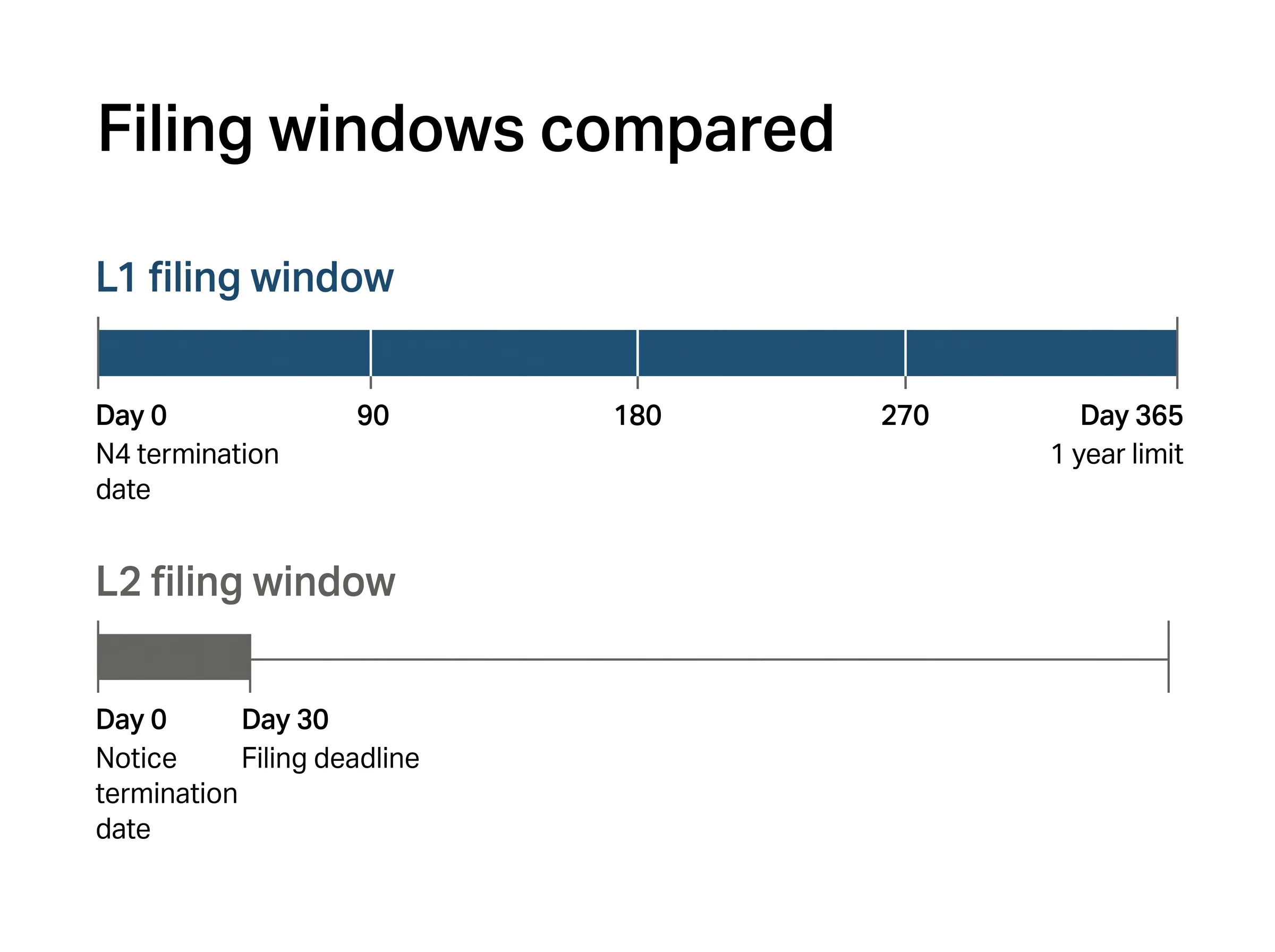
- L1: 1-year window. The landlord must file L1 within 1 year of the termination date on the most recent N4.
- L2: 30-day window. The landlord must file L2 within 30 days of the termination date on the underlying notice. Miss the 30 days, and the notice is void. A new notice must be served, with the termination clock restarting from zero.
This is the single most consequential procedural difference between L1 and L2. The 30-day L2 window catches first-time landlords off guard — they assume they have time, and by the time they look up the rule, the notice has expired. A landlord who serves an N5 in March and decides to "wait and see" through April typically discovers in May that they need to start again.
L1 documentation checklist
What the landlord must bring to (or file with) an L1:
- Copy of the N4 notice served, properly dated and naming the correct parties
- Certificate of Service proving how and when the N4 was served
- Rent ledger showing every payment received, every payment missed, dates and amounts
- Copy of the current lease, confirming the rent amount on which arrears are calculated
- Any additional evidence of payment or non-payment, correspondence, bounced cheques
L2 documentation — varies by underlying notice
The L2 documentation burden is higher and varies by the ground:
- N5 damage or interference: photos, witness statements from neighbours, police reports if applicable, repair estimates
- N6 illegal acts: police reports, conviction records where applicable
- N7 serious impairment: inspection reports, photos, expert testimony
- N12 own-use: sworn affidavit of the intended occupant confirming 12-month occupancy intent, evidence of the family relationship, supporting documents (employment, current residence)
- N13 demolition or repairs: permits, contractor statements, architectural drawings, scope of work
- N8 persistent late payment: rent ledger showing payment dates over a pattern period (typically 6-12 months)
- In all cases: the underlying notice itself, Certificate of Service, and current lease
The combo case: non-payment AND another ground
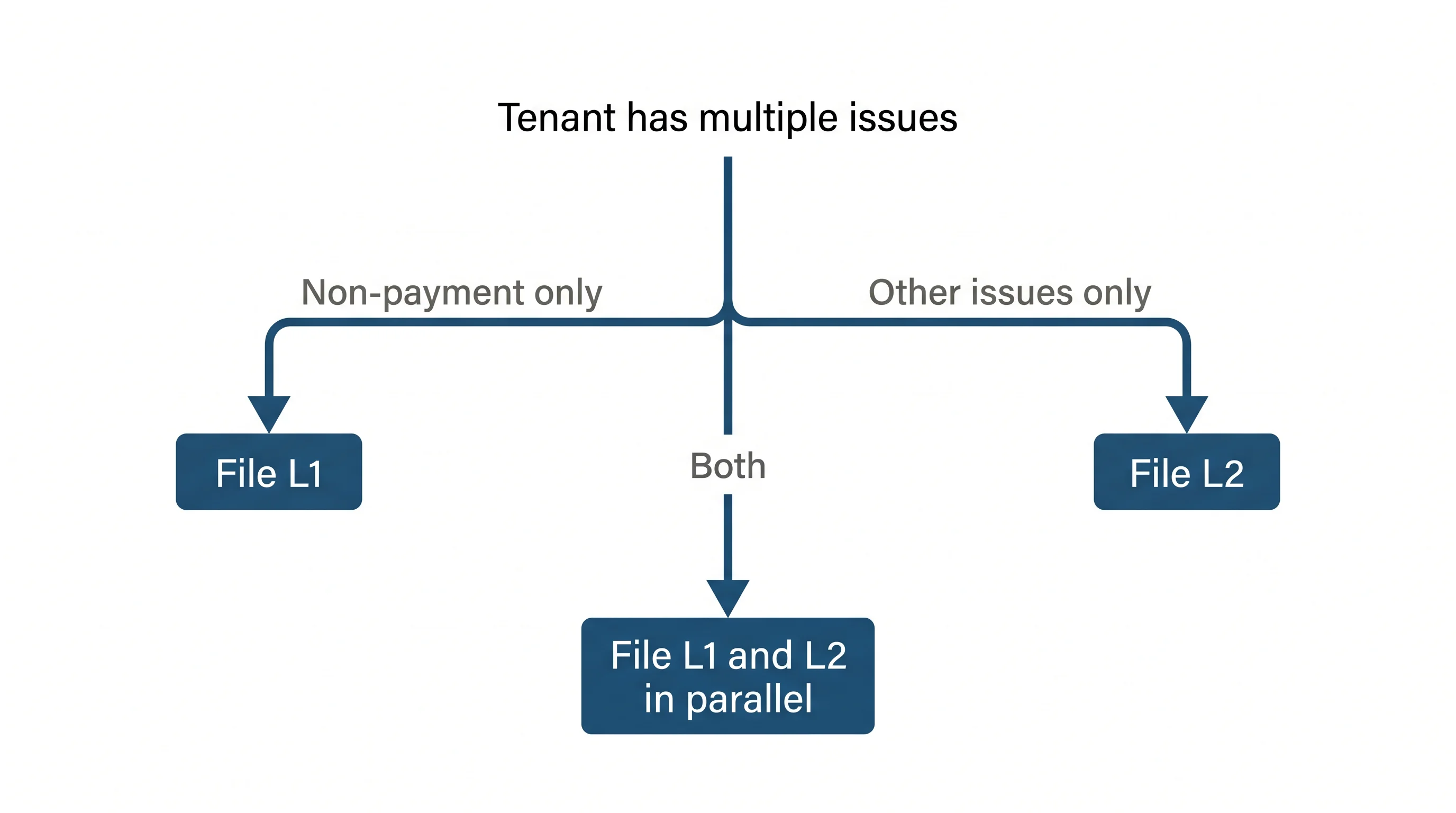
One of the most common real-world scenarios: a tenancy has both arrears AND damage, or arrears AND interference. Landlords often try to combine these into a single application. The LTB does not accept that approach.
- Correct approach: file two parallel applications — L1 for non-payment, L2 for the other ground. Two filing fees ($372 total), two notice periods, but potentially two hearing dates that can be administratively consolidated.
- Strategic consideration: If arrears are large and damage is small, many landlords file L1 only and address damage through tenant insurance claim or final settlement. If both are significant, both applications may be worth pursuing.
Hearing dynamics: what actually happens
The hearing experience differs substantially between L1 and L2 — different questions, different evidence, different outcomes.
L1 hearings: documentary and procedural
An L1 hearing is typically the most mechanical of LTB proceedings. The adjudicator focuses on three questions:
- Was the N4 valid and properly served?
- Was rent actually owed on the termination date?
- How much is owed now?
A well-prepared landlord with a clean rent ledger, proper N4, and filed Certificate of Service often gets an order on the day of the hearing. The three most common outcomes:
- Eviction order plus arrears order. The tenant has not paid; the adjudicator orders termination and the outstanding balance.
- Consent payment plan. Many L1 cases resolve with the tenant agreeing to a structured payment plan over 3-12 months. Eviction is suspended as long as payments are made.
- Void by payment. The tenant pays arrears + filing fee before the hearing; the application dissolves.
L2 hearings: adjudicative and evidentiary
L2 hearings are more substantive. The adjudicator must evaluate whether the underlying allegation is substantiated — a legal and factual judgment, not a mathematical one. This means:
- More witness testimony (neighbours for interference cases, intended occupants for N12 cases, contractors for N13 cases)
- More documentary exhibits and photographs
- More back-and-forth between parties and the adjudicator
- Substantive tenant defences — challenging whether interference actually occurred, challenging whether an N12 is in bad faith
- Less predictable outcomes; the landlord needs strong, organized evidence
L2 hearings involving N12 own-use in tight-market regions now attract particular adjudicator scrutiny. Adjudicators increasingly ask follow-up questions about the intended occupant's current living situation, employment, and specific move-in plan. Weak N12 cases often lose at hearing — and even when they win, the landlord faces a 12-month bad-faith T5 window after the tenant vacates. For the full N12 picture, see Ontario N12 Notices: A Complete Guide to Own-Use Tenancy Endings.
What each audience should prepare for
- Landlord. Plan to present, not just hand over documents. Be prepared to answer questions about service methods, rent collection patterns, and any prior correspondence with the tenant.
- Tenant. Attend the hearing. Not attending almost always means a default order against you. Tenant Duty Counsel is available at the LTB — use it. Bring evidence of any defence, including payment records, photos, or witness statements.
- Property manager. Represent or accompany the landlord per your agreement. Ensure the file is complete before the hearing — adjudicators are not sympathetic to missing certificates of service or incomplete ledgers.
How different situations play out
Five real-world scenarios that show how the L1/L2 distinction translates into actual cases:
Scenario A: Classic L1 with clean documentation
Mississauga condo, $2,400/month. Tenant misses April 1, 2026 rent. Landlord serves N4 on April 2, 7-day period expires April 9, landlord files L1 on April 10 with complete documentation. Hearing scheduled for January 2027 (9-month wait). One day before the hearing, the tenant pays full arrears + $186 filing fee. L1 is void; tenancy continues with the arrears caught up. The landlord has spent 9 months and $186 but is no worse off financially.
Scenario B: L2 for damage with proper evidence
Toronto apartment, $2,200/month. Tenant causes significant damage. Landlord serves first N5 (damage notice) March 1, 2026. Tenant does not remedy within 7 days. N5 termination date is March 21. Landlord files L2 on March 22 — safely within the 30-day window — with photographs, repair estimates, and neighbour witness statements. Hearing scheduled for October 2026 (7-month wait). Adjudicator finds the tenant responsible, orders eviction plus damages.
Scenario C: Combo case done right
Hamilton apartment, $1,900/month. Tenant has $5,700 in arrears AND has caused approximately $3,000 in damage. Landlord files L1 for the arrears and L2 for the damage as two parallel applications. $372 total in filing fees. Both hearings end up consolidated into one calendar date in November 2026. Adjudicator grants eviction and orders the tenant to pay both arrears and damages.
Scenario D: The wrong-application mistake
Waterloo apartment, $1,500/month. Landlord wants to end the tenancy because the unit is being sold to a buyer who will occupy. Landlord confuses herself by serving an N4 (non-payment notice) despite rent being paid, then filing L1. At hearing, the adjudicator dismisses the application — there's no non-payment. Landlord must start over with a properly drafted N12 and a later L2 filing. 7 months of unnecessary wait, $186 wasted.
Scenario E: Persistent lateness mistaken for non-payment
Toronto apartment, $2,000/month. Tenant pays every month but consistently 10-14 days late. Landlord serves N4s monthly for 8 months and tries to file L1 for the pattern. L1 is dismissed because the tenant is current on rent. Correct path: serve an N8 notice (persistent late payment), wait 60 days, file L2 within 30 days of the N8 termination date.
Practical takeaways
Before you file — the decision checklist:
- What ground am I relying on? Non-payment → L1. Anything else → L2.
- Did I serve the correct underlying notice (N4 for L1; N5/N6/N7/N8/N12/N13 for L2)?
- Is the underlying notice valid and properly served, with Certificate of Service filed?
- Am I within the filing window? L1 = 1 year from N4 termination; L2 = 30 days from notice termination.
- Do I have the documentation the application type requires?
- For N12 specifically: do I have a sworn affidavit of the intended occupant?
- Am I prepared for the hearing — documents organized, potential witnesses ready, outcomes thought through?
Combo-case reminder: If the tenancy has multiple issues (arrears + damage, arrears + interference), file TWO parallel applications: L1 for non-payment, L2 for the other ground. Do not try to combine them in one filing.
Quick wins:
- Use the official Tribunals Ontario forms for both underlying notices and the L1/L2 applications
- File your Certificate of Service immediately after serving any notice
- Keep a clean, up-to-date rent ledger from day one
Longer term:
- Track the filing windows on every notice you serve — 30 days for L2 goes fast
- Build template documents (rent ledger, certificate of service, affidavits) so you're not drafting from scratch under time pressure
- For PM firms: consider software that validates notice-to-application matching and tracks filing deadlines automatically
Calculate notice termination dates accurately: Use the Ontario Termination Date Calculator to compute the correct termination date for any notice — preventing the most common defective-notice mistakes that derail L1 and L2 filings.
The L1 vs L2 Quick Reference Guide for Ontario Landlords, Property Managers, and Tenants
Confused about L1 vs L2 LTB applications in Ontario? This free quick-reference guide lays out the key differences, filing deadlines, and what each audience — landlord, PM, or tenant — should do at every stage.
Get Free PDF →Conclusion
The L1 vs L2 distinction isn't complicated at its core — L1 is for non-payment, L2 is for everything else — but the procedural rules around each application can easily cost a landlord months if misapplied. The 30-day L2 filing window, the different documentation requirements, the void-payment rule unique to L1, the proper matching of notice to application: these are the details that separate landlords who get orders in 9 months from landlords who are still filing a year from now.
For landlords, the work of a successful L1 or L2 happens before the hearing — in the notice, the ledger, the certificate of service, and the documentation file. For property managers, that same work is the value proposition. For tenants, understanding the application type clarifies what defences are available and what outcomes are realistic.
If you're preparing to file an L1, see How to Use the N4 Notice in Ontario: A Landlord's Complete Guide for the prerequisite steps. If you've received an N4, see Got an N4 Notice? Here's What to Do.
File your L1 or L2 with the right documentation, the first time
Generate compliant LTB notices, calculate termination dates automatically, and track every filing deadline — free to start.
Free • Updated for the Bill 60 changes in force 21 Sep 2026 • Includes Certificate of Service templates
Frequently asked questions
What's the main difference between L1 and L2 applications?
L1 is filed when the issue is non-payment of rent — it follows an N4 notice. L2 is filed for every other ground for eviction, including damage, interference, illegal acts, own-use, and demolition — following the appropriate notice type (N5, N6, N7, N8, N12, or N13). Both cost $186 to file in 2026.
Can I combine L1 and L2 in one application if my tenant has multiple issues?
No. If a tenancy has both non-payment and another issue (damage, interference, etc.), the landlord must file two parallel applications — L1 for non-payment, L2 for the other ground. Each has its own $186 filing fee, but the LTB can consolidate the hearing dates administratively.
How long do I have to file an L1 or L2?
L1 must be filed within one year of the termination date on the N4. L2 must be filed within 30 days of the termination date on the underlying notice. Missing the L2 window voids the notice and restarts the process.
What happens if my tenant pays before the L1 hearing?
For L1 cases, if the tenant pays all arrears plus the $186 filing fee before the hearing, the application becomes void and the tenancy continues. This is a statutory tenant protection in the RTA. From the landlord's perspective, the outcome is neutral — rent is caught up, but the tenancy remains in place.
What if I file the wrong application?
The LTB will dismiss the incorrect application. The landlord must serve the correct underlying notice and file the proper application — effectively starting over. This typically adds 7-10 months to the timeline and risks additional arrears accumulating in L1 cases.