An N7 notice in Ontario gives a tenant as little as 10 days—yet the hearing that decides whether they actually leave can be months away. That gap between the short notice on paper and the long wait at the Landlord and Tenant Board (LTB) is exactly where serious-problem evictions succeed or fall apart. The N7 is the province’s tool for the worst situations: threats to someone’s safety, deliberate damage, dangerous misuse of a unit. These can’t wait for the slower, “fix-it-or-leave” process built for minor issues. But the N7 is also narrow and unforgiving—use the wrong form, serve it the wrong way, or show up with thin evidence, and the case gets dismissed.
This guide is written for Ontario landlords, property managers, and the tenants on the receiving end. You’ll learn exactly when the N7 applies (its four grounds), how its 10-day, non-voidable timeline really works, how to serve it without sinking your own application, what evidence actually holds up, and what 2026’s Bill 60 changes—and pointedly doesn’t change. We’ll move through four parts: what the N7 is, how the process works step by step, where landlords go wrong, and the 2026 outlook.
Received an N7 Notice in Ontario? Your Tenant Action Checklist
Got an N7 notice and not sure what to do? This free step-by-step checklist walks Ontario tenants through checking the notice for errors, protecting their rights, hitting every LTB deadline, and showing up to the hearing prepared.
Get Free PDF →What an N7 Notice Is (and When It Applies)
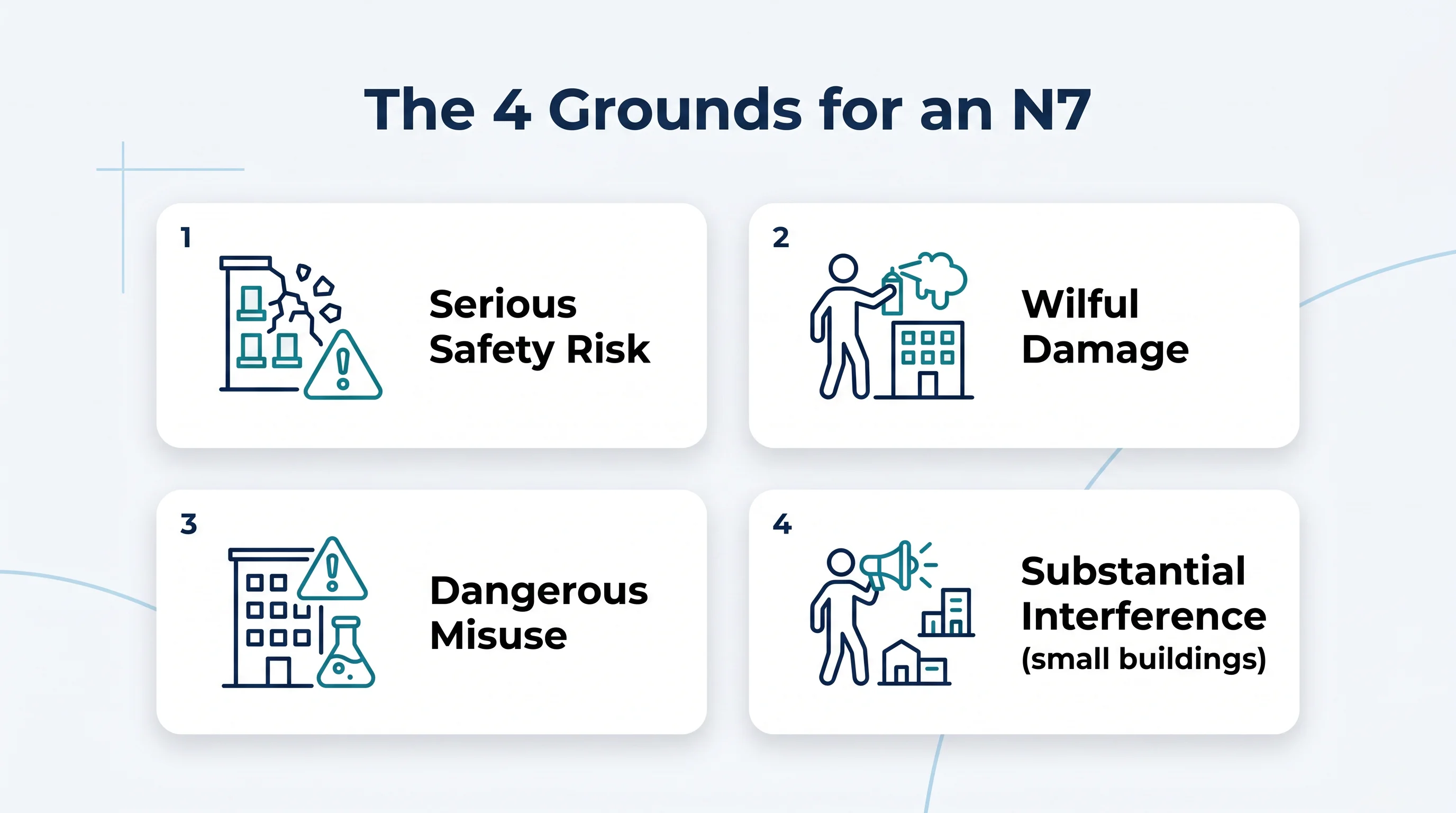
The N7 is the Notice to End your Tenancy For Causing Serious Problems in the Rental Unit or Residential Complex—an official LTB form under the Residential Tenancies Act, 2006. The single most important thing to understand is what it is not: it is not an eviction. It is the first formal step toward one, reserved for the most serious conduct. A landlord can only use it on one or more of four grounds, and must be able to prove what they allege.
- Serious safety risk. The tenant, a guest, or another occupant has behaved in a way that seriously impaired—or could be expected to impair—another person’s safety, and it happened in the residential complex. Think threats, violence, or reckless endangerment.
- Wilful damage. Someone in the unit deliberately damaged the rental unit or the complex. The key word is intentional. If you can’t show the damage was wilful, the N5 is the correct form, not the N7.
- Dangerous misuse. The tenant used the unit in a way inconsistent with residential use, causing or likely to cause serious damage—for example, an activity that stresses the building’s structure or systems.
- Substantial interference (small buildings only). In a building of three or fewer units where the landlord also lives, behaviour that substantially interfered with the landlord’s reasonable enjoyment or other lawful rights.
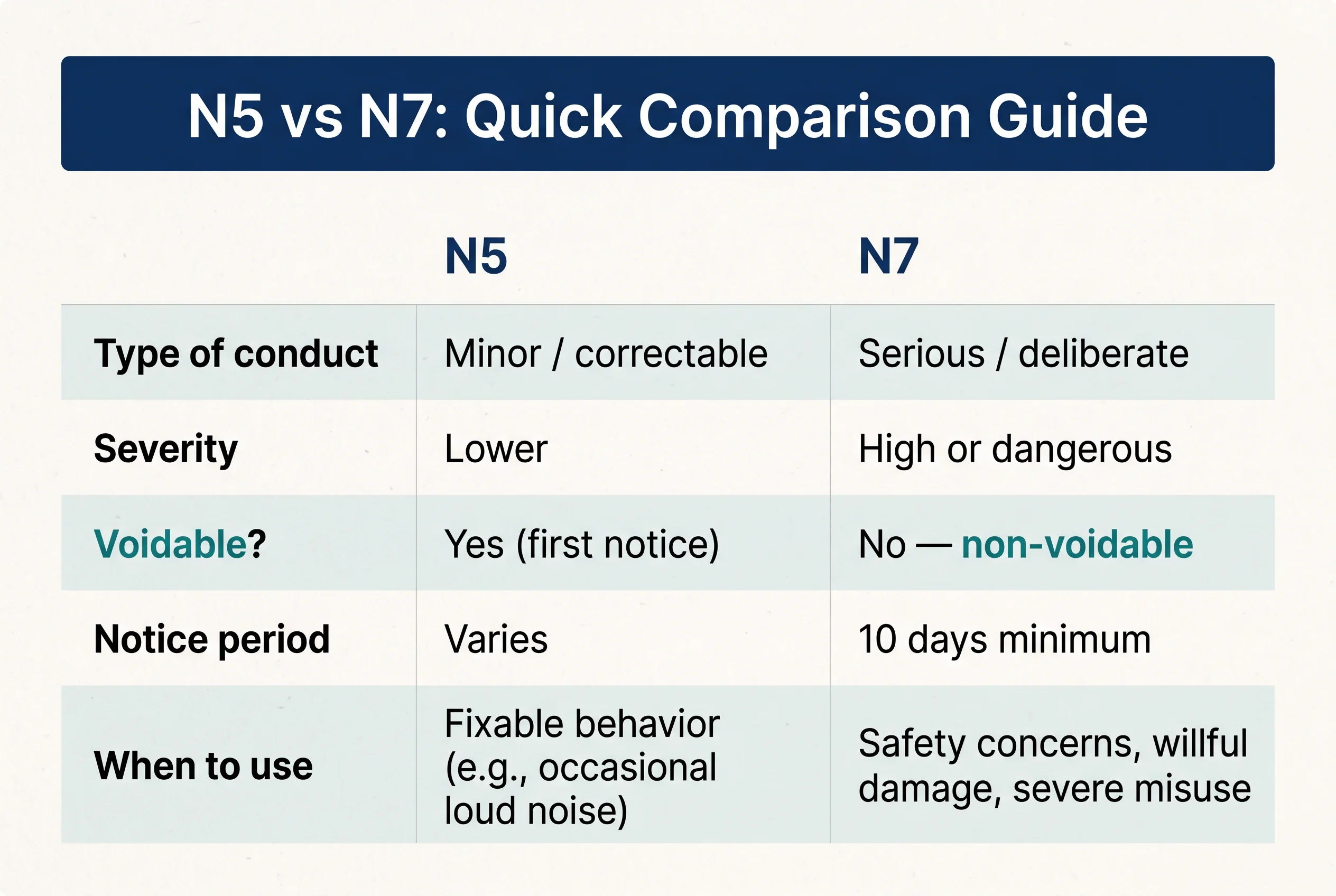
The N7’s defining feature is that it is non-voidable. With a first N5 notice, a tenant can cancel the notice by correcting the behaviour within a set window. The N7 offers no such second chance—there is no correction period. That makes choosing between the two notices one of the most consequential decisions a landlord makes, which we’ll return to in detail below.
Why does precision matter more in 2026? Because the market has shifted. After years of sub-1% vacancy, CMHC now forecasts Ontario vacancy settling around 3–5%, and average asking rents have softened—the national figure sits near $2,123 after roughly a year of decline. A problem tenancy is costlier to carry and slower to backfill in a looser market, so getting the process right the first time carries higher stakes than it did during the frantic shortage years.
How the N7 Process Works, Step by Step
The mechanics are specific, and the deadlines cut in both directions. Here is the sequence:
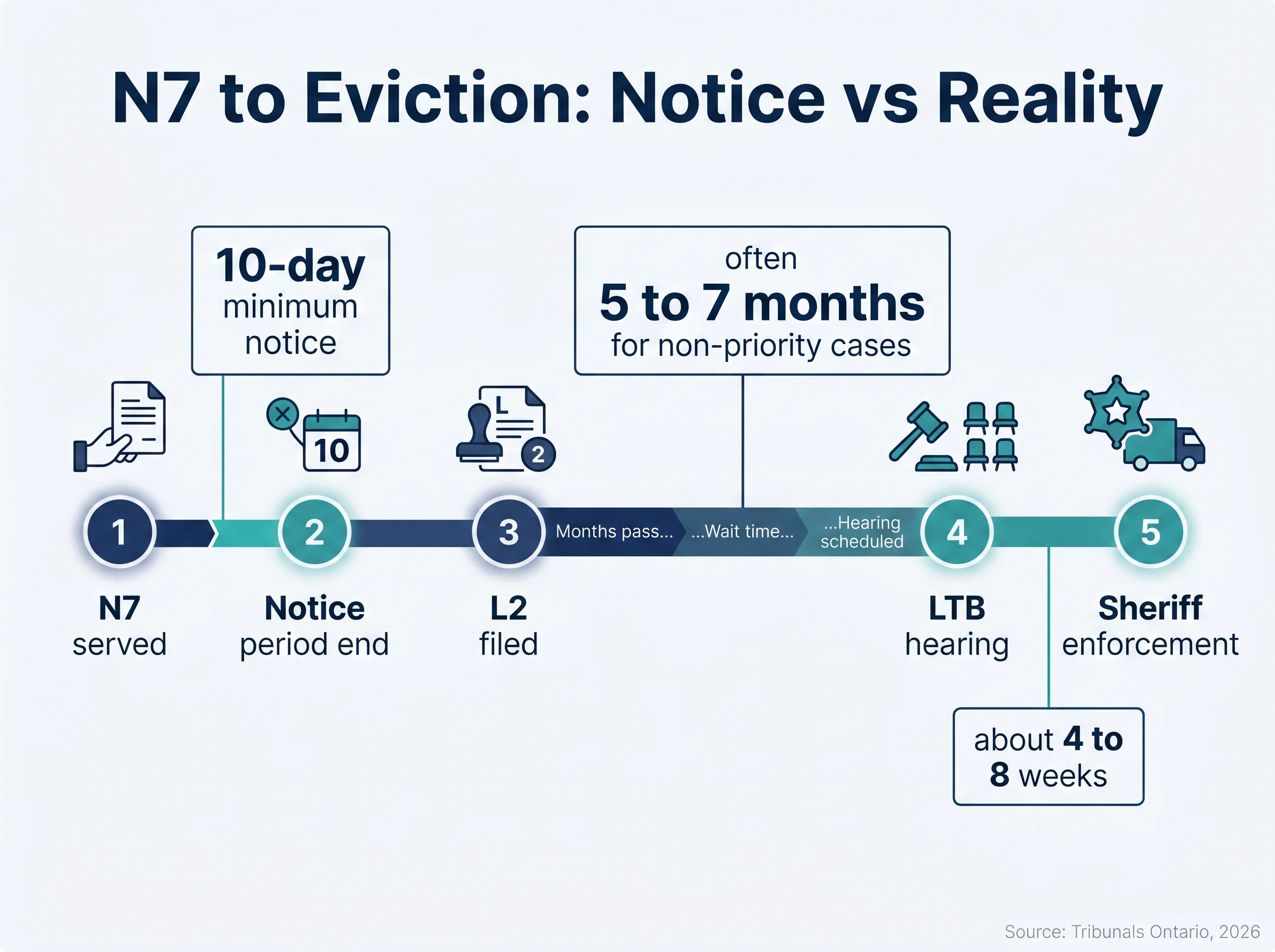
- Serve the N7 with a proper termination date. The termination date must be at least 10 days after the tenant receives the notice (the day of service doesn’t count). Add five days if you serve by mail.
- You can apply to the LTB immediately. Unlike some notices, you don’t have to wait for the termination date to pass. You file an L2 application to ask the Board to end the tenancy.
- Mind the 30-day filing window. The L2 must be filed no later than 30 days after the termination date on the N7. Miss it and you may have to start over.
- The hearing decides. The LTB schedules a hearing; if you succeed, it issues an eviction order. Only the Sheriff can enforce that order—never the landlord.
Here’s the reality check that most guides skip: the 10-day notice is fast, but the hearing queue is not. As of early 2026, non-payment (L1) applications are being scheduled in roughly three months, while most other application types—the bucket an N7-driven L2 falls into—run about five to seven months. Urgent matters move in five to six weeks, but a contested serious-problems case rarely qualifies as “urgent” in scheduling terms. One independent tracker found about 80% of cases were heard somewhere between 2.7 and 15.7 months. Plan for the queue.
According to Tribunal Watch Ontario, even with the backlog shrinking, landlords and tenants now wait roughly three times longer for a hearing than they did before the LTB came under Tribunals Ontario—a gap the organization links to virtual hearings and adjudicator turnover.
Where most N7s actually fail is service. Acceptable methods include hand delivery, leaving it in the tenant’s mailbox or mail slot, registered mail, courier, or fax. Posting it on the unit door is a common cause of challenges, and email or text generally isn’t recognized. Whatever method you choose, complete and keep a Certificate of Service recording the date, time, and method—undocumented service is one of the leading reasons applications get denied.
Filling it out matters too. Use full legal names, the complete unit address, select each ground that applies, and—critically—describe each incident with specific dates, times, people, and impact. Vague, “the tenant is a problem” descriptions get dismissed. If you’re unsure your termination date is right, our Ontario Termination Date Calculator works it out under the RTA rules.
Where Landlords Go Wrong (and How to Get It Right)
Three mistakes account for most failed N7 applications—and all three are preventable.
1. The wrong notice
Using an N7 where an N5 notice was the right call is a frequent reason cases are thrown out. The distinction is genuinely make-or-break: the N5 is for less serious, correctable conduct and its first notice is voidable; the N7 is for serious, dangerous, or deliberate conduct and is non-voidable. If the behaviour is something a reasonable tenant could fix—noise, a one-off mess, a minor breach—it almost certainly belongs on an N5, not an N7.
As noted above, improperly served or undocumented notices are a leading reason applications are denied. The fix is simple discipline: pick an accepted method, never the door, and keep your Certificate of Service every single time.
3. Weak evidence
Roughly 29% of LTB applications are now withdrawn before a hearing—up sharply from about 12% in 2018–19—and weak evidence or procedural defects are a big part of why. Build your evidence pack before you serve: police reports for threats, violence, or illegal activity; dated photos or video of damage (showing intent where the ground is wilful damage); witness statements from neighbours or other tenants; repair invoices; and that specific incident log.
On the cost side, the math favours doing it right. From a first serious incident to vacant possession can realistically take five to twelve months once you add the hearing wait and four to eight weeks of Sheriff enforcement. Strong front-end tenant screening and clean documentation are far cheaper than a back-end eviction that collapses on a technicality.
For tenants reading this, the balance matters: receiving an N7 does not mean you must leave on the termination date. You have the right to dispute it at the hearing, and you can only be removed by an LTB order enforced by the Sheriff. If you’re unsure whether a notice is even valid, that’s worth checking carefully—and getting advice early.

The 2026 Outlook: Bill 60 and a Shifting Market
The biggest recent change to the landscape is Bill 60, the Fighting Delays, Building Faster Act, 2025, which passed on November 24, 2025 and received Royal Assent. Many of its RTA provisions still await regulations before they take full effect, so treat the details as in transition—but the direction is clear. For a fuller breakdown, see our guide on Ontario rental law changes 2026 and how Bill 60 affects Ontario landlords.
What changed around evictions: the N4 notice period for non-payment is being shortened toward seven days; the window to ask for a review of an LTB order has been cut from 30 days to 15; and non-payment hearings are being streamlined. What didn’t change: the four N7 grounds and the 10-day, non-voidable structure remain intact. One detail worth noting is that the amended s.43(1) confirms notices must be in a form approved by the Board unless a form is prescribed—so always use the current N7 version.
On the backlog, the trend is genuine if uneven. Scheduling for non-payment cases has improved from eight to ten months back in early 2023 toward roughly three months now, helped by adjudicator headcount rising to 133 as of March 2025. Expect continued, bumpy improvement rather than an overnight fix.
The reforms are contested. Landlord-side voices—including TRREB and the Small Ownership Landlords of Ontario—want faster, firmer enforcement, while tenant advocates such as ACTO and the Ontario Bar Association warn that shorter notices and tighter review windows erode due process. The N7, as a non-voidable serious-grounds notice, sits squarely in the middle of that debate.
How to prepare regardless of where the regulations land: keep your documentation habits tight, confirm you’re using the current form version, and watch for the regulations that will operationalise Bill 60.
Received an N7 Notice in Ontario? Your Tenant Action Checklist
Got an N7 notice and not sure what to do? This free step-by-step checklist walks Ontario tenants through checking the notice for errors, protecting their rights, hitting every LTB deadline, and showing up to the hearing prepared.
Get Free PDF →Key Takeaways: Your N7 Checklist
Before you serve an N7, work through this:
- Confirm the conduct meets one of the four N7 grounds—not a correctable N5 issue.
- Use the current Board-approved N7 form; enter full legal names and the complete unit address.
- Describe each incident specifically: dates, times, people, impact.
- Set the termination date at least 10 days out (add five if you mail it).
- Serve by an accepted method—never door-posting, never email or text—and keep the Certificate of Service.
- Assemble the evidence pack before serving: reports, photos and video, witnesses, invoices, incident log.
- If the tenant stays, file the L2—immediately is allowed, and within 30 days of the termination date is required. Never self-evict.
Think of it as quick wins versus long-term habits. The quick win is a correct form, clean service, and a Certificate of Service. The long game is front-end tenant screening, consistent incident logging, and a working relationship with a licensed paralegal so you’re never improvising when a serious situation arises.
Still deciding which notice fits? If the behaviour is correctable, compare your options first with our guide to N5 notices and our breakdown of L1 vs L2 applications before you commit to the N7 path.
Conclusion
The N7 is powerful but narrow: reserved for serious, dangerous, or deliberate conduct, non-voidable, and tied to a 10-day notice that still feeds into a months-long hearing. Almost every failed application traces back to one of three avoidable mistakes—the wrong notice, bad service, or thin evidence. Get those right and the N7 does its job: protecting other tenants and your property through a lawful process.
For tenants, the same facts are reassuring: you keep the right to dispute, and no one can remove you without an LTB order and the Sheriff. For landlords and property managers, the path forward is to verify the conduct against the four grounds, use the current form, and start your incident log today. Tenon10 helps landlords keep their documentation, notices, and timelines clean—so a serious-problem tenancy is handled correctly the first time.
This article is general information, not legal advice. Rules change and every situation is different—consult a licensed Ontario paralegal or lawyer, or the Landlord and Tenant Board, about your specific matter.
Handle a serious-problem tenancy the right way
Start your N7 with the current Board-approved form, the correct termination date, and a clean Certificate of Service—all in one place.
Free • No signup required • Updated for the Bill 60 changes in force 21 Sep 2026
Frequently Asked Questions
Does an N7 mean the tenant has to move out immediately?
No. The tenant isn’t required to leave when they receive the notice or even on the termination date. Only an LTB order, enforced by the Sheriff, can actually evict someone.
Can a tenant void an N7 by fixing the behaviour?
No. The N7 is non-voidable. That’s the key difference from a first N5 notice, which a tenant can cancel by correcting the problem within the set window.
How long does the N7 process take in Ontario?
The notice itself is a 10-day minimum, but a contested L2 hearing is commonly scheduled months out—often in the five-to-seven-month range for non-priority cases. From first incident to vacant possession can run five to twelve months in practice.
What’s the difference between an N5 and an N7?
The N5 covers less serious, correctable conduct and its first notice is voidable. The N7 covers serious, dangerous, or deliberate conduct—safety risks, wilful damage, dangerous misuse—and is non-voidable. Choosing the wrong one is a common cause of dismissal.
What happens after I serve an N7?
If the tenant doesn’t leave, you file an L2 application—immediately is allowed, and within 30 days of the termination date is required. You then attend the LTB hearing, and if you succeed, the Sheriff enforces the order.