

When a landlord won't fix something serious, most tenants assume the Landlord and Tenant Board is their only option. It isn't. There's a second door — the city's property standards office — and understanding what a property standards officer in Ontario can do is one of the most useful things a renter (or a landlord) can learn.
The two systems get confused constantly. The Landlord and Tenant Board handles your tenancy; your municipality enforces building and safety standards. They're separate — but used together, they're far more powerful than either alone, and a lot of people don't understand how the municipal side actually works.
This guide explains who property standards officers are and what law they enforce, how the complaint-and-order process works, how an owner can appeal, and how a municipal order and an LTB application reinforce each other. It's general information, not legal advice — and because property standards are municipal, the details vary by city, so always check your own bylaw and follow the dates on your own order.
The Property Standards Complaint & Order Toolkit
How to document, file, read an order, appeal, and pair a city order with an LTB T6 — on one page.
Get Free PDF →Who Property Standards Officers Are (and What They Can't Do)
Property standards are set and enforced by your city or town, not the province, under Ontario's Building Code Act together with a local property standards bylaw. The people who enforce them are called property standards officers or bylaw enforcement officers, and what they enforce is building, property, and safety standards — heat, plumbing, structural issues, pests, mould, and the like. What they don't do is resolve your tenancy. An officer can order a landlord to fix a hazard, but they can't order rent abatement, award you compensation, or settle a dispute about your lease.
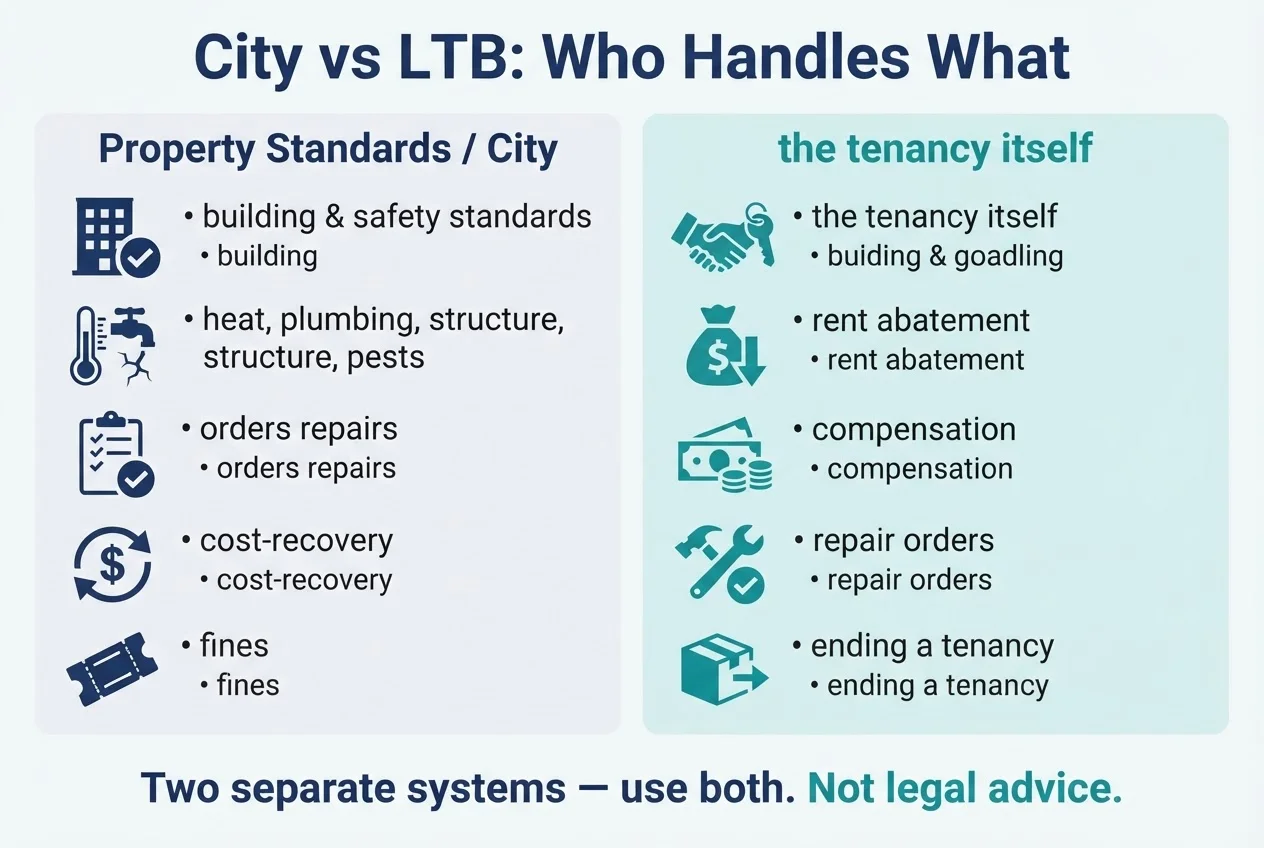
That's the key mental model: the city handles building, standards, and safety, while the Landlord and Tenant Board handles tenancy remedies. Two separate doors — and the whole point of this article is that you can use both. If you want the full picture of the landlord's underlying duty to repair and how tenants enforce it at the Board, the maintenance standards pillar covers that side in depth.
How to Make a Complaint (the Right Way)
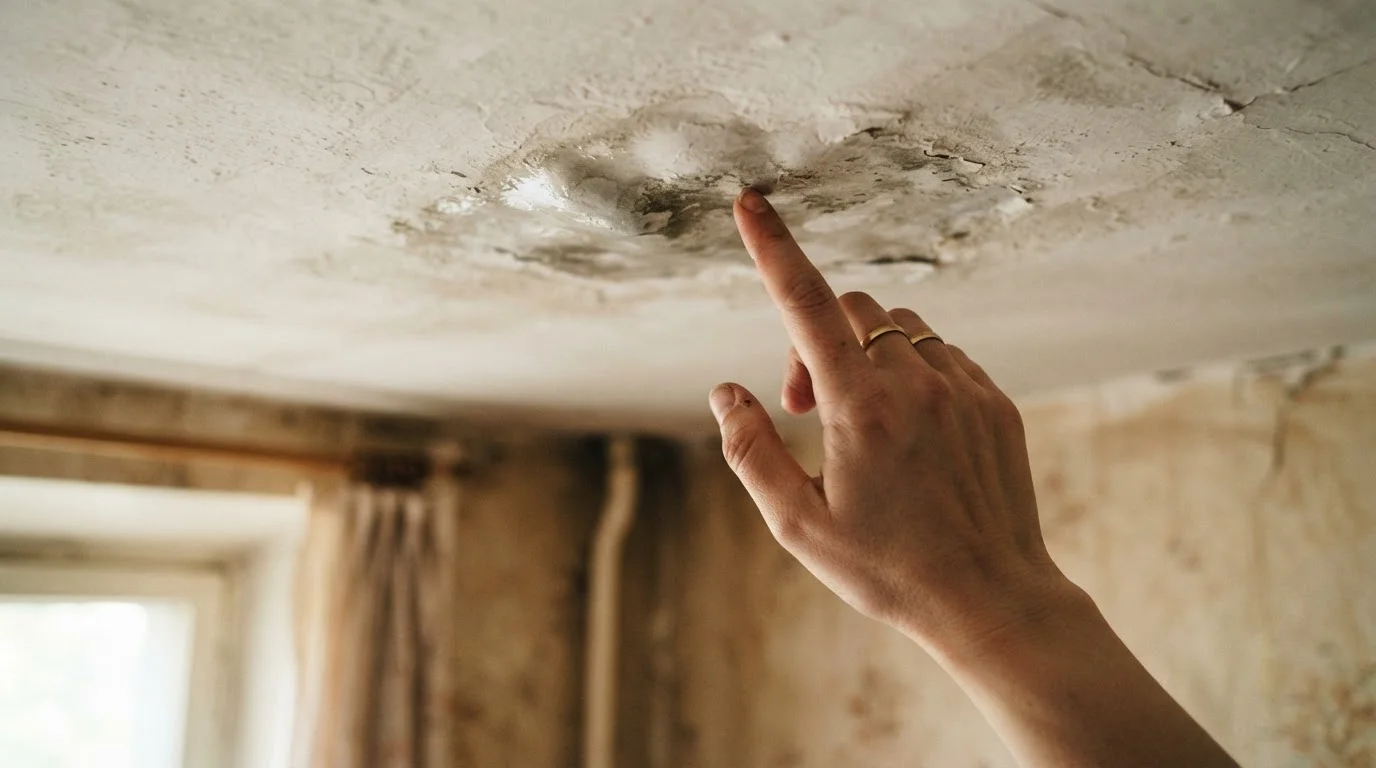
Start with your landlord, in writing. Tell them about the problem, give them a reasonable chance to fix it, and document everything as you go — dated photos or video, a log of what happened when, and copies of your messages. This step often solves the problem on its own, and if it doesn't, it builds the evidence you'll need next.
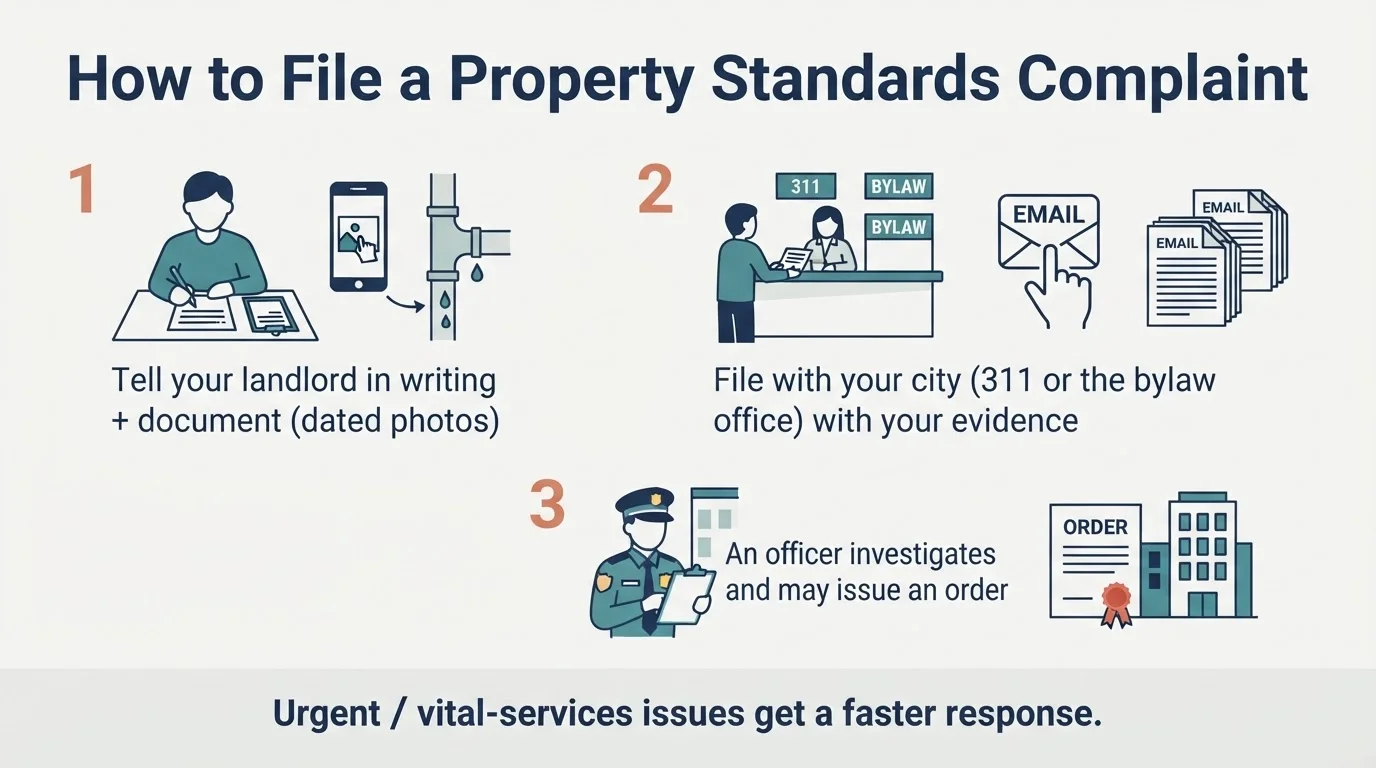
If the landlord doesn't act, file with the city — in Toronto, Ottawa, and Windsor that's 311; elsewhere it's the bylaw or property standards office. An officer reviews the complaint, may ask for your photos and a copy of what you sent the landlord, and investigates, usually with a site visit. Response times vary by city and by urgency: an urgent or vital-services problem like no heat in winter or no water can draw a response within about 24 hours, while a non-urgent issue might take five to ten days, and some cities aim to investigate within about 30 days. If you don't hear back within your city's stated service standard, follow up and escalate. And a note for landlords and property managers: a complaint isn't a penalty. The process almost always starts with education, so responding quickly and fixing the issue is by far the cheapest path.
The Order, the Deadline, and the Appeal
Enforcement is progressive. It usually begins with education, and if that doesn't resolve things the officer issues a notice of violation or an order to comply that names the specific violation and sets a compliance deadline — anywhere from immediate for an urgent hazard to around 30 days for a non-urgent one. If the owner ignores the order, the consequences escalate: the city can do the work itself and recover the cost from the owner, often by adding it to the property tax bill, and it can charge re-inspection fees, issue a set-fine ticket, or summons the owner to court.
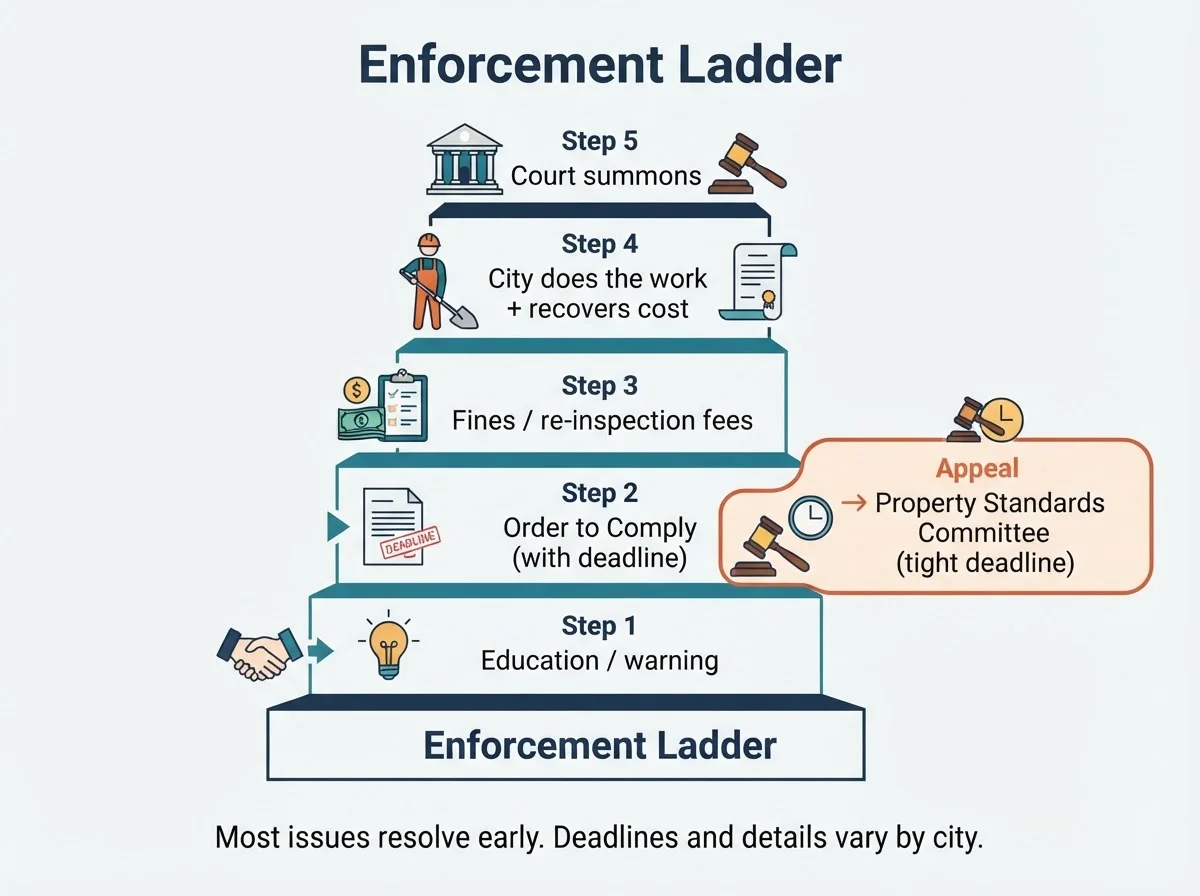
An owner who disagrees with an order can appeal it to the municipality's Property Standards Committee — a quasi-judicial body of at least three members appointed by, but separate from, city council, as required by the Building Code Act. The committee can confirm, modify, or rescind the order, or extend the time to comply. The catch is timing: appeal windows are short and vary by city (one municipality, for example, allows 14 days if the order was served in person or 19 days if sent by registered mail), they carry a fee, and a late or incomplete appeal is simply refused. If the committee's decision doesn't resolve things, it can be appealed further to the Superior Court of Justice. The practical takeaway for any owner is to read the date on the order the moment it arrives.
Using Both Doors: The Municipal Order and the LTB
Here's where the two systems come together. A property standards officer enforces standards, not tenancy — but the written order they issue is powerful evidence for a tenant's maintenance application at the Landlord and Tenant Board, filed on Form T6. It independently corroborates that the problem is real and serious, which can strengthen the case and shorten the process.
So the strongest play is to use both doors: report the problem to the city, get the written order, and attach it to your T6 at the Board. Which door for what? Use the city to get the building and safety issue fixed, and use the Board for tenancy remedies like a repair order, rent abatement, or compensation. One practical overlap worth knowing: entry to make the ordered repairs still interacts with your rights under the Residential Tenancies Act, so the landlord generally still needs to give 24 hours' written notice to enter, though serious hazards can involve different rules — follow what the order and the city tell you. The notice of entry rules cover that in more detail. And the reminder that runs through this whole topic: because property standards are municipal, the bylaws, fees, deadlines, forms, and even program names differ from city to city, so check yours and follow your specific order.
Keep your evidence organized for either door
Photos, written requests, orders, and applications in one place — ready for the city, the LTB, or both.
Free • No signup required • Built for Ontario
Key Takeaways
- Property standards are municipal (Building Code Act + local bylaw), enforcing building and safety standards — not your tenancy.
- Tell your landlord in writing and document first; then file with the city (often 311).
- An Order to Comply sets a deadline; ignoring it triggers cost-recovery, fines, or court.
- Owners can appeal to the Property Standards Committee, but the window is short — read the date on the order.
- A municipal order is strong evidence for an LTB T6 — use both doors together.
Conclusion
Property standards officers are your municipality's enforcement arm for building and safety standards — separate from the Landlord and Tenant Board, but a powerful complement to it. Tell your landlord in writing first, document everything, and file with the city; if an order is issued, it sets a deadline the landlord must meet or face cost-recovery, fines, or court. Owners can appeal to the Property Standards Committee, but the window is short. And whatever your role, remember that a municipal order is strong evidence at the Board.
You have two doors, not one, and using them together is the strongest move — whether you're a tenant trying to get a repair done or a landlord trying to handle an order the right way. This is general information, not legal advice — property standards are municipal, so check your city's bylaw and the LTB, and always follow the dates and instructions on your own order.
Frequently Asked Questions
How do I report my landlord to the city in Ontario?
Contact your municipality's property standards or bylaw enforcement office — in many cities that's 311. Tell your landlord in writing first and document the problem with dated photos, then file the complaint with that evidence. An officer will investigate and can issue an order.
What's the difference between a property standards order and the Landlord and Tenant Board?
A property standards officer enforces municipal building and safety standards and can order a landlord to fix a hazard. The Landlord and Tenant Board handles tenancy disputes and remedies like rent abatement or compensation. They're separate systems, but a municipal order helps an LTB case.
What happens if a landlord ignores a property standards order?
The city can do the work itself and recover the cost from the owner (often added to the property tax bill), charge re-inspection fees, issue a fine, or take the owner to court. Ignoring an order usually costs more than complying.
How do I appeal a property standards order in Ontario?
An owner can appeal to the municipality's Property Standards Committee, usually within a short window (often around 14–19 days) and with a fee. The committee can confirm, modify, or rescind the order or extend the deadline, and its decision can be appealed to the Superior Court of Justice.
How long does a landlord have to comply with a city order?
The order states the compliance deadline, which can range from immediate for urgent hazards to about 30 days for non-urgent issues. Always follow the specific date on the order.
Do property standards rules apply to my building?
Building and safety standards apply broadly, but programs and details vary by city — for example, Toronto's RentSafeTO covers apartment buildings of three or more storeys and ten or more units, while other cities have their own bylaws and programs. Check your municipality.


