

A credit check is the easy part of tenant screening. The moment you go beyond it — a criminal record check, someone's income, a quick scroll through their social media — the legal lines get sharp, and it's surprisingly easy for the landlord to be the one breaking the law. Knowing what's legal for a tenant background check in Ontario is what separates a defensible process from a human-rights complaint.
Ontario screening sits at the intersection of three laws at once: the Human Rights Code, the province's screening regulation, and federal privacy law. Most landlords know the credit piece but not the rest — and getting the rest wrong can mean a Human Rights Tribunal complaint or a privacy problem, not just a bad tenant.
This guide lays out what you can legally check beyond credit, what you can't, the specific rules for criminal record checks, your privacy duties, and the one habit — consistency — that makes your whole process defensible. It's general information, not legal advice, and because this area is fact-specific and actively enforced, consult a paralegal or lawyer and the Ontario Human Rights Commission for your situation.
The Legal Tenant Screening Checklist
The permitted toolkit, the criminal-check rules, your privacy duties, and the consistency defence — on one page.
Get Free PDF →The Three Laws (and What You're Actually Allowed to Use)
Three laws apply to tenant screening simultaneously, and complying with one doesn't excuse breaching another. The Ontario Human Rights Code governs which factors you cannot consider — the protected grounds, from race and creed to family status, disability, and receipt of public assistance. Ontario Regulation 290/98, made under the Code, sets out the tools you may use. And the federal Personal Information Protection and Electronic Documents Act (PIPEDA) governs how you handle the information you collect.
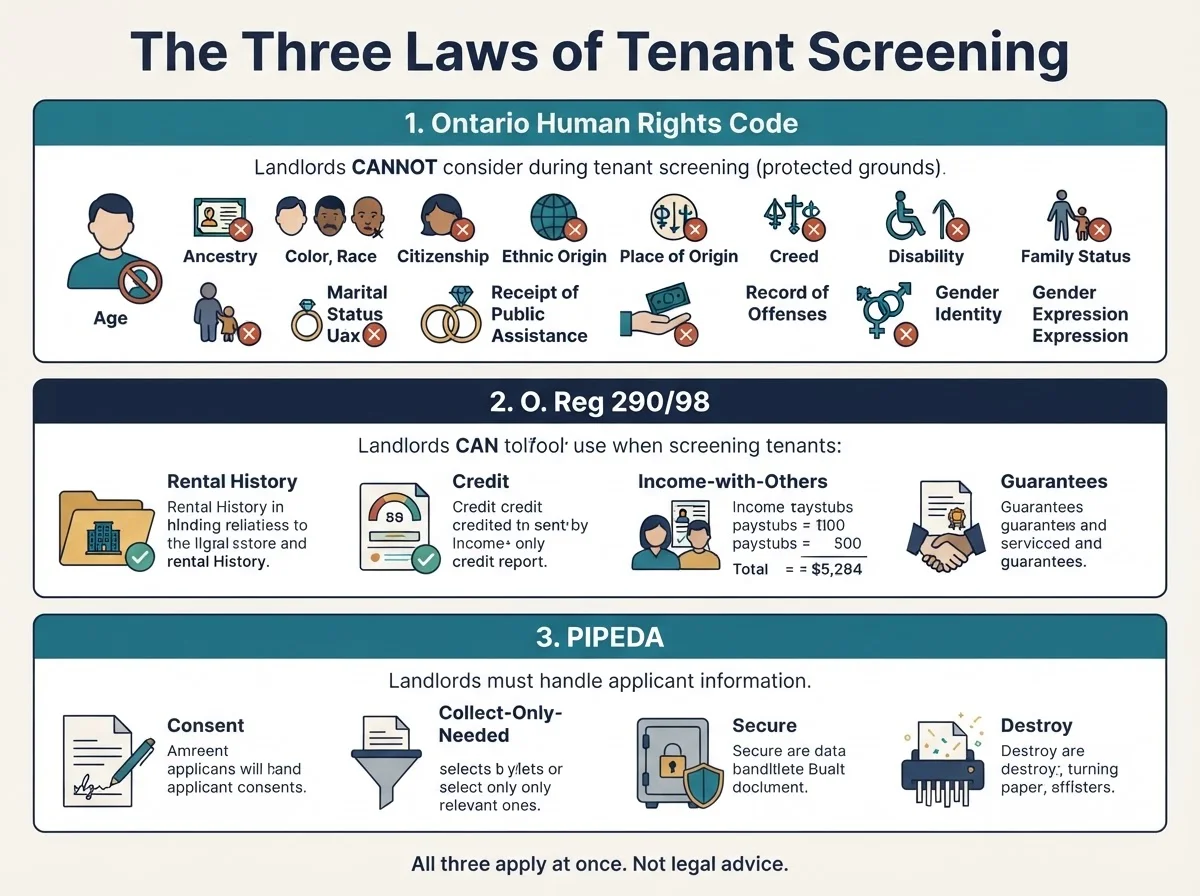
Under O. Reg 290/98, the permitted toolkit is specific: rental history, credit references, credit checks, income information, and guarantees. The rule people most often miss is about income — you may consider it only if you also consider credit references and rental history, never income on its own. Related to that, the Human Rights Commission has been clear that applying a rent-to-income ratio, like the common "30% rule," as a cutoff is not permitted, and that the source of someone's income is protected. You cannot refuse an applicant because their income comes from ODSP, Ontario Works, disability benefits, or alimony — the question is their ability to pay, not where the money comes from. The tenant screening pillar walks the full core process, and credit checks get their own deep dive.
Criminal Record Checks: The Rules Landlords Get Wrong

Nothing outright bans asking about a criminal record, but almost everything about how landlords use these checks is where the trouble starts. First, you need the applicant's written consent, and you generally can't run the check yourself — the applicant obtains it through an accredited provider or the police and voluntarily provides the result. Second, the Code protects pardoned or record-suspended convictions, so you can't refuse someone solely because of a pardoned offence.
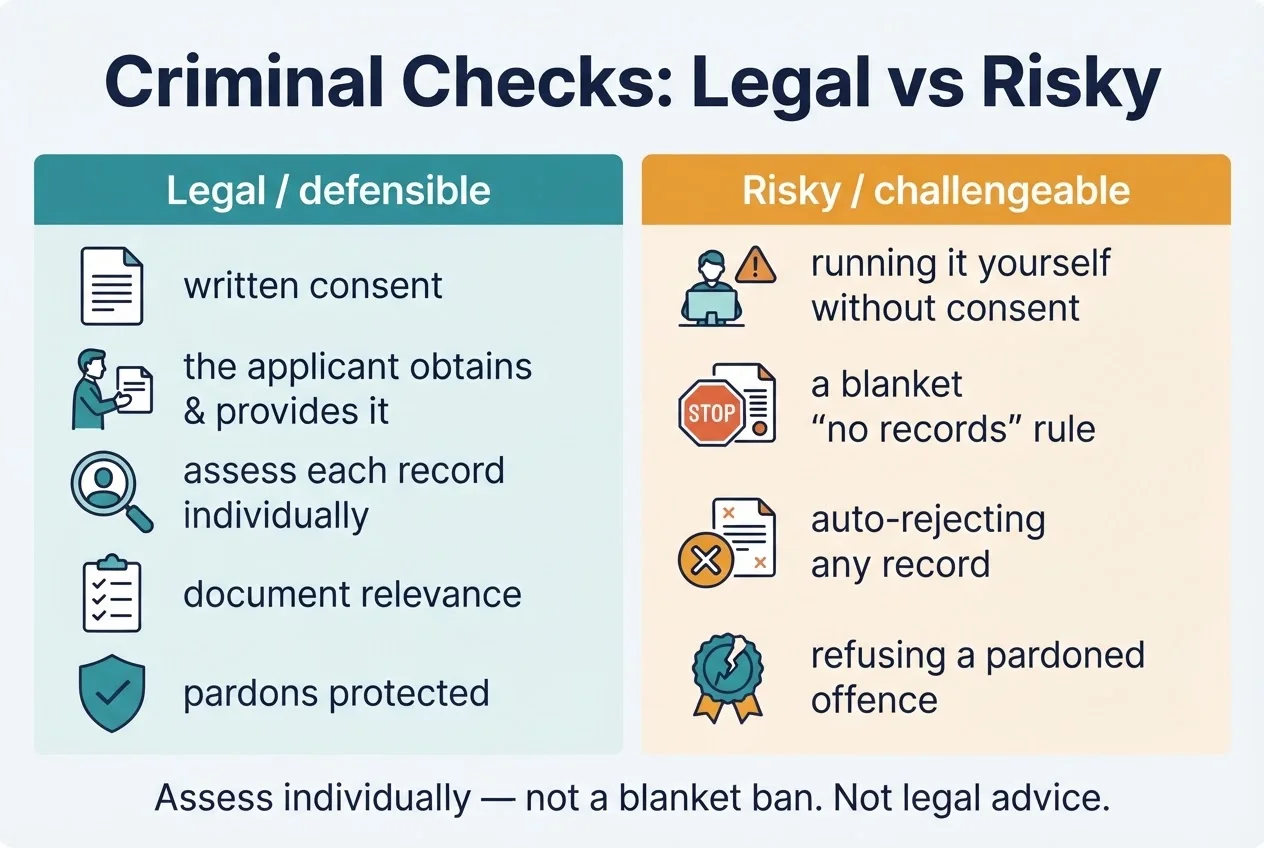
The biggest mistake is the blanket policy. Automatically rejecting anyone with any criminal record has been successfully challenged at human-rights tribunals — it's a legal risk, not a safe default. The defensible approach is to assess each record individually: document how its nature is genuinely relevant to this specific tenancy, and weigh how recent it is and the circumstances around it. Context can make a check reasonable — a senior renting a room in their own home, shared housing, or a situation involving proximity to vulnerable people — but even then, consent and individual assessment still apply.
Privacy, Consent, and What You Can Ask For
Once you collect someone's personal information, PIPEDA gives you real obligations. You need meaningful, written consent before collecting anything — whether you do the collecting or a screening vendor does it for you. You should collect only what the tenancy decision reasonably requires, let applicants access and correct the information you hold, store it securely, and destroy it when it's no longer needed. And you can't share it with third parties without consent, which is exactly where informal "bad tenant" lists get landlords into trouble.
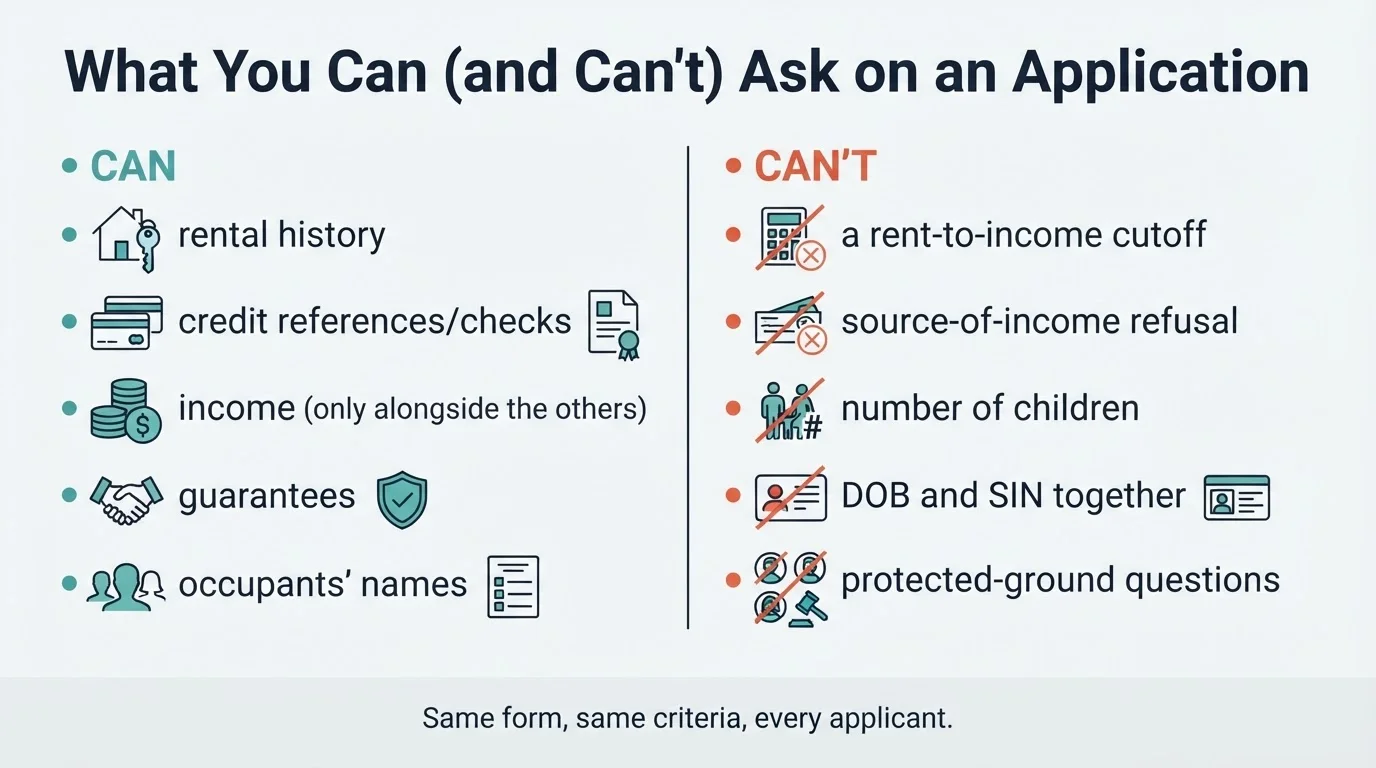
There are also some small but real limits on the application itself. You may lawfully request a date of birth or a Social Insurance Number, but not both. A driver's licence number is optional — you can ask, but you can't require it. And while you can ask the names of the people who will live in the unit, you can't ask how many children there will be, because family status is a protected ground. Mishandling data is its own liability, separate from human rights, and the Privacy Commissioner has been actively looking at the tenant-screening industry — so the safe posture is to collect less, secure what you keep, and shred what you no longer need.
The Other Checks — and the Habit That Protects You
Beyond credit and criminal records, the everyday checks each have their own guardrails. Reference calls to previous landlords are genuinely valuable — just keep the questions Code-appropriate (did they pay on time, keep the place up, would you rent to them again?) and off protected grounds. Employment and income verification through a pay stub, letter, or Notice of Assessment (or bank statements and an NOA for the self-employed) is fine, applied consistently. Ontario's Openroom even lets you search LTB decisions for eviction history. Two modern checks deserve real caution, though: scrolling an applicant's social media can expose protected-ground information you then can't un-know, manufacturing a discrimination risk by looking; and AI screening tools carry no human-rights exemption, so if the outcome is discriminatory, the liability is yours no matter what the vendor's algorithm did.
Which brings us to the single habit that protects you more than any tool: consistency. Use the same application form and the same criteria for every applicant, and document each decision and the reason for it. Inconsistency is the raw material of a discrimination claim — if you'd have to explain why one applicant got a different question or a different standard, fix the process before you screen anyone. (Consistency also helps on the other side: if a tenant materially misrepresented their application, that can itself be a ground at the Landlord and Tenant Board.) None of this stops you from screening well. It just means screening the same way, for everyone, with consent and documentation — which protects you as much as it protects applicants. This is general information, not legal advice; consult a paralegal or lawyer and the OHRC.
Screen consistently, every time
A standardized application and a documented screening record — the paper trail that makes your process defensible.
Free • No signup required • Built for Ontario
Key Takeaways
- Three laws apply at once: the Human Rights Code, O. Reg 290/98, and PIPEDA.
- The permitted tools are rental history, credit references, credit checks, income (only alongside the others), and guarantees — no rent-to-income cutoff, no source-of-income discrimination.
- Criminal checks need consent, are applicant-provided, and must be assessed individually — never a blanket ban, and pardons are protected.
- Under PIPEDA: get consent, collect only what's needed, secure it, and destroy it. DOB or SIN — not both.
- Consistency — same form, same criteria, documented — is your best defence, and social media and AI tools carry real risk.
Conclusion
Beyond the credit check, Ontario tenant screening is governed by three laws at once. Use the permitted tools, consider income only alongside credit and rental history, never apply a rent-to-income cutoff or judge someone on the source of their income, handle criminal records with consent and individual assessment rather than blanket bans, and treat personal data with genuine privacy discipline.
None of that stops you from screening well — it just means screening the same way, for everyone, with consent and documentation. A consistent, Code-aware process is the thing that protects you if a decision is ever challenged. This is general information, not legal advice — standardize your form, add clear consent language, and consult a paralegal or lawyer and the OHRC for your situation.
Frequently Asked Questions
Can a landlord do a criminal record check in Ontario?
A landlord can ask, but generally can't run the check themselves — the applicant obtains it and voluntarily provides the result, with written consent. And the results must be assessed individually, not used as an automatic rejection.
Can a landlord reject a tenant because of a criminal record?
Not automatically. A blanket "no criminal records" policy has been challenged successfully at human-rights tribunals, and pardoned convictions are protected. Landlords should assess each record individually and document why it's relevant to the specific tenancy.
What can Ontario landlords legally check?
Under Ontario's screening regulation, landlords may use rental history, credit references, credit checks, income information, and guarantees. Income can only be considered alongside credit references and rental history — not on its own.
Is it legal to reject a tenant based on income in Ontario?
You can't apply a rent-to-income ratio (like a 30% cutoff), and you can't refuse someone because of the source of their income, such as ODSP or disability. You assess ability to pay, not the source.
Do I need consent to screen a tenant?
Yes. Under PIPEDA you need written consent before collecting personal information, you should collect only what's necessary, store it securely, and destroy it when it's no longer needed.
Is it legal to check a tenant's social media?
Looking at public information isn't illegal, but it's risky — a social-media check can reveal protected-ground information (like religion or family status) that you then can't un-know, which can create a discrimination claim. Many landlords avoid it for that reason.


