

Most landlords ask references the same generic question — "were they a good tenant?" — and get the same useless answer: "Yeah, they were great." A reference call is only as good as the questions you ask, and the right landlord reference check questions surface what credit and income reports can't: whether someone paid on time, looked after the place, gave proper notice, and why they really moved.
Two things tend to go wrong. Either landlords skip the call entirely, or they ask soft questions that a coached friend posing as a "previous landlord" can sail right through. Meanwhile, roughly 80% of major operators have caught applicants misrepresenting themselves on applications — references included, according to screening firm Snappt.
This guide gives you the specific questions that actually work — for previous landlords and employers — the test that exposes a fake reference in seconds, and a simple way to score and document each call. It also draws the line you can't cross: every question stays about conduct and the tenancy, never about who someone is. It's a companion to our full guide on how to screen tenants in Ontario. This is general information, not legal advice.
The Landlord's Reference Call Script & Checklist
The previous-landlord and employer questions that actually work — plus the address-date-amount test to catch fakes and the questions you must never ask. Keep it by the phone.
Get Free PDF →Why the Call Matters, and Who to Actually Call
Rental history is one of the five categories of information Ontario law lets you use to screen, and the reference call is where it comes alive — it's the human layer behind the credit and income numbers. A perfect credit score can still hide a tenant who paid late every month, never gave notice, or left damage. References fill in the part the numbers can't.
So why do most reference calls fail? Because landlords either skip them or ask vague questions and get vague answers. The fix is structured, factual, open-ended questions asked the same way every time.
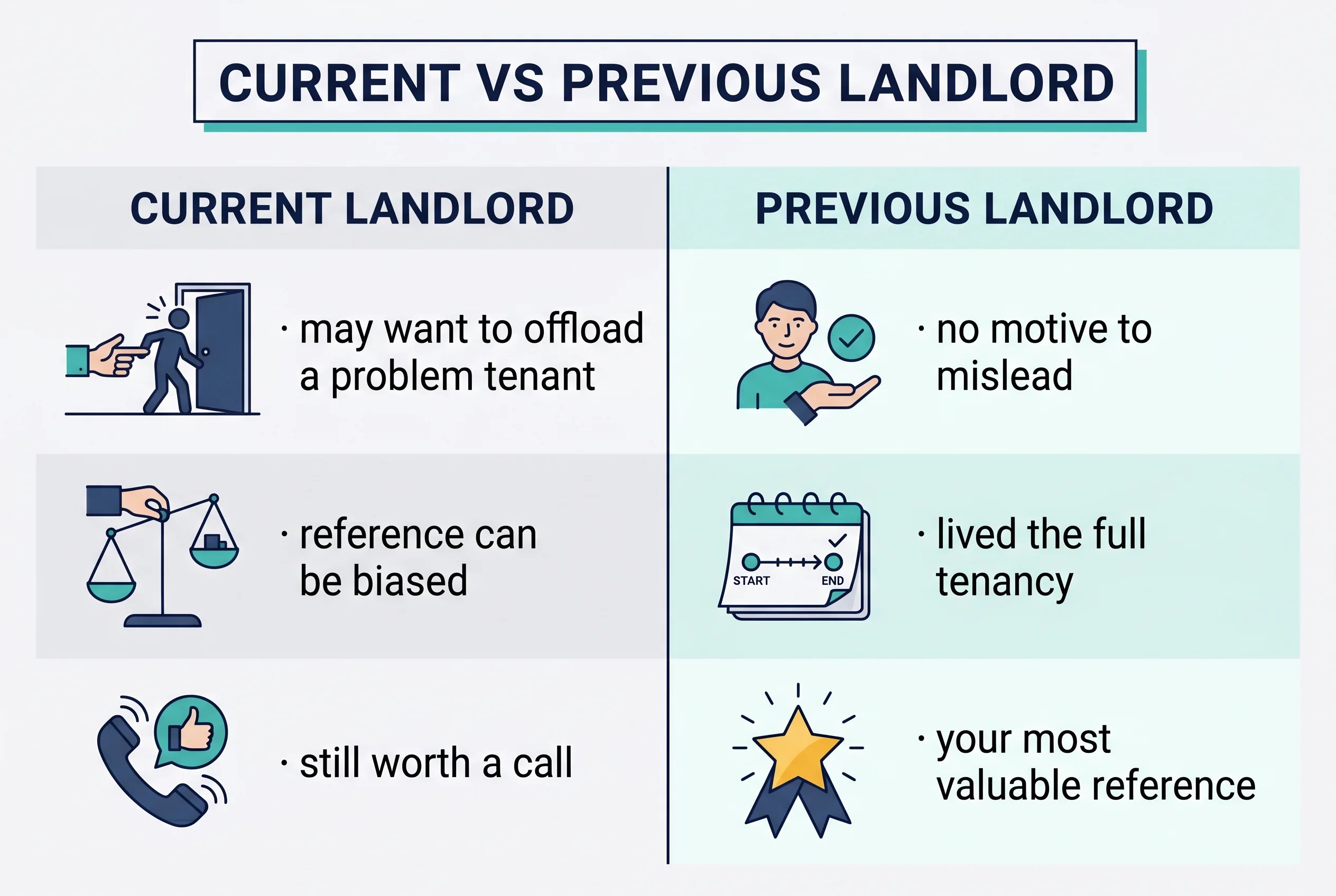
There's also a question of who you call. The instinct is to phone the current landlord — but that's the one with a reason to mislead you. A current landlord stuck with a problem tenant may hand out a glowing reference just to move them along. The previous landlord has no such motive; they've already lived the full tenancy and have nothing to gain. Call the previous landlord, not just the current one, and make sure you're reaching the actual owner or manager — not just a number the applicant gave you.
One step comes before any of this: written consent. Put an authorization line on your application — "I authorize the release of information from previous and current landlords and employers." No authorization, no calls. (It pairs naturally with the consent you already collect to run a credit check for Ontario landlords.) Weigh the effort against the stakes: a ten-minute call versus an eviction that can run five to twelve months at the LTB. It's cheap insurance.
The Previous-Landlord Questions That Actually Work
The principle is simple: ask open-ended, factual questions that make evasion visible — not yes/no items a coached friend can guess. Use the same set for every applicant. Here's the script:
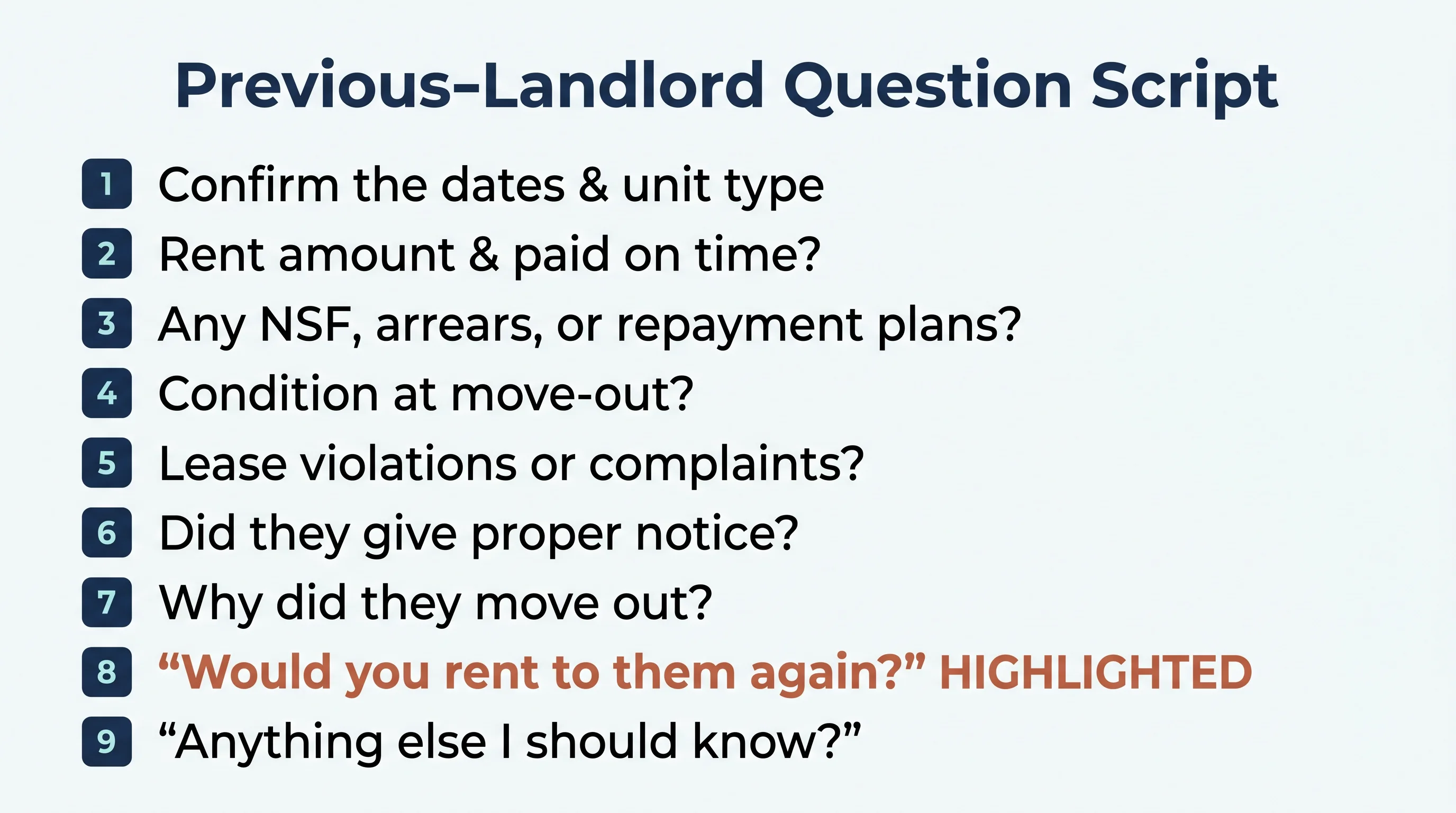
- "Can you confirm the dates they rented from you, and the unit type?"
- "What was the monthly rent — and were payments on time?"
- "Were there any NSF payments, arrears, or repayment plans?"
- "What condition was the unit in when they moved out?"
- "Were there any lease violations, noise issues, or complaints from neighbours?"
- "Did they give proper notice when they left?"
- "Why did they move out?"
- "Would you rent to them again?" — the single most revealing question. Listen for the pause as much as the answer.
- Always close with: "Is there anything else I should know?"
As one Canadian screening firm puts it, ask about "rent payment, care of the home, and complaints — not vibes." The questions are designed to get facts, not opinions. Read the answers fairly, though: previous landlords aren't obligated to answer everything, and some, on legal advice, will confirm only the dates and the rent. A limited answer isn't a negative — and one isolated late payment isn't a pattern. You're looking for patterns, not a single data point.
Employer Questions and How to Spot a Fake Reference
Keep the employer call tight. You're confirming four things: "Is the applicant currently employed here?", "What's their job title?", "How long have they been employed?", and "Is the role full-time, part-time, contract, or permanent?" Many employers will verify only these basics by policy — that's normal, not a red flag.
And here's the line that matters: employment verification confirms the income exists and is steady. It does not let you apply a rent-to-income ratio. There's no legal "30% rule" or "3× rent" cut-off in Ontario's private market. For self-employed applicants, lean on their Notices of Assessment and ask a previous landlord whether rent was paid reliably despite irregular income.

Now the fraud problem. Applicants with a bad history — an eviction, damage, unpaid rent — will list a friend or family member as a "previous landlord" to manufacture a clean reference. The fastest way to catch it is the address–date–amount test: a real landlord can instantly confirm the exact address, the tenancy dates, and the rent. A coached friend fumbles. Other tells include a vague or personal-sounding phone greeting (not a business line), overly perfect generic praise, details that don't match the application, no online trace of the landlord or property, and the wrong person answering the number.
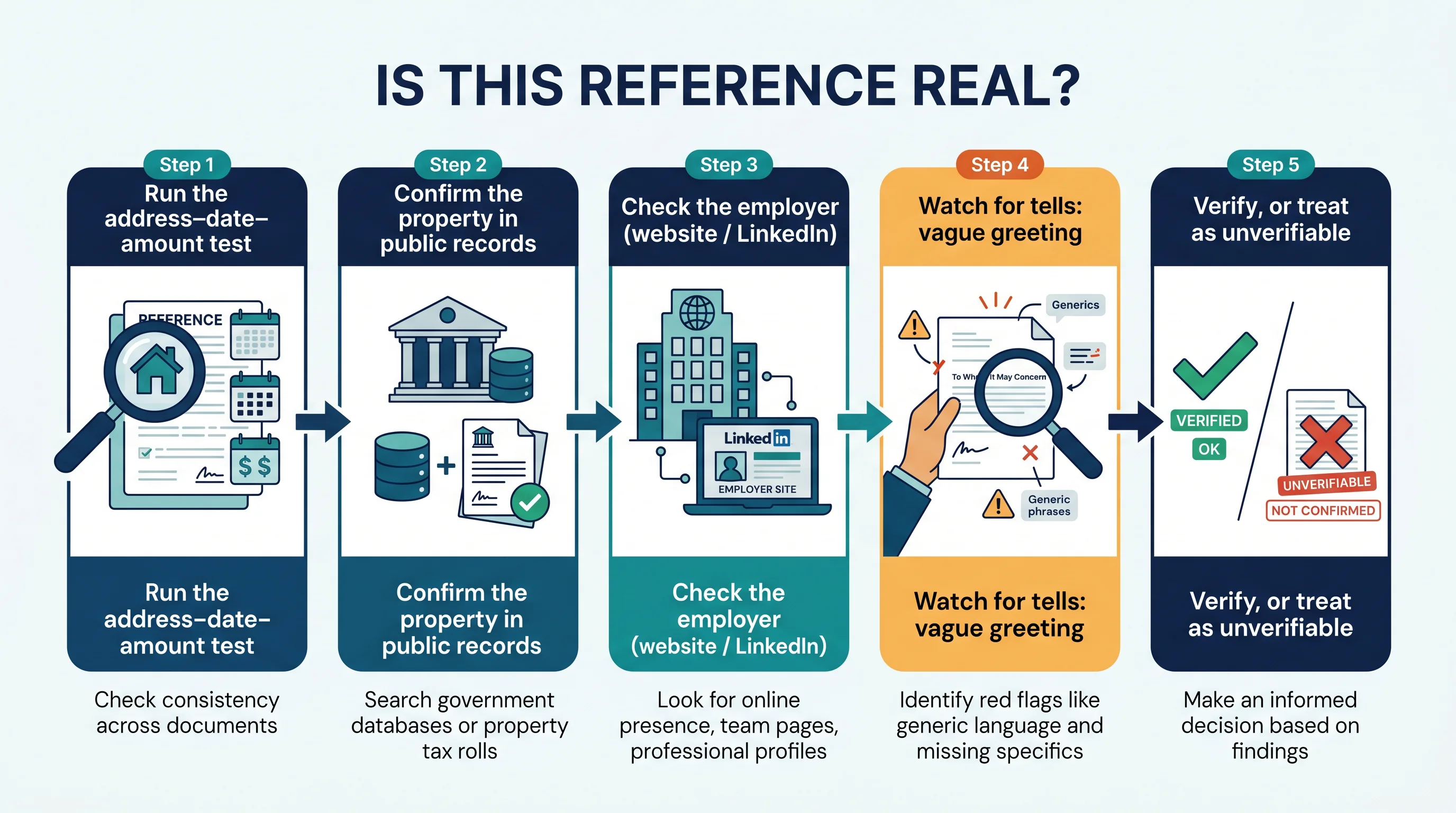
Verify independently rather than trusting the contact the applicant supplied. Look the rental address up in public municipal property records to confirm the "landlord" actually owns it. Google the employer plus the named supervisor, and check the company website or LinkedIn. And don't over-correct on the family question: renting from family is common and not automatically suspicious. Apply the same verification — confirm ownership, ask for the dates and rent. If the "family landlord" can't answer those basics, treat it as unverifiable, not as fraud proven. This is the same instinct that powers our guide to tenant application red flags.
Running the Call, Scoring It, and What You Must Never Ask
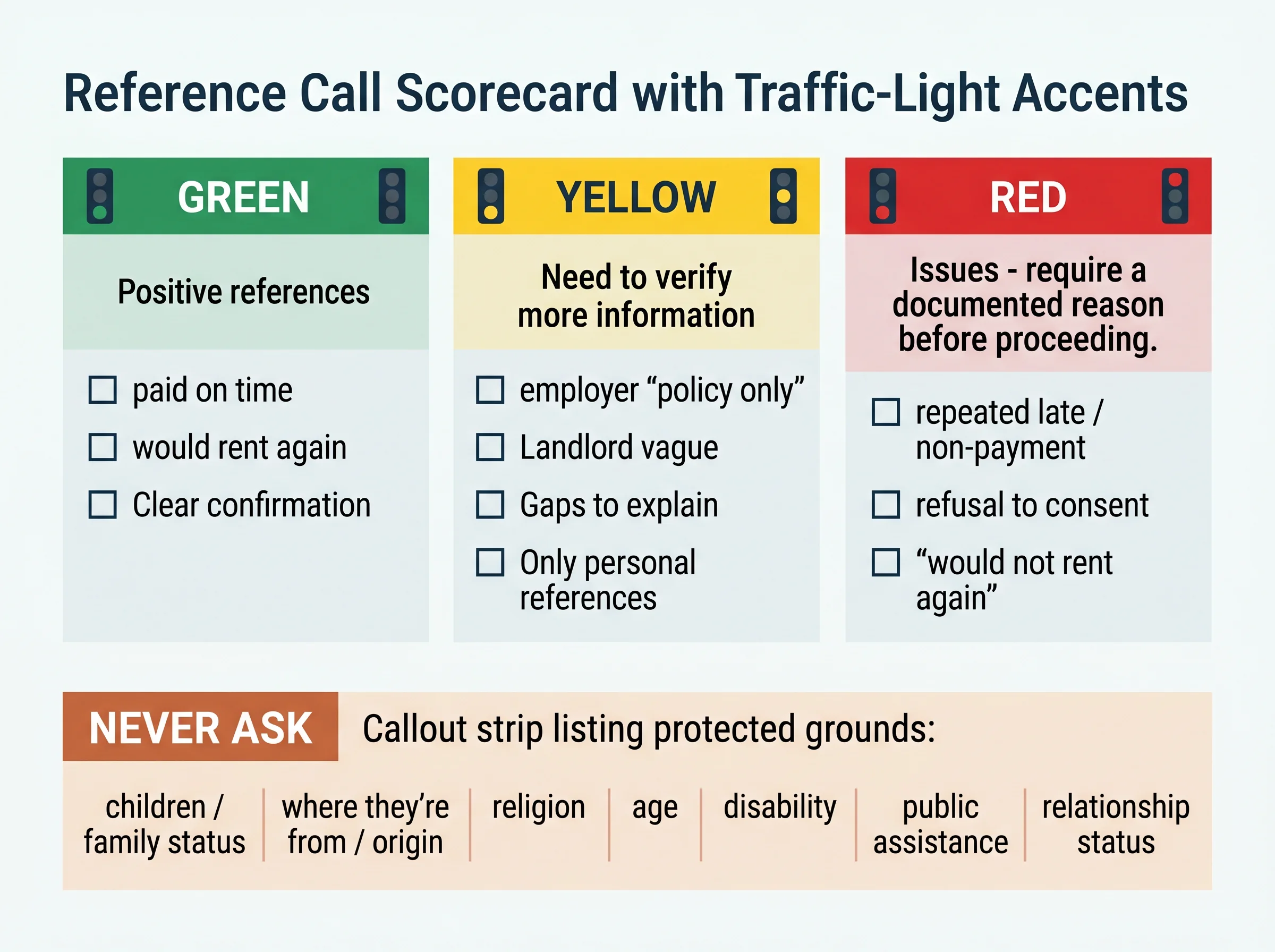
Score each applicant simply, with a Green / Yellow / Red system:
- Green: clear confirmation, paid on time, would rent again.
- Yellow (verify more): employer "policy only," landlord vague, minor issues that were resolved, gaps needing explanation, or only personal references offered.
- Red (don't proceed without a documented reason): repeated late or non-payment, refusal to consent, major contradictions, or a landlord who says "would not rent again" with specific reasons.
If a concern surfaces, follow up with the applicant before deciding. An explanation that's consistent with what the reference said may resolve it; one that contradicts the reference usually confirms it. That's the point where a second reference call earns its time. Document everything as you go — the reference's name and relationship, the number you called, the date and time, and a summary of the answers (especially payment, reason for moving, and would-rent-again). Keep it in the applicant file; it's your protection if a decision is ever challenged.
Which brings us to the line you cannot cross. Keep every question about conduct, finances, and the tenancy. Never ask a reference about the applicant's children or family status, where they or their name are "from," their religion, age, a disability or health condition, whether they receive public assistance, or their relationship status. Those are protected grounds under Ontario's Human Rights Code, and steering a reference call into that territory is exactly what gets a landlord into trouble. When in doubt, don't ask — and ask the same questions of everyone.
Key Takeaways
A reference call works when it's structured, consistent, and aimed at the right things:
- Get written consent on the application before any reference or employer call.
- Call the previous landlord, not just the current one; reach the actual owner or manager.
- Ask the same open-ended question set every time, ending with "would you rent to them again?" and "anything else I should know?"
- Run the address–date–amount test, and verify the property and employer independently.
- For employers, confirm employment, title, length, and status — never apply a rent-to-income ratio.
- Ask nothing tied to a protected ground (kids, origin, religion, age, disability, public assistance, relationship).
- Score each applicant Green / Yellow / Red, and document every call.
The quick win is putting a consent line and a fixed question script in front of you before your next call. The long game is running that same documented script and scorecard on every single applicant. For the full lawful process this fits inside, read the tenant screening pillar, and pair it with the credit checks guide.
The Landlord's Reference Call Script & Checklist
The nine previous-landlord questions, the employer set, the address-date-amount test, and the Green/Yellow/Red scorecard — on one printable page.
Get Free PDF →Conclusion
A reference call works when the questions are specific, the same for everyone, and aimed at conduct and the tenancy. Call the previous landlord, ask the nine questions, run the address–date–amount test on anyone who feels coached, score it Green / Yellow / Red, document it, and never stray into protected-ground territory.
This isn't about grilling people. It's about asking the right factual questions consistently — which is both a sharper screen and your best legal protection. Do it once, build it into your process, and every future call goes smoother.
Reminder: this is general information, not legal advice. For your situation, consult a licensed paralegal or lawyer, or the Ontario Human Rights Commission.
Capture consent and references in one place
Tenon10 captures consent on the application, sends a standard reference request, and records the answers alongside credit and income — so every screening is consistent and documented.
Free to start • Built for Ontario landlords
Frequently Asked Questions
What questions should I ask a previous landlord?
Ask the dates and unit type, the rent and whether it was paid on time, any NSF or arrears, the condition at move-out, any lease violations or complaints, whether proper notice was given, why they moved, and — most telling — "would you rent to them again?" Close with "anything else I should know?"
Should I call the current or the previous landlord?
Both, but weight the previous one. A current landlord may give a glowing reference to move a problem tenant along; the previous landlord has no such motive and has seen the full tenancy.
How do I spot a fake landlord reference?
Use the address–date–amount test: a real landlord instantly confirms the exact address, the tenancy dates, and the rent. Watch for a personal-sounding phone greeting, overly perfect praise, and no online trace — and confirm the property's ownership in public records.
What questions can't I ask a reference in Ontario?
Anything tied to a protected ground — the applicant's children or family status, where they're from, religion, age, disability, whether they receive public assistance, or relationship status. Keep every question about conduct, finances, and the tenancy.
What if an applicant only has personal references?
Treat it as a yellow flag, not an automatic no — it's common for first-time renters. Ask for at least one housing reference or other proof of a payment history (like past rent or bill payments), and apply the same standard to everyone.


