

The credit check is one of only five screening tools Ontario law actually lets you use — and most landlords get at least one rule wrong. Here's a big one that changed recently: since November 2024, running a rental credit check for Ontario landlords no longer affects the applicant's score at all. If you've been hesitating to pull a report because you didn't want to "ding" a good applicant, that worry is gone.
But a credit check is a primary risk tool that runs on a strict legal path. Skip consent, demand a SIN, charge a fee, or reject someone for "no credit," and you've turned a routine step into a privacy breach, an illegal charge, or a human-rights complaint. This guide walks you through doing it right, start to finish — getting consent, actually running the check, reading the report without over-relying on the number, and using the result lawfully. It's the tactical companion to our full guide on how to screen tenants in Ontario.
This is general information, not legal advice.
The Ontario Landlord's Credit-Check Checklist
A free, Code-compliant checklist: consent, the soft-inquiry rules, how to read the report, and what you legally can't charge. Keep it by your desk while you screen.
Get Free PDF →Start With Consent: The Non-Negotiable First Step
A credit check is one of the five categories of information Regulation 290/98 permits a landlord to use — alongside income, credit references, rental history, and guarantees. It's a powerful risk tool, but it only works on a strict legal path, and that path starts with consent.
Written consent is mandatory. You cannot legally pull a credit report without signed, written authorization. Both Equifax Canada and TransUnion Canada require it before releasing a report, and so does privacy law. The simplest way to handle it is a clear credit-check authorization clause built into your standard rental application — so consent is captured the moment someone applies. No consent, no check.
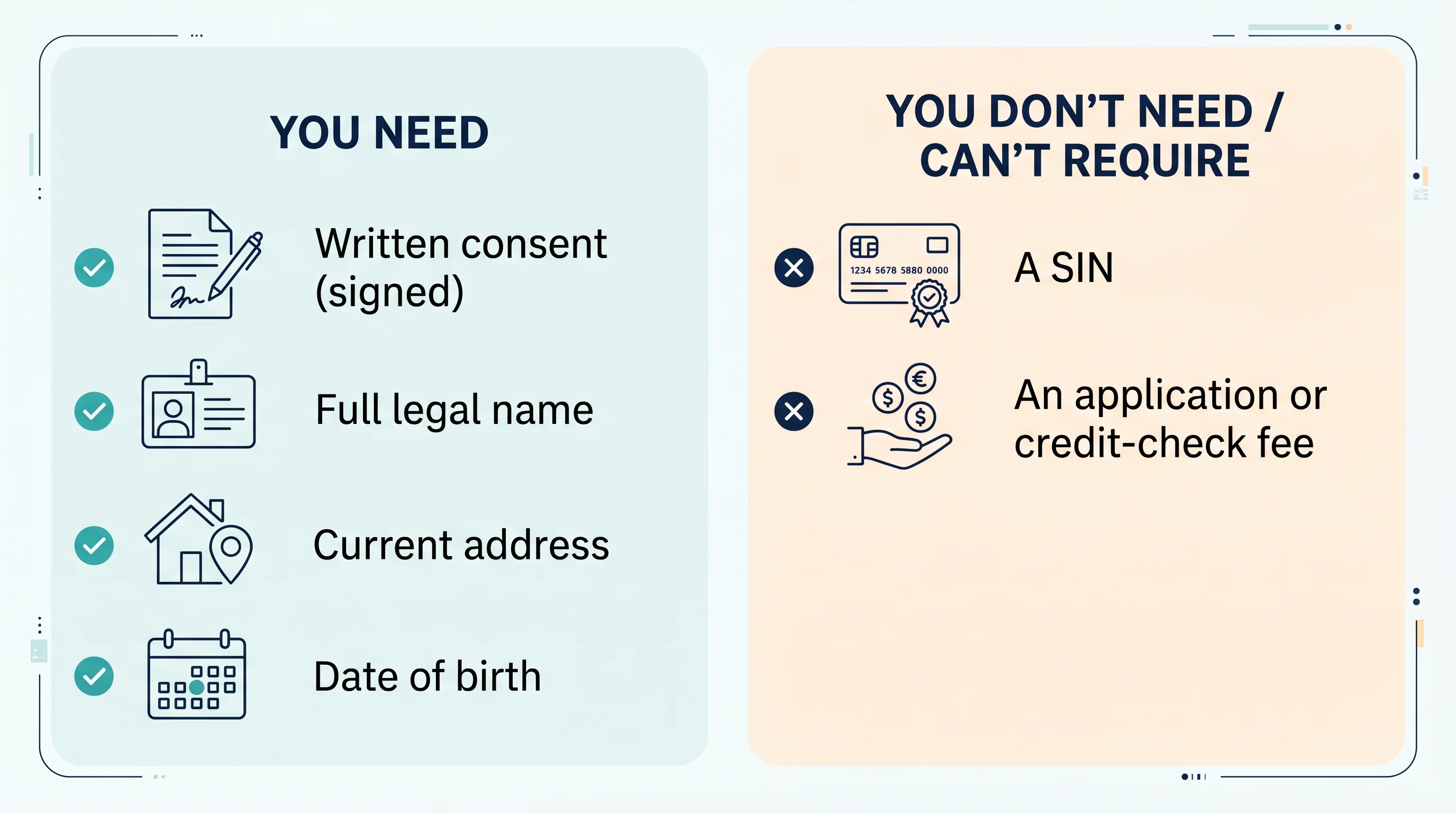
What you actually need to pull a report is short: the applicant's full legal name, current address, and date of birth. That's it. Which brings us to the most common myth — you do not need a SIN. You can't require one, an applicant may decline to share it, and you cannot reject someone solely for refusing. Asking is fine; demanding it, or treating a refusal as a black mark, is not.
One more practical point: if an applicant believes something on their report is wrong, they can dispute it directly with the bureau. If a concern like that is raised, note it before you make your decision rather than acting on a contested entry.
How to Run It (and the 2026 Soft-Inquiry Change)
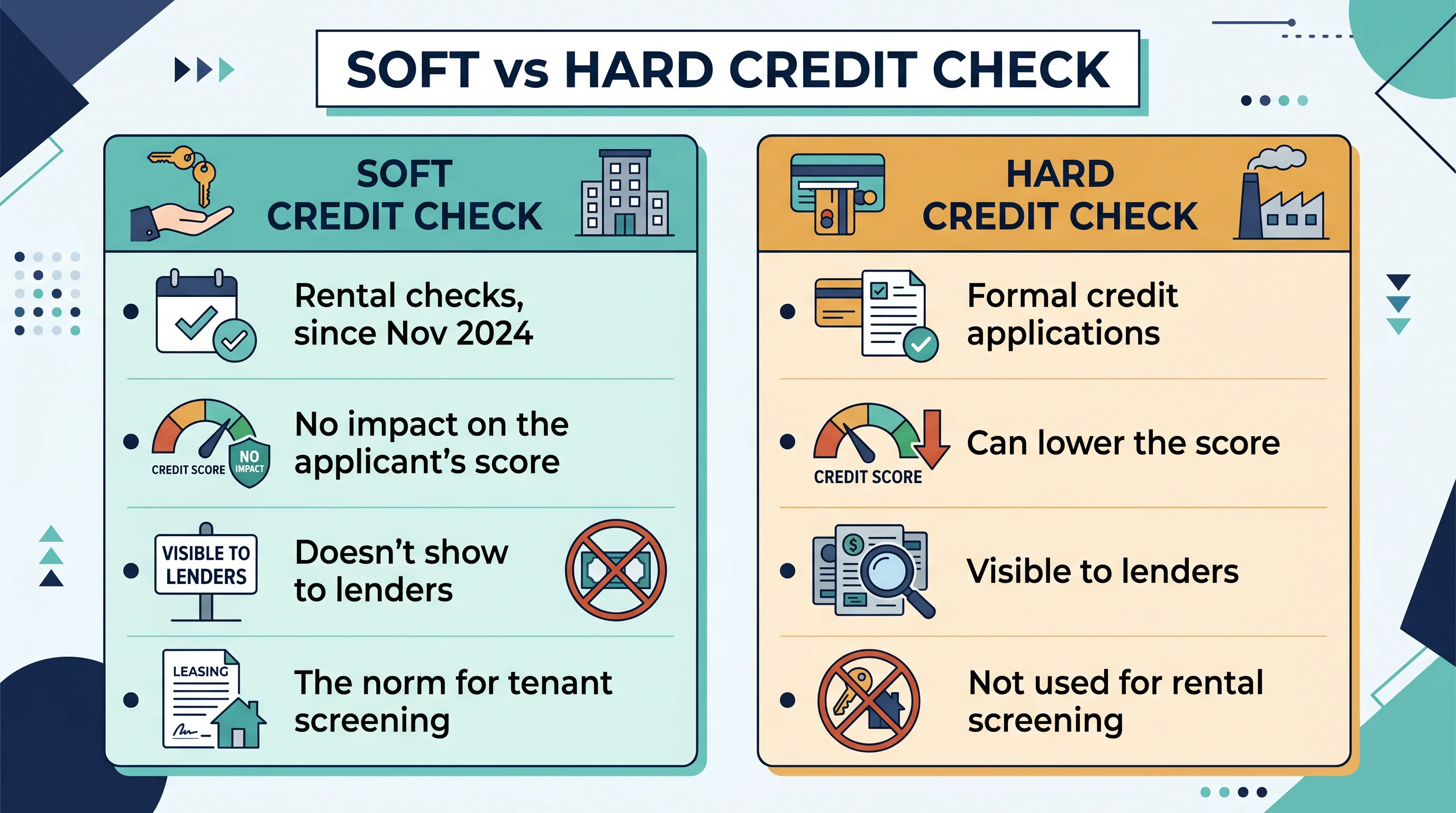
Here's the change worth knowing about. Since November 2024, both Equifax and TransUnion classify rental credit checks as soft inquiries. The check doesn't appear on the tenant's credit file and doesn't lower their score — even if they apply to several units in a short window. It even applied retroactively to rental checks from roughly the prior two years. The applicant can still see the inquiry on their own MyEquifax portal, but lenders can't, and it has no effect on their score.
Why does that matter to you? It removes the single most common applicant objection — "please don't ding my score" — so you can screen properly without penalizing good applicants who are shopping several places at once. Consent is still required; only the score impact has changed.
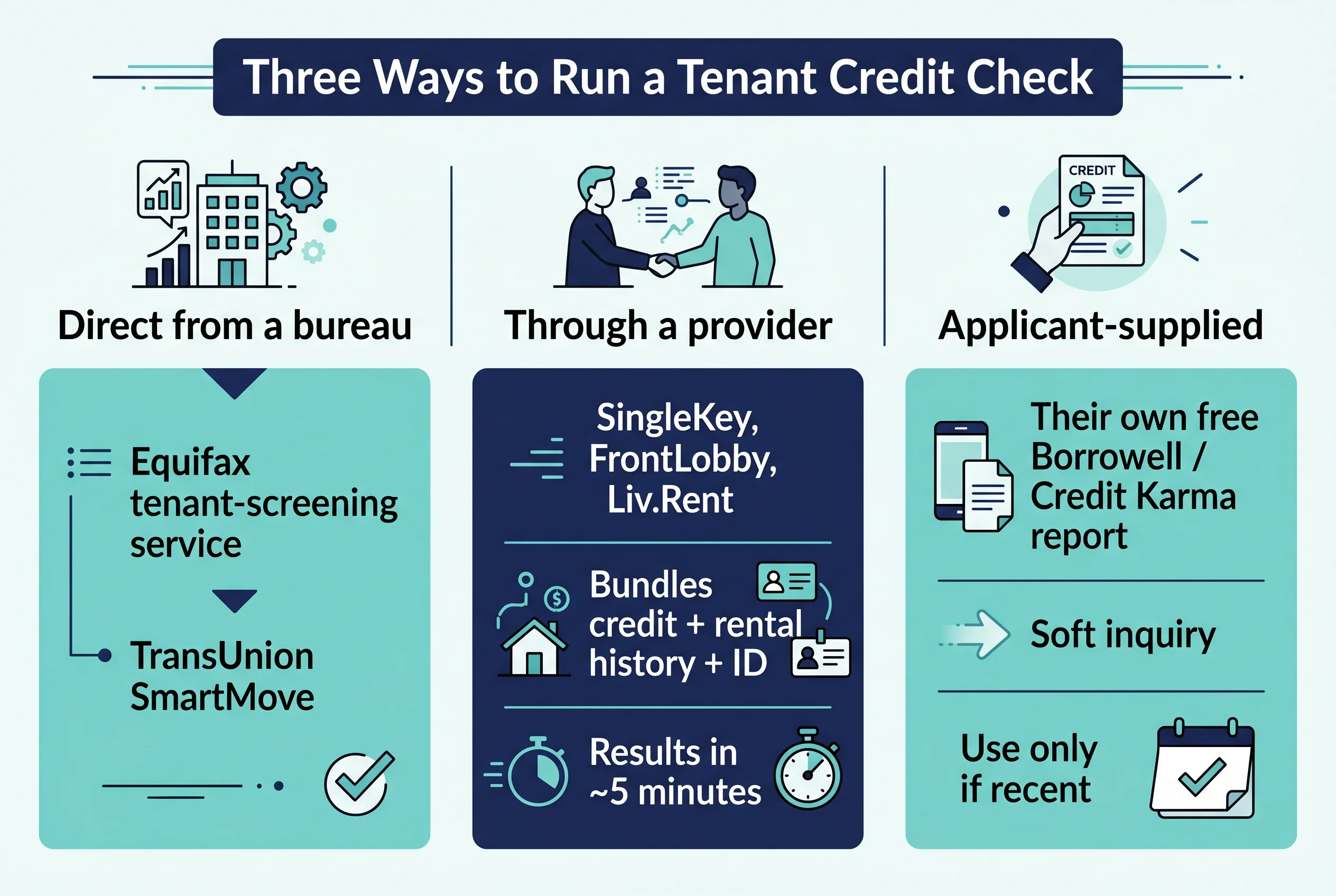
There are three ways to run the check:
- Direct from a bureau — Equifax's tenant-screening service or TransUnion's SmartMove.
- Through a third-party provider that pulls from the bureaus — SingleKey, FrontLobby, Liv.Rent, LandlordEzy and others. These often bundle credit with rental history, income, ID verification, and eviction or public-record scans, and can return results in about five minutes.
- Accept the applicant's own recent report — they can pull it free from Borrowell, Credit Karma, or the bureau directly, and checking their own credit is always a soft inquiry.
Equifax and TransUnion both use a 300–900 scale, and the two can show different information, so some landlords run a dual report for a fuller picture. One caution that ties into spotting tenant application red flags: an applicant-supplied PDF is fine if it's recent, but it can be outdated or altered — pulling your own (or going through a provider) removes that risk.
How to Read the Report (Without Over-Relying on the Number)
The headline score is a starting point, not a verdict. The detail underneath it is what actually tells you whether someone pays their obligations. Read these five areas:
- Payment history — the most predictive part. Look for patterns of on-time payment across accounts, not one isolated late payment.
- Credit utilization — how much of their available credit they're using. High utilization can signal strain, but it needs context.
- Credit-history length — a thin file isn't a bad one. It's common for newcomers and young adults.
- Recent inquiries — many hard pulls in a short period can indicate someone actively seeking new credit.
- Public records and collections — judgments, collections, consumer proposals, bankruptcies, and especially any collection from a previous landlord.
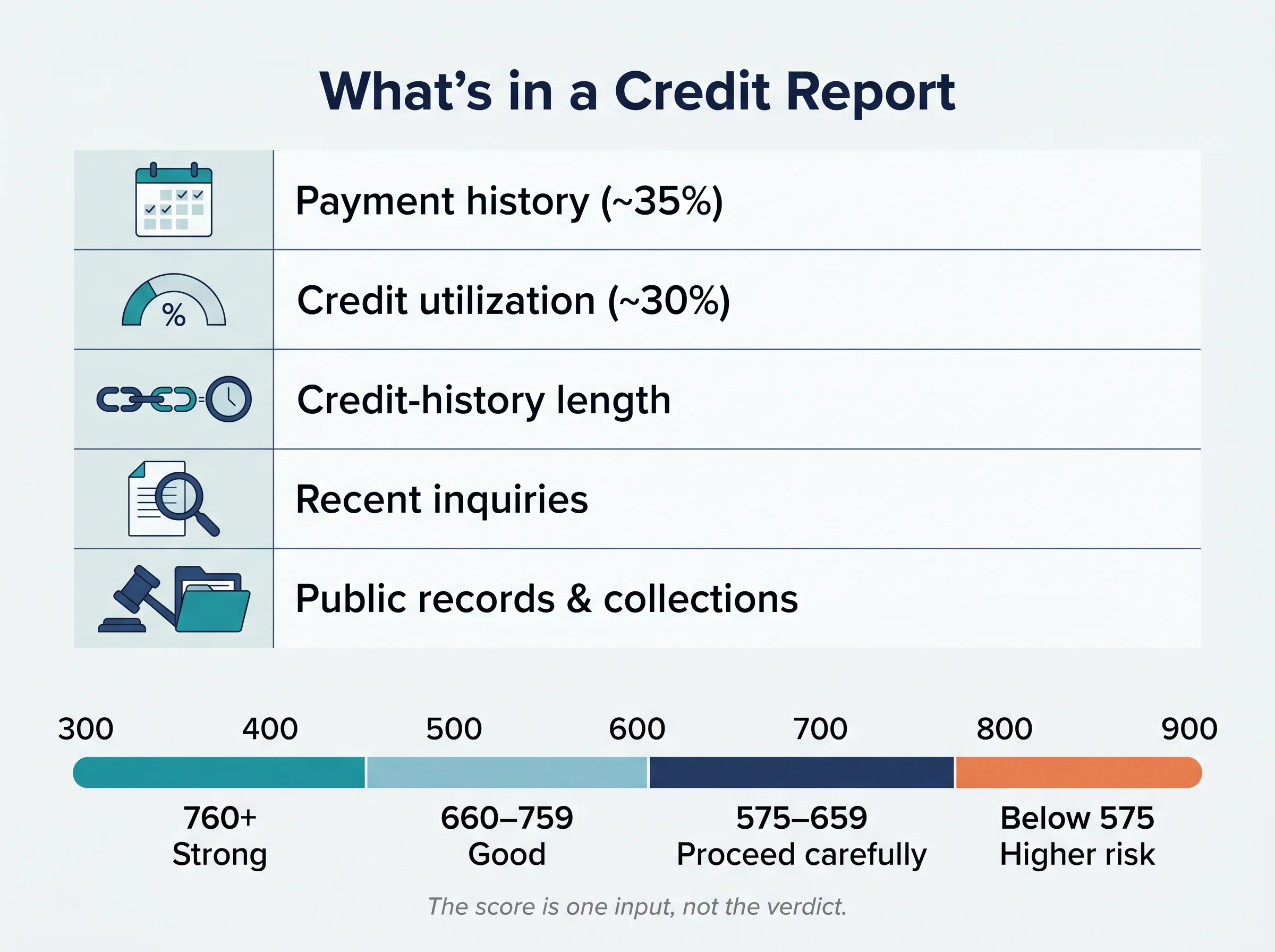
As a rough framework — not a legal cut-off — roughly 760+ is strong, 660–759 is good (understand what's pulling it down), 575–659 means proceed carefully (a guarantor may help, if you require one of everyone), and below 575 is higher risk that warrants explanation and mitigating factors. For reference, the Canadian average is around 760, with 660+ generally "good" and 725+ "very good."
And always read credit alongside the rest of the file — income, references, and rental history. A clean score can still hide a poor rental history that two reference calls would reveal, and a "good tenant, bad score" is common and usually explainable.
Using the Result Lawfully: Fees, No-Credit, and Consistency
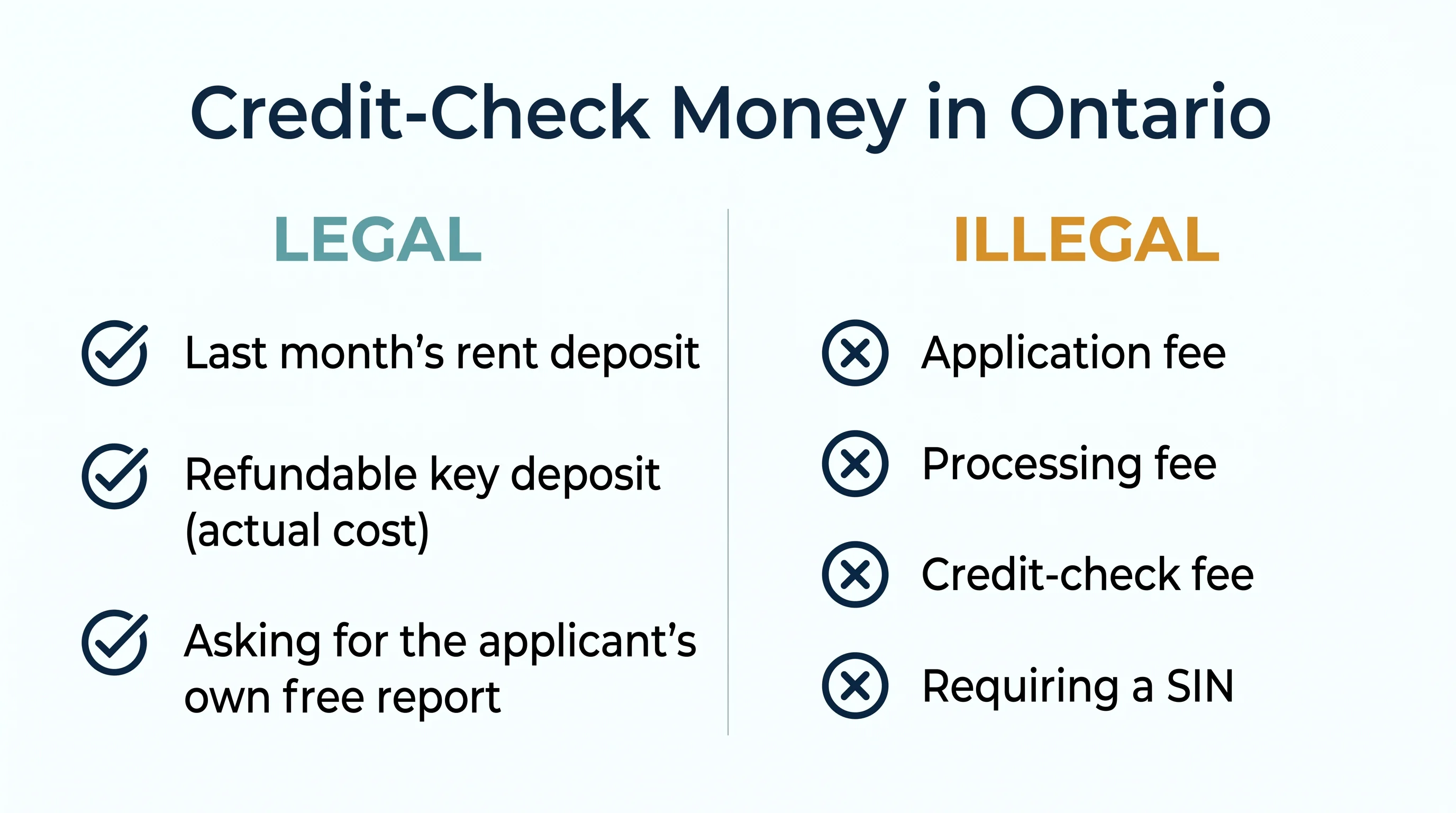
Start with what you can't charge. Application fees, processing fees, and credit-check fees are all illegal in Ontario. The only money you may collect is the rent deposit (last month's rent) and a refundable key deposit at its actual cost. An applicant who's forced to pay an illegal fee can recover 100% of it by filing a T1 at the Landlord and Tenant Board. You absorb the cost of the check yourself — a real bureau-based report runs about $10–30 — or, if you'd rather not pay, you simply ask the applicant to provide their own free report.
Now the safety message that matters most: thin or no Canadian credit is not a red flag. Ontario law protects applicants here — you cannot reject someone solely for lacking credit history, and doing so to a newcomer can be adverse-effect discrimination on the basis of place of origin or citizenship. No history isn't bad credit; it just means someone hasn't used credit products that report to the bureaus. Assess them another way: references, proof of past rent or bill payments, a guarantor (only if you require one of all applicants), or their own report read in context.
Two more lines to hold. Seeing income on a report doesn't let you apply a rent-to-income ratio — no "30% rule," no "3× rent" cut-off; that's still illegal. And the real legal risk in credit screening isn't the check itself, it's inconsistency. Document your criteria, apply them identically to every applicant, weigh credit alongside conduct and finances rather than in isolation, and keep your records for at least a year. Consistency is simultaneously better screening and your best legal protection.
Key Takeaways
Running a credit check the right way comes down to a handful of habits:
- Put a written credit-check consent clause on your standard application, and get it signed first.
- Collect only name, address, and date of birth — never require a SIN.
- Run a soft-inquiry check (bureau or reputable provider), or accept the applicant's own recent report.
- Charge no fee — only last month's rent and a key deposit are lawful.
- Read the full report (payment history, utilization, length, inquiries, public records), not just the score.
- Treat thin or no Canadian credit as neutral; use references and proof of payment instead.
- Apply the same criteria to everyone, weigh credit with income and references, and document the decision.
The quick win is adding the consent clause and dropping any "application fee" today. The long game is a documented, identical credit-screening routine you run on every applicant. For the full lawful process this fits inside, read the tenant screening pillar, and pair it with the red flags guide for spotting fraud.
The Ontario Landlord's Credit-Check Checklist
A free, Code-compliant checklist: consent, the soft-inquiry rules, how to read the report, and what you legally can't charge.
Get Free PDF →Conclusion
Run it right and the credit check earns its place as one of your most useful tools: get written consent, collect only name, address, and date of birth, use a soft-inquiry check, read the full report rather than the headline number, charge nothing, never reject solely for no Canadian credit, and apply your criteria consistently.
The credit check is powerful precisely when it's one input among several and applied the same way every time. That's better screening — and it's also your strongest protection if a decision is ever challenged.
Reminder: this is general information, not legal advice. For your situation, consult a licensed paralegal or lawyer, or the Ontario Human Rights Commission.
Build consent and credit into one documented file
Tenon10 builds consent into the application, runs a soft-inquiry check, and records credit alongside income and references — so every screening is consistent and defensible.
Free to start • Built for Ontario landlords
Frequently Asked Questions
Does a tenant credit check affect the applicant's credit score?
No. Since November 2024, both Equifax and TransUnion treat rental credit checks as soft inquiries — they don't lower the applicant's score, even across multiple applications. You still need written consent.
Do I need a SIN to run a tenant credit check in Ontario?
No. You only need the applicant's full legal name, current address, and date of birth. You can't require a SIN, and you can't reject someone just for declining to share it.
Can a landlord charge a credit-check or application fee in Ontario?
No. Application and credit-check fees are illegal — the only money you can collect is last month's rent and a refundable key deposit at actual cost. You can ask the applicant to provide their own free report instead.
What credit score do you need to rent in Ontario?
There's no legal minimum. As a rough guide, 660+ is generally good and 725+ very good (the Canadian average is around 760), but the score is just one input — read the payment history and the rest of the file, and never reject someone solely for no credit history.
Can I reject a tenant for having no credit history?
No — that can be adverse-effect discrimination, especially for newcomers. No history isn't bad credit. Assess them on references, proof of past rent or bill payments, or a guarantor instead.


