

A self-employed applicant hands you a rental application with no pay stub and no T4. That's not a problem to screen out — it's a normal income file that just looks different. With freelancers, contractors, gig workers, and small-business owners making up a fast-growing share of renters, knowing how to do income verification for self-employed tenants is now a basic landlord skill, not a niche one.
Two mistakes are common. Some landlords reject self-employed applicants outright for lacking traditional proof — losing good tenants and, in places like Ontario, risking a human-rights complaint. Others accept a single self-printed document at face value and get burned. The right approach sits between the two: ask for the documents that actually verify income, read them properly, and decide the same way you would for anyone else.
This guide shows you which documents prove self-employed income, how to read them (including the net-vs-gross trap that fools a lot of landlords), how to sanity-check them, and how to stay onside human-rights and privacy law. It's a companion to our full guide on how to screen tenants in Ontario. This is general information, not legal or tax advice.
The Self-Employed Income Verification Checklist
The exact documents that verify a self-employed applicant's income, how to read them (mind the net-vs-gross trap), and how to decide fairly. Keep it by your desk while you screen.
Get Free PDF →Why Self-Employed Verification Is Different (Not Harder)
An employee proves income with a T4 and a couple of pay stubs. The self-employed don't get a T4 — unless they're also employed somewhere else — so they verify income through tax documents, bank deposits, and business records instead. Different paperwork, exactly the same goal: confirm the income exists and is stable.
This covers a broad and growing group: freelancers, independent contractors, gig and platform workers, consultants, solopreneurs, and small-business owners. Treating "no pay stub" as a disqualifier means turning away a large and rising slice of the rental market.
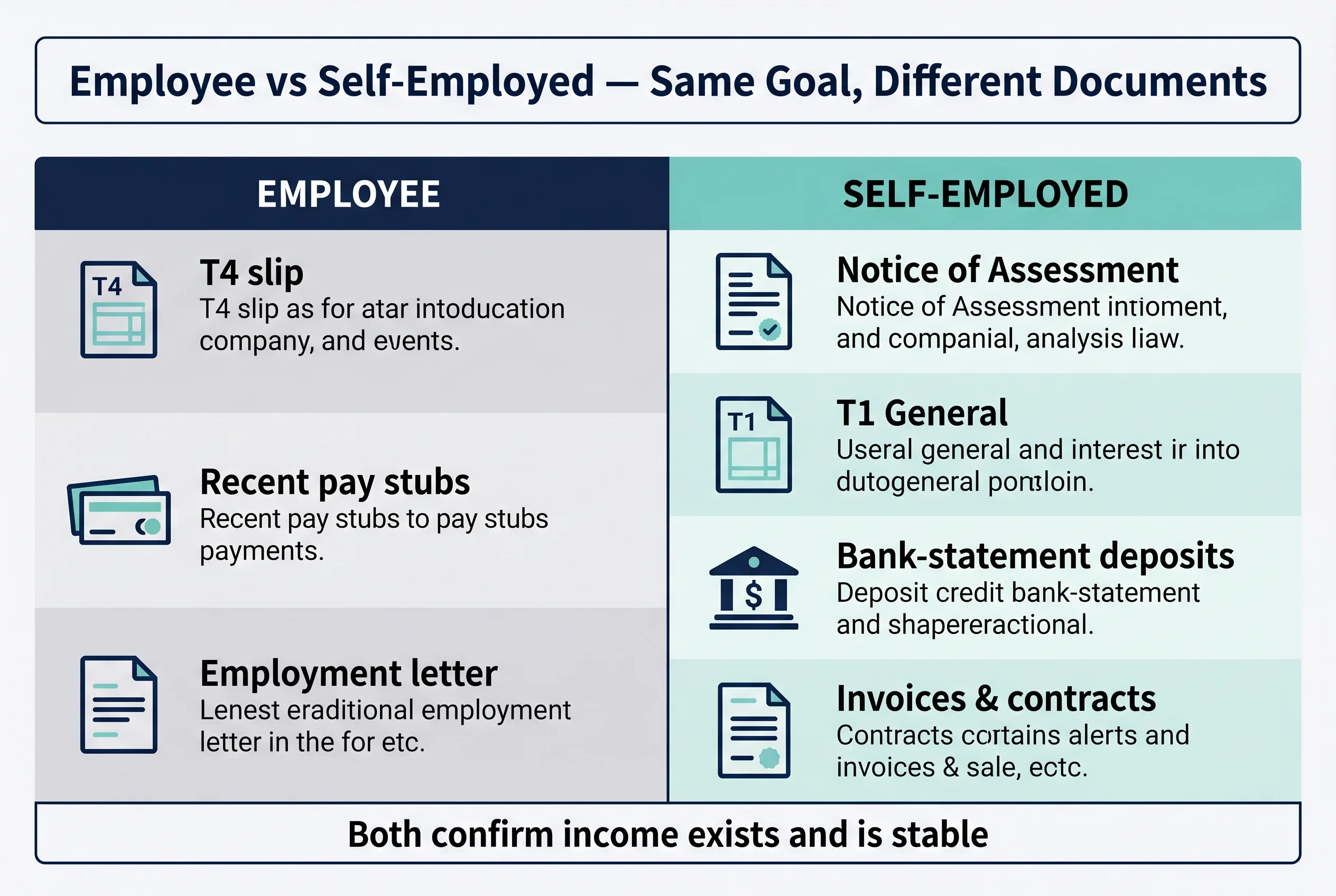
The mindset shift that matters most: variable income is not unstable income. The right question isn't "is every month identical?" but "does the annualized income and payment history support the rent?" A freelancer who earns $8,000 one month and $2,000 the next can be a perfectly strong tenant — their yearly income may comfortably cover the rent even though no two months look alike.
The stakes are real. Screening someone out for "no pay stub" can cost you a good tenant, and in Ontario it can raise a discrimination issue, because source of income is a protected ground under the Human Rights Code. Other provinces have their own source-of-income protections — so wherever you rent, the safe and smart move is the same: verify the income properly rather than dismiss it.
The Documents That Actually Verify Income
Start with the gold standard — documents that come from the Canada Revenue Agency:
- Notice of Assessment (NOA): the summary the CRA issues after assessing someone's return. It's CRA-issued, hard to fake, and shows assessed income for the year. Ask for the most recent — ideally two years, to show a trend.
- T1 General (the personal tax return): the full return. Self-employed business income is detailed on Form T2125 (Statement of Business or Professional Activities), filed with the T1. Two years of T1 Generals plus an NOA is the standard self-employed ask.
- CRA "proof of income statement" (Option-C printout): a CRA-generated income summary the tenant can request directly from the CRA by phone. It's a clean, harder-to-doctor alternative when a self-printed return looks doubtful.
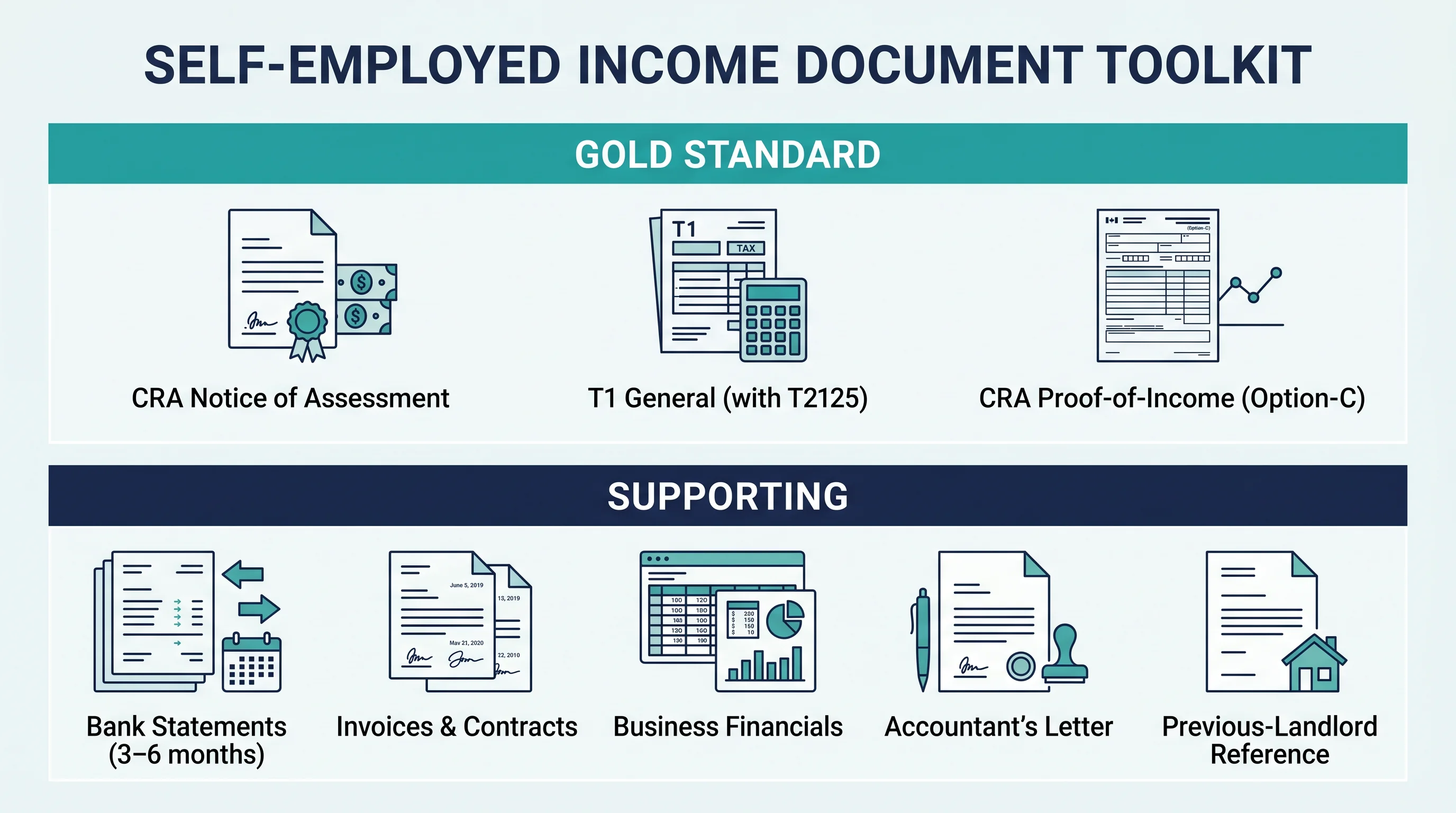
Then build out the picture with two or three supporting documents — never rely on just one:
- Bank statements showing regular business-income deposits (commonly three to six months) — these confirm the cash flow is real and ongoing.
- Business financial statements (a profit-and-loss statement, balance sheet).
- Invoices and signed contracts — concrete evidence of ongoing work, especially useful for freelancers and contractors.
- An accountant's (CPA) letter for third-party credibility, and GST/HST registration to corroborate an active business.
- A previous-landlord reference confirming rent was paid reliably despite irregular income — often the single most reassuring signal. (Our reference-check guide covers exactly what to ask.)
The principle throughout: assemble a picture from a few sources that corroborate each other, not a single sheet of paper.
How to Read the Documents (The Net-vs-Gross Trap)
Having the documents is only half the job — reading them well is the other half. Three habits make the difference.
Read the trend, not one month. Average the income across the year, and use two years of NOAs to see whether it's stable, rising, or falling. A single spiky month tells you almost nothing on its own.
Mind the net-vs-gross trap. This is the one that catches landlords out. Self-employed income is reported as net — gross income minus business expenses — on the T1 and Form T2125. A business owner who expenses aggressively (vehicle, home office, equipment) can show a modest net income on paper while running healthy cash flow. So read the NOA's assessed income alongside the actual bank deposits, not in isolation. A contractor with a low NOA figure but strong, consistent monthly deposits and a full invoice book is often a stronger tenant than the number alone suggests.
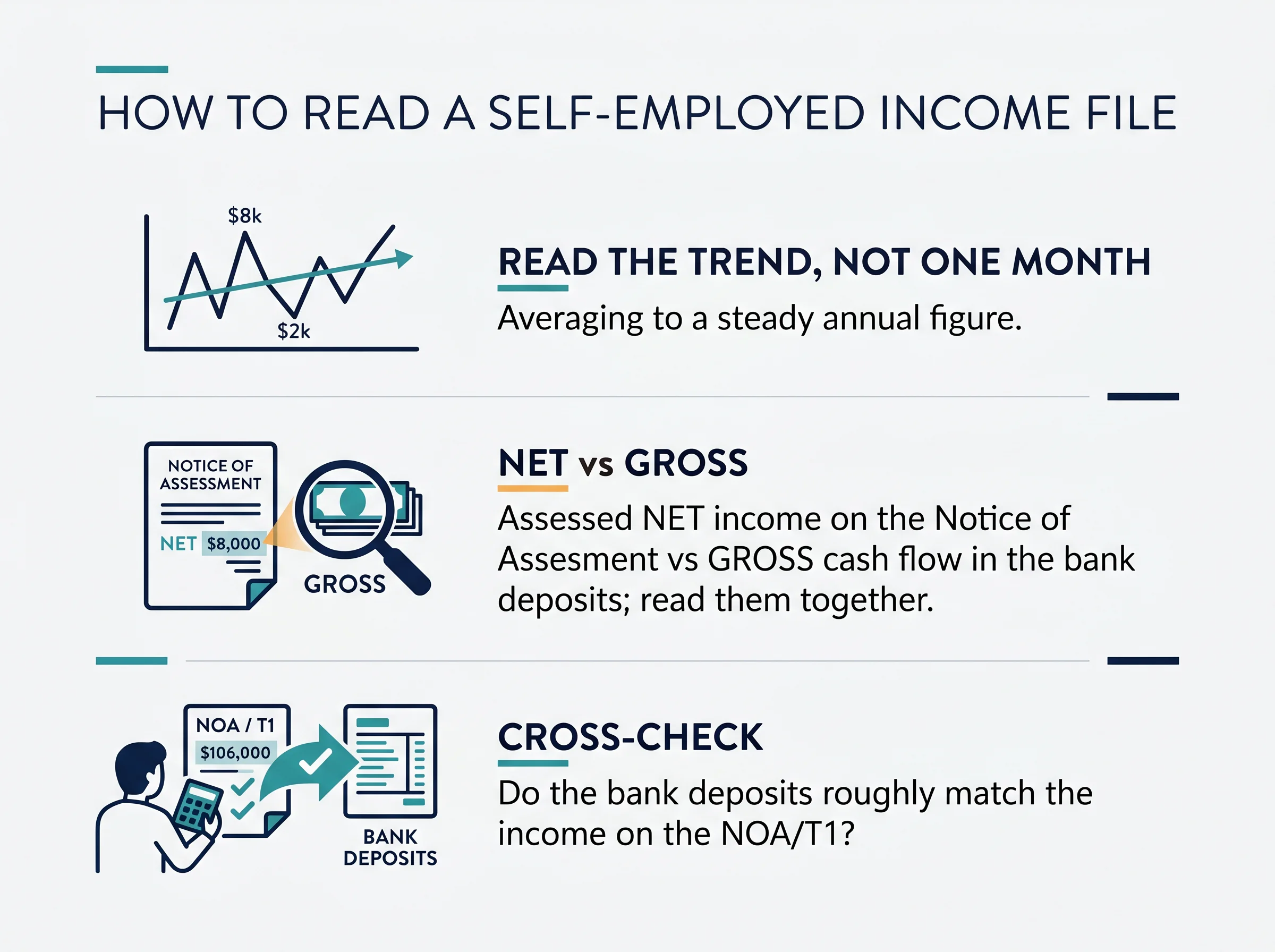
Cross-check for consistency. Do the bank deposits roughly line up with the income claimed on the NOA and T1? Agreement across documents is the real test. A mismatch — deposits that don't match stated income, altered balances, suspiciously round numbers — is a flag worth pausing on, the same kind of inconsistency our red-flags guide covers.
Finally, remember compensating factors. Strong savings, a cash cushion, a solid credit history, or a clean rental history can all offset month-to-month variability. You're assessing the whole financial picture, not auditing a single line.
Deciding Fairly and Legally
This is where good intentions can quietly cross a legal line, so handle it precisely.
The ratio question. Many landlords use a "30% rule" or insist income be "2.5–3× the rent." It's a widespread practice — but check your province, because human-rights law constrains it. In Ontario, a rent-to-income ratio is not permitted in the private market: income may be weighed alongside credit, references, and rental history, but it can't be used as a hard cut-off. The safe, portable rule everywhere is the same one this whole guide is built on — verify that income exists and is steady, and weigh it with the full file. Don't reduce a person to a ratio.
Source of income is protected. You can't reject or downgrade an applicant because their income comes from self-employment, gig work, a contract, social assistance, disability benefits, CPP/OAS, or EI. That's protected under Ontario's Human Rights Code, and other provinces have their own source-of-income protections — check yours.
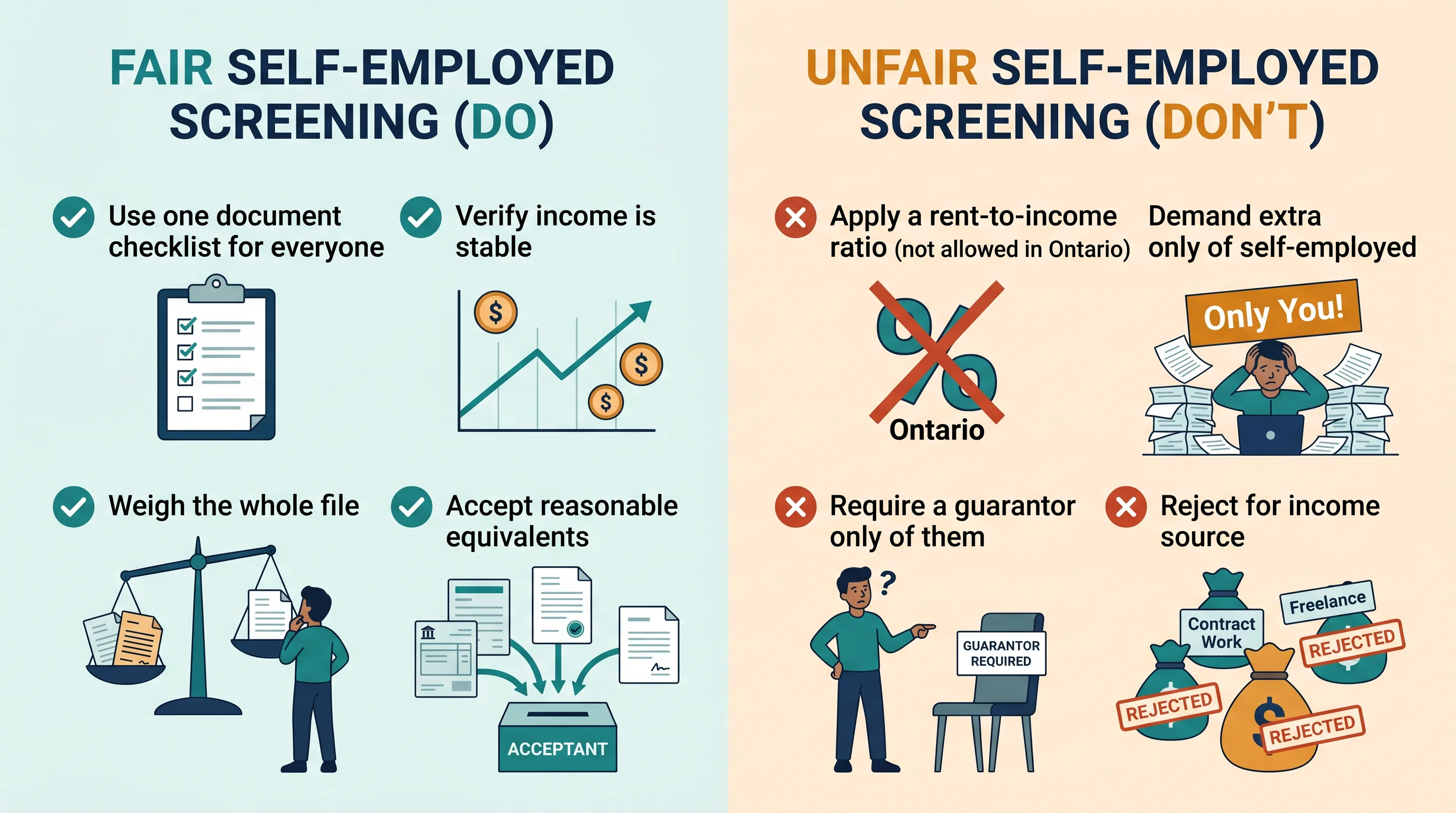
The same-standard rule is the most practical safeguard you have. Demanding more documents — or a guarantor — only of self-employed (or newcomer) applicants is adverse-effect discrimination. Use one income-document checklist for everyone, accept reasonable equivalents (pay stubs or NOA/T1/bank statements), and document what you asked for. A guarantor or prepaid rent is fine as an option offered to everyone, not a requirement aimed at the self-employed — and only within your province's deposit limits (in Ontario, last month's rent plus a key deposit; no separate "security" deposit).
Key Takeaways
Verifying self-employed income comes down to a few repeatable habits:
- Use one income-document checklist for every applicant; accept equivalents (pay stubs or NOA/T1/bank statements).
- For the self-employed, ask for the most recent NOA (ideally two years) and the T1 General, plus two or three supporting documents.
- Read the trend, not one spiky month; cross-check the bank deposits against the NOA and T1.
- Mind the net-vs-gross trap — read assessed income alongside the deposits.
- Verify that income exists and is steady; don't apply a rent-to-income ratio (and in Ontario, you can't).
- Never reject or downgrade for income source; ask for a CRA Option-C statement if a return looks doubtful.
- Offer any guarantor or prepaid-rent option to everyone, not just the self-employed — and document the documents you requested.
The quick win is building one document checklist you hand to every applicant. The long game is a documented, consistent process that treats variable income fairly. For the full lawful process this fits inside, read the tenant screening pillar, and pair it with the credit checks guide.
The Self-Employed Income Verification Checklist
The document toolkit, the net-vs-gross trap, and the same-standard rule — on one printable page you can use on every application.
Get Free PDF →Conclusion
A self-employed income file just looks different — not weaker. Ask for the CRA documents (the NOA and T1) plus a couple of supporting records, read the trend and the net-vs-gross picture, cross-check the deposits, and decide on the whole file — never on a ratio or a stereotype about "irregular" income.
Done consistently, this protects your rent and treats a growing share of good tenants fairly. And a documented, identical process is also your best defence if a decision is ever questioned. Build your one checklist, apply it to everyone, and the rest gets easier.
Reminder: this is general information, not legal or tax advice. For your situation, consult a licensed paralegal, lawyer, or accountant, or your provincial human-rights body (in Ontario, the Ontario Human Rights Commission).
One income checklist, applied to everyone
Tenon10 collects the same income documents from every applicant, records them alongside credit and references, and keeps the paper trail — so your screening is consistent and defensible.
Free to start • Built for Canadian landlords
Frequently Asked Questions
How do self-employed tenants prove income in Canada?
With CRA documents — a Notice of Assessment (ideally two years) and the T1 General — backed by bank statements showing regular deposits, invoices or contracts, and sometimes an accountant's letter. No T4 or pay stub is needed.
What is the best proof of income for a self-employed renter?
The CRA Notice of Assessment is the gold standard because it's CRA-issued and hard to fake. Pair it with bank statements and, if a self-printed return looks doubtful, a CRA "proof of income statement" (Option-C) the tenant requests directly.
Can a landlord require a self-employed tenant's income to be 3× the rent?
It's a common practice, but check your province. In Ontario a rent-to-income ratio isn't permitted in the private market — verify that income is stable and weigh it with credit, references, and rental history instead.
Can a landlord reject a self-employed applicant?
Not for being self-employed. Source of income is a protected ground in Ontario (and other provinces have their own protections). You can decline based on a documented, consistent assessment of the whole file — applied the same way to everyone.
Do self-employed renters need a guarantor?
Not automatically. A guarantor or prepaid rent can be an option, but requiring one only of self-employed applicants is discriminatory. Offer it the same way to everyone, or assess the income file on its merits.


