A guarantor feels like a safety net — someone who promises to cover the rent if your tenant can't. But here's what catches a lot of Ontario landlords off guard: if you ever need to collect, you can't get an order against the guarantor at the Landlord and Tenant Board. The LTB has no jurisdiction over them. That single fact reshapes how you should think about guarantor agreements in Ontario — because a guarantee only protects you if it's set up properly and enforced through the right door.
Two mistakes are common. One is relying on a name scribbled onto the lease that turns out to be unenforceable when you need it. The other is requiring a guarantor only from certain applicants — which can be a human-rights violation. This guide covers what a guarantor actually is (and how it differs from a co-signer), how to put a guarantee in writing that holds up, how to screen the guarantor, the real enforcement path, and the discrimination line you can't cross. It builds on our full guide to tenant screening in Ontario. This is general information, not legal advice — Tenon10 is not a law firm.
The Guarantor Agreement & Screening Checklist
Write a guarantee that holds, screen the guarantor, and enforce it the right way — on one printable page you can use on every application.
Get Free PDF →What a Guarantor Actually Is (and Isn't)
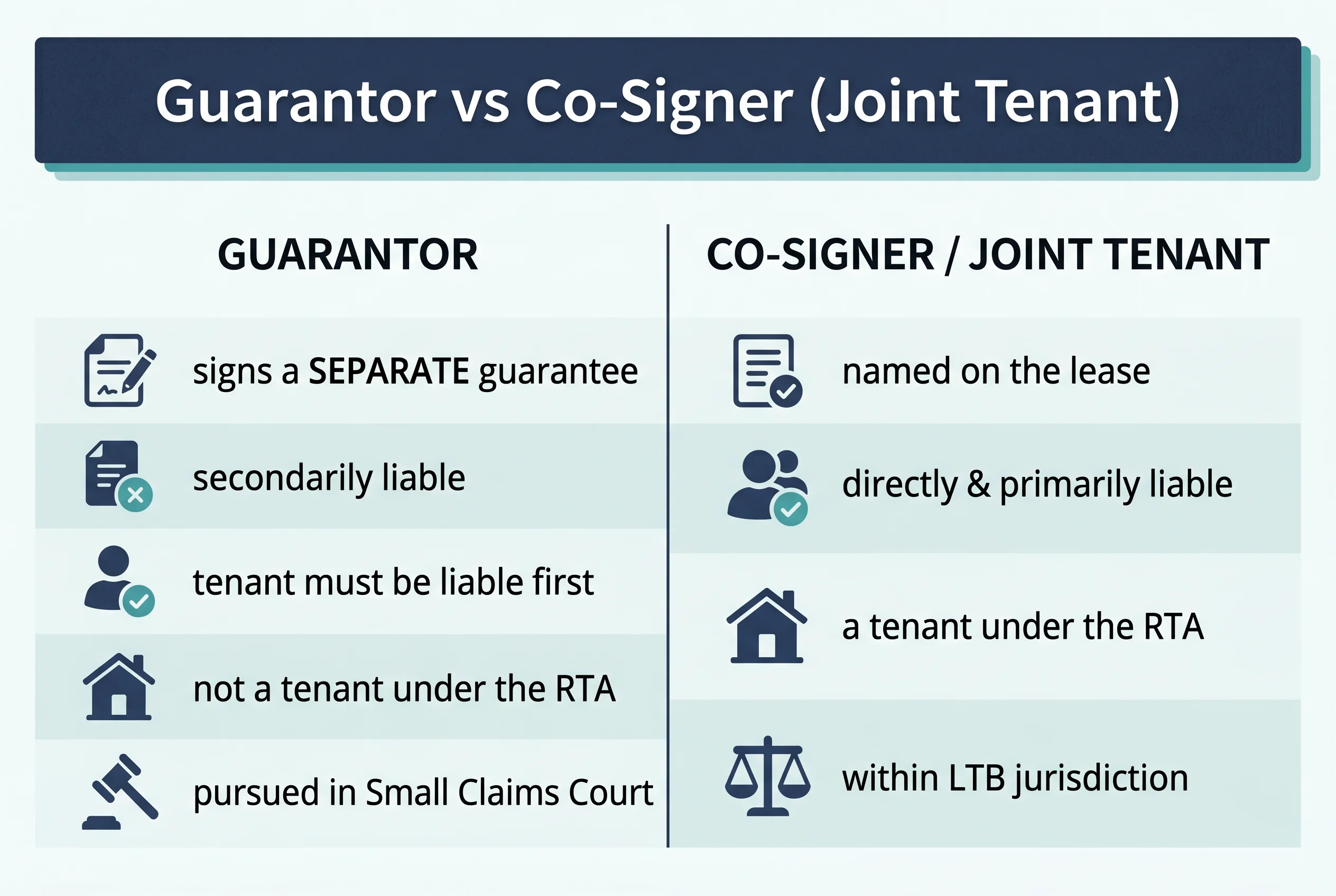
A guarantor is a third party who signs a separate agreement promising to cover the tenant's financial obligations — unpaid rent, damage costs, related costs — if the tenant defaults. Crucially, a guarantor is generally not a "tenant" under the Residential Tenancies Act and doesn't live in the unit. Their role is purely financial security.
That's where the most useful distinction comes in. "Guarantor" and "co-signer" get used interchangeably in everyday conversation, but they can mean different things in practice. A true guarantor signs a separate guarantee and is secondarily liable — the tenant has to be found liable first. A person added as a joint tenant on the lease (often what people mean by "co-signer") is directly and primarily liable as a tenant, and falls within the LTB's jurisdiction like any other tenant. Those are two very different legal positions, so decide which one you actually want and draft for it.
Guarantees are one of the five categories of information a landlord is permitted to consider when screening, under Ontario Regulation 290/98. But unlike most screening tools, they're governed less by the RTA and more by contract law, the Human Rights Code, and case law. In practice, a guarantor is most useful for applicants with a thin credit file or limited income — often students, newcomers, and first-time renters — usually backed by a family member or close friend in a strong financial position.
Writing a Guarantee That Actually Holds
If you take one practical thing from this guide, make it this: use a separate, written guarantee agreement. Don't just add the guarantor's name to the Ontario Standard Lease and hope it sticks. A proper guarantee clearly defines its scope (rent, damages, and related costs) and its duration.
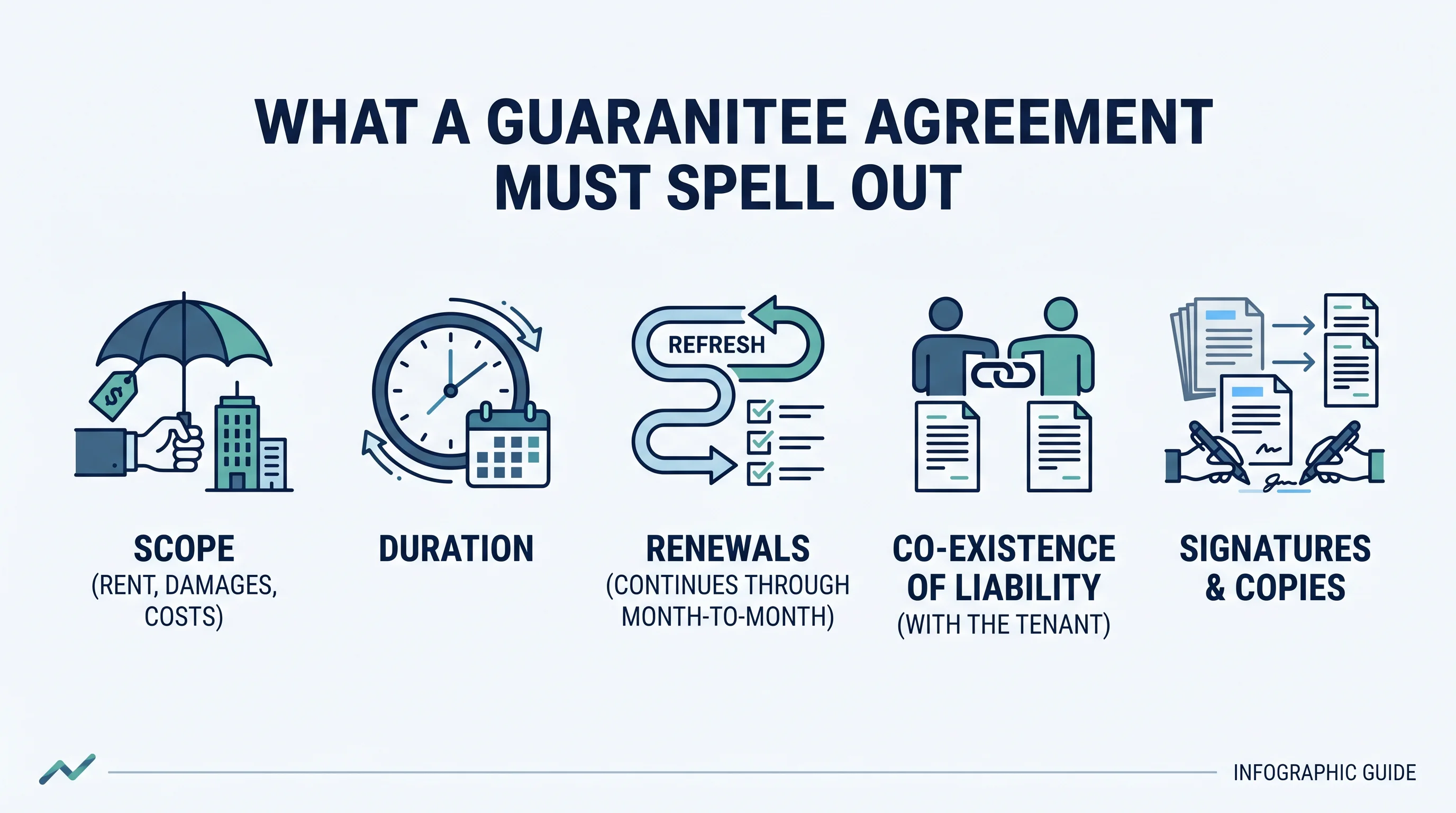
And here's the trap that quietly voids more guarantees than anything else — the statutory-renewal gap. In Ontario, a fixed-term lease automatically converts to month-to-month when the term ends. Courts may treat that converted tenancy as a "statutory renewal" — a new liability the original guarantee may not automatically cover. To keep the guarantee alive for as long as the tenant occupies the unit, the agreement needs express, unambiguous wording that the guarantor's liability continues through all renewals and extensions, whether by agreement or by operation of law. A guarantee that stops at the original term can leave you exposed exactly when you need it.
Two more essentials. State plainly that the guarantor's liability co-exists with the tenant's — if the wording doesn't say so clearly, that co-existence isn't presumed, and the claim can fail. And get the guarantor to sign the separate guarantee, keeping copies for the landlord, tenant, and guarantor.
Screening the Guarantor
A guarantee is only as good as the person standing behind it. So screen the guarantor as seriously as you'd screen the tenant — verify their income, employment, and credit history to confirm they could actually cover the obligation if it ever came to that.
Use the same toolkit you'd use on an applicant: written consent for a credit check (a soft inquiry that doesn't dent their score), income documents — and for a self-employed guarantor, the Notice of Assessment and T1, read for the trend rather than one month — plus references.

Some landlords set a higher income bar for the guarantor than the tenant — for example, an income around 80 times monthly rent versus 40 times. Treat that as a common market practice, not a legal rule, and keep in mind that in Ontario you assess the tenant on the whole file, not a rigid rent-to-income ratio.
One more thing: a guarantor supplements screening, it doesn't replace it. Still run your normal checks on the applicant — a guarantee strengthens a borderline file, it doesn't excuse skipping diligence on the tenant who'll actually be living there.
Enforcing It (and Staying Onside the Code)
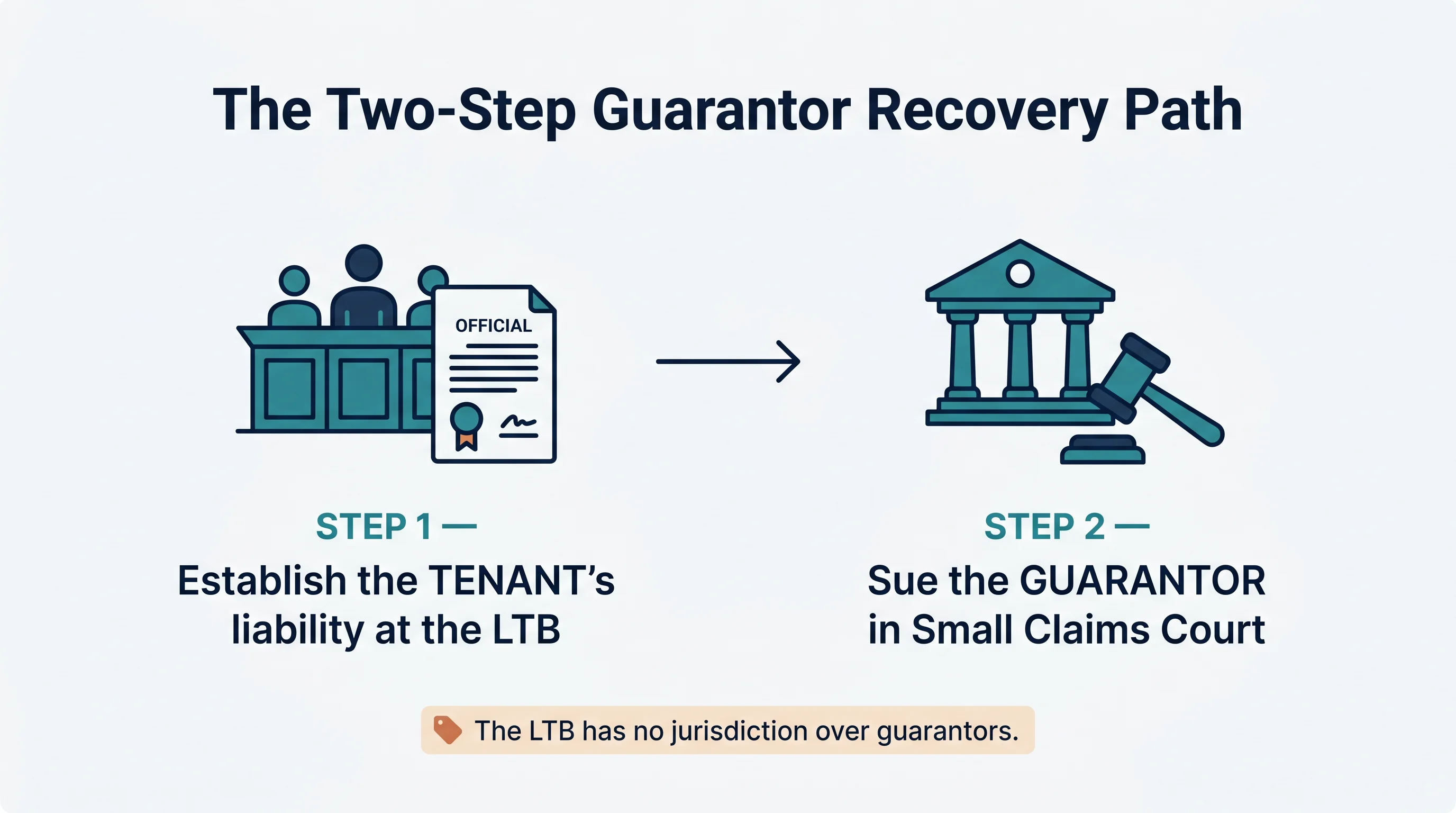
Now the part that surprises people. The LTB has no jurisdiction over a guarantor. Because a guarantor isn't a "tenant" under the RTA, the Board simply can't make an order against them — a point Ontario courts have confirmed (in Stamm Investments, citing the earlier Manbauhar decision). So recovery runs through two doors, in order:
- Establish the tenant's liability first — at the LTB, for rent arrears or damages, via an order (or the tenant otherwise being found liable).
- Then sue the guarantor in Small Claims Court (or Superior Court above the limit) to enforce the separate guarantee contract.
The guarantor's liability is secondary, which is why the order matters: skip step one, and a claim against the guarantor generally fails, because the tenant has to be liable before the guarantee is triggered.
There's a helpful 2026 update on the second step. Since October 1, 2025, Small Claims Court and the LTB both handle monetary claims up to $50,000 (raised from $35,000 under O. Reg. 42/25) — so more guarantor claims now fit within Small Claims; above that figure, you're in Superior Court. Just remember a judgment isn't the same as payment: collecting can still mean garnishing wages or a bank account, so build that into your expectations.
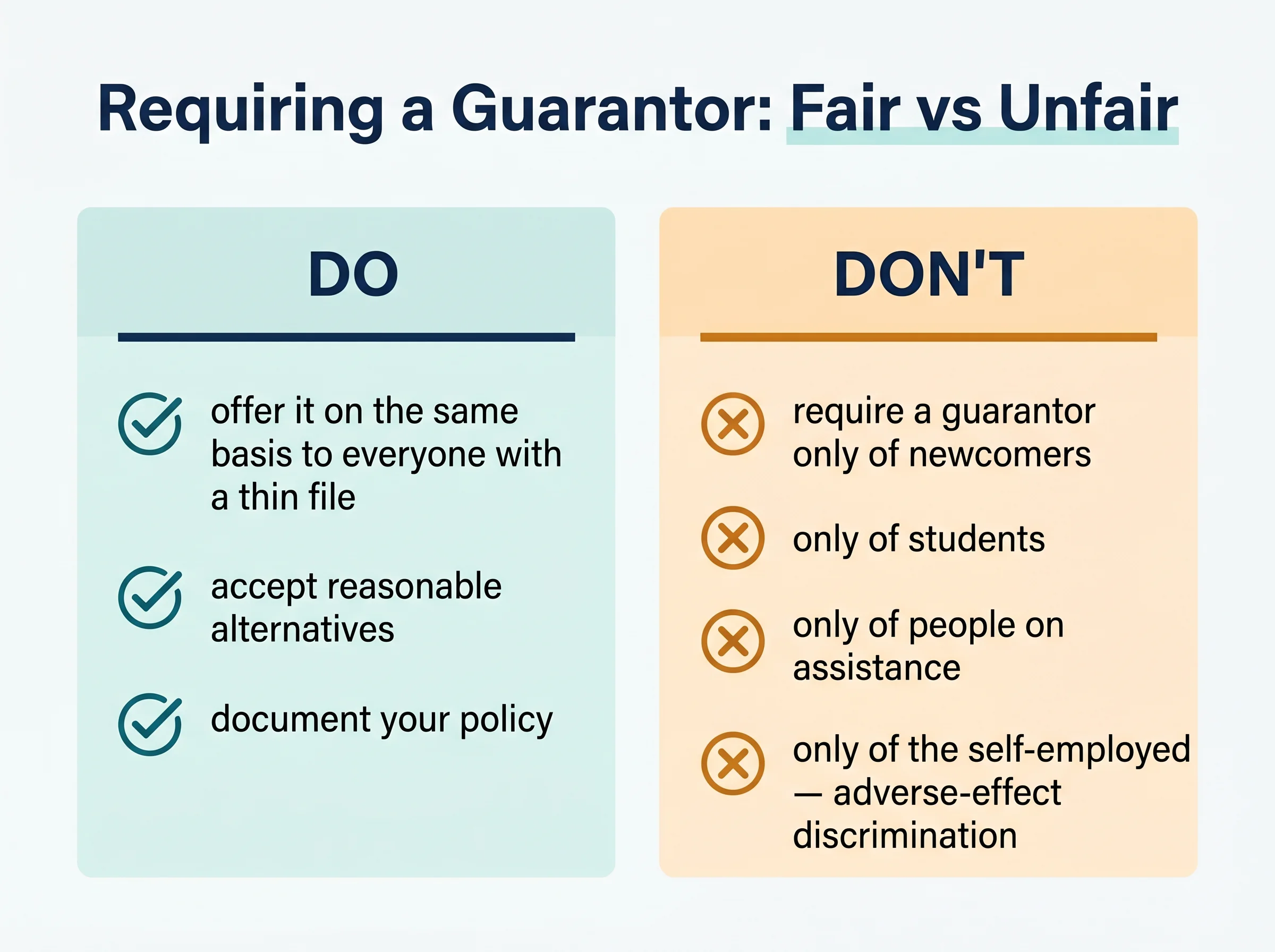
Finally, the line you can't cross. You're allowed to ask for a guarantor — but you cannot require one only from certain groups. Demanding a guarantor only of newcomers, students, social-assistance recipients, or self-employed applicants is adverse-effect discrimination, because place of origin, age, receipt of public assistance, and source of income are all protected grounds. Offer the guarantor option on the same basis to everyone whose file genuinely needs strengthening, accept reasonable alternatives (extra references, proof of a payment history, a rental tradeline), and document your policy.
And don't use a guarantee to bend other rules: it doesn't let you take an extra deposit or charge an illegal fee. Deposits stay capped at last month's rent plus a key deposit, guarantor or not.
Key Takeaways
A guarantee is real security when it's done right. The essentials:
- Offer a guarantor on the same basis to everyone whose file needs strengthening — never require one only of a protected group.
- Use a separate, written guarantee (not just a name on the lease) defining scope, duration, and renewals.
- Include express language continuing the guarantee through month-to-month and statutory renewals.
- State the guarantor's liability co-exists with the tenant's; get it signed; keep copies for all parties.
- Screen the guarantor like a tenant — consent-based credit check, income and employment verification, references.
- Know the path: establish the tenant's liability at the LTB first, then sue the guarantor in Small Claims (up to $50,000) or Superior Court.
- Don't use a guarantee to take an extra deposit or charge a fee; have the wording reviewed by a paralegal or lawyer.
The quick win is a properly drafted separate guarantee template. The long game is a consistent, documented guarantor policy applied to everyone — which is also your best protection if a decision is ever questioned. For the full lawful flow this fits inside, read the tenant screening pillar, and pair it with the red-flags guide.
The Guarantor Agreement & Screening Checklist
The write-it-right items, the screening toolkit, and the two-step enforcement path — keep it by your desk while you screen.
Get Free PDF →Conclusion
A guarantor can turn a borderline applicant into a safe one — but only if you set it up right. Use a separate written guarantee that covers renewals, screen the guarantor as carefully as the tenant, and know the recovery path runs through the LTB (for the tenant) and then Small Claims Court (for the guarantor), not the LTB alone.
Offered consistently and drafted properly, a guarantee is genuine security and a fair way to say yes to good tenants with thin files. Build (or have reviewed) a proper separate guarantee, apply your policy to everyone, and you've turned a common source of risk into a reliable backstop.
Reminder: this is general information, not legal advice. To draft or review a guarantee, or for a specific situation, consult a licensed paralegal or lawyer; for discrimination questions, contact the Ontario Human Rights Commission.
Screen the tenant and the guarantor — the same way, every time
Tenon10 screens tenant and guarantor with one consistent process, stores the signed guarantee with the file, and keeps the paper trail that protects you.
Free to start • Built for Ontario landlords
Frequently Asked Questions
Does the LTB have jurisdiction over a guarantor?
No. A guarantor isn't a "tenant" under the RTA, so the Landlord and Tenant Board can't order them to pay. You establish the tenant's liability at the LTB, then sue the guarantor in Small Claims Court on the separate guarantee.
Can a landlord require a guarantor in Ontario?
You can ask for one, but you can't require a guarantor only from certain groups (newcomers, students, people on assistance, the self-employed) — that's adverse-effect discrimination. Offer it on the same basis to everyone whose file needs strengthening.
What's the difference between a guarantor and a co-signer?
A guarantor is secondarily liable on a separate guarantee (the tenant must be liable first). A co-signer added as a joint tenant is directly liable as a tenant. The terms get used interchangeably, so draft for the outcome you want.
Does a guarantee continue when the lease goes month-to-month?
Not automatically. A fixed term converting to month-to-month can be treated as a "statutory renewal" the original guarantee may not cover — unless the agreement expressly continues through renewals and extensions.
What should a guarantor agreement include?
A separate written document defining the scope (rent, damages, costs), the duration (including renewals), a statement that the guarantor's liability co-exists with the tenant's, and the guarantor's signature — ideally reviewed by a paralegal or lawyer.
Related Resources
- How to Screen Tenants in Ontario: A Landlord's Complete Guide
- Credit Checks for Ontario Landlords: How to Run One Legally
- Income Verification for Self-Employed Tenants: A Landlord's Guide
- Reference Check Questions That Actually Work: A Landlord's Guide
- Fixed-Term Leases in Ontario: Why They All Convert to Month-to-Month