You've found a new place, you're excited to go — and then a small paperwork mistake costs you a whole extra month's rent on a unit you've already left. That's the trap with the N9 notice in Ontario. The form itself is short and simple, but the timing is where renters get caught, and email or a quick text to your landlord doesn't count as notice at all.
Here's the part most people miss: Ontario's rule isn't just "give 60 days." It's 60 days and your move-out date has to land on the last day of a rental period — two rules working together. This guide walks you through all of it in plain language: what the N9 is, exactly how much notice you owe for your type of tenancy, how to calculate your termination date with real dated examples, how to serve it so it actually counts, and two little-known shortcuts that can let you leave sooner. We'll go in four parts — what the N9 is, the date math, how to fill it out and serve it, and the special situations and rights that are on your side.
Moving Out in Ontario? Your N9 Notice Checklist
A free step-by-step checklist that helps you calculate the correct termination date, serve your N9 properly, and avoid paying an extra month's rent.
Get Free PDF →What the N9 Is and When You Need It
Form N9, the "Tenant's Notice to End the Tenancy," is the official Landlord and Tenant Board (LTB) form you use to end your own tenancy in writing, under the Residential Tenancies Act, 2006. It's the tenant's counterpart to the landlord's notices — your way of formally saying when you'll be moving out.
A few things are worth knowing right away. You don't have to give a reason for leaving. It has to be a proper written notice — an email, a text, or a verbal heads-up doesn't count. And you should always keep a signed, dated copy for yourself.
You'll use the N9 in three main situations: ending a month-to-month tenancy, leaving at the end of a fixed term, or in a couple of special early-exit situations we'll cover later. One reassuring point for renters worried about a fixed-term lease: at the end of the term it doesn't simply expire and force you out — in Ontario, a fixed term lease Ontario automatically continues month-to-month, so you stay until you choose to give a valid N9 (or the landlord lawfully ends it).
Why does precision matter so much right now? The market has softened — national average asking rent slipped to around $2,123 after roughly a year of decline, and Ontario vacancy is forecast near 3–5%. There's more choice for movers than there's been in years. But a mistimed N9 still costs real money, and because new tenants often pay more than long-settled ones (the so-called "moving penalty"), leaving a unit you've held a while deserves a clean, deliberate exit.
How Much Notice You Owe (and How to Calculate Your Termination Date)
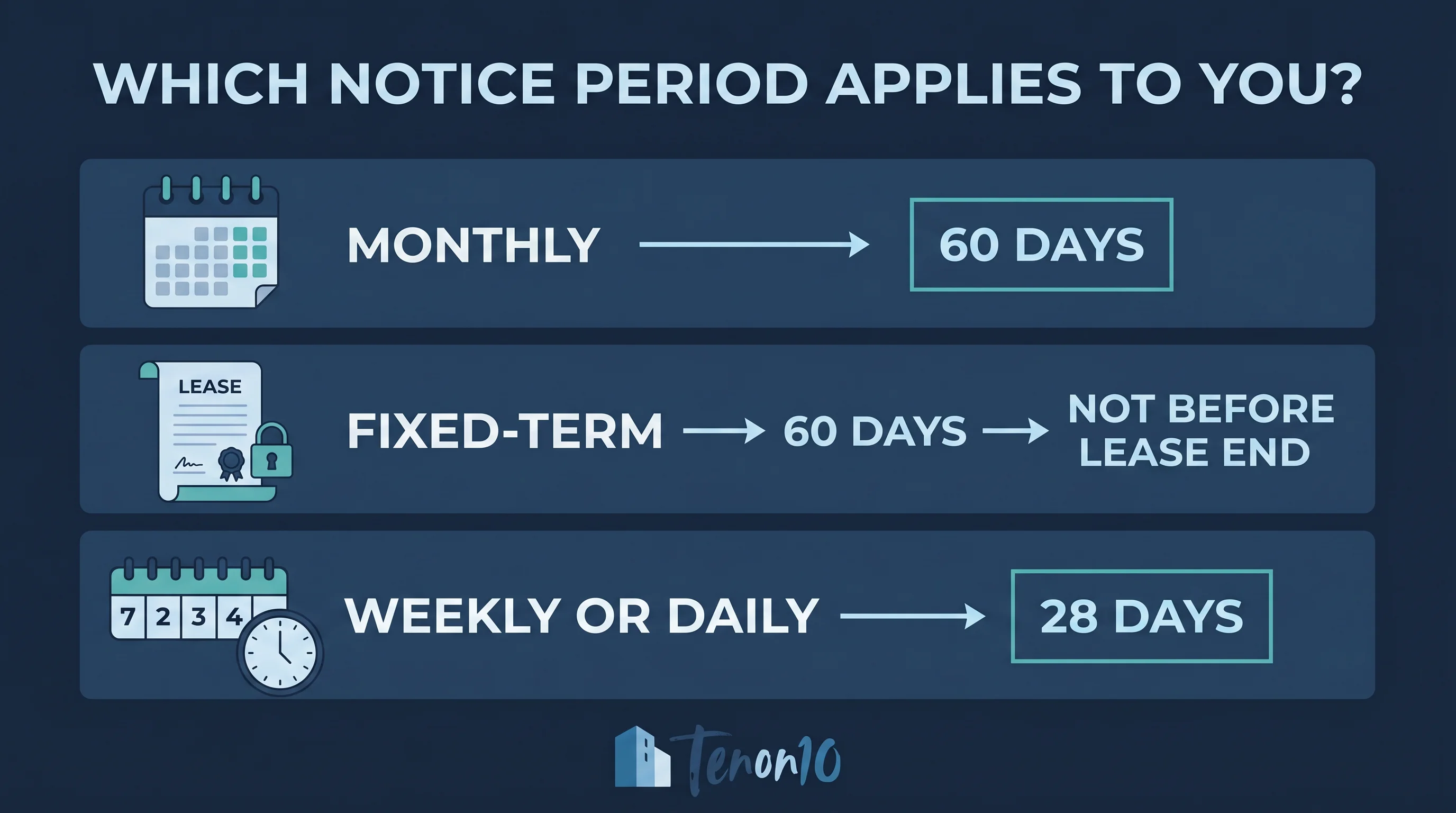
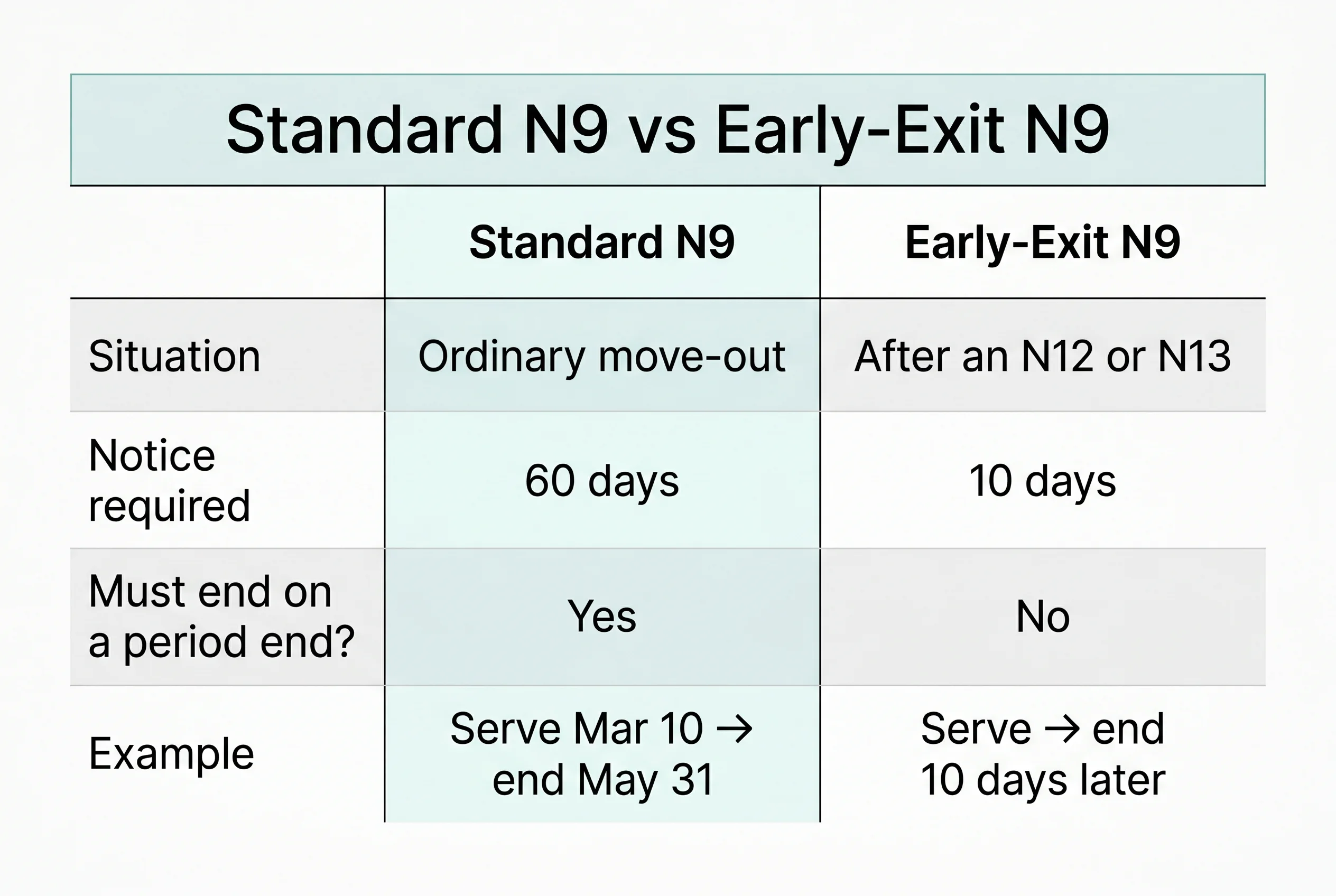
This is the heart of it, so let's be precise. For a monthly tenancy, two rules apply together: you must give at least 60 days' notice, AND your termination date must be the last day of a rental period. It is not simply "60 days from today."
Here's how it breaks down by tenancy type:
- Monthly: at least 60 days, ending on the last day of a rental period.
- Fixed-term: at least 60 days, and the end date can't be before the last day of the term.
- Weekly or daily: at least 28 days, ending on the last day of the rental week.
- Mailing it? Add 5 days to your timeline.
Now the part competitors skip — actual dated examples:
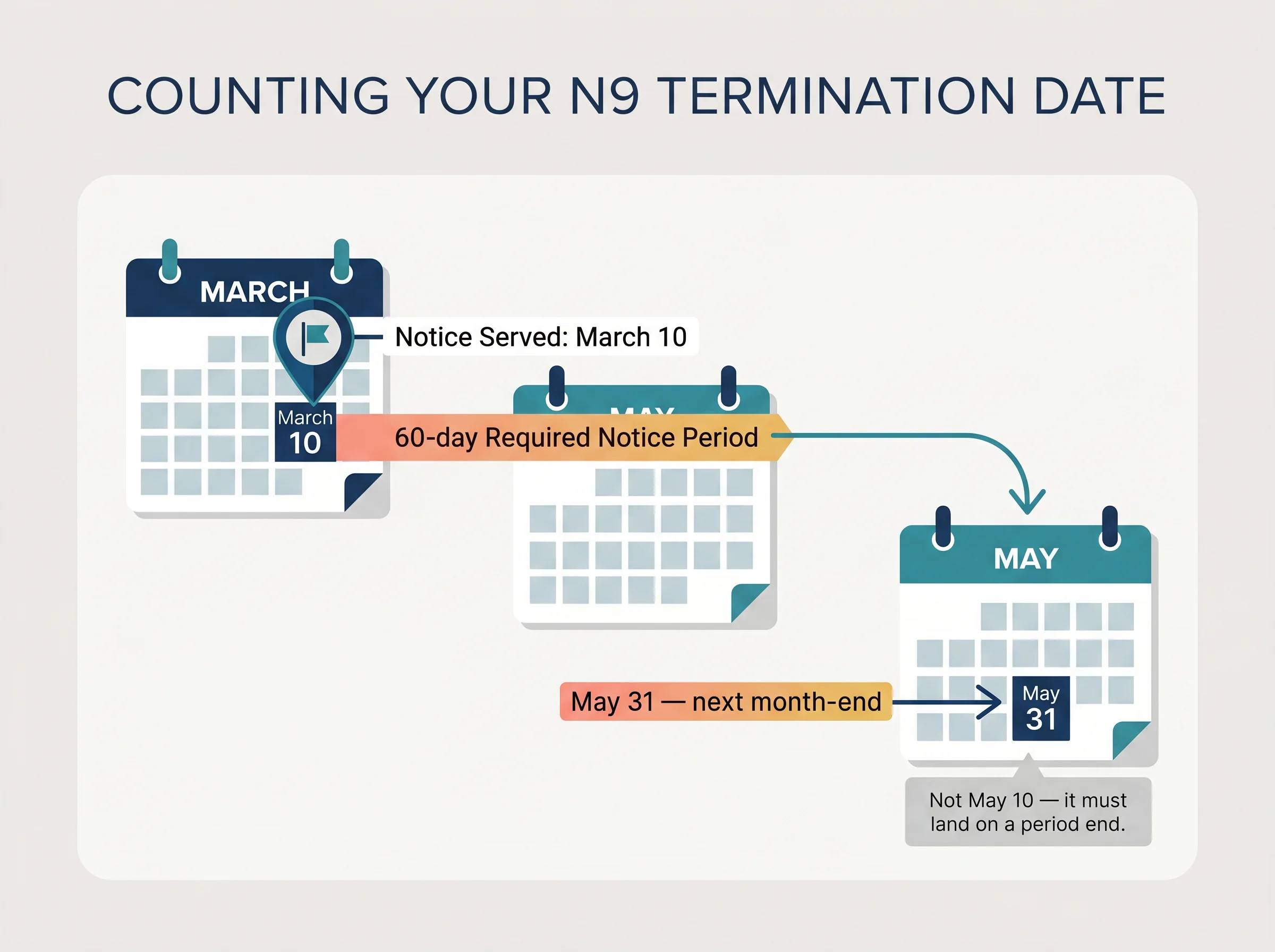
- Your rent is due on the 1st and you hand your landlord the notice on March 10. Sixty days lands in mid-May, but your earliest lawful termination date is May 31 — the next end-of-period — not May 10.
- Your fixed term ends August 31. The earliest you can give notice is July 1, with an August 31 termination date.
- You mail the notice instead of handing it over: the 5-day rule pushes your effective start date back, so count accordingly.
As paralegals who handle these disputes put it, getting the notice period right is essentially everything: mistime it and you can end up owing extra rent or missing your intended move date. If the math feels fiddly, that's normal — it trips up plenty of people.
Check your date in seconds: Plug your details into the Ontario Termination Date Calculator before you write anything down — it applies the 60-day-plus-period-end rule for you.
How to Fill It Out, Serve It, and Avoid Costly Mistakes
Filling out the N9 is straightforward. Enter the full legal names of every tenant on the lease (not just yours, if it's a joint tenancy), the complete unit address including unit number or basement/floor and postal code, your calculated termination date, and your signature and the date. Keep a copy.
Serving it is where care pays off. Use a method that creates proof: hand delivery with a signed receipt, registered mail, or tracked courier. Email, text, and verbal notice are not valid. Complete a Certificate of Service the moment you deliver it, noting how and when.

Why all the fuss about proof? Because disputes over whether the landlord actually received the notice are a leading reason tenants get billed beyond their move-out date. A receipt or tracking number is your protection if the date is ever questioned.
A few myths worth clearing up while you're at it. "Thirty days is enough" — no, monthly tenancies need 60. "I can leave exactly 60 days later" — not if that date isn't a period-end. "I can cancel if I change my mind" — generally no; once you give valid notice, the landlord has to agree to call it off. And "my last-month's-rent deposit covers my final month, so I don't need to give notice" — also no; the deposit isn't a substitute for an N9.
What happens after you serve it? Your tenancy ends on the termination date. If you were to overstay, the landlord can apply to the LTB (an L3 application) for an order — but you don't have to leave before your date, and no one can lock you out or force you out without that order.
Special Situations and Your Rights
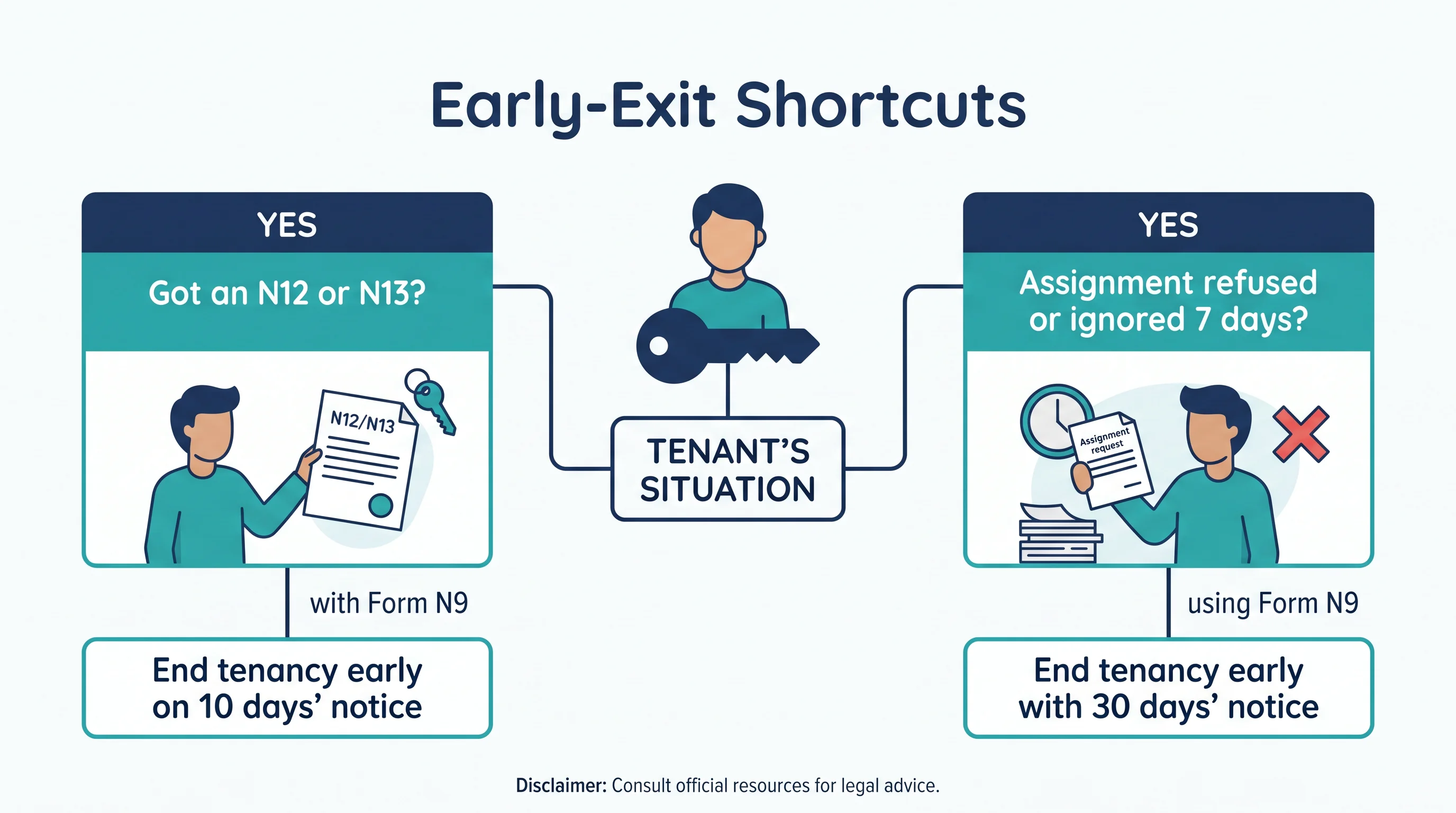
Two lesser-known shortcuts can let you leave sooner than the standard 60 days.
You received an N12 or N13. If your landlord serves an N12 notice Ontario (for their own, a purchaser's, or a family member's use) or an N13 (for demolition, conversion, or major repairs), you don't have to wait around for their date. You can respond with an N9 giving as little as 10 days' notice, and that date doesn't have to be a period-end — so you move on your timeline, not theirs.
Your assignment was blocked. If you ask to assign your unit and the landlord refuses or doesn't respond within 7 days, you can end the tenancy early with an N9 on 30 days' notice — but you have to give it within 30 days of your request.
You also have real protections. An N9 — or an N11 agreement to end — that you were required to sign as a condition of renting is not valid (the main exception is student residences). And under the RTA's security-of-tenure rules, a landlord can't end your tenancy just by asking; you stay until you give valid notice, you both agree, or the landlord lawfully ends it for a permitted reason. If you want to know more about where landlords overstep, our guide on what landlords cannot do in Ontario is a good companion read.
On the 2026 front: earlier proposed changes to how fixed-term leases end were walked back after pushback, so the standard 60-day N9 rules described here remain in force. You can track the broader picture in our overview of Ontario rental law changes 2026.
Moving Out in Ontario? Your N9 Notice Checklist
A free step-by-step checklist that helps you calculate the correct termination date, serve your N9 properly, and avoid paying an extra month's rent.
Get Free PDF →Key Takeaways: Before You Hand In Your N9
Run through this quick checklist:
- Identify your tenancy type to set the right notice length — 60 days for monthly or fixed-term, 28 for weekly/daily.
- Calculate the termination date: count 60 days, then move to the next period-end; add 5 days if you're mailing it.
- Fill in all tenants' full legal names and the complete unit address.
- Serve it properly — in person (get a receipt), registered mail, or courier; never email or text.
- Complete a Certificate of Service and keep a signed, dated copy.
- Special cases: got an N12/N13? You can give just 10 days' notice. Assignment blocked? 30 days' notice, given within 30 days of your request.
- Plan to actually move out by your termination date — you can't cancel unless the landlord agrees.
The quick win is a correct date plus proof of service. The longer-term payoff is a documented, drama-free exit that protects your rental history and your deposit. For the official details, the LTB's N9 form and its tenant brochure are worth a look.
Conclusion
The N9 is your cleanest exit as a tenant — but it only works if the timing is right. Sixty days for a monthly tenancy, landing on the last day of a rental period; proper written service you can prove; and a copy you keep for yourself. Get those right and your move is smooth and final.
And remember what's on your side: you don't need to give a reason, no one can lock you out, you have shortcuts if you've been served an N12/N13 or your assignment was blocked, and a notice you were forced to sign as a condition of renting simply isn't valid. Confirm your tenancy type, calculate your date, fill out the N9, and serve it with proof — that's the whole job.
This article is general information, not legal advice. Rules can change and every situation is different — for help with yours, contact the Landlord and Tenant Board at 1-888-332-3234 or a community legal clinic.
Give notice the right way the first time
Calculate your termination date, fill out your N9, and serve it with proof — all in one place.
Free • No signup required • Built for Ontario tenants
Frequently Asked Questions
How much notice do I have to give my landlord in Ontario?
For a monthly tenancy, at least 60 days — and your move-out date must be the last day of a rental period. Weekly or daily tenancies need 28 days.
Can I give notice today and leave in exactly 60 days?
Usually not. The termination date has to fall on the last day of a rental period, so your actual move-out date is often a bit more than 60 days away.
Can I end my fixed-term lease early with an N9?
Generally no. You can't end a fixed term before its last day unless the landlord agrees, or you use the assignment or sublet rules.
Does email or a text message count as notice?
No. The N9 must be a proper written notice, served in person, by mail (add 5 days), or by courier — keep proof of delivery.
Can I cancel my N9 after I've given it?
No. Once you give valid notice, you're held to it unless the landlord agrees to cancel — so line up your next place before you hand it in.