

Every rent payment you collect is taxable income, and every legitimate expense you can document is money back in your pocket — but only if your books can prove both. That's the whole case for bookkeeping for landlords: the difference between a rental that runs like a business and one that costs you at tax time usually comes down to how well you keep your records.
Most landlords start with a shoebox of receipts and a vague sense of what's deductible. Then a CRA review asks for support they don't have, or they discover too late that the "repair" they wrote off was really a capital improvement. Good books prevent both. This complete guide shows you how to set up a simple system, what records to keep and for how long, which expenses are deductible, the two tax traps that catch landlords most often, how HST really works on rent, and how it all rolls into your T776 at year-end.
One note before we start: the bookkeeping and tax rules here are federal (CRA) rules that apply across Canada — the Ontario context is your world as a landlord, but the tax substance is national. And this is general information, not tax advice — for your situation, especially the judgment calls, see a CPA.
The Rental Bookkeeping Starter Kit & Year-End Checklist
Set up clean books, capture every deduction, avoid the two big tax traps, and roll it all into your T776 — on one printable page.
Get Free PDF →Why Bookkeeping Is the Backbone of a Rental
Start with the fact that shapes everything else: all rental income is taxable, and it all counts. Cash, cheque, e-transfer, payment in kind, or services — plus "other income" like separately-billed parking, laundry, or utilities — every dollar your property brings in gets reported. There's no version of rent that quietly stays off the books.
Records are your audit defence. The CRA can ask to see them, and if you can't support an expense with a receipt or document, it can be disallowed. Clean books turn a scary letter into a routine filing exercise. Beyond the CRA, good books do two more jobs: they show you your real cash flow (are you actually making money, or just moving it around?), and they support financing and portfolio decisions when you want to grow.
It's also worth knowing which kind of income you earn. Most landlords earn income from property — you rent space and provide basic services like heat, light, parking, and laundry. Provide extra services like cleaning, security, or meals, and the CRA may treat it as income from a business, which is reported differently. For the typical Ontario landlord renting out a unit or two, it's property income — but if you're running something closer to a hospitality operation, that line matters, and it's worth a word with an accountant.
Setting Up Your System (and the 6-Year Rule)
If you do only one thing after reading this, do this: open a separate bank account (and card) for the rental. Mixing personal and rental money is the single most common bookkeeping mistake, and it's the fastest way to turn a routine review into a nightmare of untangling which coffee was a leasing meeting and which was Saturday morning. A dedicated account means your statements are most of your bookkeeping.
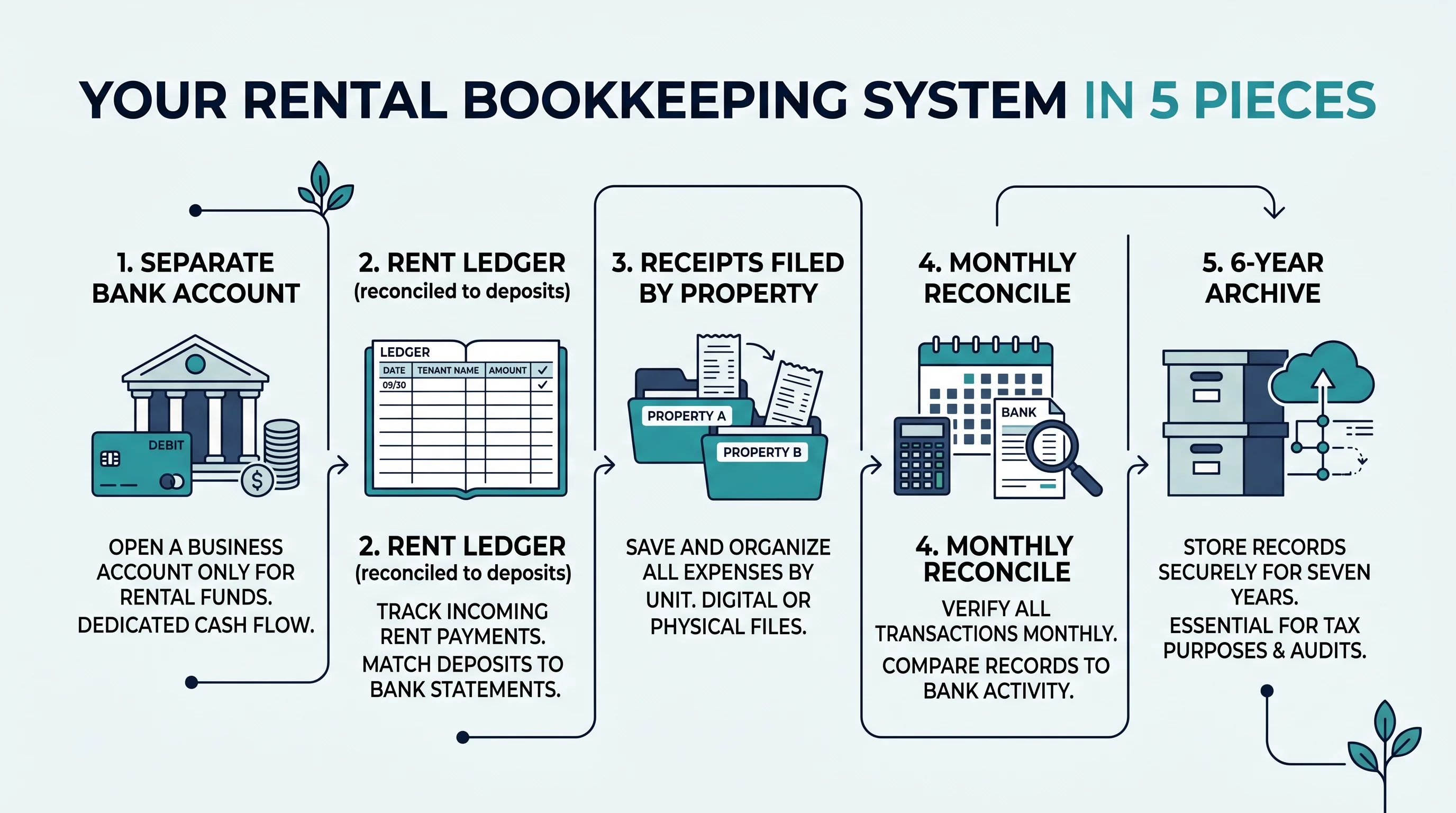
From there, keep the records that support your return: the lease; a rent ledger (rent by month, reconciled to deposits); receipts and invoices for every expense; proof of payment; bank and mortgage statements; property tax bills; condo or maintenance-fee statements; renovation and capital receipts; insurance policies; a mileage log; and short-term-rental or HST records if they apply. Keep a separate folder per property and a simple dated repairs log — the CRA likes simple, consistent methods.
How long do you keep all this? Generally six years from the end of the tax year the records relate to. Keep capital records even longer — the documents that establish a property's cost should be held until six years after you sell, because you'll need them to calculate your capital gain (and any CCA recapture) down the road.
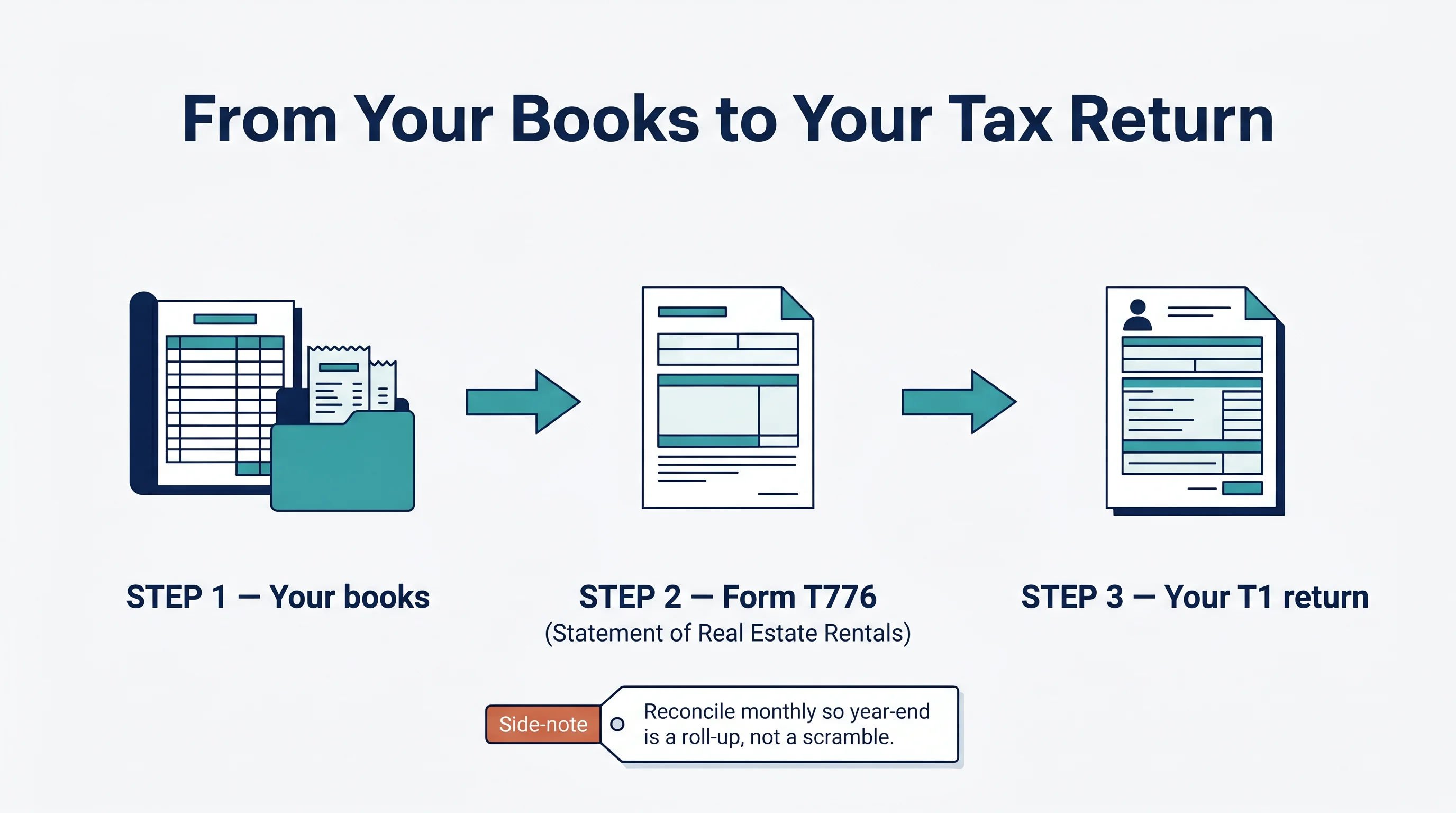
Most individual landlords use the simpler cash method — record income when you receive it and expenses when you pay them — rather than accrual. Either way, just be consistent year to year. As for tools, match them to your portfolio: a spreadsheet is perfectly fine for one or two units; accounting software like QuickBooks or Wave adds automation and reports; and purpose-built property-management software tracks rent and expenses and generates year-end summaries. Whatever you use, reconcile monthly — match your rent ledger to your bank deposits, tick off your e-transfers — so year-end is a roll-up, not a scramble.
Tracking Income and Expenses on the T776
Everything you track lands in one place: Form T776, the Statement of Real Estate Rentals, filed with your personal T1 return. Rentals have a December 31 year-end and your T1 is generally due April 30. The trick that makes year-end painless is to set your bookkeeping categories up to match the form from the start — then filing is mostly copying totals across.
On the income side, the form separates gross rents, other income (payment in kind, recorded at fair market value), and short-term rents. On the expense side, the CRA lists the categories you'll deduct from: advertising; insurance; interest and bank charges; office expenses; professional fees (legal and accounting); management fees; repairs and maintenance; property taxes; utilities; travel; motor vehicle; condo fees; landscaping and snow removal; and more. Map your spending to these buckets as you go.
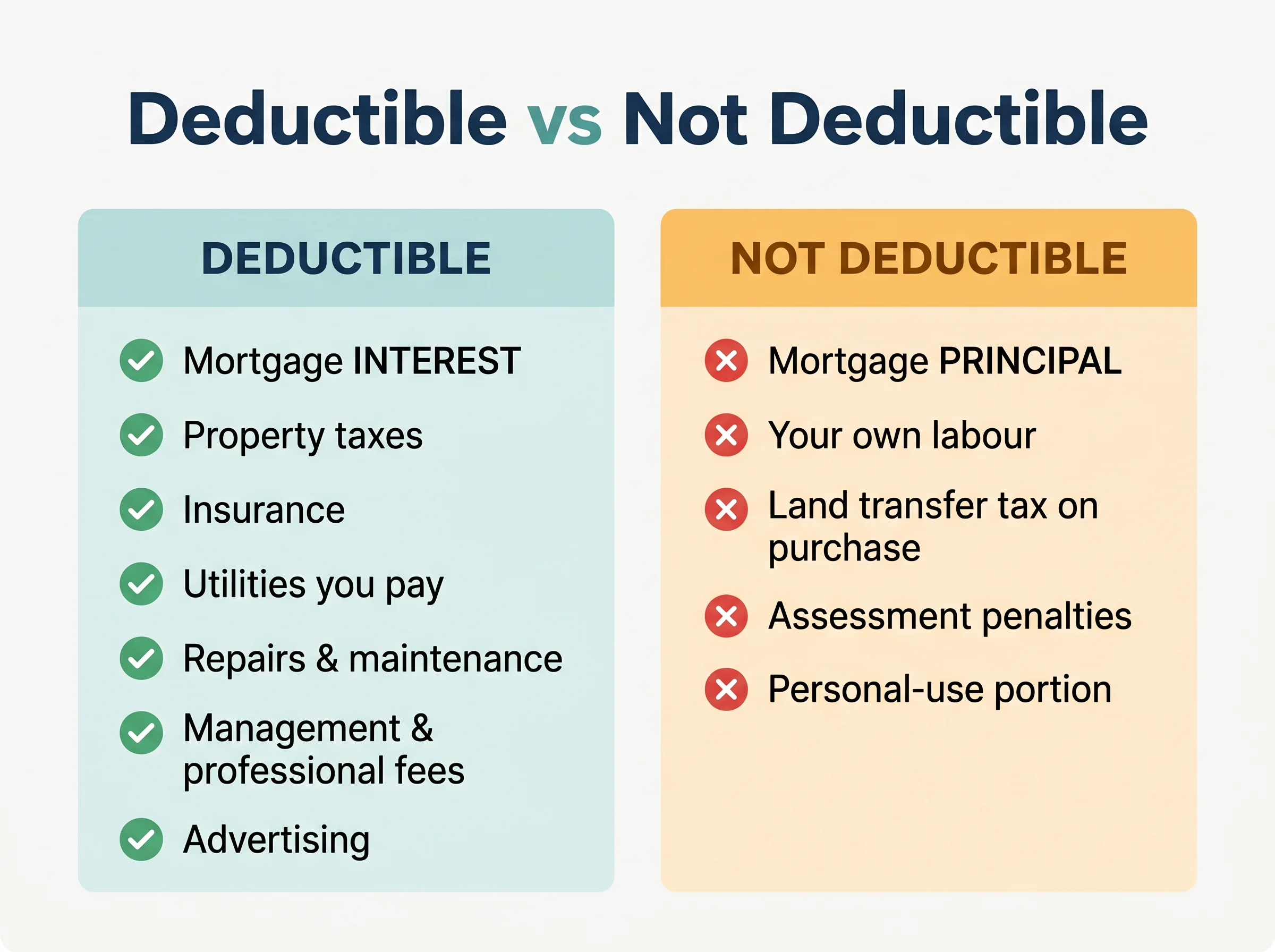
The quiet traps are on the non-deductible side. You can deduct mortgage interest, but never the principal portion of your payment. You can't deduct the value of your own labour — your Saturday spent painting isn't an expense. Land transfer tax paid on purchase isn't a current deduction (it's added to the property's cost). Neither are penalties on a notice of assessment. And you can't deduct the personal-use portion of any shared cost.
That personal-use split matters if you rent part of your own home — a basement, or a few rooms. Only the rental-use share of shared costs (utilities, property tax, insurance) is deductible. Allocate by area or room count, apply the same method consistently, and keep a simple sketch or measurements to back it up. The CRA's own example has an owner renting 3 of 12 rooms and claiming a quarter of the shared costs — clean, consistent, defensible.

The Two Tax Traps: Current-vs-Capital and CCA
Two areas catch more landlords than anything else. Get them right and the rest of your bookkeeping is mostly clerical.
Trap #1: current versus capital. A current expense is recurring and restores something to its original condition — repainting, fixing a leak, a minor repair. It's generally deductible in full the year you pay it. A capital expense provides a lasting benefit, or upgrades, improves, or extends the life of the property — a new roof, a kitchen renovation, an addition. It isn't deducted all at once; it's added to the building's cost and claimed over time through CCA. The rule of thumb: restores to original condition is a repair (current); upgrades or improves is capital.
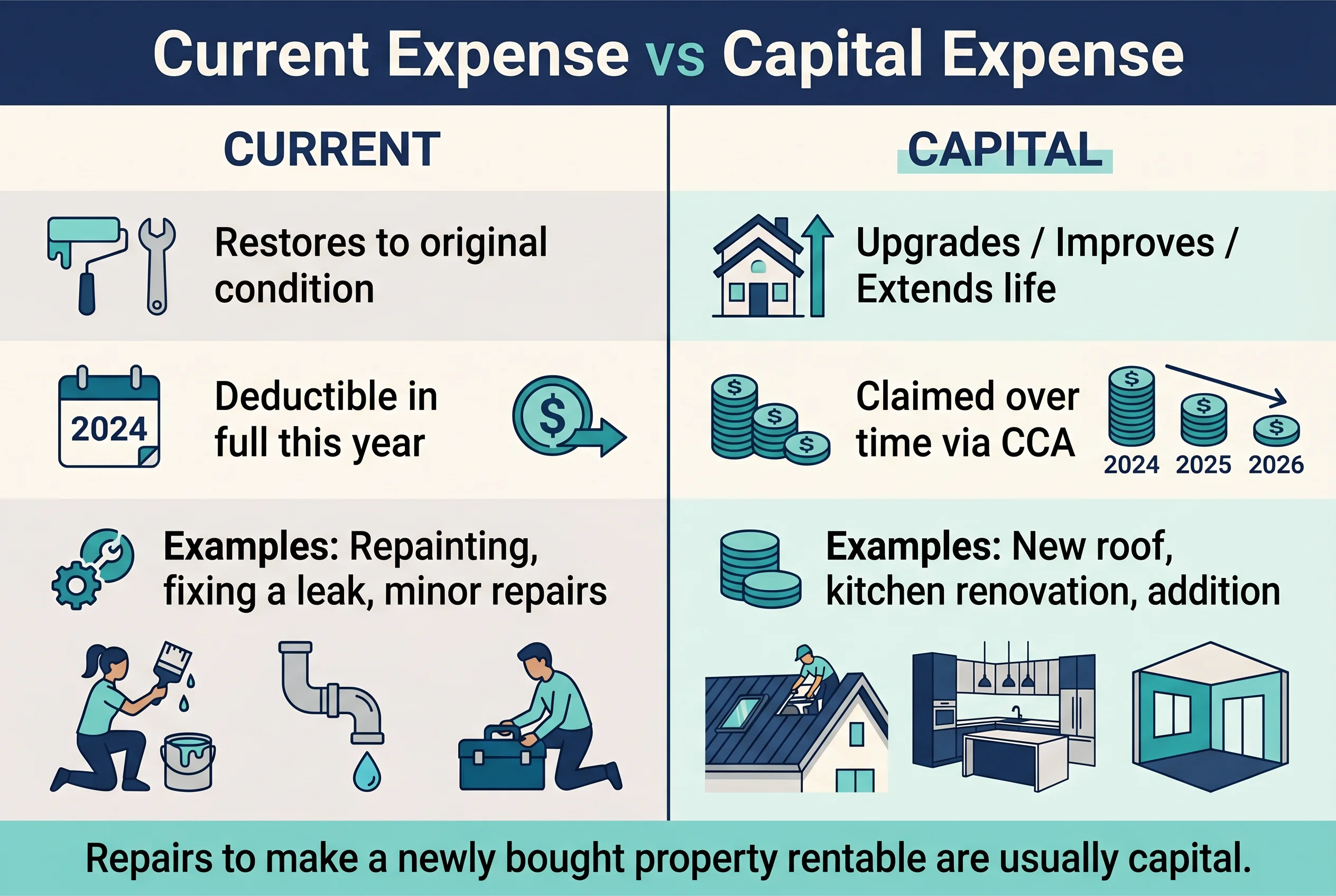
There's a sub-trap that surprises new investors: repairs made to put a just-purchased property into rentable condition are treated as capital — even if the identical work would be a current expense a year later. Fixing up a place you've owned and rented for years is usually a repair; fixing up a place you bought last month to get it rentable is usually capital. Misclassifying capital as current is one of the top CRA audit triggers for rentals, so when a cost is a judgment call — a furnace replacement can go either way depending on the facts, while a full kitchen reno is almost always capital — document what you did and why, and ask a CPA if it's material.
Trap #2: CCA (Capital Cost Allowance). This is optional depreciation on the building portion of your property (land isn't depreciable). A few things to know before you claim it. You can claim any amount from zero up to the maximum — you don't have to take it. The half-year rule limits your claim in the year you acquire. And CCA can't create or increase a rental loss — you can only claim it down to net rental income of zero.
HST, and Turning Books into a Tax Return
Here's the HST rule most landlords get wrong. Long-term residential rent — continuous occupancy of one month or more as a residence — is GST/HST-exempt. You don't charge HST on rent. But "exempt" is not the same as "zero-rated": because your rental income is exempt, you also cannot claim input tax credits on your expenses. The HST you pay on repairs, management fees, and supplies is simply a cost you deduct — you report those expenses HST-included on the T776. Landlords who assume residential rent is "tax-free" and try to claim the HST back on their expenses have it wrong.
Short-term rentals are a different world. Continuous stays under one month are generally a taxable supply; cross $30,000 in taxable revenue over four consecutive quarters and you must register for and charge HST. And since 2023, non-compliant short-term rentals — those without the municipal permit or registration where it's required — can lose their expense deductions. Compliance there isn't just admin; it has real tax consequences.
One fresh development worth watching if you're building or buying: the 2026 Ontario Budget, tabled in March 2026, proposed temporary relief from the 8% provincial part of HST on new rental housing, with federal rebate regulations now available. That pairs with the existing GST/HST New Residential Rental Property (NRRP) rebate, which lets landlords of newly built or substantially renovated rental housing recover some of the tax on the purchase even though the rent itself is exempt. These are exactly the kind of new-build questions to take to an accountant.
Pull it together and the payoff is obvious. If you've kept a separate account, logged income, filed receipts by property, and reconciled monthly, then year-end is a roll-up into the T776 — not a shoebox scramble in April. The system is the point: it does the work quietly all year so filing is almost anticlimactic. Our T776 guide walks through the filing itself line by line.
Key Takeaways
Good landlord bookkeeping comes down to a handful of habits:
- Open a separate bank account and card for the rental — never mix personal and rental money.
- Log every rent payment and reconcile to deposits monthly; report all income, including in-kind, parking, and laundry.
- Keep every receipt, invoice, and statement; file by property; keep a dated repairs log.
- Map expenses to the T776 categories; deduct only the rental-use portion of shared costs.
- Separate current (deduct now) from capital (claimed via CCA) — and treat "make it rentable" repairs on a new purchase as capital.
- Don't deduct the non-deductibles: mortgage principal, your own labour, land transfer tax, assessment penalties.
- Keep records six years from the end of the tax year — longer for capital records (six years after you sell).
The quick win is opening the separate account and starting a rent ledger today. The long game is a monthly-reconciled system that treats the rental like the business it is. For the neighbouring pieces, see the T776 filing guide and, if you're just starting out, becoming a landlord in Ontario.
The Rental Bookkeeping Starter Kit & Year-End Checklist
The system setup, the deductions, the two tax traps, and the HST rules — a printable page to keep by your desk all year.
Get Free PDF →Conclusion
Good landlord bookkeeping isn't complicated: a separate account, consistent records kept for six years, expenses mapped to the T776, the current-vs-capital line drawn correctly, a deliberate CCA decision, and a clear read on HST. Get those right and your rental runs like a business instead of a source of April anxiety.
You don't need to be an accountant to do this. A simple system, kept up monthly, does most of the work and protects you if the CRA ever asks. Set up the separate account and ledger this week, and the hardest part is already behind you.
Reminder: this is general information, not tax advice. Bookkeeping and tax rules here are federal (CRA) and apply Canada-wide. For your situation — and especially for CCA, HST, and current-vs-capital judgment calls — consult a CPA or tax professional.
Keep clean books without the shoebox
Tenon10 logs your rent, tracks expenses by category, and keeps a clean, exportable record you can hand straight to your accountant at year-end.
Free to start • Built for Canadian landlords
Frequently Asked Questions
How long do landlords have to keep records in Canada?
Generally six years from the end of the tax year the records relate to. Keep records that establish a property's cost (for capital gains and CCA) longer — until six years after you sell.
What expenses can a landlord deduct?
Reasonable costs to earn rental income: advertising, insurance, mortgage interest, property taxes, utilities you pay, repairs and maintenance, management and professional fees, and more. You can't deduct mortgage principal, the value of your own labour, or the personal-use portion of shared costs.
What's the difference between a current and a capital expense?
A current expense restores something to its original condition (a repair) and is deductible now. A capital expense upgrades or improves the property and is claimed over time through CCA. Repairs to make a newly bought property rentable are usually capital.
Do I charge HST on rent in Ontario?
Not on long-term residential rent — it's GST/HST-exempt (one month or more of continuous occupancy). Because it's exempt (not zero-rated), you also can't claim input tax credits on your expenses. Short-term rentals are different and can be taxable.
Should I claim CCA on my rental?
Maybe — it lowers your tax now, but it can trigger a taxable "recapture" when you sell and can affect the principal-residence exemption. It's optional, and it's a decision worth running past a CPA.


