

Roughly 35% of Ontario renters have no tenant insurance, according to a 2025 LowestRates.ca survey — and among renters who do have a policy, nearly half only bought one because their landlord required it. Both groups tend to be working from the wrong facts. Ask five people whether tenant insurance is mandatory in Ontario and you'll hear five confident answers: "It's the law." "It's not the law." "Your landlord can't force you." "You'll be evicted without it." Each of those is partly true — and each is incomplete in a way that can cost you real money, or in rare cases, your tenancy.
This guide gives you the precise answer. You'll learn exactly what Ontario law requires (spoiler: nothing) versus what your lease can require (quite a lot, within one important limit), what tenant insurance actually covers for roughly $25 a month, what really happens at the Landlord and Tenant Board when a tenant skips a required policy — including four real cases — and how to buy smart in 2026's softer rental market. This is general information, not legal or insurance advice; for your specific situation, speak with a licensed paralegal, lawyer, or insurance broker.
The Ontario Tenant Insurance Checklist: 18 Steps to Get Covered and Stay Protected
Know exactly what your lease can legally require, get properly insured for about $25/month, and learn the 7-day move that protects your tenancy if you ever slip. Free tenant-first PDF.
Get Free PDF →What the Law Actually Says: Required vs. Requirable
Start with the clean legal fact: no Ontario statute requires you to carry tenant insurance. It isn't in the Residential Tenancies Act, 2006 (RTA), it isn't in any municipal bylaw, and there's no provincial insurance mandate for renters the way there is for drivers. If your lease is silent on insurance, you are under no legal obligation to buy any.
But that's only half the answer. The Ontario Standard Lease — the mandatory form for most tenancies signed since April 2018 — contains a dedicated spot for this. Section 11 is where you and your landlord agree whether you must carry liability insurance during the tenancy. If that section (or a properly drafted custom clause) requires it and you signed, the requirement is binding. And if your landlord asks for proof of coverage, you have to provide it.
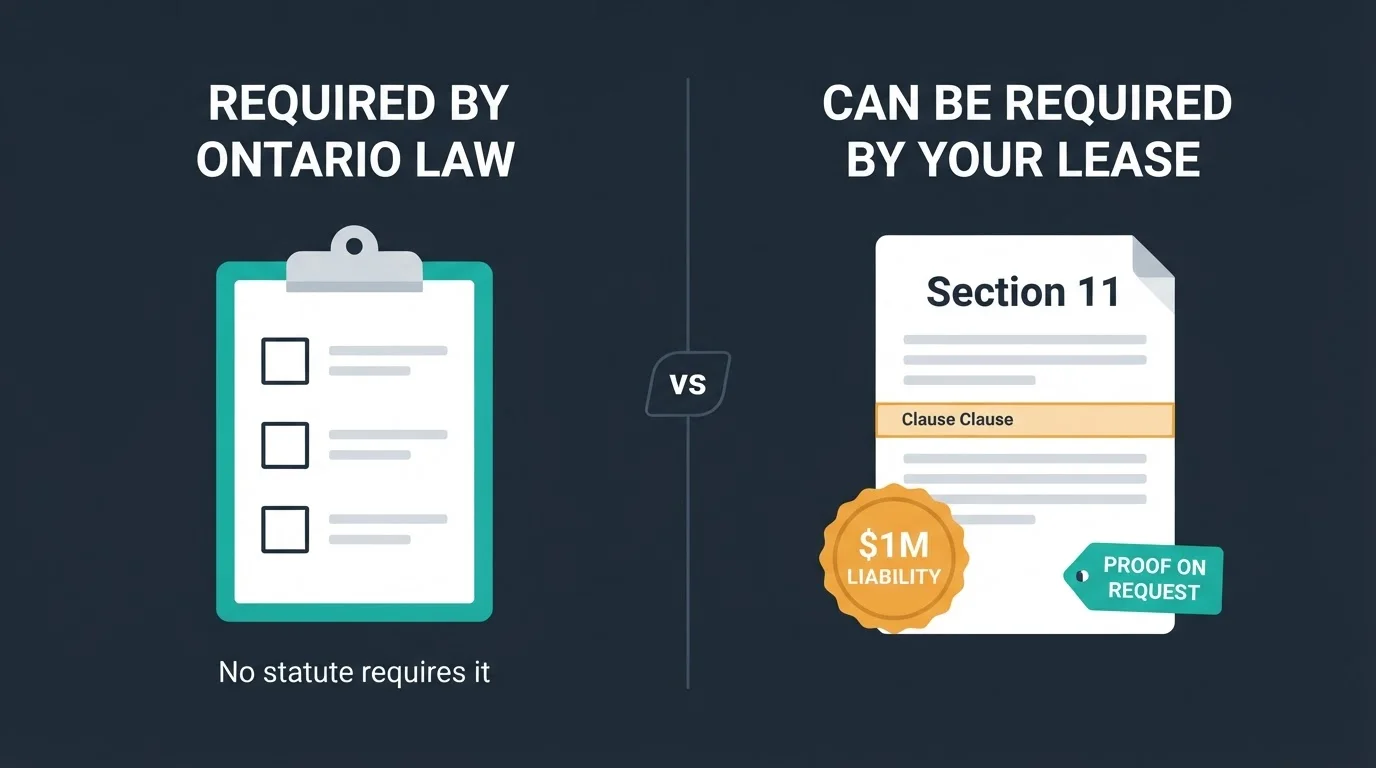
There is, however, a line landlords cannot cross: a landlord can require liability coverage, but cannot require contents insurance. Whether you insure your own belongings is always your choice. You may see websites claiming Ontario landlords can't require insurance at all — that's a myth. The requirement is enforceable when it's in the lease you agreed to, and Ontario's Divisional Court has confirmed as much (more on the cases below). What's true is narrower: the requirement must be consensual, and it can only reach liability coverage.
That "consensual" part matters in one more way. A landlord can't unilaterally impose an insurance requirement after you've moved in. If it wasn't in the lease you signed and you never agreed to it at a renewal, it doesn't bind you. If you're unsure whether a clause in your agreement holds up generally, our guide to common Ontario lease mistakes that void terms walks through how to tell enforceable terms from empty ones.
In practice, insurance clauses are now close to standard. Professionally managed buildings typically require a minimum of $1 million in liability coverage and routinely ask for a certificate of insurance naming the landlord or property manager. Surveys consistently find that 44–49% of insured renters got their policy because the lease demanded it — which means the clause, not the law, is doing most of the work in Ontario.
What Tenant Insurance Actually Covers (and What It Doesn't)
The single most expensive misconception in this topic: "my landlord's insurance covers me." It doesn't. Your landlord's policy covers the building — the structure, the systems, the landlord's own property. It does not cover your belongings, your legal liability, or your hotel bill if a fire puts you on the street. In one national study, about one in six renters believed the landlord's policy protected their possessions; insurers report it's the most common reason renters go without coverage.
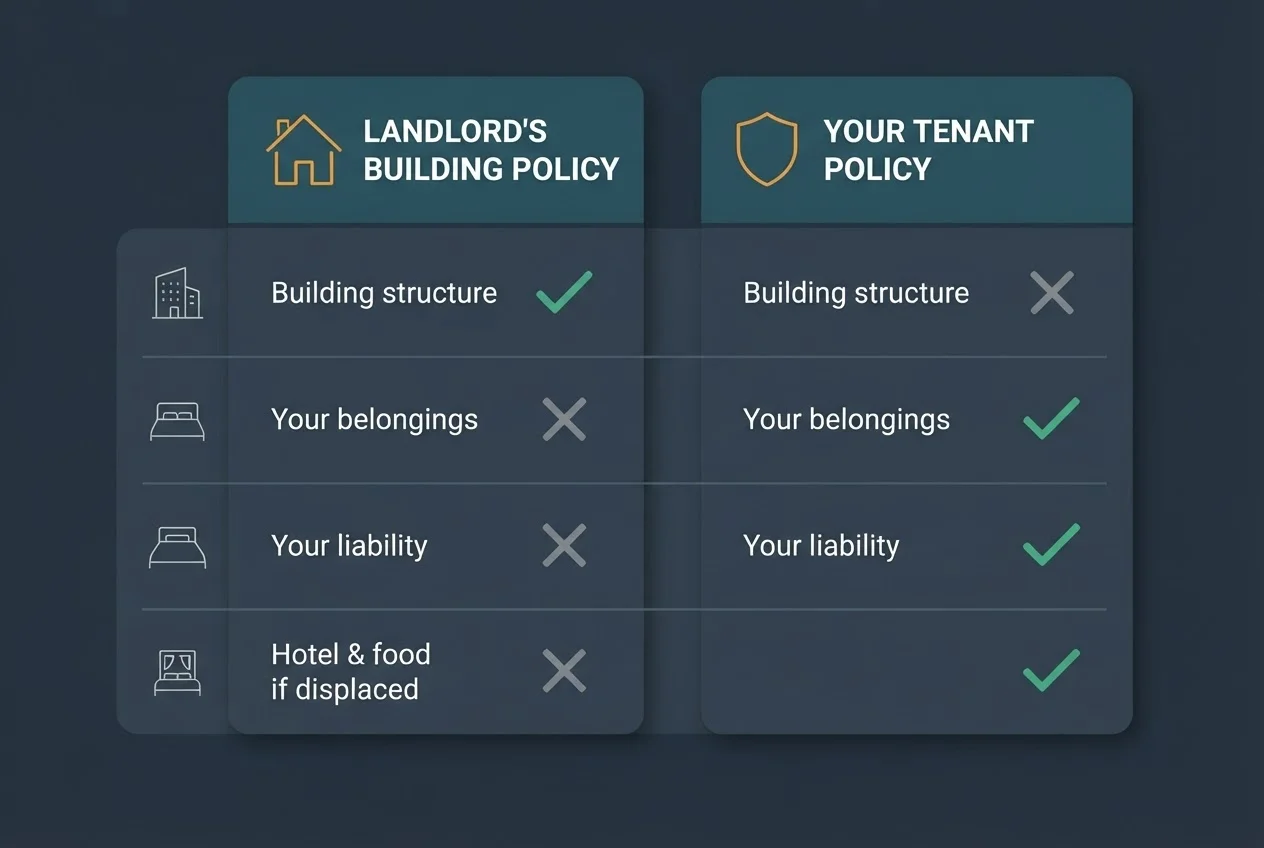
A standard tenant policy has three pillars:
- Contents coverage — your furniture, electronics, clothing, and everything else you own, typically $25,000–$30,000 in a base policy. Most renters underestimate what they'd need: only about two in ten say they could replace all or most of their belongings out of pocket.
- Personal liability — usually $1 million. This is the pillar landlords care about and the one that can genuinely save you. If your bathtub overflows into the unit below or a guest is injured in your apartment, liability coverage handles the legal costs and compensation.
- Additional living expenses (ALE) — hotel, food, and related costs if a covered event makes your unit unlivable while repairs happen.
Now the price, because perception and reality are far apart. Surveyed renters guess tenant insurance costs around $664 a year in Ontario. The actual average is about $302 a year — roughly $25 a month — as of Q1 2026, with downtown Toronto only slightly above at ~$313. Entry-level policies start around $12–$16 a month. That's less than a dollar a day for all three pillars.
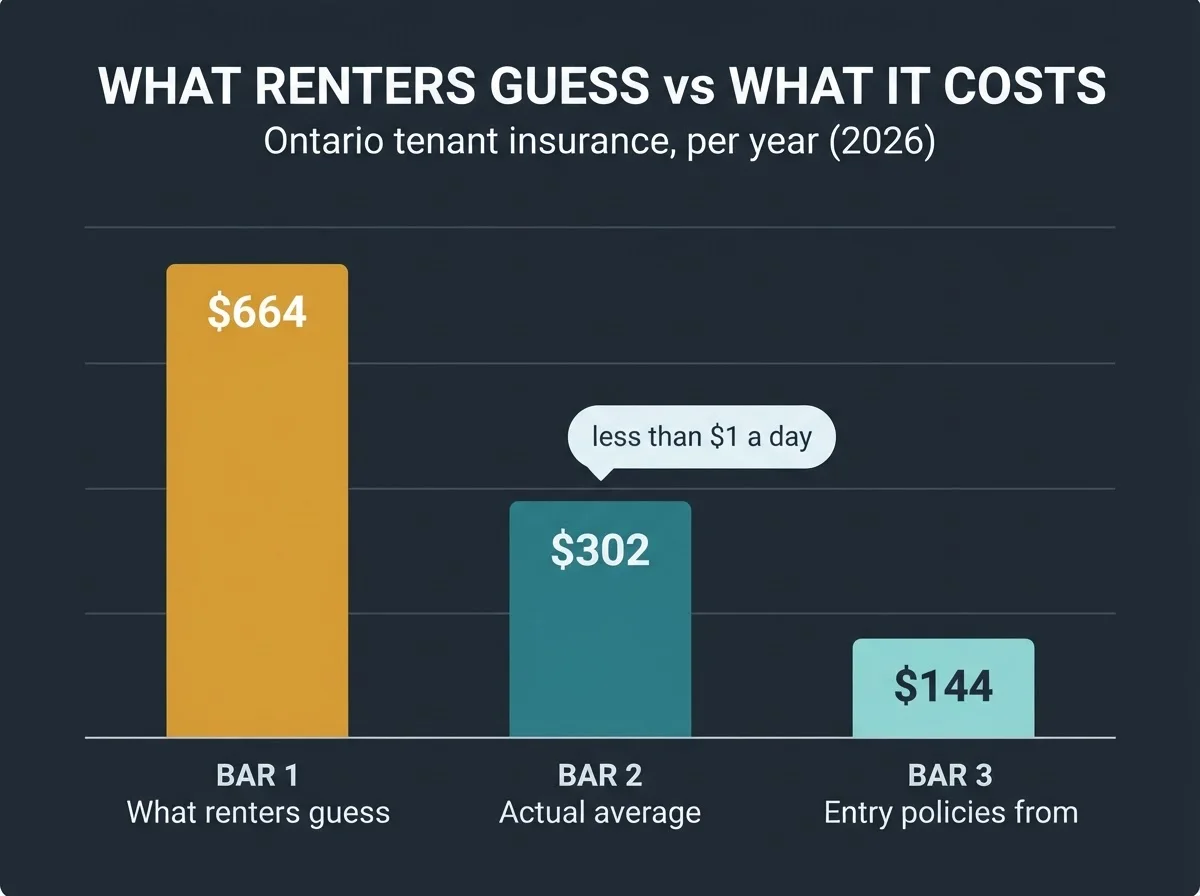
Where you live moves the number. GTA suburbs like Ajax, Markham, Milton, and Newmarket are among the cheapest in the province, while some northern communities pay up to 30% above the provincial average. Two Ontario-specific wrinkles are worth knowing regardless of your postal code:
- Sewer backup: many Ontario cities run aging combined sewers, and extreme-rain events — like the July 2024 storm that dumped over 100 mm on parts of the GTA — can push sewage back up into basements. A sewer-backup endorsement typically costs $5–$15 a month and is especially worth considering for basement apartments.
- The roommate trap: your roommate's policy does not cover you unless you are personally named on it. If you're not listed, you're uninsured — confirm in writing with the insurer, not just with your roommate.

If you're curious how this looks from the other side of the lease — what a landlord can ask for, and why so many now do — see our landlord-facing companion piece on what you can and can't add to the Ontario Standard Lease.
What Happens If You Don't Have It: The N5 Reality
Here's the part most insurance blogs skip and most legal blogs bury: what actually happens when a tenant whose lease requires insurance doesn't have it.
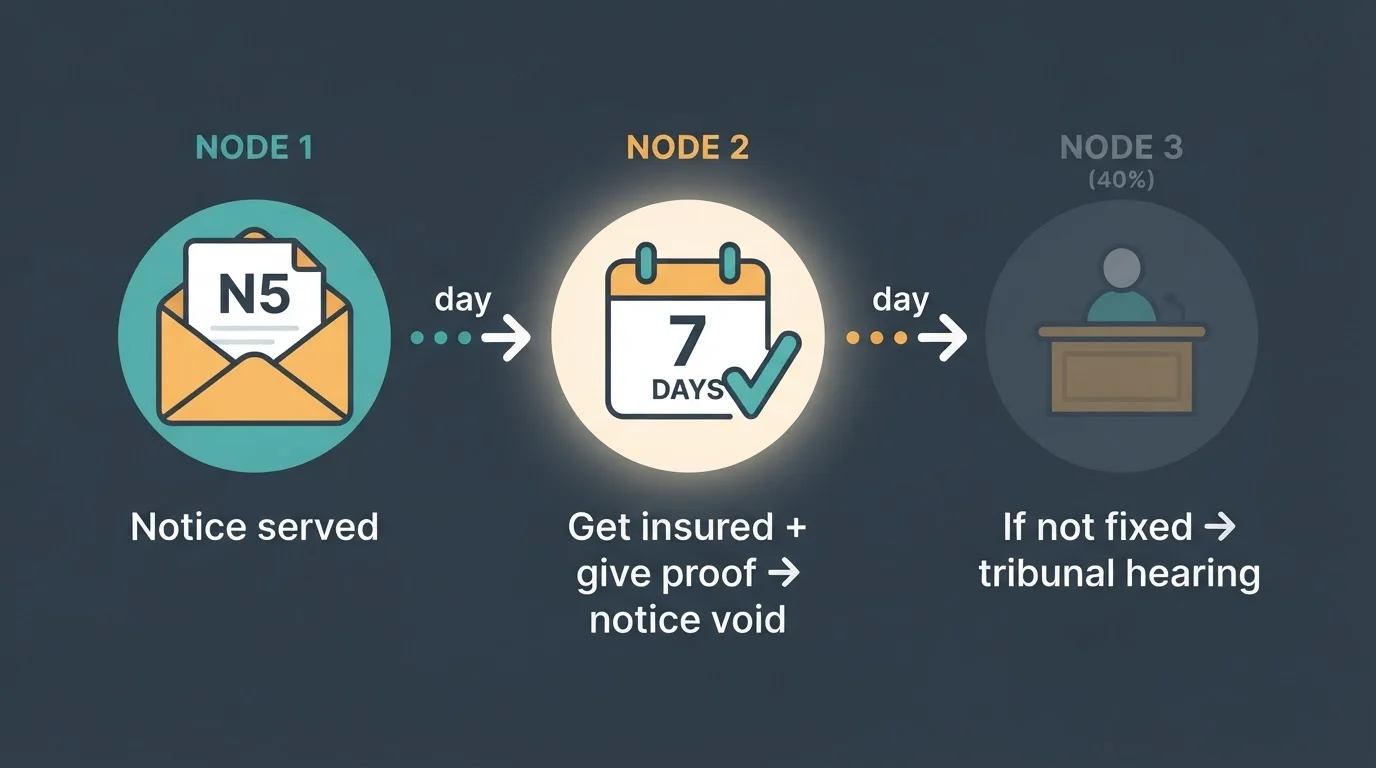
The landlord's route runs through the N5 notice — the RTA's "substantial interference" notice under section 64 — followed, if nothing changes, by an L2 application to the Landlord and Tenant Board. The legal foundation comes from Ontario's Divisional Court: in Stanbar Properties Ltd. v. Rooke (2005), a tenant refused on principle to provide proof of the liability insurance his lease required, and the court held that breaching a consensual lease term substantially interfered with the landlord's lawful rights. Morguard Residential v. Asboth (2017) reaffirmed the principle. In plain terms: the clause has teeth.
But the case law also shows the teeth don't always bite, and the pattern is instructive:
- Policy lapsed mid-tenancy → eviction. In a 2017 Toronto case (TSL-85766-17), the landlord learned the tenant's policy had been cancelled, served an N5, and the Board ordered eviction. The lesson isn't about buying insurance — it's about keeping it. A lapse is what sank this tenant.
- Proof delivered late → no eviction, small costs. In Terracorp Management v. Hamza (2022), the tenants produced proof of insurance after the landlord had already filed at the Board. Result: no eviction — just a $186 order covering the landlord's filing fee.
- Board unpersuaded → application dismissed. In a 2019 case (TEL-98422-19), the Board found the lack of insurance didn't rise to substantial interference and declined to evict. Outcomes genuinely vary by facts and adjudicator — which cuts both ways: don't count on a sympathetic member, and don't let anyone tell you eviction is automatic either.
The most important thing to take from all of this is the tenant's safety valve: a first N5 is curable. If you correct the problem within 7 days of receiving the notice, the notice is void. Since online policies can start the same day you buy them, the practical playbook is simple — get covered immediately, deliver written proof to your landlord, and keep dated evidence that you did. Our complete guide to N5 notices in Ontario covers the mechanics in detail.
One more scenario: what if the demand itself oversteps? If a landlord insists you buy contents coverage, or tries to impose an insurance requirement you never agreed to, respond in writing, citing your signed lease. If pressure escalates into harassment or threats, tenants have their own applications — the T2 application about tenant rights exists for exactly those situations. For a broader picture of the limits on landlord conduct, see 5 things your landlord can't do in Ontario. And never simply ignore a formal notice — get advice first.
Buying Smart in 2026
The 2026 market context works in your favour. Vacancy rates across Ontario's major cities are the highest they've been outside the pandemic in two decades, asking rents have softened, and CMHC expects conditions to stay renter-friendly into 2027. You have more room to ask questions before signing than renters did two years ago — but insurance clauses aren't going anywhere, so the smart move is to make the policy cheap and right-sized rather than fight it.
The efficient path looks like this:
- Compare at least three quotes online. It takes 10–15 minutes, and comparison shoppers save meaningfully — one major rate-comparison site reported average savings around $138.
- Bundle if you drive. Combining tenant and auto insurance commonly saves 10–25% across both policies — often enough to make the tenant policy nearly free.
- Set the deductible deliberately. A higher deductible lowers the premium, but only choose a number you could actually pay on a bad day.
- Right-size, don't minimum-size. Use your inventory video to set a realistic contents limit, and consider endorsements where they fit — sewer backup for basements and older buildings, scheduled coverage for high-value items like bikes or camera gear.
- Get the certificate. Ask your insurer for a certificate of insurance naming your landlord or property manager. It's routine, usually same-day, and it pre-empts the proof-of-insurance dance entirely.
- Protect the renewal. Set two reminders — 30 days out and day-of. Remember: the eviction case above wasn't about a tenant who never bought insurance; it was about a policy that lapsed.
Practical Takeaways
Everything above, compressed into the seven moves that matter:
- Read Section 11 before you sign. Know whether liability insurance is required and at what minimum (typically $1 million).
- Know the legal line. Liability coverage can be required; contents insurance never can. And a requirement added mid-tenancy without your agreement doesn't bind you.
- Get covered before move-in and request a certificate naming your landlord or property manager.
- Never let the policy lapse — calendar the renewal. A lapse, not a missing purchase, is the classic losing fact pattern at the LTB.
- Provide proof promptly when asked. Refusing on principle is exactly what lost the leading court case.
- Served an N5 over insurance? Buy a policy the same day, deliver written proof within 7 days, and keep dated evidence — that voids a first notice.
- Sharing with roommates? Confirm you're personally named on the policy, in writing from the insurer.
Quick wins are the same-day online policy and the auto bundle; the long game is an annual re-quote, an updated inventory video, and honestly sized limits. For deeper reference, the Ontario government's Standard Lease guide, Steps to Justice, and the LTB's own resources are the authoritative starting points.
The Ontario Tenant Insurance Checklist: 18 Steps to Get Covered and Stay Protected
Know exactly what your lease can legally require, get properly insured for about $25/month, and learn the 7-day move that protects your tenancy if you ever slip. Free tenant-first PDF.
Get Free PDF →The Bottom Line
Nothing in Ontario law forces you to buy tenant insurance. But a Section 11 clause you signed does — it's enforceable, the courts have said so, and the enforcement path runs through an N5 you can void by fixing the problem within 7 days. Meanwhile, the smart-money case barely needs the legal one: for about $25 a month you get your belongings protected, a million dollars of liability behind you, and a hotel room if disaster strikes. When the required answer and the smart answer converge this neatly, the move is obvious.
Tonight: pull out your lease and read Section 11. Tomorrow: get three quotes. This is general information, not legal or insurance advice — for decisions about your specific coverage or a live dispute, talk to a licensed insurance broker or a paralegal or lawyer familiar with the RTA.
Keep Your Lease, Policy, and Proof in One Place
Tenon10 keeps your lease documents, insurance certificate, and renewal dates organized — so if a dispute ever starts, your whole answer is already assembled.
Free • No signup required • Updated for the Bill 60 changes in force 21 Sep 2026
Frequently Asked Questions
Is tenant insurance mandatory in Ontario?
No law requires it — the RTA doesn't mandate tenant insurance and neither does any municipal bylaw. But a lease can require liability coverage through Section 11 of the Standard Lease, and once you've signed, that requirement is binding and enforceable.
Can my landlord require contents insurance?
No. A landlord can require liability insurance in the lease, but contents coverage — insuring your own belongings — is always your choice. Practically, most policies bundle both anyway, so meeting a liability requirement usually gets you contents protection at little extra cost.
Can I be evicted for not having tenant insurance?
It's possible if your signed lease requires it: the landlord can serve an N5 and apply to the LTB, and tenants have been evicted — notably where a policy lapsed mid-tenancy. But a first N5 is void if you fix the problem within 7 days, tenants who delivered proof even after a filing have escaped with minor cost orders, and the Board has dismissed some applications outright. It's a real risk, not an automatic outcome — and it's almost always avoidable.
How much does tenant insurance cost in Ontario?
The provincial average is about $302 a year (roughly $25 a month) as of early 2026, with basic policies from around $12–$16 a month. Your location, contents limit, deductible, building type, and claims history all move the number; GTA suburbs tend to be cheapest and northern Ontario most expensive.
Does my landlord's insurance cover my belongings?
No. The landlord's policy covers the building's structure and the landlord's own property. Your belongings, your personal liability, and your living costs if you're displaced are only covered by your own tenant policy.
My landlord added an insurance requirement after I moved in — do I have to comply?
Not if you never agreed to it. An insurance requirement binds you through the lease you signed or a renewal you agreed to — it can't be imposed unilaterally mid-tenancy. Respond in writing citing your lease, and if you receive any formal notice, get advice before ignoring it.


