

Your landlord's duty to repair is one of the strongest obligations in Ontario law. It applies no matter what the lease says, no matter what condition the unit was in when you moved in, and no matter how many times "we'll look into it" gets said. It also enforces itself exactly never. Ignored emails don't fix furnaces. The T6 does.
Most tenants living with disrepair take one of three losing paths: suffering quietly, withholding rent (which hands the landlord an N4 and an arrears case), or firing off an application so vague the Board dismisses it for "failure to provide sufficient particulars." Here's the reframe this guide is built on: the application itself costs $48 — the cheapest filing at the Board — and the record behind it is what wins or loses. Below: the three before-you-file moves that decide the case, the nine remedies as a menu (including a rent-increase freeze — and the one remedy that can backfire), the abatement math adjudicators actually use, and the honest limit from the Court of Appeal on what the T6 can't do. Our duty-to-repair guide covers what the landlord owes; this is its promised enforcement sequel. General information, not legal advice.
The T6 Repair Enforcement Kit: Turn Ignored Repairs Into LTB Orders
Your landlord's duty to repair doesn't enforce itself — a $48 application and a disciplined record do. This free kit walks the three moves before you file, the nine remedies with the abatement math, the Schedule A method that survives the particulars test, and the case conference and hearing.
Get Free PDF →Before You File: the Three Moves That Decide the Case
One paragraph of law, then the practical part. Section 20 of the RTA requires your landlord to keep the unit and building in a good state of repair, fit for habitation, and compliant with health, safety, housing and maintenance standards — covering structure, plumbing, heat, appliances provided under the lease, pests, smoke and CO alarms, locks, railings, and common areas. Lease clauses waiving it are void; "you saw the place before you signed" is irrelevant. One honest carve-out: damage you caused is the landlord's N5 territory, not T6 material.
Move 1 — the notice email. This is the most valuable document your file will ever contain. Report each defect in writing with a repair-by date: "There's been no heat in the bedroom since April 12 — please arrange repair by April 22." That two-line email does three jobs at once: it proves the landlord knew, it satisfies the reasonable-opportunity-to-repair the Board expects you to have given, and it starts the abatement clock. Verbal complaints to the super do none of these reliably. Move 2 — the inspection order. For anything serious — no heat in winter, sewage, broken locks — call 311 or your municipal by-law office in parallel (Toronto's RentSafeTO exists for exactly this). A city inspection order is the single strongest exhibit a T6 ever contains: an official found the condition, in writing. Move 3 — the running record. Dated photos and video, every message, every receipt — kept as you go, not reconstructed later.
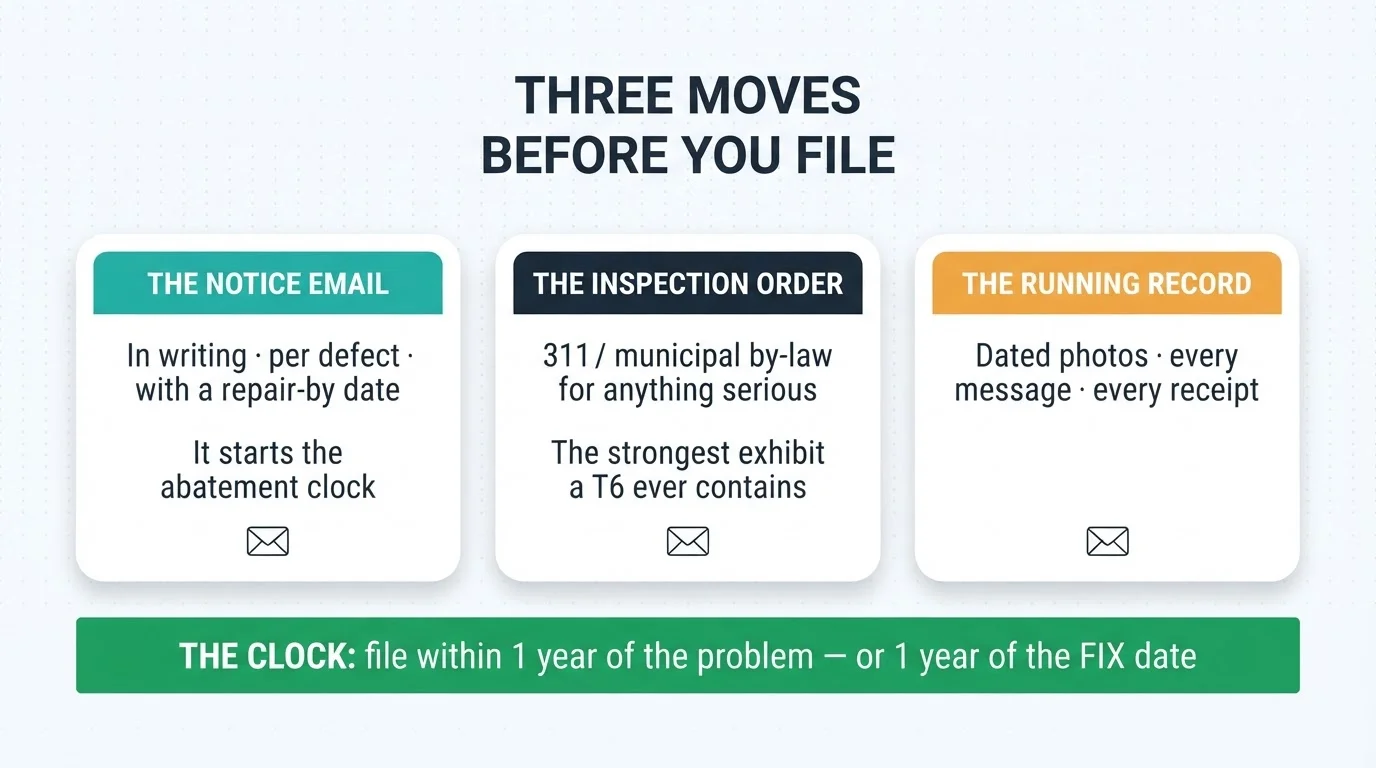
And the clock: under section 29(2), you generally must file within one year of the problem. Here's the save most tenants miss — a problem that's been fixed still supports a T6 filed within one year of the repair date, and former tenants can file within a year of moving out. Near the deadline? File first and supplement the evidence later. Claims expire; documents can be added.
The Nine Remedies: Choose Deliberately
The T6 form offers nine remedies, and the Board may substitute its own — but what you select frames the case. The menu: (1) rent abatement — retroactive relief from a portion of rent; (2) your damaged property — the couch under the leak, itemized with receipts; (3) out-of-pocket expenses — space heaters, hotel nights, ruined groceries, plus the filing fee itself; (4) reimbursement for work you already did; (5) permission to do the work; (6) a repair order with a deadline — and it's an offence for a landlord to disobey one; (7) a freeze on rent increases until serious repairs are done — the tenant-side face of the same maintenance bar that can stall a landlord's above-guideline increase application; (8) ending your tenancy — flagged honestly: if the Board orders it and you don't move by the date, the order can carry eviction provisions the landlord can take to the Sheriff. Choose it only if you truly want out; and (9) anything else the Board considers appropriate. (Fines and legal fees? Rarely ordered — ask reasonably.)

The abatement math is knowable: a percentage of rent, for the affected period, running from your written notice. The standard framing: 25% × $2,000 rent × 2 months = $1,000. Anchor the percentage to severity — a lost bedroom, a health risk, an essential service — and know that ongoing issues practically cap around a year of rent. Two asking rules govern everything: the Board will never award more than you request, so claim completely; and inflated numbers damage your credibility, so claim credibly. The total cap across claims is $50,000 under the current instructions — older PDFs still circulating say $35,000; that figure is stale.
One underused lane deserves its own sentence: out-of-pocket expenses are the easiest remedies to win, because receipts prove themselves. Practically, buying the space heater and claiming it back usually beats shivering for the record's sake.
Building the Application: Dates Beat Adjectives
The dismissal to avoid has a name: "failure to provide sufficient particulars." An application that says "mold and leaks all spring, the landlord ignored us" loses — even when every word is true — because the adjudicator can't verify anything in it. The fix is the Schedule A method: write "See attached Schedule A" in the form's cramped boxes and attach a chronological, incident-by-incident narrative where every entry has three parts — the date, the specific defect, and who was told, how, and when.
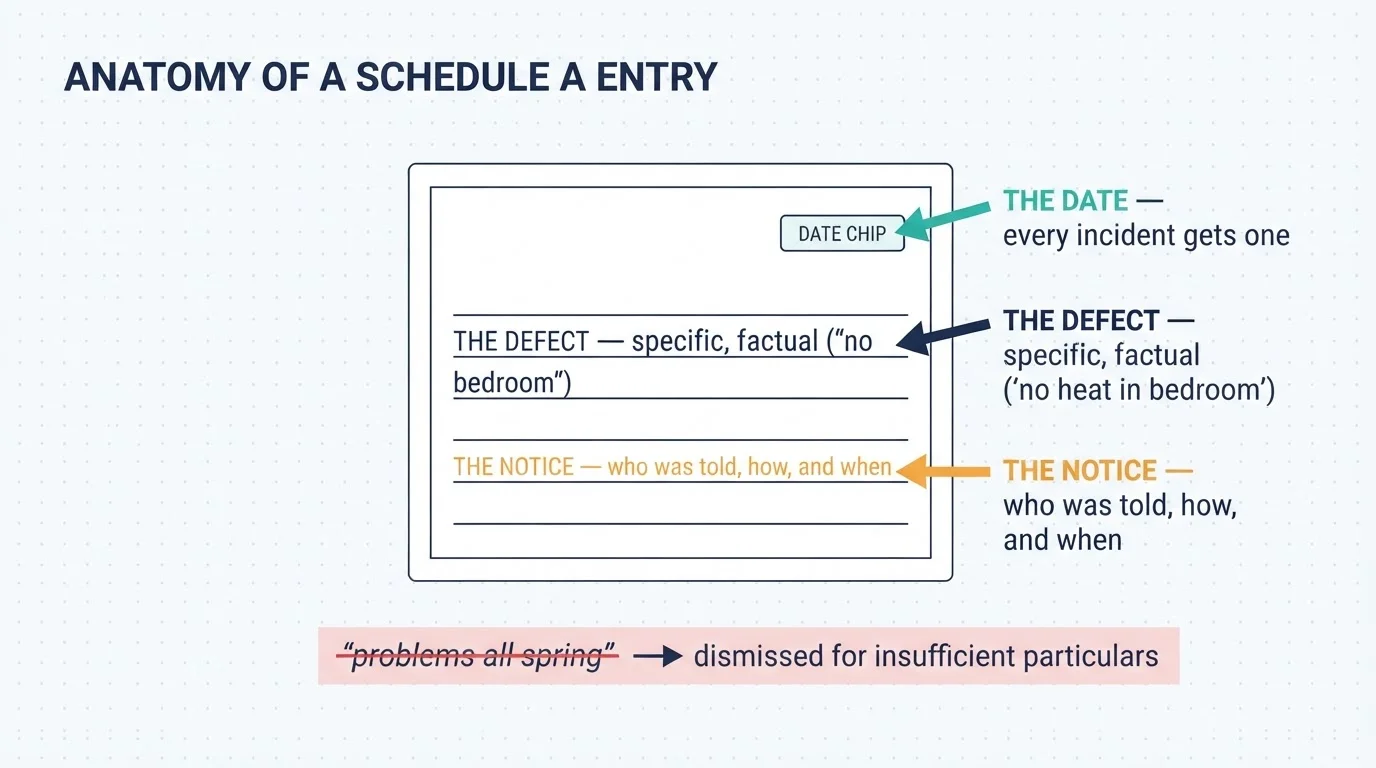
Watch the contrast play out. The vague file above gets dismissed. Now the textbook win: no heat in a bedroom from November 3; the tenant emails notice that day, follows up November 17, calls 311 on November 20 and an inspection order issues; the landlord does nothing until February. The T6 goes in with a dated Schedule A, both emails, the order, and photos — asking for a 25% abatement from November through February, $310 in space-heater and utility receipts, and a repair deadline. It's granted substantially as asked. Same genre of problem; entirely different record.
Mechanics: file on the Tribunals Ontario Portal for $48 ($53 by mail or courier), as a current or former tenant. If conduct problems overlap the disrepair — illegal entry to "inspect," harassment when you complain (see the 24-hour entry rule) — file a T2 and T6 together: one Schedule A, one combined fee. And file complete: new incidents after filing need an amendment the adjudicator may or may not accept.
The Hearing, the Honest Limit, and After
Fair warning about pace: tenant applications currently move slower than landlord eviction files — Ontario's Ombudsman has documented multi-year delays for some matters, and we'll cover planning around the backlog in a dedicated guide. Partly in response, T6s now typically get an Adjudicative Case Conference (ACC) before any hearing: an on-the-record event where an LTB Member explores settlement, narrows the issues, confirms your remedies, and can set binding directions — or resolve parts of the case outright. Treat it as the main event in disguise, and prepare accordingly. Then the evidence clock: serve your package — a single indexed PDF, media files separately — on the Board and the landlord at least 7 days before the hearing, and at the hearing walk the Member through exhibits by date. Adjudicators can't award what they can't verify.
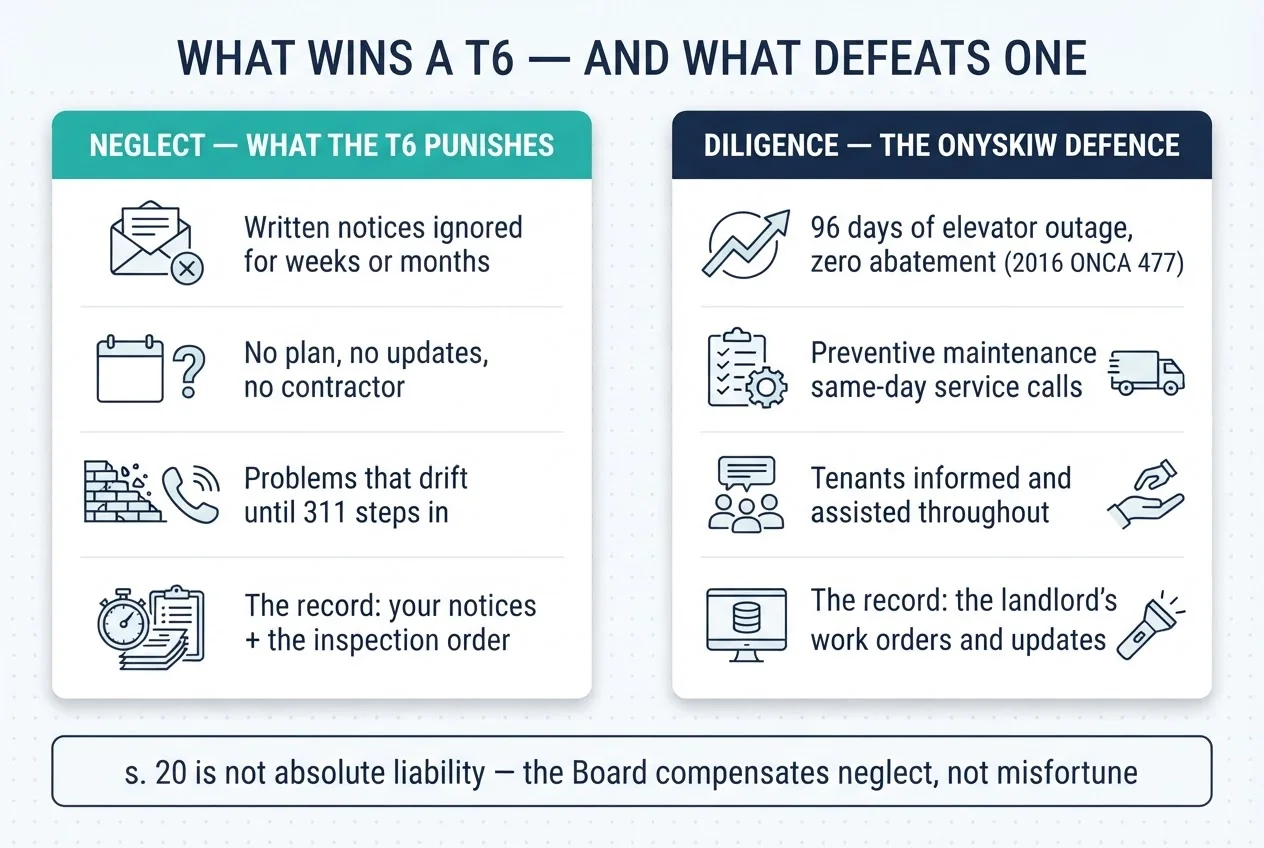
Now the honest limit, from the Court of Appeal. In Onyskiw v. CJM Property Management (2016 ONCA 477), a building's only elevator was out of service for 96 days in a single year — and the tenants recovered nothing. Why? The landlord proved a preventive-maintenance program, prompt repairs after every breakdown, a full elevator replacement, and constant communication and assistance. Section 20 is not absolute liability: a landlord who responds diligently and reasonably to a genuine problem may not be in breach at all. The T6 punishes neglect and delay — not the existence of a breakdown. Aim your application at the gap between your notices and their response: ignored emails, drift, no plan. (Landlords reading along: that's the defence blueprint — respond fast, document everything, communicate.)
After the order: a repair deadline is enforceable, and disobeying it is an offence. And if your landlord's behaviour turns cold after you file — sudden entry notices, sudden complaints — know that retaliation against a tenant for exercising their rights is itself unlawful. Document it; it can ground a further application. One housekeeping note for filers: Bill 60 and Bill 97's 2026 operational updates keep adjusting LTB forms and processes, so confirm you're on the current T6 version when you file.
Practical Takeaways
For tenants:
- Put every defect in writing with a repair-by date — that email starts the abatement clock.
- Chase the municipal inspection order on anything serious; it's the strongest exhibit there is.
- Keep the record as you go: dated photos, every message, every receipt.
- File inside one year — of the problem or its fix — and file-first near the deadline.
- Write the Schedule A with dates, not adjectives; particulars win cases.
- Choose remedies deliberately: show the abatement math, attach the receipts, use the Remedy 7 freeze if an increase looms — and touch Remedy 8 only if you truly want out.
- Treat the ACC and the 7-day evidence rule as the case itself, not paperwork around it.
The landlord's side, stated plainly: Onyskiw means documented diligence can defeat a claim entirely — a breakdown alone isn't a breach. And damage the tenant caused belongs in the N5/L2 lane, not inside a T6.
The T6 Repair Enforcement Kit: Turn Ignored Repairs Into LTB Orders
Your landlord's duty to repair doesn't enforce itself — a $48 application and a disciplined record do. This free kit walks the three moves before you file, the nine remedies with the abatement math, the Schedule A method that survives the particulars test, and the case conference and hearing.
Get Free PDF →The Bottom Line
The T6 is the cheapest application at the Board and one of the most winnable — for tenants who do three unglamorous things: notify in writing, chase the inspection order, and keep dates. The remedies are a genuine menu, the abatement math is knowable, and the honest limit is real: as Onyskiw teaches, the Board compensates neglect, not misfortune. Your landlord's duty to repair doesn't enforce itself. But for $48 and a disciplined record, you can. General information, not legal advice — for a complex file, a community legal clinic or licensed paralegal is worth the conversation. Next in this series: the T1 — how tenants get money back from a landlord, from illegal charges to unreturned deposits to unpaid compensation.
Your Repair Record, Building Itself
Tenon10 keeps maintenance requests, timestamps, and message trails organized automatically — so when it's time to enforce, the Schedule A writes itself.
Free • No signup required • Always current rules
Frequently Asked Questions
How do I file a T6 application in Ontario?
Complete Form T6 (attaching a dated, chronological narrative — the "Schedule A" method), choose your remedies, and file through the Tribunals Ontario Portal for $48 (or $53 by mail/courier). You must generally file within one year of the problem — or within one year of the date it was fixed — and current and former tenants can both apply.
How much rent abatement can I get for no heat?
Abatements are discretionary percentages of rent for the affected period, usually running from the date you notified the landlord in writing. Tenants commonly frame requests like 25% of a $2,000 rent over two months — $1,000 — with the percentage anchored to severity. The Board won't award more than you ask, so claim completely and credibly.
Can I claim repairs after they've been fixed?
Yes — a fixed problem still supports a T6 filed within one year of the repair date, and the abatement is retroactive to the neglected period. Former tenants can also file within a year of moving out.
What evidence do I need for a T6 hearing?
Your written notices to the landlord (they date the abatement period), dated photos or video, a municipal inspection order if you can get one — the single strongest exhibit — receipts for out-of-pocket costs, and a chronological Schedule A. Serve everything on the Board and the landlord at least 7 days before the hearing as a single indexed PDF.
What happens at an LTB adjudicative case conference?
An ACC is an on-the-record event before an LTB Member, now standard for T6 applications: the Member explores settlement, narrows the issues, confirms remedies, and can set binding directions — or resolve parts of the case outright. Prepare for it as if it were the hearing.
Can my landlord raise rent while repairs are outstanding?
You can ask the Board to prohibit rent increases until serious maintenance problems are fixed (Remedy 7 on the T6) — and serious outstanding breaches can also block or delay above-guideline increases on the landlord's own AGI application.


