

That $300 "key deposit" you paid to get the lease. The pet fee. The last month's rent that never came back when you moved out. The interest on your deposit that nobody ever mentioned. The N12 compensation that was supposed to arrive and didn't. In Ontario, every one of those is recoverable — through a single application with eight grounds and a filing fee under $60.
The T1 is arguably the LTB's most underused application, for two reasons. First, tenants assume paid money is gone money — and the law says nearly the opposite. Second, its deadlines are quiet and brutal: most claims run on a 12-month lookback, and an illegal rent increase you pay without protest for twelve consecutive months becomes the legal rent. The statute rewards the tenant who keeps receipts and watches the calendar. This guide covers the eight reasons as a menu, the use-it-or-lose-it clock (with the case-law arc that runs right into 2026), the deposit-interest math nobody does, the two extra asks that multiply the remedy, and the lane map so the right application gets filed. (Our T6 guide covers money for disrepair; this is money the landlord collected or withheld.) General information, not legal advice.
The T1 Recovery Kit: Get Back Every Dollar Your Landlord Shouldn't Have
Illegal fees, kept deposits, unpaid interest, missing N12 compensation — all recoverable through one $48 application with eight grounds. But most claims expire at 12 months, and a year of silent payment makes an illegal increase legal. This free kit walks the inventory, the clock, the math, and the two extra asks most tenants miss.
Get Free PDF →The Eight Ways Landlords End Up Owing You Money
One form, eight reasons — inventory first, then bundle everything that applies into a single filing. (1) Illegal rent you paid: an increase with no 90-day N1, above the guideline without an AGI order, or inside 12 months of the last one (our 2026 rent-increase guide and the calculator cover the lawful process). (2) Illegal charges: section 134 prohibits any "fee, premium, commission, bonus, penalty, key deposit or other like amount" beyond lawful rent — in real life: damage deposits, pet deposits, non-refundable key fees, cleaning and move-in fees, lease-change fees, guest fees. And here's the point people miss: a signed lease is irrelevant — agreement is not authorization (our illegal-clauses guide explains why). (3) The last month's rent deposit neither applied to your final month nor returned. (4) You signed and paid but were never allowed to move in — and the deposit wasn't returned. (5) Interest owed on your deposit (more below). (6) N12/N13 compensation unpaid by the termination date — one month's rent, or three months for qualifying N13s in larger buildings. (7) Your personal property sold without paying you the proceeds. (8) Rent charged under a hidden rent-freeze order — an undisclosed Order Prohibiting a Rent Increase, the enforcement cousin of the T6's Remedy 7.
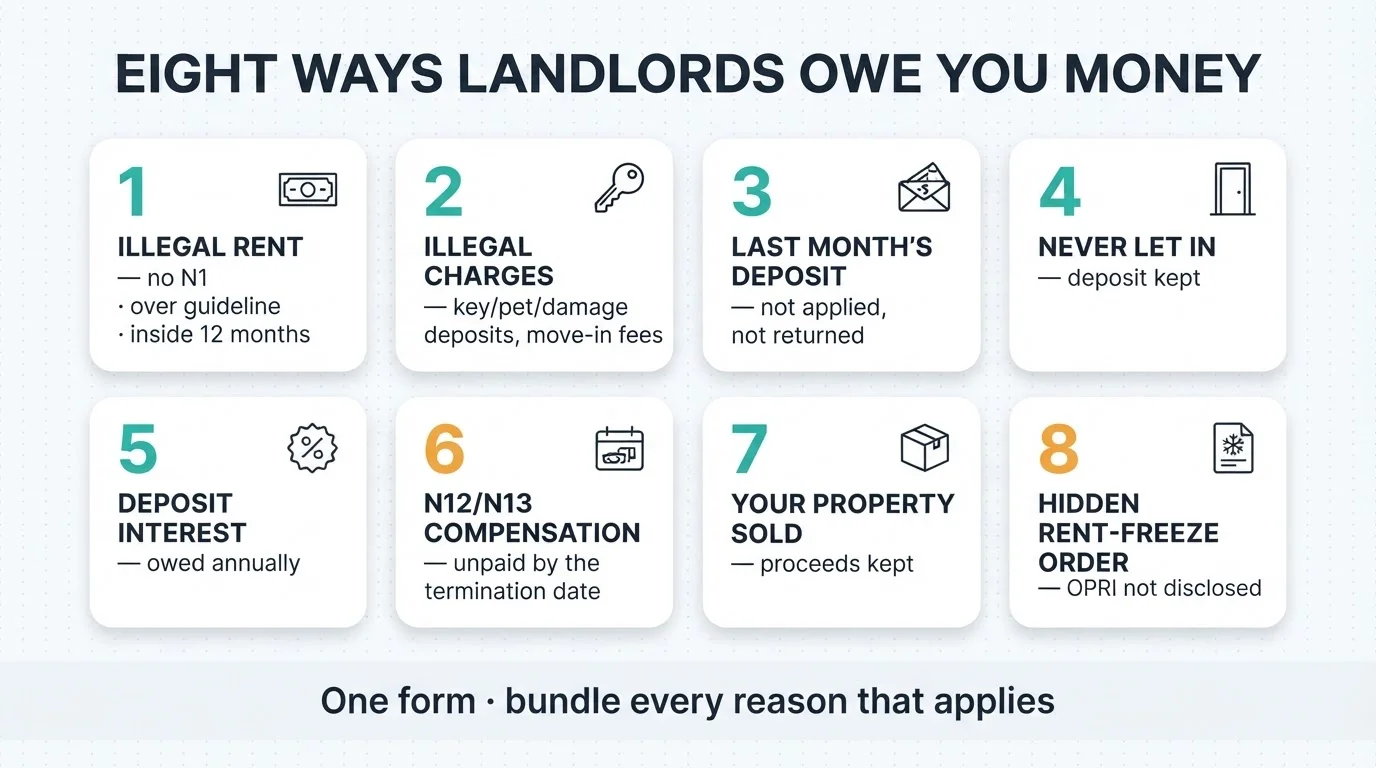
Two honest lines to draw. Legitimate charges exist: a refundable key deposit at actual replacement cost, genuinely separate agreed services, NSF administration charges — the T1 targets the rest. And who can file is broader than you'd think: current or former tenants, and you can name the superintendent or agent who actually took the money. Watch the design work in practice: a tenant pays a $300 non-refundable key deposit, a $500 pet deposit, and a $150 "move-in fee" at signing — because refusing means losing the unit. They keep the e-transfer records, send a polite letter at month three, and file at month five. All three are section 134 charges paid within 12 months: roughly $950 back, plus the filing fee.
The Clock: Use It or Lose It
Every number in this section matters. Illegal charges are recoverable only if paid within the last 12 months. Illegal-rent claims reach back 12 months from filing — the LTB's own instructions walk an example where the arithmetic lands on a precise $208 rebate; the window is firm and the math is granular. But the rule that decides cases is the conversion rule. Section 136 deems rent charged a year ago lawful unless you challenged it within a year. And since July 2020, section 135.1 goes further: even a void increase — one imposed with no N1 at all — is deemed valid once you've paid it for 12 consecutive months, unless you filed within a year of when it was first charged.
The case-law arc runs right into this year. In Price v. Turnbull's Grove (2007), the Court of Appeal held a void increase could never be cured — void meant void, forever. The 2020 legislation deliberately reversed that; the Divisional Court confirmed the new regime in Sapershteyn (2023), and applied it again in Guilbeault v. Williams — decided in 2026. This is live, current law, and it's deliberate policy: the Legislature wanted rent certainty after a year, which means the calendar is now the tenant's job. Picture it: a landlord texts "rent's going to $2,150 from March" — no N1, plainly void. Filed at month 10? Every overcharged dollar comes back. Paid silently through month 12? The illegal number is your lawful rent now.

The Money Math: Interest, Compensation, and Proof
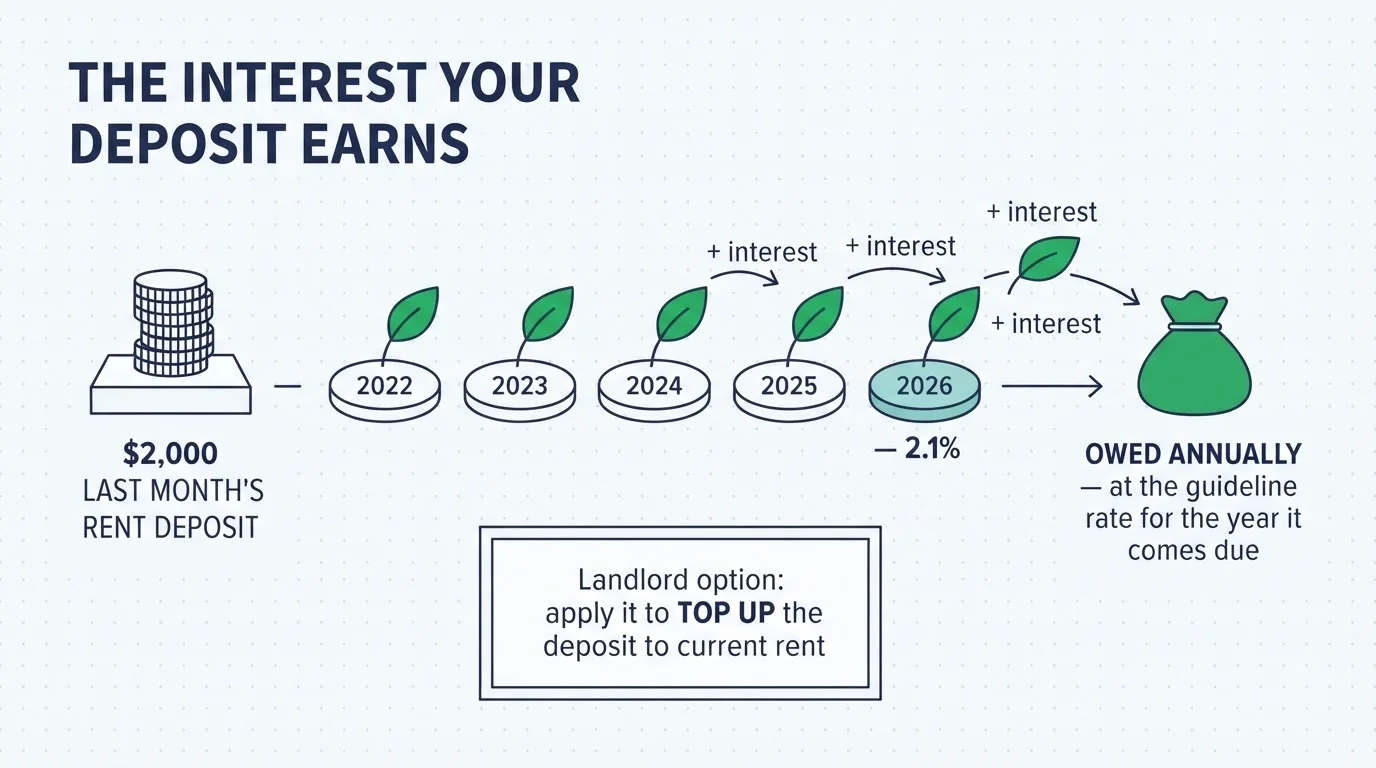
Deposit interest is the claim nobody calculates. Your landlord owes interest on the last month's rent deposit annually, at the rent-increase guideline rate for the year the payment comes due — 2.1% for 2026, 1.9% for 2027 — though they can lawfully apply it to top the deposit up to current rent instead. A $2,000 deposit held five years with no interest and no top-ups works out to roughly $200: modest, near-automatic with the year-by-year table attached, and usually filed alongside a Reason 3 claim when the deposit itself vanished at move-out.
The N12/N13 compensation claim is just as clean. That one month's rent was due by the termination date on the notice — not after you're out, not when convenient. If it never arrived, a former tenant files Reason 6 within the year and the Board orders it. (Lane flag: unpaid compensation is the T1; a landlord who then never moved in is a separate bad-faith claim under the T5 — later in this series.) Across all eight reasons, proof of payment is the whole case: e-transfer confirmations, receipts, the lease, the texts — and rent-based claims require a 12-month rent history filed with the application. Before filing anything, try step zero: a written note asking "where in the Residential Tenancies Act is this charge authorized?" Tenant advocates report many cases end right there — and the ones that don't now have a paper trail.
Filing, the Two Extra Asks, and the Lane Map
Mechanics: file on the Tribunals Ontario Portal for $48 ($53 by paper) — and note the T1's group design, unique in this series: $5 per additional unit, to a $450 maximum. When a whole building was charged the same illegal fee, neighbours can file together for less than a dinner out. Fee waivers exist; false filings are an offence; and the Board can order either party to pay the other's costs. The cap is $50,000 under the current instructions — older PDFs still say $35,000; that figure is stale — with amounts above the cap extinguished once the order issues.
Then ask completely, because the form offers two extras most tenants skip. The Board can order the landlord to pay a fine where the conduct warrants it. And the Board can determine the lawful rent for your unit — the sleeper remedy. A rebate pays you once; a lawful-rent determination resets your baseline, and every future increase calculates from the corrected number, compounding month after month. If your rent history is tangled, ask for the determination even when the rebate is small. Finally, thirty seconds on lanes, because one wrong form costs months:
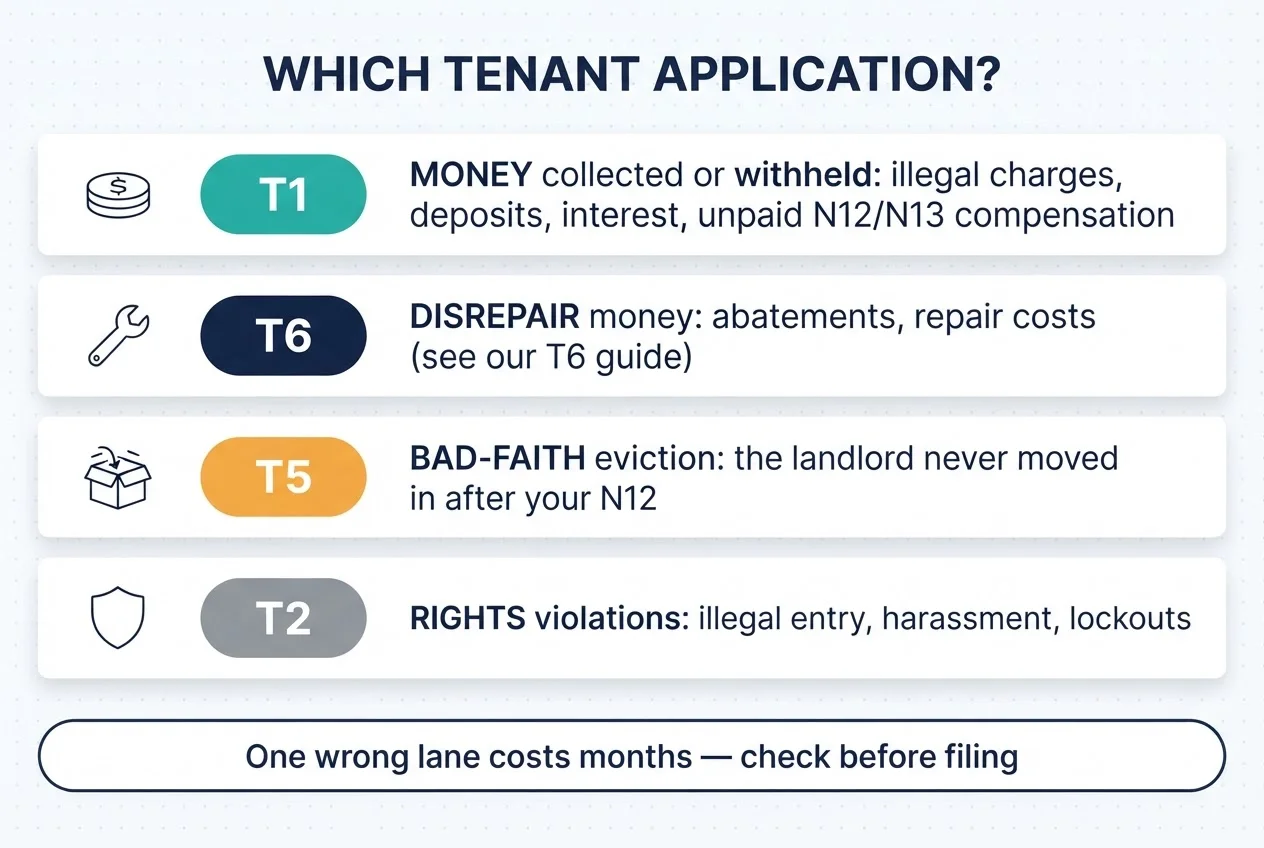
Money collected or withheld → T1. Disrepair money → T6. A landlord who never moved in after your N12 → T5. Illegal entry, harassment, lockouts → T2. For landlords reading along, the prevention blueprint is three lines: collect nothing at signing beyond first month plus the deposit (a refundable key deposit at actual cost is the one exception); pay or top up deposit interest annually, documented; and pay N12/N13 compensation before the termination date, with proof. Given the fine exposure — and the raised offence maximums in our Bill 60 coverage — prevention is dramatically cheaper than any hearing. One filing note: Bill 60 and Bill 97's operational updates keep adjusting LTB forms, so confirm you're on the current T1 version.
Practical Takeaways
For tenants:
- Inventory against all eight reasons and bundle everything into one filing.
- Keep proof of every payment from day one — the e-transfer memo line is evidence.
- Send the ask-first letter before filing; many cases end there.
- Diarize month 10 of any un-noticed increase — twelve months of silence converts it.
- Never deduct from rent; pay in full, then file.
- Ask completely: rebate, interest, a fine where warranted, and the lawful-rent determination.
- Check the lane before filing: T1 for money, T6 for disrepair, T5 for bad faith, T2 for rights.
For landlords, stated plainly: collect nothing at signing beyond first plus the deposit, pay or top up deposit interest annually, and pay N12/N13 compensation before the termination date, with proof. The deemed-lawful provisions protect properly-noticed increases after a year — they are not a strategy for skipping the N1.
The T1 Recovery Kit: Get Back Every Dollar Your Landlord Shouldn't Have
Illegal fees, kept deposits, unpaid interest, missing N12 compensation — all recoverable through one $48 application with eight grounds. But most claims expire at 12 months, and a year of silent payment makes an illegal increase legal. This free kit walks the inventory, the clock, the math, and the two extra asks most tenants miss.
Get Free PDF →The Bottom Line
The T1 flips the move-in power imbalance on its head. The law knows you had no bargaining leverage at signing — so it expects you to pay for the keys, and then makes the illegal parts recoverable, with interest, for a year. Eight reasons, one filing under $60, and two extra asks most people never make. The only real enemy is the calendar: what you don't challenge within twelve months, the statute quietly blesses. Keep the receipts; watch month 10. General information, not legal advice — a community legal clinic or licensed paralegal is worth the conversation for a tangled rent history. Next in this series: the T3 — when your rent should go down: lost parking, lost laundry, lost services, and the rent-reduction application.
Every Payment on the Record, Automatically
Tenon10 keeps payment histories, deposit records, and date alerts organized from day one — so when money needs recovering, the proof is already filed.
Free • No signup required • Always current rules
Frequently Asked Questions
How do I file a T1 application in Ontario?
Complete Form T1, shade every reason that applies, attach your proof of payment (plus a 12-month rent history for rent-based claims), and file through the Tribunals Ontario Portal for $48 (or $53 by paper). Current and former tenants can both apply, and you can also name the superintendent or agent who collected the money.
Is a pet deposit legal in Ontario?
No. Section 134 prohibits any fee, premium, penalty, key deposit "or other like amount" beyond lawful rent — pet deposits, damage deposits, cleaning fees, and move-in fees are all illegal even if you agreed to them in the lease. If you paid one within the last 12 months, it's recoverable through a T1.
How much interest does my landlord owe on my deposit?
Interest on the last month's rent deposit is owed annually at the rent-increase guideline rate for the year the payment comes due — 2.1% for payments due in 2026. Landlords can alternatively apply it to top the deposit up to the current rent. Unpaid years are claimable together on a T1.
What happens if I paid an illegal rent increase for a year?
Since 2020, section 135.1 deems even a void increase (one with no proper notice) valid once you've paid it for 12 consecutive months — unless you filed an application within one year of when it was first charged. File before the year runs out and every overcharged dollar is recoverable; wait past it and the illegal number becomes your lawful rent.
My landlord never paid my N12 compensation — what can I do?
Compensation equal to one month's rent was due by the termination date on the notice. If it never arrived, file a T1 (Reason 6) within one year — former tenants can file after moving out. If the landlord also never moved into the unit, that's a separate bad-faith claim under the T5.
How much money can the LTB order on a T1?
Up to $50,000 under the current instructions — claims above that belong in court, and amounts beyond the cap are extinguished once the order issues. The Board can also order the landlord to pay a fine and can formally determine the lawful rent for your unit going forward.


