You moved out because your landlord said they needed the unit — for themselves, a family member, or a buyer. Weeks later, it's back on the market, often at a higher rent. That's a bad-faith eviction, and in Ontario the T5 application is how a former tenant fights back and gets paid. It's one of the most powerful tools a tenant has, and one of the least understood.
Most tenants assume that once they've handed back the keys, it's over. It isn't. But the T5 is procedural and time-limited — miss your deadline, name the wrong parties, or walk in without the re-listing in hand, and even a strong claim can fail.
This complete guide covers what legally counts as bad faith, the powerful presumption that can flip the burden of proof onto your landlord, the deadline that splits by reason (one year for most claims, up to two for a renovation), the compensation you can claim — up to 12 months' rent plus a fine — and the evidence that actually wins. It's general information, not legal advice — for your situation, confirm with the LTB or a legal clinic.
The Bad-Faith Eviction Evidence Kit
Spot the signs, use the presumption, and gather the proof that wins a T5 — the whole process on one printable page.
Get Free PDF →What Counts as a Bad-Faith Eviction
The T5 is the application a former tenant files at the LTB after moving out because of one of two notices they believe was given dishonestly: an N12 (the landlord, a family member, a caregiver, or a purchaser claimed to need the unit) or an N13 (the landlord claimed they'd demolish, convert, or do major repairs or renovations).
The core definition is simple: a notice is in bad faith if, at the time it was given, the landlord didn't genuinely intend to do what it claimed — move the person in, or actually do the work. Importantly, the analysis isn't frozen at that moment. The Court of Appeal confirmed in Elkins v. Van Wissen (2023) that the LTB can look at what the landlord did afterward, not just their state of mind the day they served the notice. What happened next is evidence of what they intended.
The flip side: if the landlord genuinely followed through — the named person moved in within a reasonable time, or the renovation was actually done — there's no bad faith, and no claim.
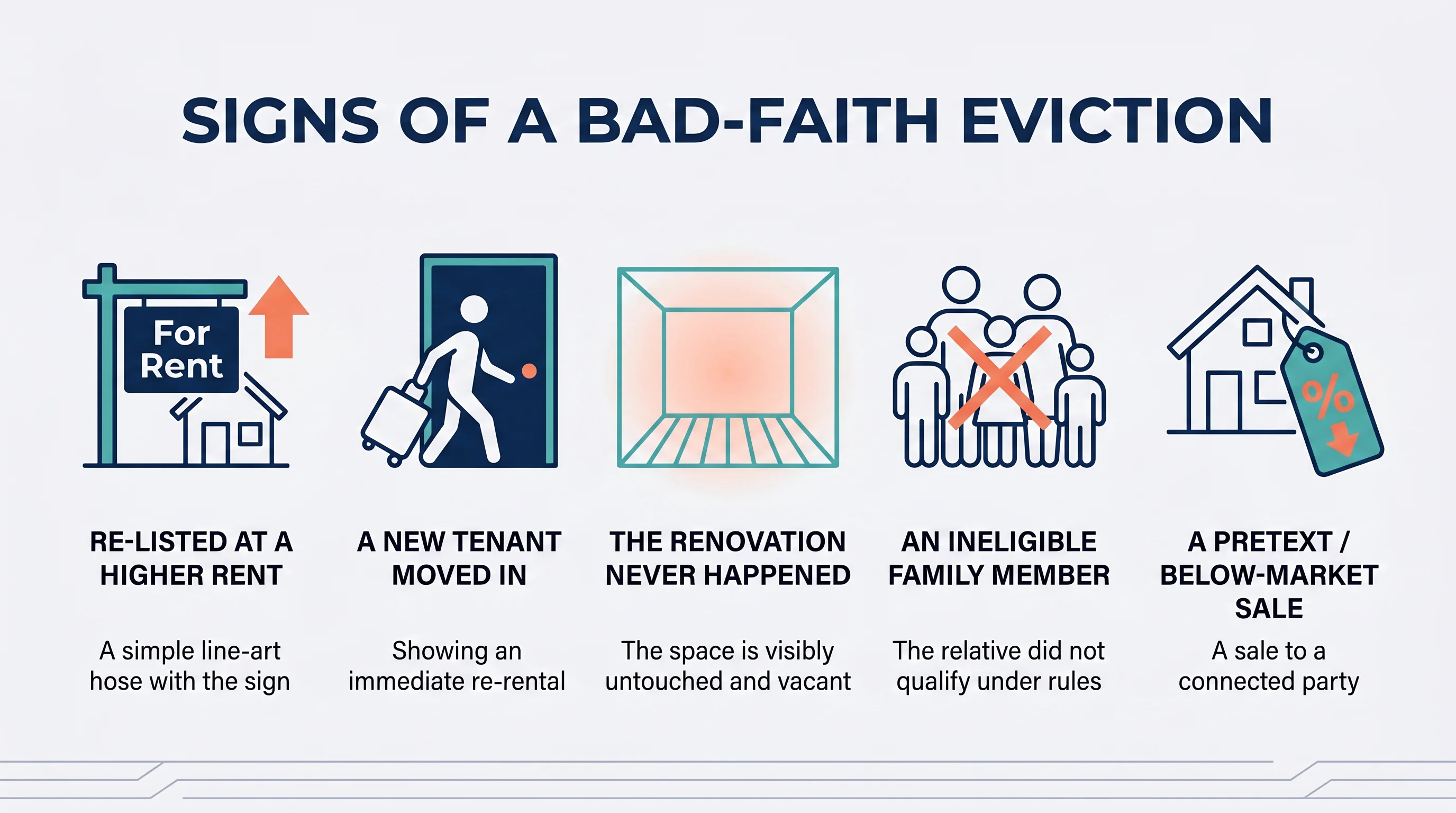
In practice, bad faith usually shows up as one of a handful of tell-tale signs: the unit re-listed (often at a higher rent) soon after you left; the named person never actually moved in; the renovation never happened or was trivial; the "family member" wasn't an eligible person (a sibling, for instance, doesn't qualify under the own-use rules); or a "sale" that was really a below-market transfer to a relative to manufacture a reason to evict.
One procedural point that matters: name the landlord as the respondent — and, if the eviction was for a purchaser's own use, name the purchaser too, using the T5 Schedule of Parties. The LTB can order either or both to pay you, but it can't make an order against a purchaser you didn't include.
The Presumption That Flips the Burden
Here's the fact that changes everything, and the reason a bad-faith claim is far more winnable than most tenants assume. Normally, you'd have to prove your landlord's state of mind — nearly impossible to do directly. But for an own-use N12, the law does the heavy lifting for you.
Under the Residential Tenancies Act, bad faith is presumed if, within one year of you moving out, the landlord did any of the following: advertised the unit for rent, rented it to someone else, advertised the unit or building for sale, demolished it, or converted it to non-residential use. When that happens, the burden flips. The landlord now has to prove they did not act in bad faith — your dated re-listing screenshot can be enough, on its own, to shift the entire case onto them.
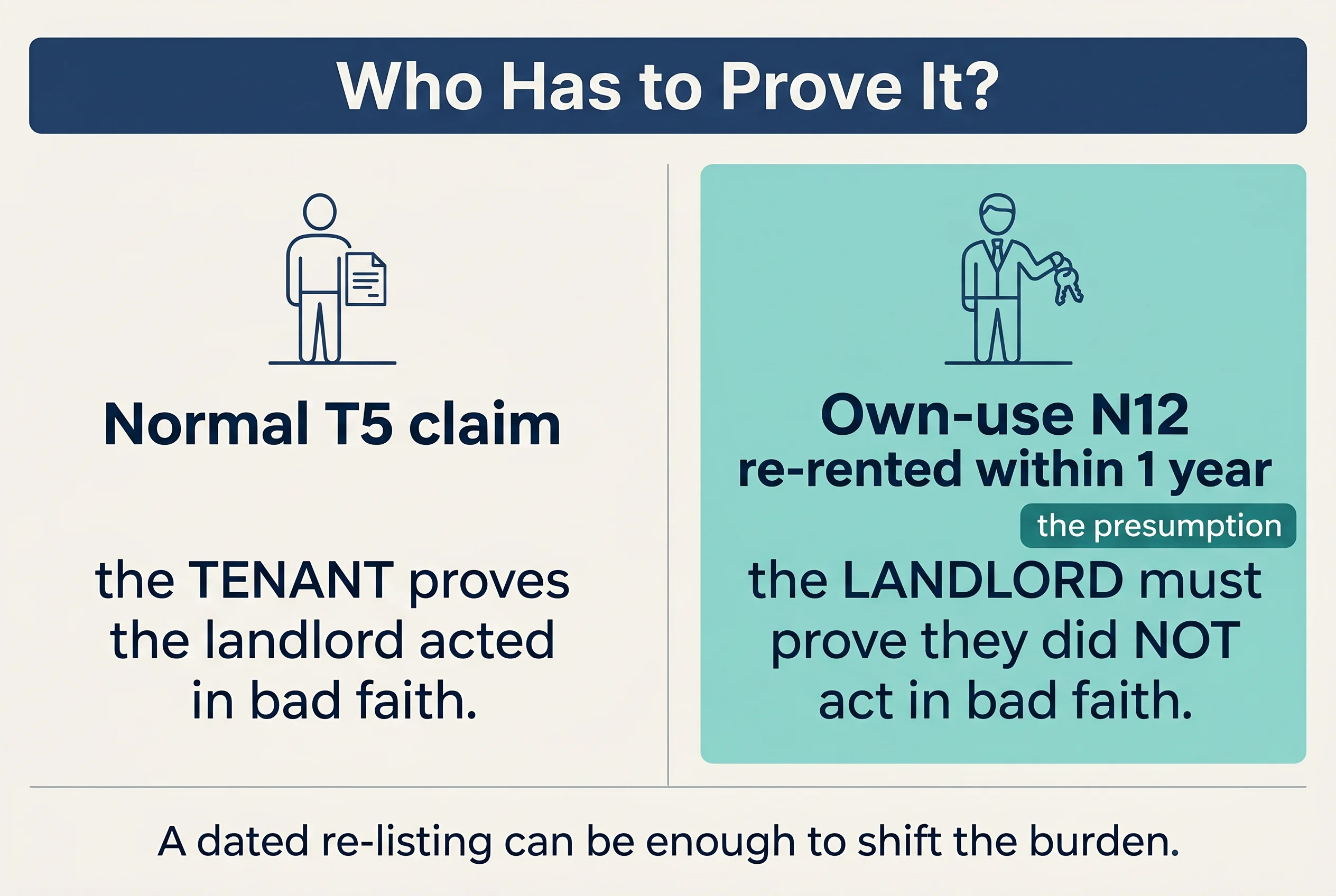
A landlord can rebut the presumption — but only by showing a genuine, unforeseen change of circumstances: the family member's job offer fell through, an illness, a death in the family. It's decided on a balance of probabilities, and a weak or convenient story often doesn't survive scrutiny, especially when the new rent is conspicuously higher than what you were paying.
For a renovation or demolition N13, the presumption doesn't operate in quite the same way — there, you show the work wasn't intended or wasn't done — but the same evidence patterns (the undone work, a new tenant already installed) carry the day. Either way, the practical takeaway is the same: the timeline usually speaks for itself. If you want the broader picture of what landlords can't lawfully do, our guide to 5 things your landlord can't do in Ontario is a useful companion.
Your Deadline, and the Right to Move Back In
The T5 deadline is the detail most guides get wrong — because it splits by reason.
For most claims — an own-use N12 where the person didn't move in, or an N13 demolish/convert/repair the landlord didn't carry out — you have one year from your move-out date to file. But there's a second track: if you received a renovation N13, gave the landlord written notice that you wanted to move back in, and were refused, you have two years to file. Assume "one year for everything" and you can either miss a live two-year claim or file a one-year claim too late.
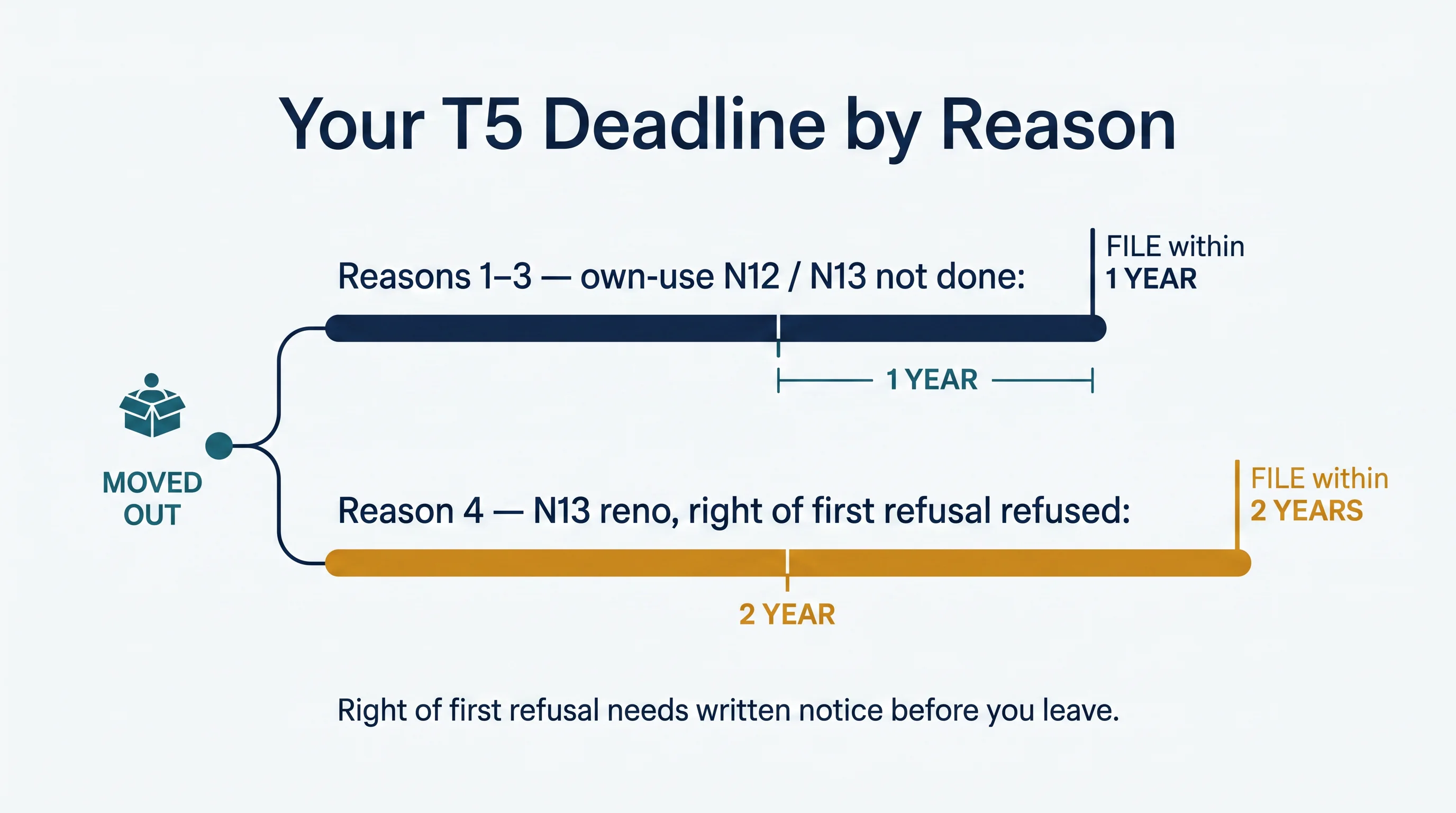
That second track exists because of a right many tenants don't know they have: the right of first refusal. If a landlord serves a renovation N13 and you give them written notice — before you move out — that you want to return once the work is finished, you have the right to move back in at your old rent. Refusing to let you return is its own standalone ground for a T5, and the LTB can order the landlord to give you the unit back if it hasn't already been re-rented.
If you're weighing whether an N13 renovation was legitimate in the first place, our complete guide to renovictions walks through when the tactic crosses the line.
What You Can Claim: The Remedies
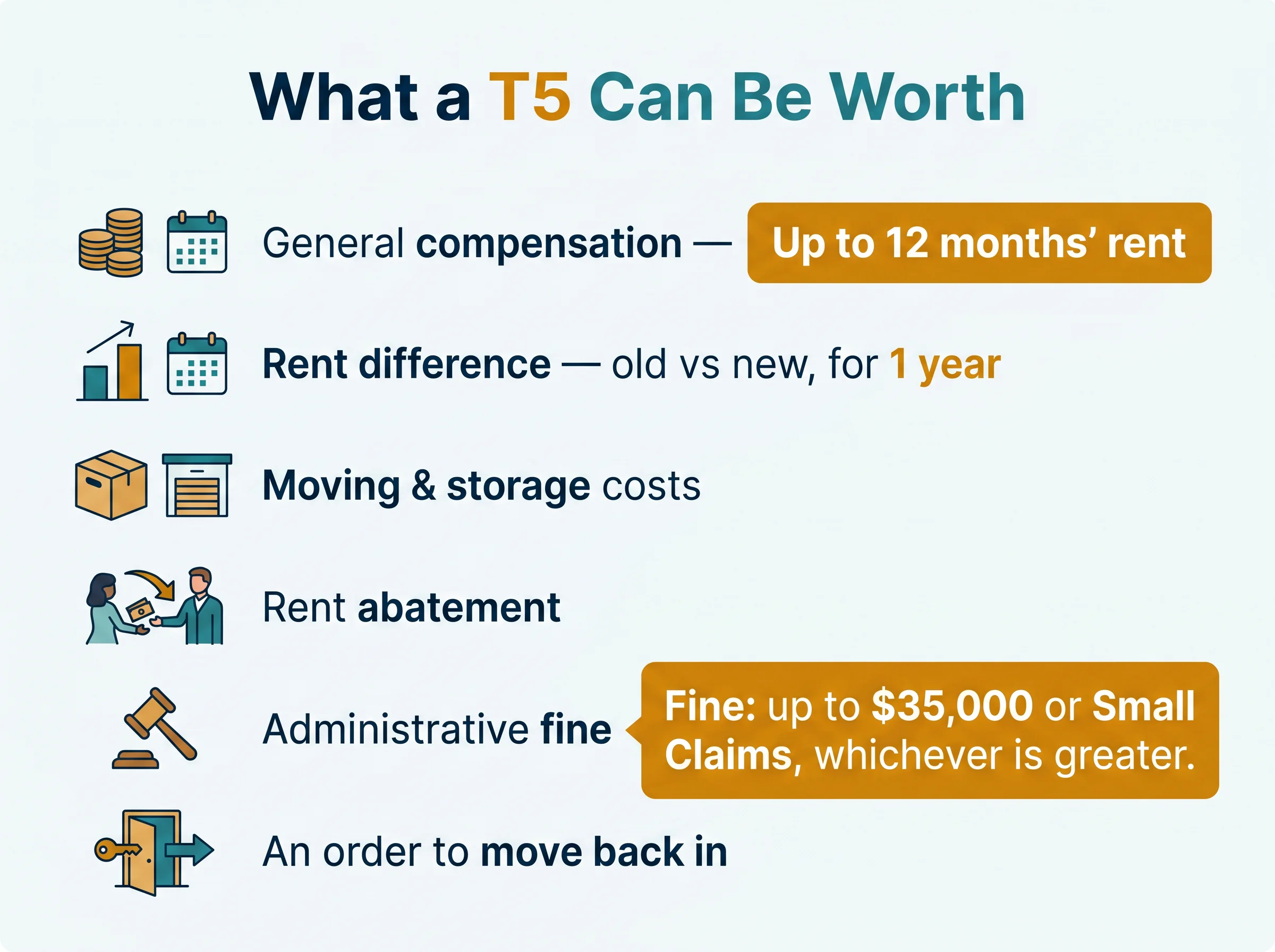
On the T5, you choose the remedies you want by shading the boxes — and the numbers can be substantial. This is where a bad-faith claim stops being about principle and starts being about real money.
- General compensation — up to the equivalent of 12 months of your last rent. This is the headline remedy, and crucially, you can claim it even if you had no out-of-pocket expenses.
- Rent difference — if your new place costs more, the landlord pays the gap between your old and new rent for one year.
- Moving and storage — your actual, receipted costs to move and store your belongings.
- Rent abatement — a refund for some or all of the period affected.
- An administrative fine to the LTB — up to $35,000 or the Small Claims Court limit, whichever is greater — used to deter landlords who show blatant disregard for the rules.
- An order to move back in — returning you to the unit if it hasn't already been re-rented.
Consider a real-world shape of claim. A tenant paying $2,200 a month in Mississauga leaves on an own-use N12 in June; by October the unit is re-listed at $2,900 and rented to someone new. Under the presumption, the burden falls on the landlord — who can't explain the higher rent away — and the tenant recovers the rent difference, their moving costs, and general damages toward the 12-month cap. The total can run well into five figures.
Whatever you claim, justify each number. Show your math — the rent gap, the receipts, why your general-compensation figure is fair. A documented claim is far more persuasive than a round number, and it signals to the adjudicator that you've done the work.
The Evidence That Wins, and How to File
The re-listing is the case. A dated screenshot of your old unit advertised for rent or sale — ideally at a higher rent, shortly after you left — is the single strongest piece of evidence in most bad-faith claims. Build around it: proof a new tenant moved in; for an N13, photos or a permit search showing the work never happened; evidence the named person was ineligible; or the signs of a pretext or below-market sale. Keep the N12 or N13 itself, your move-out date, and every message in one place — a dated record, the same discipline that wins a T2.

You file the T5 through the Tribunals Ontario Portal (you can also file by mail, courier, or at some ServiceOntario counters). Name the landlord — and the purchaser, with the Schedule of Parties, where relevant. Pay the filing fee, and ask for a fee waiver (Form FW) if you're on a low income. Upload your evidence and serve it before the hearing; hearings are held by video or phone, and you need to attend, because not showing up risks automatic dismissal. You don't need a lawyer: Tenant Duty Counsel is free on the hearing day, and Community Legal Clinics help low-income tenants through the whole process.
For landlords reading this: the way to never face a T5 is to serve an N12 or N13 only when you genuinely mean it — never as a workaround for a bad relationship or to reset a below-market rent. Disclose all N12/N13 notices you've given in the prior two years, pay the required N12 compensation on time, and if your plans genuinely change after the tenant leaves, document the unforeseen reason carefully. Don't re-rent within 12 months without advice, and for a renovation N13, honour the right of first refusal and keep a written renovation timeline. The N12 guide and N13 guide cover the good-faith requirements in full.
The Bad-Faith Eviction Evidence Kit
The signs, the presumption, your deadline, and the proof — everything you need to build a T5 on one page.
Get Free PDF →Key Takeaways
If you moved out on an N12 or N13 and something feels off, here's the short version of what to do:
- Confirm you moved out because of an N12 or N13 — the T5 is for former tenants.
- Find your reason and deadline: one year for most, two years for a refused renovation return.
- Gather the killer evidence: the re-listing, the new tenant, the undone work, or the ineligible person.
- If it's an own-use N12 re-rented within a year, lean on the presumption — the burden is on the landlord.
- Name the landlord — and the purchaser (Schedule of Parties) for a purchaser's-own-use N12.
- Pick and justify your remedies: general compensation (up to 12 months), rent-difference, moving costs, abatement, fine, move-back-in.
- File through the Tribunals Ontario Portal, ask for a Form FW waiver if eligible, upload your evidence, and attend.
The quick win is to screenshot the re-listing the moment you spot it, with the date visible. The long game is keeping the notice, your move-out date, and every message together in one place — so if an eviction turns out to be bad faith, your case is already built.
Conclusion
A bad-faith eviction — an N12 or N13 the landlord never genuinely meant — isn't something you have to accept as the cost of renting. The T5 lets a former tenant claim real money: up to 12 months' rent, the rent difference, moving costs, and a fine, with a presumption that can put the burden of proof on the landlord and even a right to move back in.
You don't need a lawyer, you have one to two years depending on your reason, and the strongest piece of evidence is often something you can capture in a minute. If you moved out on an N12 or N13 and suspect the reason wasn't real, screenshot any re-listing today and check your deadline — those two steps put you ahead of most claims before you've even filed.
This is general information, not legal advice. Deadlines, remedies, fees, and procedures can change; confirm the current details and your situation at tribunalsontario.ca or with the Landlord and Tenant Board.
Keep your tenancy paper trail in one place
Tenon10 helps you hold onto the notice, your move-out date, and every message — so if an eviction turns out to be bad faith, your evidence is ready when you need it.
Free • No signup required • Built for Ontario tenants
Frequently Asked Questions
What is a T5 application in Ontario?
It's the application a former tenant files at the LTB when they moved out because of an N12 (own use) or N13 (demolish/convert/repair) notice they believe the landlord gave in bad faith — meaning the landlord never genuinely intended to do what the notice claimed.
How much compensation can I get for a bad-faith eviction?
Potentially a lot: general compensation up to 12 months of your last rent, the difference between your old and new rent for a year, moving and storage costs, a rent abatement, and an administrative fine to the LTB of up to $35,000 or the Small Claims limit, whichever is greater.
How long do I have to file a T5?
One year from your move-out date for most reasons (an own-use N12, or an N13 the landlord didn't carry out), and two years if it's an N13 renovation where you gave written notice you wanted to move back and the landlord refused.
Do I have to prove my landlord lied?
Often not. For an own-use N12, if the landlord re-rented, re-listed, or sold the unit within a year of you leaving, the law presumes bad faith — and it's the landlord who has to prove they acted in good faith.
My landlord re-rented the unit at a higher rent right after I left — what do I do?
Screenshot the listing with the date and rent visible, check your one-year window, and file a T5. That re-listing is often the strongest single piece of evidence, and for an own-use N12 it can trigger the presumption of bad faith.
Related Resources
- T5 — Landlord Gave a Notice of Termination in Bad Faith
- Ontario N12 Notices: A Complete Guide to Own-Use Tenancy Endings
- The N13 Notice in Ontario: Demolition, Conversion, and Major Repairs Explained
- Ontario Renovictions: A Complete Guide for Landlords and Tenants
- 5 Things Your Landlord CAN'T Do in Ontario