Most LTB eviction cases don't end in eviction. They end in a deal: a payment plan, a set of conditions, a second chance — blessed by the Board itself, often at mediation on hearing day. The L4 is what happens when that deal breaks. It's the application that converts a missed condition into an eviction order, and — in the form's own words — the LTB will "normally" issue it without a hearing.
The second chance carries a tripwire both sides underestimate. Landlords assume any breach triggers it — it doesn't; a relatedness rule filters which conditions count — and they quietly forfeit enforcement by letting informal grace outrun a 30-day clock that runs from the breach itself. Tenants assume a signed deal means the fight is over — until an order arrives in the mail with no hearing attached. This guide walks both sides through it: the four-prerequisite gate, why drafting day matters more than breach day, the clock, the package and the money (up to $50,000), and the 10-day Motion to Set Aside that freezes everything — plus the Sheriff-notification step the LTB's own brochure recommends. (This is the sibling of the L3 — together, the only two applications the Board can decide without a hearing.) General information, not legal advice.
The L4 Enforcement Kit: Making Your Settlement or Payment Plan Actually Enforceable
A payment plan is only as strong as its section 78 clause — and its enforcement window is just 30 days from the breach. This free kit walks the whole arc: drafting conditions the LTB will enforce without a hearing, the breach clock, the filing package, the $50,000 money math, and lawful enforcement.
Get Free PDF →The Second Chance, and Its Four-Part Tripwire
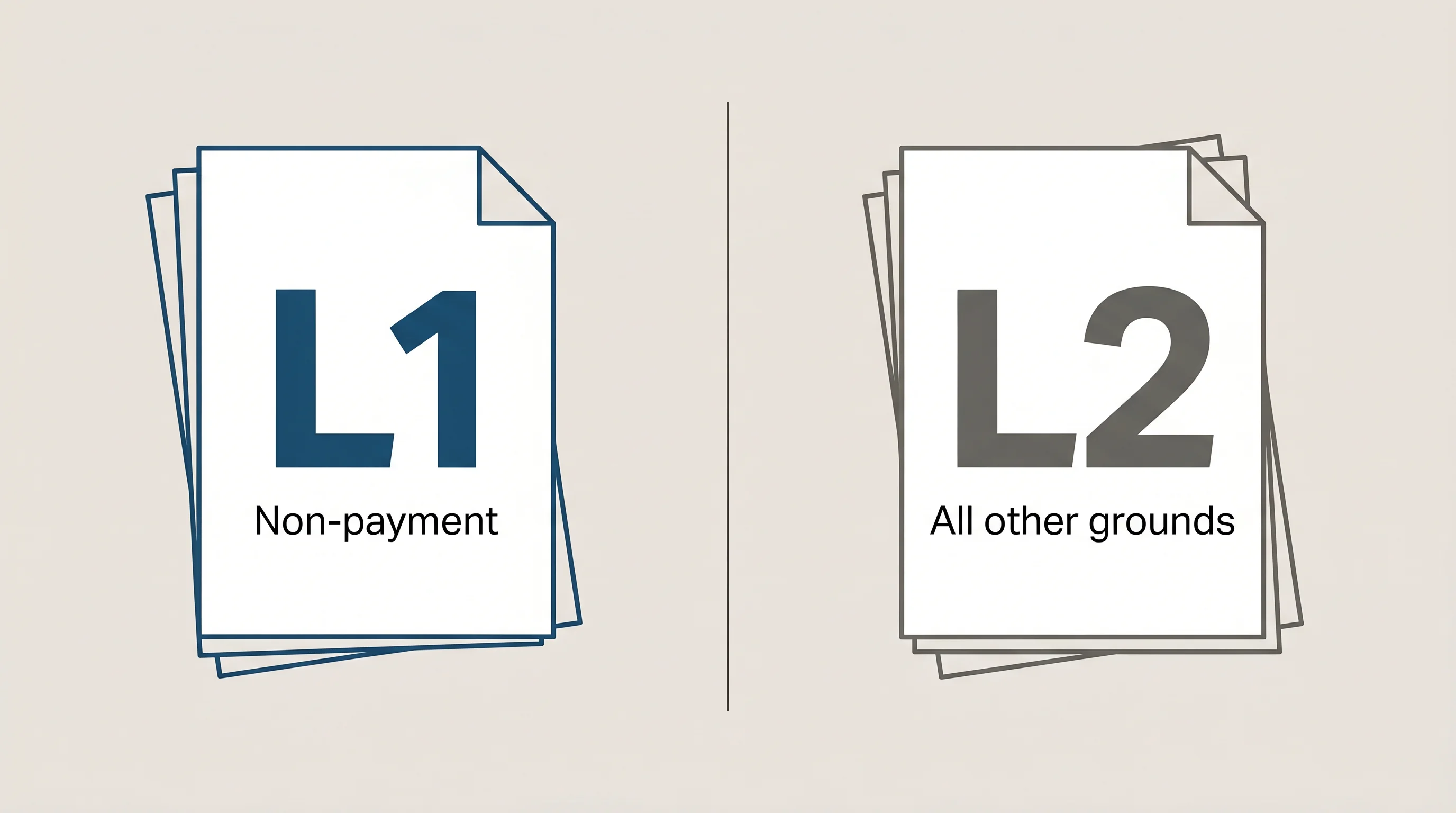
Here's where L4s come from. An eviction application — usually an L1 for arrears, sometimes an L2 (our L1 vs L2 guide covers that fork) — reaches mediation or a hearing and ends not in eviction but in an LTB-mediated settlement or a conditional order: the tenancy continues if conditions are met. Classically, a payment plan. Section 78 of the RTA is that deal's enforcement arm.
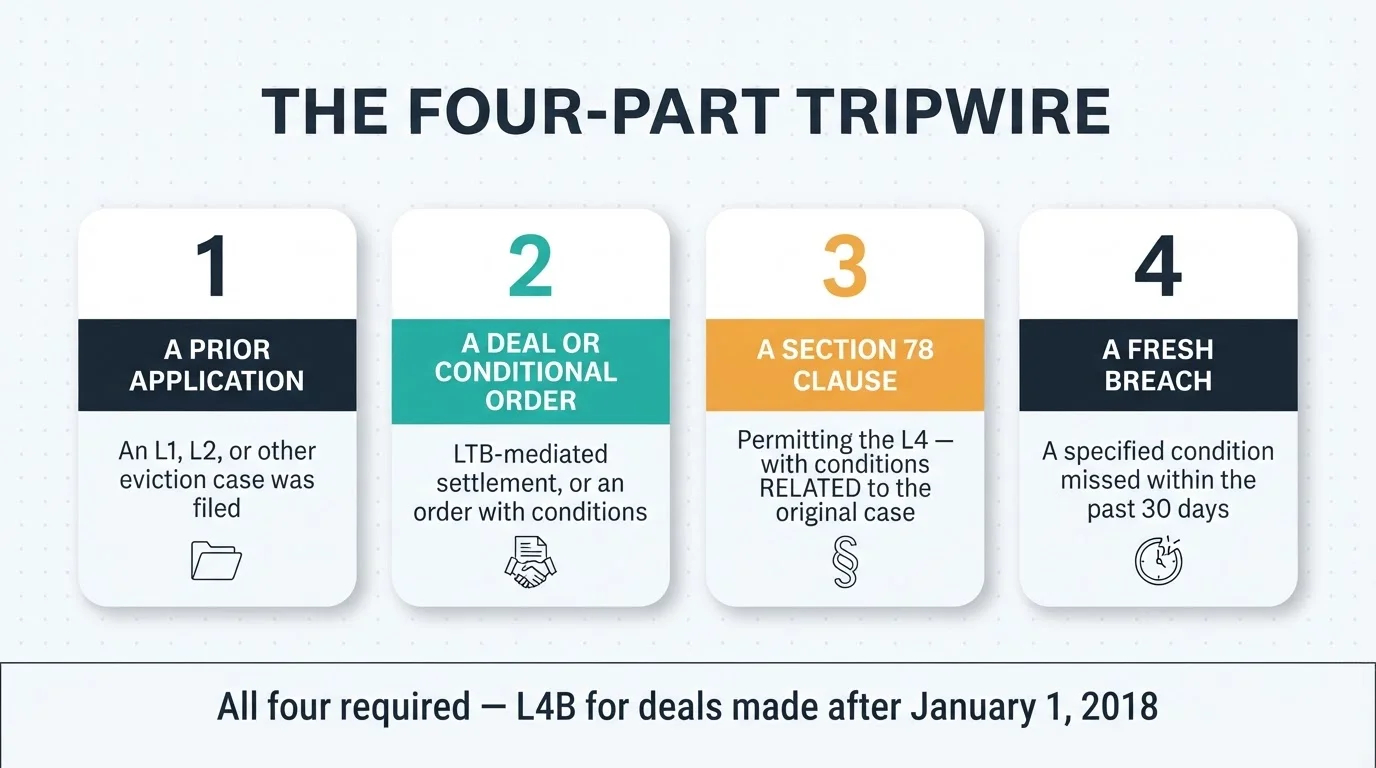
Four prerequisites, all required: (1) a previous application to end the tenancy was filed; (2) it was resolved by a mediated settlement or an order setting conditions; (3) that settlement or order contains a section 78 clause — a term permitting an L4 if conditions are breached — with conditions that relate to the same reason as the original application; and (4) the tenant failed to meet a specified condition within the past 30 days. One housekeeping note: January 1, 2018 splits the form family — L4A for older deals, L4B for everything since, which is virtually all current filings.
With the L3, the L4 is one of only two applications the Board can decide without a hearing — and the L4's language is the strongest in the L-series: the order is "normally" issued on the papers alone. With arrears cases dominating LTB volume and payment plans the standard mediated outcome, this application is quietly the backbone of the whole settlement system. It's the reason a payment plan means anything.
The Relatedness Rule: Drafting Day Beats Breach Day
The rule most people miss: ex parte enforcement isn't available for just any breached term. The condition must be materially connected to the original application's grounds. A missed installment on a payment plan that settled an arrears case? Squarely qualifies. But consider a real pattern: an L1 payment-plan settlement that also required weekly unit cleaning. The tenant pays perfectly; the housekeeping slips; the landlord files an L4 on the cleaning term. That file doesn't belong in the no-hearing lane — the term doesn't relate to non-payment, and the lawful route for a genuine cleanliness problem is a fresh N5 and L2, not an L4. The Board retains discretion throughout, and sloppy or overreaching files get routed to ordinary hearings.
Which yields the piece of advice that outranks everything else in this guide: the settlement is the eviction case, deferred — so win the drafting day. Landlords: at the mediation table, keep conditions on-subject, insist on the explicit section 78 clause, make every condition specific and dated, and diarize each date before you leave the building. Extra bolted-on terms buy paper, not protection. Tenants: read the deal the same way before signing — know exactly which conditions carry the tripwire. And if an ex parte order ever arrives, checking whether the breached term actually related to the original application is a real defence, not a technicality.

The Conversion: the Breach Clock, the Package, and the Money
The clock works differently than the L3's, and the difference matters: the L4 must be filed no later than 30 days after the breach itself — not after any termination date. Grace is humane and often smart business. Undocumented grace that outruns the clock is a quiet forfeit: picture an installment missed January 10, an informal "I'll give them a couple of weeks," and a filing on March 5 — day 54. That breach is stale and can't support the application; enforcement now waits for the next missed installment, or restarts with a fresh N4 cycle. Extend grace deliberately, in writing, with the clock in view.

The package is compact and unforgiving: the L4B (previous file number, reason selection) filed on the Tribunals Ontario Portal at $186 ($201 by paper); a copy of the settlement or order being enforced — the Board enforces that document, not your account of it; and a signed declaration or sworn affidavit setting out which conditions weren't met and how, with dates and amounts — the LTB attaches a declaration form to the application. "Tenant breached the agreement," unparticularized, loses the fast lane. Here's the clean version: a six-month payment plan with a section 78 clause; the March 15 installment doesn't arrive; the landlord files March 20 with the settlement copy and a declaration itemizing the exact missed payment. The ex parte order issues — and when the tenant catches up two weeks later, it's simply never enforced. The order stood ready; that was its whole job.
The money: arrears-based (L1) settlements can add the unpaid settlement balance, NSF charges (capped at $20 per cheque), and additional rent that came due after the settlement date; damage-based (L2) settlements can add unpaid compensation. The cap is $50,000 under the current instructions — worth stating plainly because older materials still circulate a stale $35,000 figure. Amounts above the cap are extinguished once the order issues; claims that size belong in court (and post-move-out money has its own vehicle, the L10). One standing line: filing false or misleading information with the LTB is an offence.
The Order, the S2, and the Sheriff
"Normally without a hearing" means an adjudicator reviews the papers: clean, related, timely files get the ex parte order, mailed to both parties; questionable ones get routed to a hearing. Now the tenant's side, at full depth — because this order can arrive as a genuine surprise.
The counterweight is the Motion to Set Aside an Ex Parte Order (Form S2), filed within 10 days of the order date. Filing on time automatically stays the order — nothing can be enforced until a hearing decides the motion. Past 10 days, file the S2 with a Request to Extend Deadline and an honest explanation. And here's the LTB brochure's quiet lifesaver: take a copy of the filed motion to the Court Enforcement Office — the Sheriff — so the stay is honoured in practice, not just on paper. Real grounds for the motion: the payments were actually made (a tenant who files on day four with e-transfer confirmations routinely beats an incomplete ledger — bring receipts); the breached term didn't relate to the original application; the settlement had no section 78 clause; the amounts are wrong. The member can also weigh whether eviction would be unfair despite a technical breach.
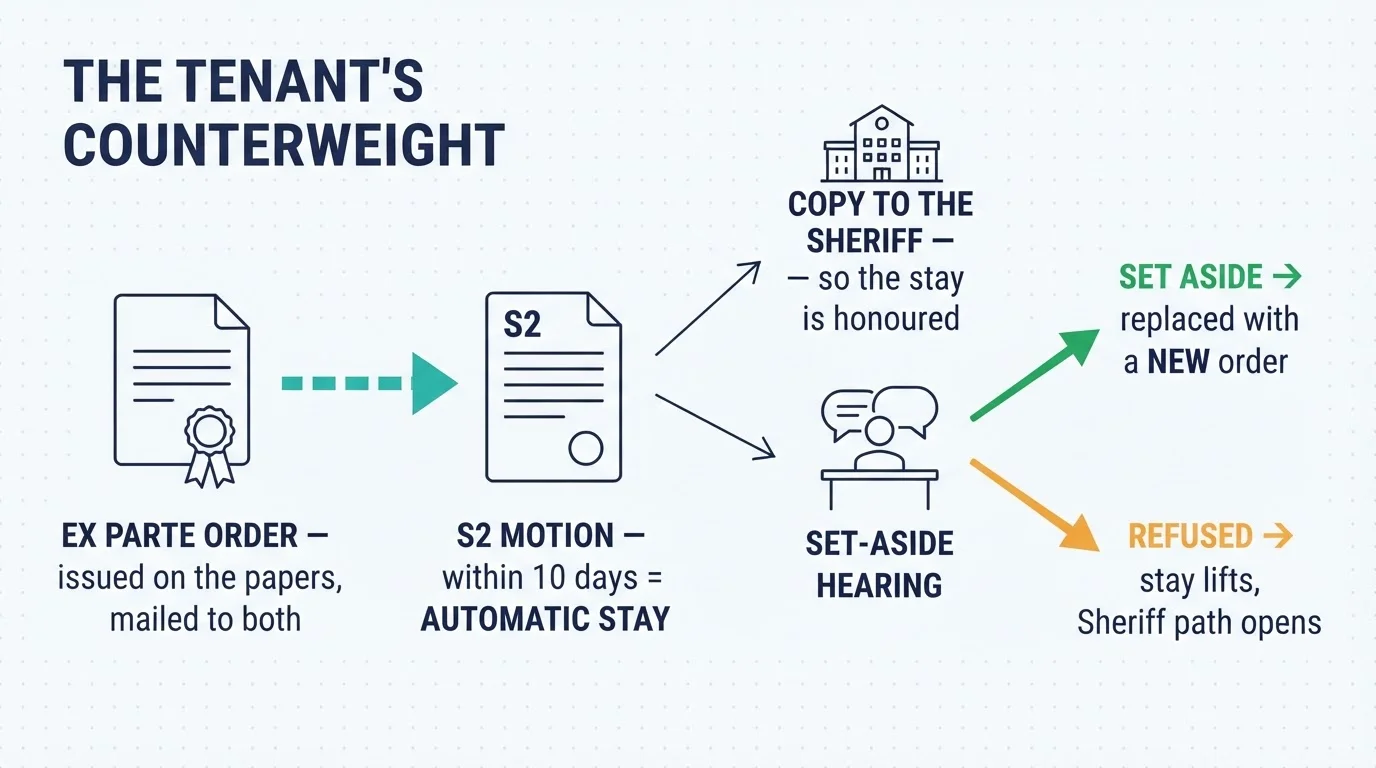
The outcomes: a successful motion doesn't merely cancel — the ex parte order is replaced with a new order; a refused motion lifts the stay, and the Sheriff path opens. (The wider stay toolkit, in one line: a Request to Review within 30 days, the once-per-tenancy Motion to Void an arrears eviction on full payment, and Divisional Court appeal.) Both endgames are strict: landlords respect the 10 days and enforce only through the Sheriff — changing locks with an order in hand is still an illegal lockout, and hands the tenant a T2; tenants who file no motion should know the Sheriff's Notice to Vacate, not the landlord's word, sets the real timeline. The Sheriff process gets its own guide later in this series. Looking ahead, Bill 60 and Bill 97's July 2026 operational updates keep pushing the LTB portal-first — confirm you're on the current L4B version before filing.
Practical Takeaways
Landlords:
- Win the drafting day: on-subject conditions, an explicit section 78 clause, every date diarized at signing.
- Treat the 30-day breach clock as un-extendable — and document any grace.
- Particularize the declaration: which condition, how, dates, amounts.
- Claim the money per the original application type — up to $50,000, NSF at $20 per cheque.
- Respect the tenant's 10-day set-aside window before any enforcement step.
- Enforce through the Sheriff alone — never change the locks.
Tenants:
- Read the settlement before signing — know which conditions carry the tripwire.
- Keep contemporaneous payment proof for every installment; receipts win set-aside hearings.
- The S2 within 10 days stays everything automatically — and walk a copy to the Sheriff's office.
- Raise real grounds: no breach, unrelated term, no section 78 clause, wrong amounts, unfairness.
- Lockouts are illegal regardless of any order — only the Sheriff enforces.
The L4 Enforcement Kit: Making Your Settlement or Payment Plan Actually Enforceable
A payment plan is only as strong as its section 78 clause — and its enforcement window is just 30 days from the breach. This free kit walks the whole arc: drafting conditions the LTB will enforce without a hearing, the breach clock, the filing package, the $50,000 money math, and lawful enforcement.
Get Free PDF →The Bottom Line
The L4 completes a pattern. The L3 enforces the tenant's own exit paperwork; the L4 enforces the Board's own blessed deal — and both run on the same trio of unforgiving numbers: a 30-day filing clock, a papers-only review, a 10-day counterweight. The differences are where the clock starts (the breach, not the calendar) and what's being enforced (a second chance, not a goodbye). None of this should scare either side away from settling — mediated deals resolve most cases faster and cheaper than any hearing. Deals are worth making; the L4 is simply the reason they're worth keeping. General information, not legal advice — for a contested set-aside or a large money claim, a paralegal or lawyer earns the fee. Next in this series, the table turns: the T6 — the tenant's application when the landlord's side of the bargain, repair and maintenance, is what didn't hold.
Every Condition Date, Already on the Calendar
Tenon10 tracks settlement conditions, payment schedules, and filing deadlines automatically — so the 30-day breach clock is an alert, not an autopsy.
Free • No signup required • Always current rules
Frequently Asked Questions
What happens if a tenant breaks a payment plan in Ontario?
If the plan came from an LTB-mediated settlement or conditional order containing a section 78 clause, the landlord can file an L4 within 30 days of the missed condition — and the LTB will normally issue an eviction order without holding a hearing. The tenant can respond with a Motion to Set Aside within 10 days, which stays the order automatically.
How long does a landlord have to file an L4?
No later than 30 days after the tenant failed to meet the specified condition. The clock runs from the breach itself — a stale breach can't support the application, and enforcement then waits for the next breach or a fresh notice-and-application cycle.
Does the breached condition have to relate to the original application?
Yes. The settlement or order's conditions must relate to the same reason as the application they resolved. A payment-plan breach on an arrears case qualifies; an unrelated conduct or housekeeping term bolted onto that deal generally can't be enforced through the no-hearing L4 lane.
How do I fight an L4 ex parte order?
File a Motion to Set Aside an Ex Parte Order (Form S2) within 10 days of the order date — filing on time stays the order automatically — and take a copy of the filed motion to the Court Enforcement Office so the eviction isn't enforced in the meantime. Real grounds include payments that were actually made, a term unrelated to the original application, a missing section 78 clause, or incorrect amounts.
What is a section 78 clause in an LTB settlement?
It's the term in a mediated settlement or conditional order that permits the landlord to apply for eviction without notice if the tenant breaches a specified condition. Without that clause — or with conditions unrelated to the original application — the ex parte L4 route isn't available.
How much money can the LTB order on an L4?
Up to $50,000 under the current instructions — the unpaid settlement balance plus NSF charges (capped at $20 per cheque) and, for arrears-based settlements, additional rent that came due after the settlement date. Claims above $50,000 belong in court, and amounts beyond the cap are extinguished once the LTB issues its order.