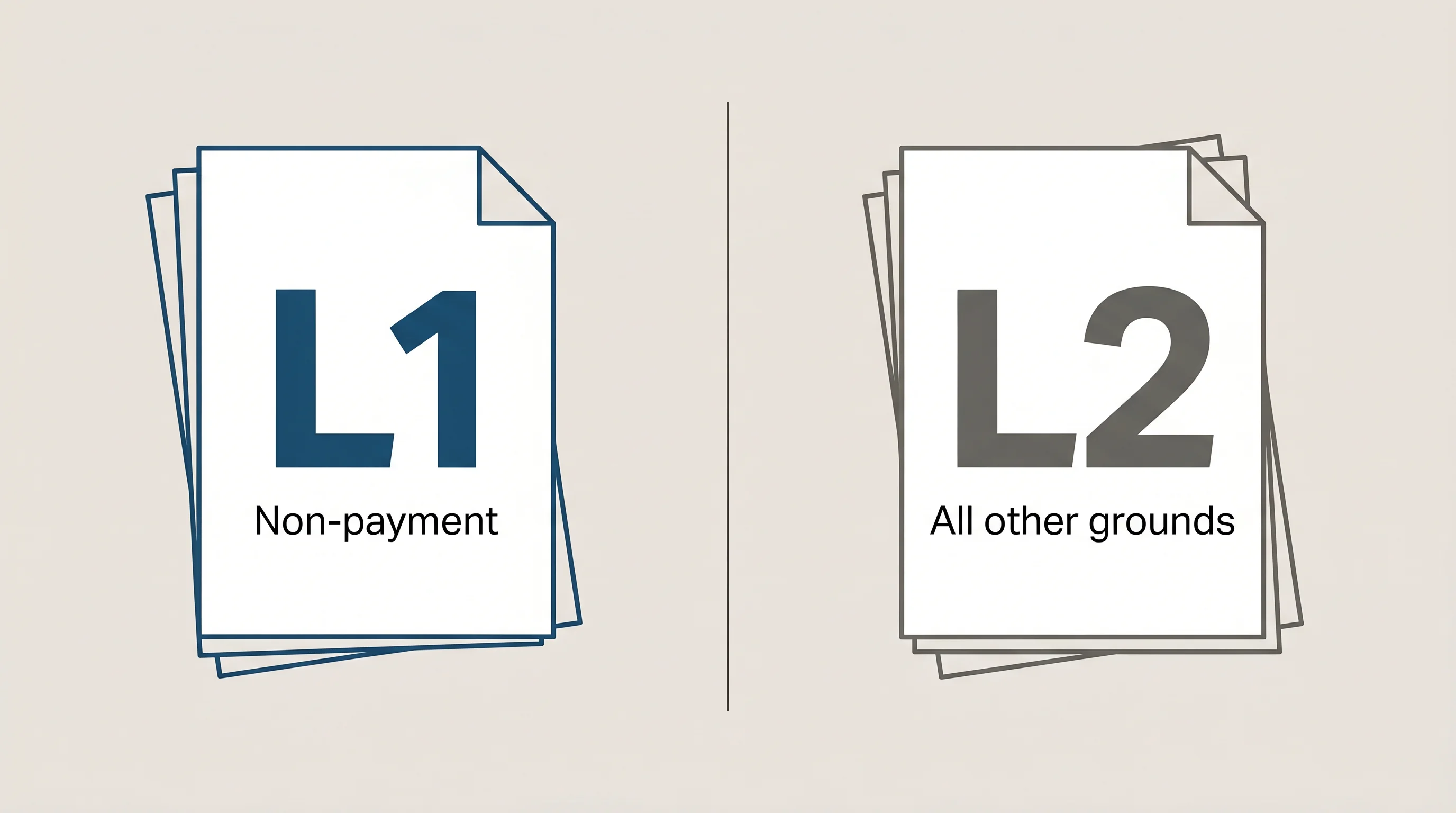
The L5 is the Landlord and Tenant Board's odd one out. Every other landlord application files through the Tribunals Ontario Portal; the L5 skips it entirely. It travels by email to a dedicated address, rides on an Excel spreadsheet with naming rules, demands every receipt and proof of payment up front, and bills $233 and up before anyone reads a word. Get the ritual right and your above-guideline increase proceeds. Get it wrong and the LTB can simply decline to process it — no hearing, no ruling, just a stalled file and a lost season.
Whether you qualify for an AGI is a different question, and it's covered in our AGI Process guide — the three legal grounds, the caps, the 18-month window, the sunset rule. Start there to confirm you have a case; this guide is the paperwork. And the paperwork changed: in November 2025 the LTB introduced email filing and a new Rental Unit Information form, and no landlord-facing walkthrough of the new procedure exists. This is that walkthrough — the pre-filing checkpoints, the package as the Board checks it, the two clocks that sink prepared applications, the hearing split, and what happens after the order. General information, not legal advice; procedure per the LTB's current instructions.
The L5 Filing Kit: The Complete-or-Refused Checklist for Ontario AGI Applications
The LTB can decline to process an incomplete L5 — and exclude late documents at the hearing. This free kit walks the entire filing as the Board checks it: the package, the RUI naming rules, the two clocks that sink prepared applications, and the hearing calendar. Updated for the November 2025 procedure.
Get Free PDF →Before You File: Substance, the FED, and the Fee
First rule: the L5 is the vehicle, not the case. It wins nothing your evidence hasn't already won. Before touching the form, confirm the substance — one of the three section 126 grounds (extraordinary municipal taxes, eligible capital work, or non-employee security services), the 3%-per-year cap, the 18-month capital-expenditure window, the section 129 sunset, and no serious maintenance problems standing in the way. If any of those fail, no filing technique rescues the application.
Second: set your First Effective Date (FED) — the date of the first rent increase you intend to take. It's the application's anchor: a granted AGI is retroactive to it. And it drives the deadline: you must file at least 90 days before the FED. File later, and you'll need a Request to Shorten Time — granted, the application proceeds; denied, it isn't accepted at all. Note that the notice machinery runs in parallel: each affected tenant still needs a proper N1 for the increase itself, on its own 90-day clock — our rent increase guide covers that side.
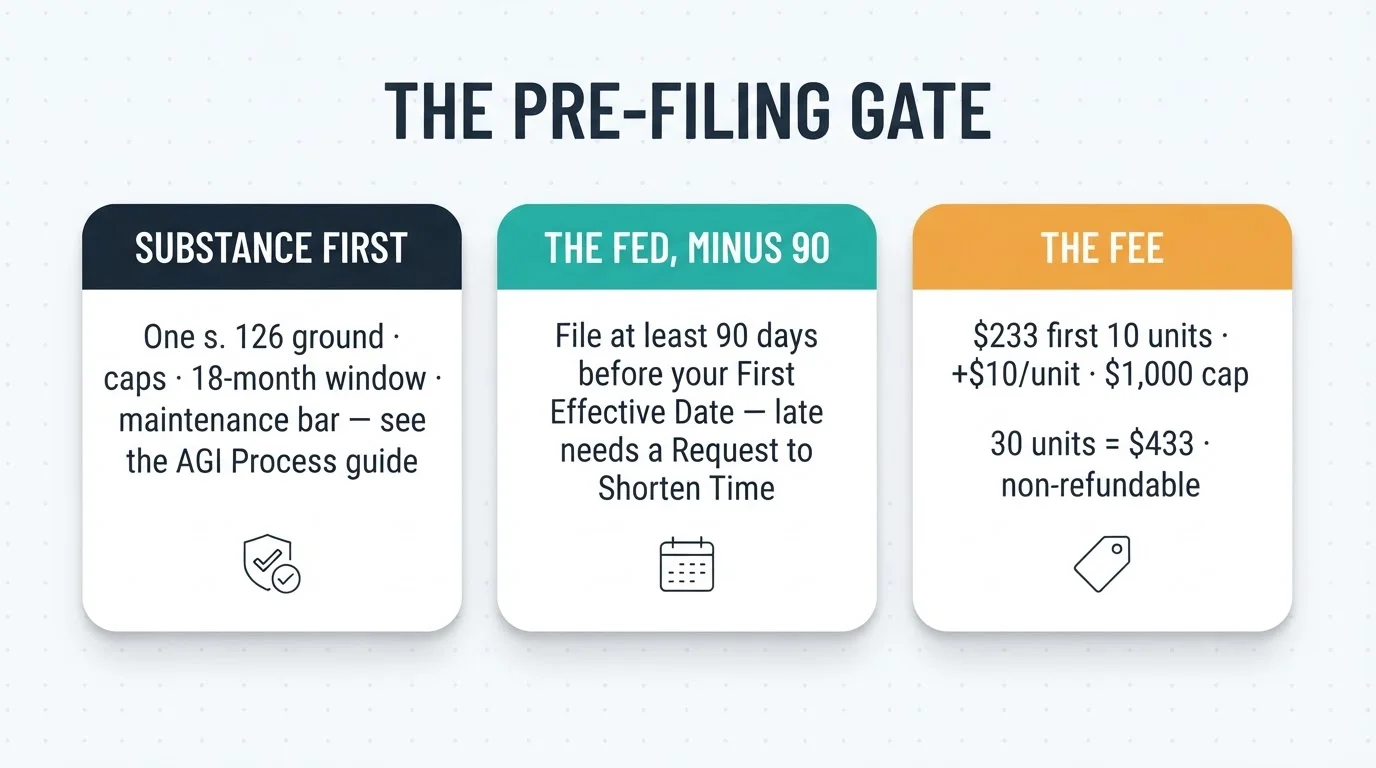
Third, the fee: $233 for the first 10 rental units, plus $10 for each additional unit, capped at $1,000. It's non-refundable, a fee waiver can be requested, and the LTB will not process an unpaid application. The math scales gently — a 30-unit building pays $433; only complexes of 87+ units hit the cap. One strategic note before spending it: in a market running 5.4% vacancy with falling rents, whether to file at all is a business decision as much as a legal one. The L5 is for costs the guideline genuinely can't carry.
The Package: Complete or Refused
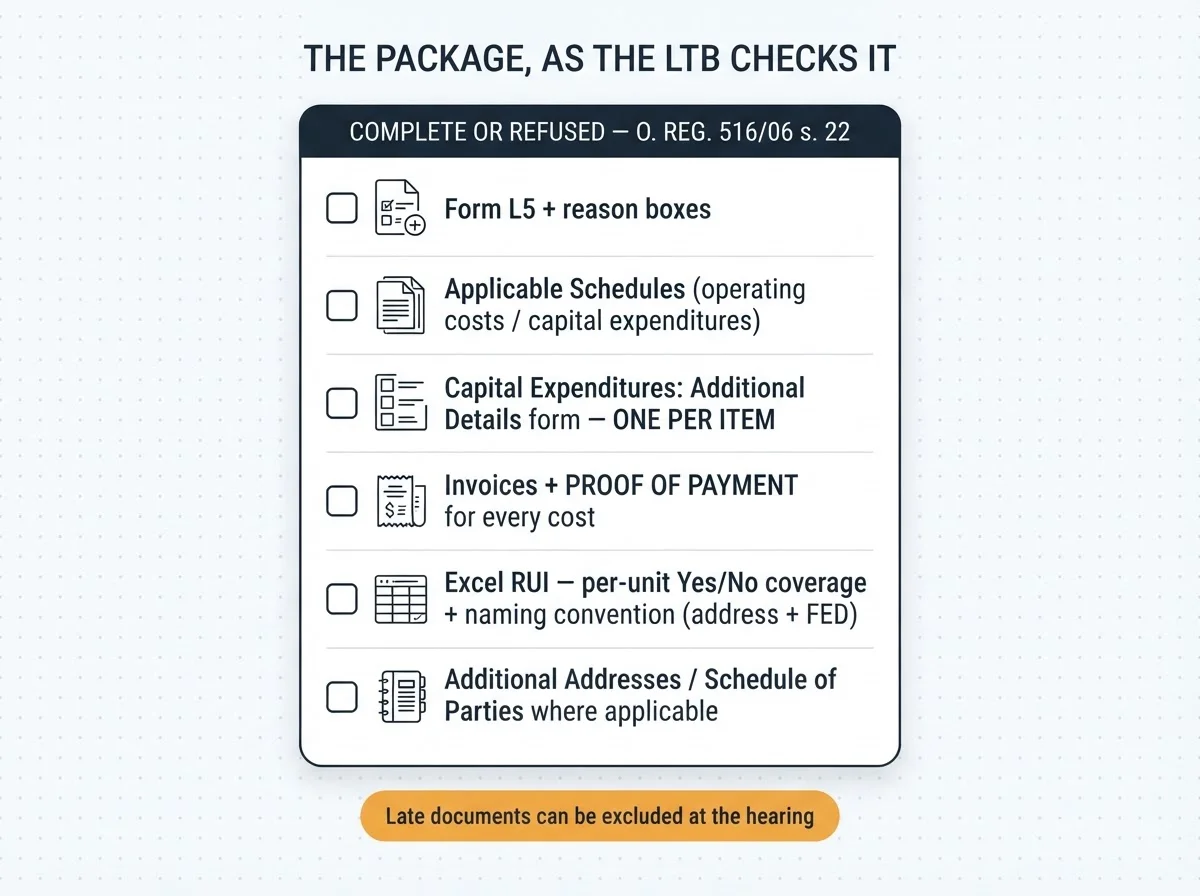
Here's the rule with teeth, from O. Reg. 516/06 and Interpretation Guideline 14: the LTB may refuse to process an incomplete application — and may refuse to let late-filed documents be used at the hearing. "Day-one evidence" isn't strategy for the L5; it's procedure. The package, in the order the Board checks it:
- Form L5 with the correct reason boxes shaded — taxes, capital expenditures, and/or security services.
- The applicable Schedules for each reason claimed — operating-cost details for taxes and security, capital-expenditure details for the work.
- For capital claims: a Capital Expenditures: Additional Details form for every single item — per item, not per project.
- Evidence of every cost AND proof that you paid it. Invoices alone are half the file; add the cancelled cheques, statements, or equivalents.
- Where applicable: an Additional Residential Addresses form and a Schedule of Parties.
Then comes the piece's most underestimated document: the RUI — the Rental Unit Information form, mandatory in MS Excel format since November 2025. It looks like admin. It's law in a spreadsheet. Beyond tenant mailing addresses and unit-by-unit rents, it carries a per-unit "covered by application: Yes/No" column — and that column administers a substantive rule: no capital-expenditure AGI for a unit whose new tenancy began after the work was completed. Cross-check every tenancy start date against every work-completion date before filing; covering an excluded unit invites challenge, and missing an eligible one forfeits lawful revenue for the life of the order. The RUI also obeys a naming law: the Excel file name and your email subject line must carry the complex address and the FED — for example, "RUI – 123 Anywhere St., Anywhere, ON (FED: 01-Jan-2027)".
A worked example, built from these rules: a 30-unit building files for a boiler and a roof. The package is the L5 with the capex box shaded, the capital-expenditure schedule, two Additional Details forms, contractor invoices with cancelled cheques clipped to each, and an Excel RUI with two post-work turnover units marked "No" — filed by email with a compliant subject line, $433 paid promptly. Every element itemized; nothing for the intake desk to bounce. One last line, because it matters: filing false or misleading information with the LTB is an offence under the RTA.

Filing Channels and the Two Clocks
Now the quirk that surprises everyone: there is no portal filing for the L5. The Tribunals Ontario Portal handles the L1, L2, L3, and L4 — not this one. The L5's three channels: email to [email protected] (added November 1, 2025, and generally the fastest), mail or courier to an LTB office, or in person at participating ServiceOntario locations. And the rule that trips mail filers every time: the Excel RUI goes by email regardless of how the application itself travels.
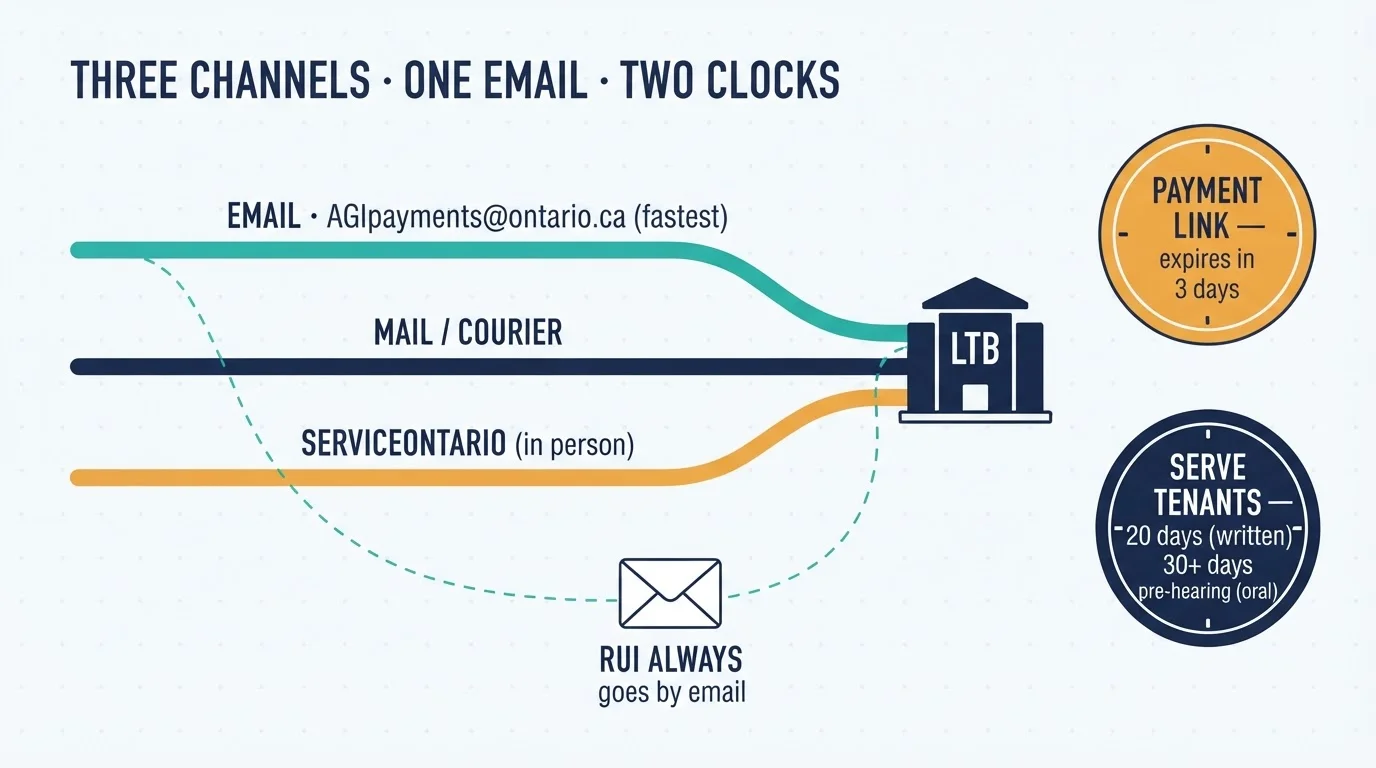
Two clocks then start, and both have sunk carefully prepared applications. Clock one: email filers receive a secure payment link from [email protected] that expires after three calendar days — pay inside it or request an extension by email, because an unpaid application is an unprocessed application. Clock two: once the LTB issues the Notice of Hearing, service obligations bite. For written hearings, serve every affected tenant with the application and Notice within 20 days of issuance; for oral hearings, materials go to tenants as soon as possible and at least 30 days before the hearing. Keep proof of service — a completed Certificate of Service per tenant is the clean way. Tenants are also entitled, on request, to the capital-expenditure evidence package — for no more than $5 on disc, photocopies at reasonable cost, or PDFs by email free.
For file-specific questions after filing, the AGI unit has its own inbox: [email protected], with your file number in the subject line.
The Hearing and the Order
The hearing's shape depends on your ground. Capital-expenditure AGIs get an oral hearing — and a Case Management Hearing is always held first, run by a Dispute Resolution Officer. Extraordinary-tax AGIs usually run as written hearings, decided entirely on the papers (an oral hearing can be requested; in-person happens only via accommodation).
The CMH carries real stakes in both directions. A landlord who misses it can have the application dismissed as abandoned — fee gone, evidence stale, refiling from zero; one double-booked agent is all it takes. A tenant who misses it may be deemed to accept the application's claims, with no further notice. And mediated settlements become consent orders binding every party, present or not — capped at what your filed evidence supports, and required, for capital claims, to state the section 129 rent-decrease date. Arrive ready to mediate: a consent order is often months faster than a contested hearing. On the written track, the rhythm is fixed: tenant responses land within 50 days of the Notice; your reply is due by day 65; the order issues on the papers.
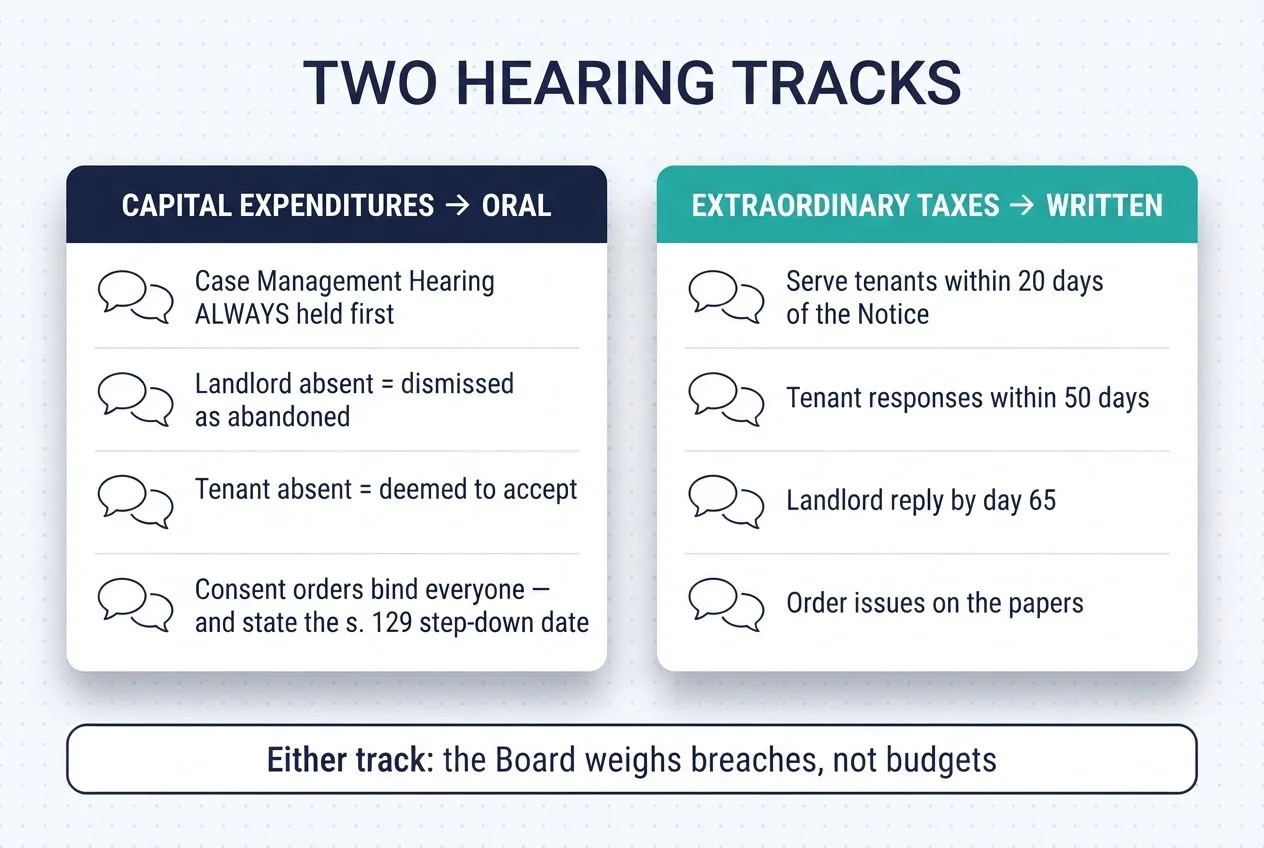
What does the Board actually weigh? Not budgets: neither your financial circumstances nor the tenants' ability to pay is legally relevant. What is relevant — and dispositive — is maintenance. Existing serious breaches of health, safety, or housing standards can lead the Board to dismiss the AGI for affected units or delay it until the work is done, and unfinished ordered elevator repairs can block it outright (both covered in the AGI Process guide). Expect scrutiny either way: tenant organizations publish detailed guides teaching cost-by-cost review of your schedules and maintenance counterevidence, and tenants can pursue repairs separately through a T6 application. Clean invoices and completed repairs are the real defence.
After the order, administration begins. The order is mailed to you and every affected tenant, and it sets the justified percentage, any phasing at 3% per year, and the retroactive amounts back to the FED — with one fairness valve: where the order issues three or more months after the increase's effective date, tenants can repay the difference in monthly installments over up to 12 months. For capital claims, it also states the section 129 step-down date, when rent decreases for sitting tenants as the expenditure's useful life ends. Diary that date permanently — it outlives the renovation, and missing it creates the exposure the AGI Process guide describes.
Practical Takeaways
Landlords:
- Confirm the substance before touching the form — the L5 is the vehicle, not the case.
- Set the FED and count back 90 days; run the N1 machinery in parallel.
- Assemble the package as the LTB checks it: schedules, per-item capex forms, invoices, and proof of payment.
- Build the RUI with per-unit coverage decisions and the naming convention — and email it no matter how you file.
- Pay inside the 3-day link; diarize the service window the day the Notice issues.
- Attend the CMH mediation-ready — absence can dismiss the application as abandoned.
- Administer the order: retroactive collection or installments, phasing, and the s. 129 date in the permanent file.
Tenants, stated plainly: you're entitled to the application, the Notice of Hearing, and the supporting evidence — and to respond, within 50 days in a written hearing or in person at the CMH and hearing. Skipping means being deemed to accept. The Board can't weigh anyone's ability to pay, but serious maintenance problems are the counterweight it can act on: document them, raise them, and know the T6 application exists.
The L5 Filing Kit: The Complete-or-Refused Checklist for Ontario AGI Applications
The LTB can decline to process an incomplete L5 — and exclude late documents at the hearing. This free kit walks the entire filing as the Board checks it: the package, the RUI naming rules, the two clocks that sink prepared applications, and the hearing calendar. Updated for the November 2025 procedure.
Get Free PDF →The Bottom Line
The L5 is a ritual with teeth: a dedicated email lane, a spreadsheet with naming law, a complete-or-refused package rule, two short clocks, and a hearing whose shape depends on your ground. None of it is hard; all of it is unforgiving. The application is effectively decided by what's in the envelope on day one — and the order is administered for years after, through retroactivity, phasing, and a step-down date that outlives the renovation. Pair this walkthrough with the AGI Process guide and you hold both halves of the file. General information, not legal advice — for a large or contested application, a licensed paralegal or lawyer earns their fee at the CMH alone. Next in this series: the L3 and L4 — the applications for tenancies that ended by agreement, and settlements that didn't hold.
Your RUI, Already Half-Built
Tenon10 keeps the data an L5 demands — unit-by-unit rents, tenancy start dates to check against work-completion dates, and every term on a calendar — so the filing starts from records, not archaeology.
Free • No signup required • Always current rules
Frequently Asked Questions
How much does it cost to file an L5 in Ontario?
$233 for the first 10 rental units, plus $10 for each additional unit, to a maximum of $1,000. The fee is non-refundable, a fee waiver can be requested, and the LTB won't process the application until it's paid.
How do I file an L5 application with the LTB?
Not through the Tribunals Ontario Portal — the L5 files by email to [email protected] (an option added in November 2025), by mail or courier to an LTB office, or in person at participating ServiceOntario locations. In every case, the Excel RUI form goes by email, with the complex address and First Effective Date in the file name and subject line.
What documents do I need for an AGI application?
The completed L5 with its applicable schedules; for capital expenditures, a Capital Expenditures: Additional Details form for every item; evidence of every cost claimed plus proof you paid it; the Excel RUI; and, where applicable, Additional Residential Addresses and Schedule of Parties forms. The LTB can refuse to process an incomplete package and can exclude late-filed documents at the hearing.
What happens at an AGI case management hearing?
A Dispute Resolution Officer helps the parties identify issues and try to settle. Capital-expenditure AGIs always get one. A landlord who doesn't attend risks dismissal as abandoned; a tenant who doesn't attend may be deemed to accept the application's claims. Settlements become consent orders binding all parties, capped at what the filed evidence supports.
How long does an L5 application take?
File at least 90 days before your First Effective Date, then expect the hearing process: written hearings run a roughly 65-day paper exchange after the Notice issues; capex applications add a CMH before an oral hearing. If the order arrives three or more months after the increase's effective date, tenants can repay the retroactive difference in installments over up to 12 months.
Can tenants dispute an L5 application?
Yes — they're entitled to the application, the Notice of Hearing, and the supporting evidence, and can respond in writing (within 50 days in a written hearing) or participate at the CMH and hearing. The Board can't weigh anyone's ability to pay, but serious maintenance breaches can lead it to dismiss the AGI for affected units or delay it until repairs are done.