One date decides whether your next rent increase is capped at 2.1% — or capped at nothing: November 15, 2018. Under section 6.1 of the Residential Tenancies Act, a unit first occupied for residential purposes after that date is exempt from Ontario's annual rent increase guideline. And for those units, the notice you serve isn't the familiar N1. It's the N2 — Notice of Rent Increase (Unit Partially Exempt).
The N2 may be the most misunderstood notice in the LTB stack. Landlords serve the N1 out of habit and unknowingly void their increase. Others assume "exempt" means "no rules" and trip over the ones that survive. Tenants often don't discover their unit is uncapped until the first renewal lands. And half the internet — including, until recently, plenty of professional content — confuses the N2 with an above-guideline increase, which is a completely different process.
Let's clear that up first: the N2 is not the AGI route. An above-guideline increase applies to rent-controlled units and requires an N1 plus an L5 application that the LTB must approve. The N2 needs no approval at all — because for qualifying units, no cap applies. This guide covers which units those are, the rules that still bind, the evidence file that wins disputes, and how to price an increase in 2026's unusually soft market. It's general information, not legal advice.
The N2 Compliance Checklist: 18 Steps to an Uncapped Rent Increase That Holds Up
Confirm your unit's rent-control exemption, build the proof file the LTB expects, respect the 12-month and 90-day clocks, and dodge the wrong-form mistake that voids increases. Free landlord PDF.
Get Free PDF →What the N2 Is — and Which Units Qualify
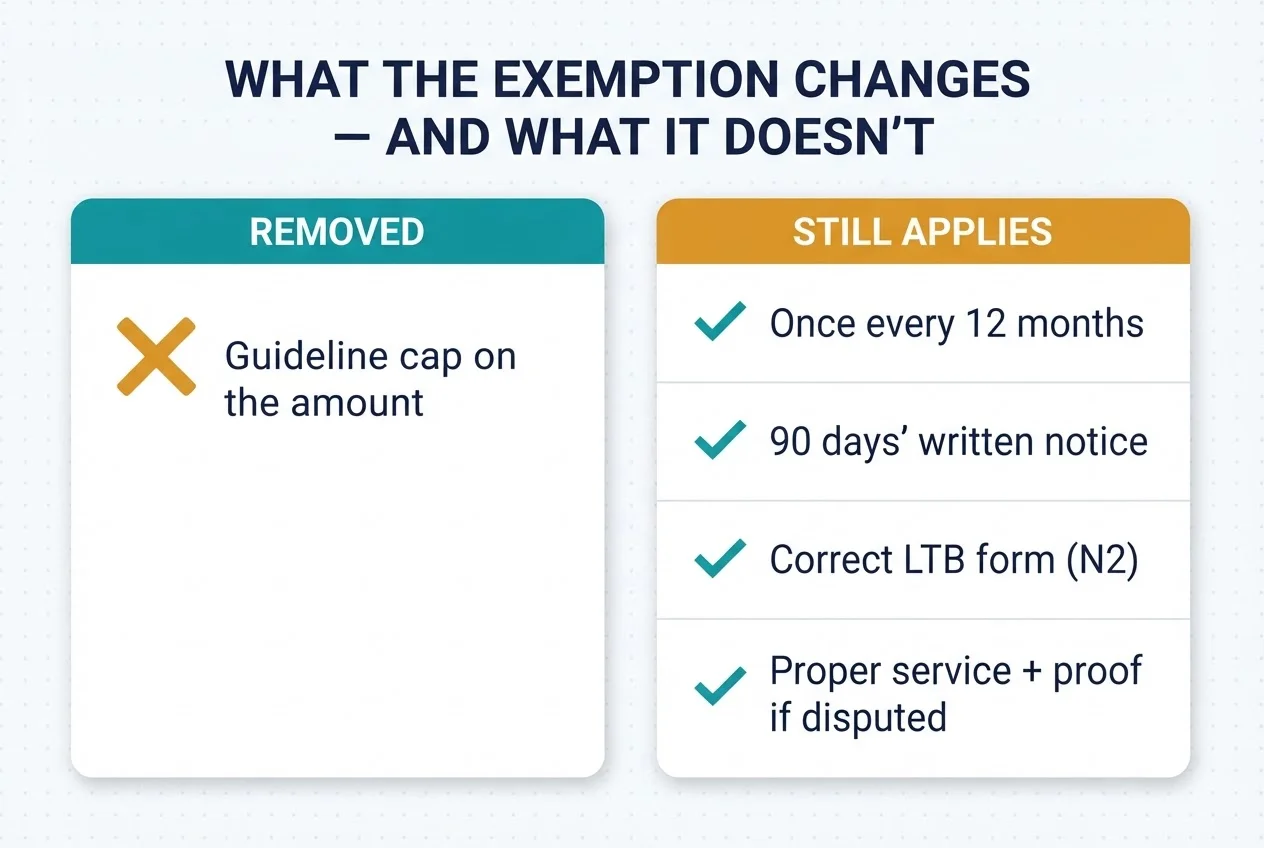
The form's official name does a lot of quiet work: Notice of Rent Increase (Unit Partially Exempt). "Partially" means exactly one thing has been removed — the guideline cap on the amount. Everything else in the RTA still applies, from notice periods to maintenance duties to eviction protections.
Section 6.1 of the RTA creates the exemption for units first occupied for residential purposes after November 15, 2018. The qualifying categories are:
- New buildings — purpose-built rentals and condos completed and first occupied after the cutoff;
- New additions to existing buildings;
- New mobile home parks and land lease communities;
- New self-contained units in existing houses — basement apartments and secondary suites — but only where the unit was created in previously unfinished space after the cutoff.
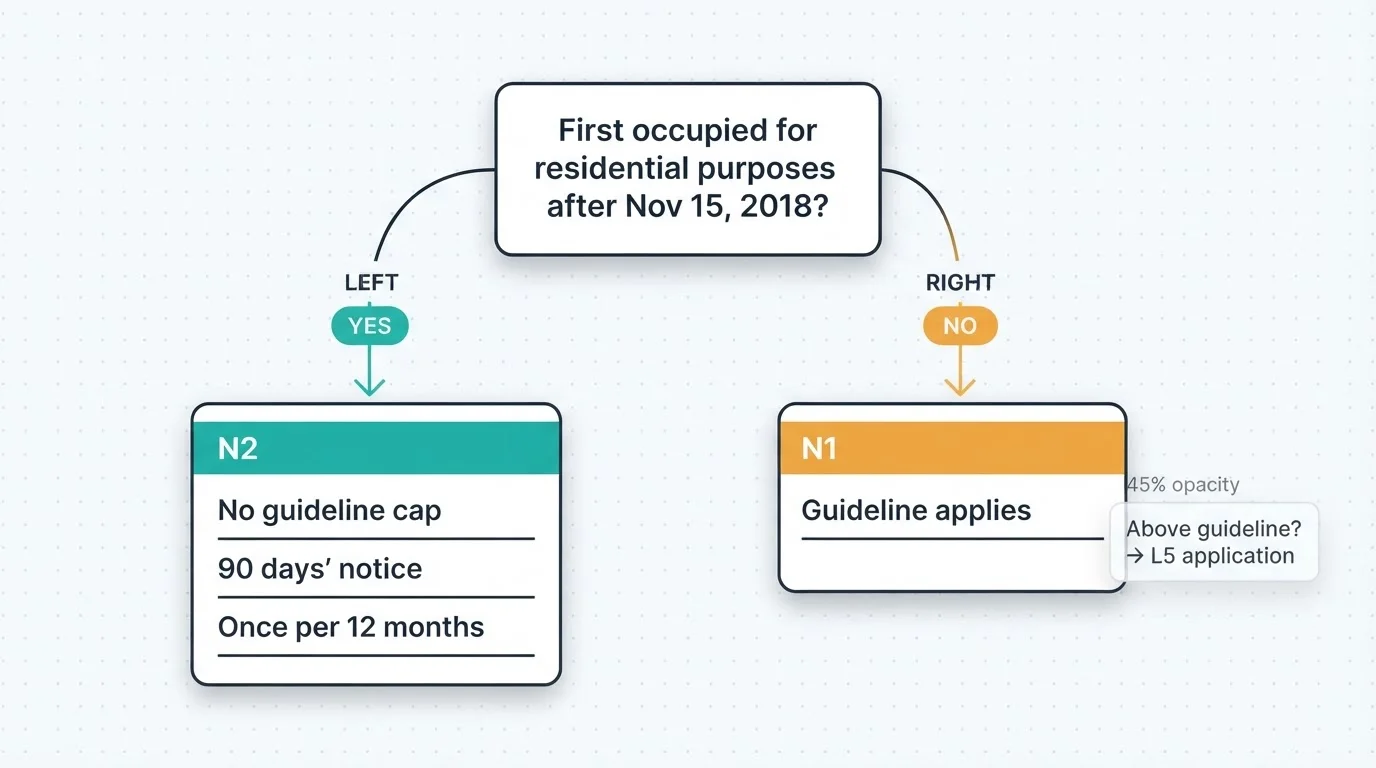
Just as important is what does not qualify. Renovating existing finished space — however extensive — does not create an exemption; repairs don't reset the clock. And the date that counts is the unit's first residential occupancy, not your current tenant's move-in date. A tenant who moved into a 2015-built condo in 2024 is still in a rent-controlled unit; a tenant who moved into a 2019-completed tower on day one is not. Note also that "available" is not "occupied" — a unit that sat finished but empty before November 15, 2018 and welcomed its first resident afterward turns entirely on the evidence.
The exemption was introduced in late 2018 to spur rental construction, and the N2's universe has grown accordingly: purpose-built rental starts across the Greater Toronto and Hamilton Area hit a multi-decade high of 10,388 units in the twelve months to Q1 2026. Virtually every new lease in new stock is N2 territory. One more housekeeping note: the Bill 60 and Bill 97 changes taking effect through 2026 reworked several notice and eviction mechanics — but as of July 2026 they did not touch the s. 6.1 exemption, the 12-month rule, or the 90-day notice requirement described below.
The Rules That Still Apply (Partially Exempt ≠ No Rules)
Three rules survive the exemption intact, and each one can sink an increase on its own:
- Once every 12 months. No increase within the first 12 months of the tenancy, and at least 12 months since the last increase.
- At least 90 days' written notice before the new rent takes effect.
- The current LTB Form N2, properly served. Not a letter, not an email thread, not the N1.
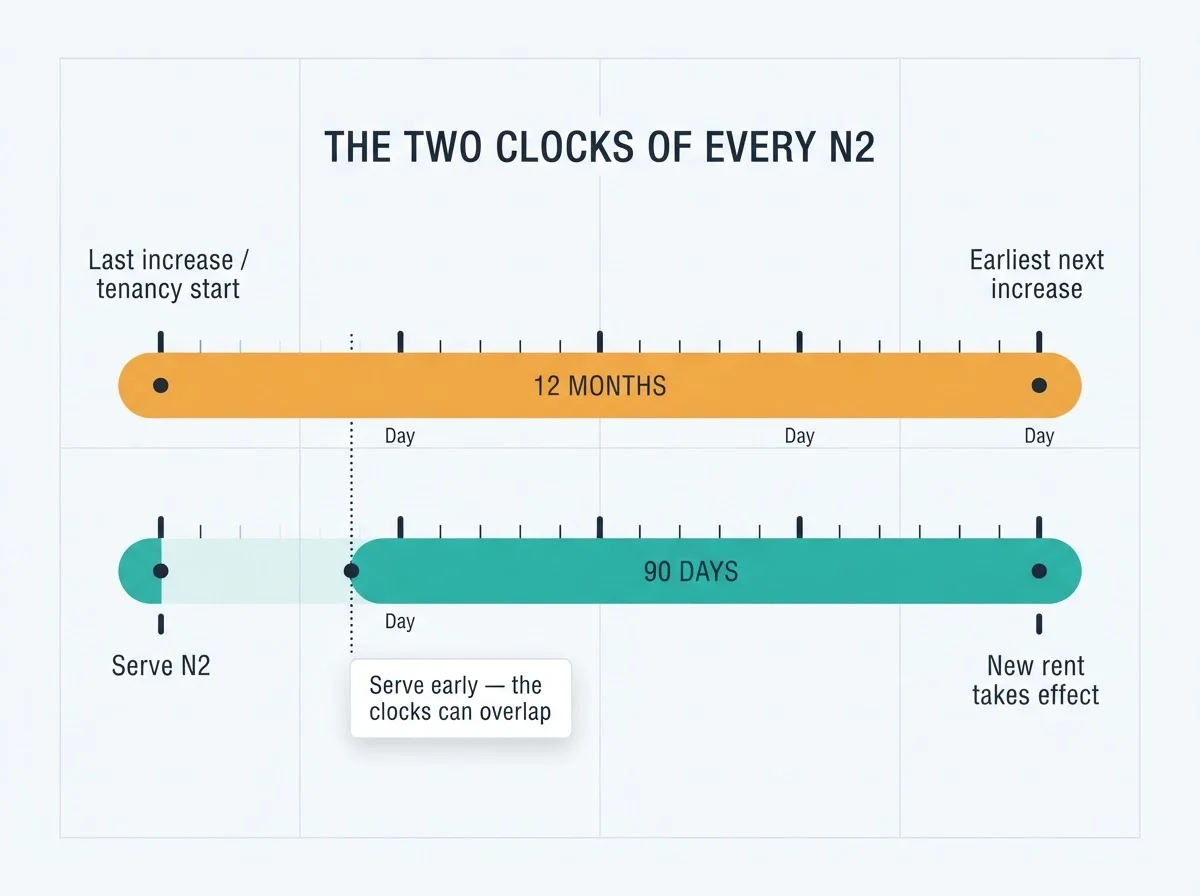
There is no cap on the amount — that's the exemption working as designed — but an increase that breaks any procedural rule is invalid regardless of exemption status, and the tenant simply keeps paying the old rent. Service is where careful landlords still stumble: never post the notice on the unit door and never serve it by text, as defective service voids the notice. Email works only with the tenant's signed consent on the LTB's consent form. Whatever method you use, complete a Certificate of Service the same day.
If you're the tenant reading this: you can check your own status. Ask in writing when the building or unit was first occupied for residential purposes, look for a section 15 additional term in your Ontario Standard Lease disclosing the exemption, and request the occupancy certificate. If an increase arrives on the wrong form, with short notice, or inside the 12-month window, it's invalid — you aren't required to pay it, and you can dispute it at the LTB with a T1 application within 12 months of first being charged the higher amount.
Proving the Exemption — and the Errors That Void Increases
Here's the part that surprises landlords most: if the exemption is disputed, the burden of proof is yours. Ontario's guidance is explicit that the landlord must prove the building or addition was first occupied after November 15, 2018, and the courts have long held that the party claiming the benefit of a statutory exemption must prove the claim. A verbal "trust me, it's a new building" fails at the Board.
The fix is a proof file, assembled before you serve anything:
- Occupancy certificate for the building or unit;
- Building permits showing completion after the cutoff;
- A statutory declaration for converted spaces, confirming no one occupied the space before the conversion was complete;
- A section 15 lease term disclosing the exemption at signing — Ontario expressly recommends this;
- The dated first lease for the unit, corroborating the timeline.

The failure patterns are well-worn. In one reported Toronto dispute, tenants defeated a roughly 7% increase after their landlord assumed renovations had created an exemption — the Board's position was that repairs don't matter; first occupancy is the only relevant date. Borderline buildings produce the ugliest fights: in one illustrative case circulating among Ontario renters, a home was ready for occupancy in September 2018, the landlord attempted an increase near 30% claiming the exemption, and the whole question collapsed into whether anyone actually lived there before November 15 — precisely the fact a proof file settles in minutes.
And then there's the most common error of all: the wrong form. Practitioners report that most landlords assume the N1 suffices for exempt units. It doesn't. Serve an N1 where the N2 belongs (or vice versa) and the increase can be void — the tenant keeps paying the old rent while you restart with a fresh 90 days. On a $200-per-month increase, that mistake costs $600 or more before any re-service slippage, and if the tenant paid an invalid increase, the T1's 12-month lookback puts rebates plus interest on the table. If your lease hygiene needs a broader check, our guide to common Ontario lease mistakes pairs well with this one.
Pricing an N2 Increase in the 2026 Market
The N2's legal ceiling is unlimited. Its market ceiling, right now, is anything but. Vacancy in newer GTHA rental buildings reached 5.4% in Q1 2026 — up from 3.6% a year earlier and the highest since the pandemic — while net effective rents on new stock fell to a 16-quarter low, with landlord incentives averaging roughly $400 a month off asking. In other words: the very buildings entitled to uncapped increases are the ones currently offering discounts to fill units.
That reshapes the math. A sitting tenant who leaves over an aggressive increase walks into a market offering incentives — and leaves you with vacancy months, your own incentive to the next tenant, and re-leasing costs. Practical pricing discipline for 2026 looks like this: benchmark against today's asking rents in your building and area rather than last year's; count each vacant month against whatever the increase would have gained; and treat the guideline — 2.1% this year, with 1.9% already announced for 2027 — as a retention anchor even where it doesn't legally bind. CMHC expects vacancies to stay elevated into 2027, so professionally managed stock is broadly expected to keep increases moderate; treat that as a forecast, not a promise. Run your own numbers with our Ontario Rent Increase Calculator.
Practical Takeaways
For landlords, the whole discipline compresses to seven moves:
- Confirm the exemption first — first residential occupancy after November 15, 2018, judged by the unit's date, not the tenant's move-in.
- Assemble the proof file before serving: occupancy certificate, permits, statutory declaration, dated first lease.
- Disclose it with a section 15 lease term at signing.
- Respect the two clocks: 12 months between increases, 90+ days' notice — and remember they can overlap.
- Use the current Form N2. The N1 will not do, and the wrong form voids the increase.
- Serve properly — no door-posting, no texts, email only with signed consent — and keep a Certificate of Service.
- Price against the 2026 market, not the legal ceiling. Vacancy is the real cap.
For tenants, three checks: find the first-occupancy date and the s.15 clause; remember an improper increase is void and you keep paying the old rent; and know the dispute window — 12 months from first being charged, via the T1. The authoritative references are the Tribunals Ontario N2 form and instructions and ontario.ca's residential rent increases page; for guideline-unit mechanics, see our complete N1 guide for 2026 and the 2027 edition.
The N2 Compliance Checklist: 18 Steps to an Uncapped Rent Increase That Holds Up
Confirm your unit's rent-control exemption, build the proof file the LTB expects, respect the 12-month and 90-day clocks, and dodge the wrong-form mistake that voids increases. Free landlord PDF.
Get Free PDF →The Bottom Line
The N2 removes exactly one thing: the cap. Everything else survives — the 12-month clock, the 90-day runway, the right form, proper service, and a burden of proof that sits squarely on the landlord. Get those right and the exemption works precisely as the legislature designed it. Get any of them wrong and the increase is void, no matter how new the building is. And in 2026's market, the smartest N2 is often a modest one: the tenant who stays at a reasonable rent beats the vacant unit chasing an unlimited ceiling.
This week: verify your unit's first-occupancy date and start the proof file. Then calendar your next eligible increase. This is general information, not legal advice — for a live dispute or a borderline occupancy date, talk to a licensed paralegal or lawyer familiar with the RTA.
Serve the Right Notice, Every Time
Tenon10 generates the correct rent-increase notice for your unit, tracks the 12-month and 90-day clocks automatically, and keeps your exemption proof file with the tenancy record.
Free • No signup required • Updated for the Bill 60 changes in force 21 Sep 2026
Frequently Asked Questions
What is an N2 notice in Ontario?
It's the LTB's Notice of Rent Increase (Unit Partially Exempt) — the form used when a unit first occupied for residential purposes after November 15, 2018 is exempt from the annual rent increase guideline. The landlord must give at least 90 days' written notice and can raise rent only once every 12 months, but there is no cap on the amount.
Is the N2 the same as an above-guideline increase (AGI)?
No. An AGI applies to rent-controlled units and requires serving an N1 plus filing an L5 application that the LTB must approve. The N2 is for guideline-exempt units and requires no LTB approval — the two processes are entirely different.
How do I know if my unit is exempt from rent control?
Check when the building or unit was first occupied for residential purposes — after November 15, 2018 generally means exempt. Look for a section 15 additional term in your lease disclosing the exemption and ask for the occupancy certificate. If it's disputed, the landlord must prove the exemption with documents; verbal claims aren't enough.
Is there any limit on how much rent can go up with an N2?
There's no statutory cap on the amount. But the 12-month rule and the 90-day written notice still apply, and an increase that breaks either — or that's served on the wrong form or by a defective method — is invalid. Practically, 2026's elevated vacancy and widespread incentives act as the real ceiling.
What happens if the landlord uses the wrong form?
The increase can be void. Serving an N1 on an exempt unit (or an N2 on a controlled one) generally means the tenant keeps paying the old rent while the landlord re-serves correctly and waits out a fresh 90 days. A tenant who paid an invalid increase can seek a rebate through a T1 application within 12 months.
Does a renovation make a unit exempt from rent control?
No. Repairs and renovations of existing finished space don't create an exemption — tribunals treat first residential occupancy as the only relevant date. Only a unit first occupied after November 15, 2018, or a new self-contained unit created in previously unfinished space after that date, qualifies.