Update, 26 Sep 2026: The change to "persistent" late payment that this guide looked ahead to took effect on September 21, 2026 — see the LTB's September 21 operational update. As of that date, a tenant is considered to have persistently paid rent late when rent is received more than seven days after the due date at least three times within a six-month period. A payment doesn't count as late if the landlord applied it to another amount the tenant owed, such as rent arrears. A tenant can still be found to have persistently paid late in other circumstances, so the Board's broader look at frequency, recency and the length of the tenancy, described below, still matters for patterns outside that test. The N8 form has also been updated, and previous versions won't be accepted as of November 30, 2026. Where the text below says there is no fixed number, or that the new definition is not yet confirmed, read it as written before September 21, 2026.
Every landlord eventually meets this tenant: the rent always arrives — on the 6th, the 12th, once memorably on the 20th — but it always arrives. The N4 can't touch them, because by hearing day nothing is owing. Late fees can't touch them either, because charging for late rent is illegal in Ontario. The lawful tool built for this exact situation is the N8 — Notice to End your Tenancy at the End of the Term.
It's also one of the most frequently dismissed notices at the Landlord and Tenant Board, and it fails on the same two technical defects again and again. Most landlords don't know it carries five distinct grounds, and fewer still know what actually happens at the hearing — where the Board's first answer is usually a payment plan, not an eviction.
One piece of context frames everything: in Ontario, a lease ending is not, by itself, a reason for anyone to leave. Fixed-term leases roll into month-to-month automatically, and that evergreen framework survived the 2026 reforms. The N8 exists precisely because "the term is up" is not a ground — ending a tenancy at term's end requires a reason, and this notice lists the only five that count. What follows is general information, not legal advice.
The N8 Checklist: 19 Steps to Handle the Tenant Who Always Pays Late
Build the due-vs-paid ledger that wins, nail the termination-date rule that voids most N8s, and walk into the LTB hearing knowing a payment plan — not eviction — is the likely first outcome. Free landlord PDF.
Get Free PDF →What the N8 Is: Five Grounds, One End-of-Term Notice
The N8 lives in section 58 of the Residential Tenancies Act, and it's a hybrid unlike any other notice in the stack: for-cause in its reason, no-fault in its timing. It can only end a tenancy at the end of the term or rental period — never mid-stream — but it still requires one of five specific grounds:
- Persistent late payment of rent — the headliner, and the subject of most of this guide;
- The tenant no longer qualifies for public or subsidized housing;
- The unit was provided as a condition of employment, and the employment has ended — building superintendents, farm workers, institutional staff;
- The tenancy arose from a purchase-and-sale agreement that has been terminated;
- A care-home occupancy agreed solely for rehabilitative or therapeutic services whose term has ended (available only where no such tenant may live in the complex more than four years).
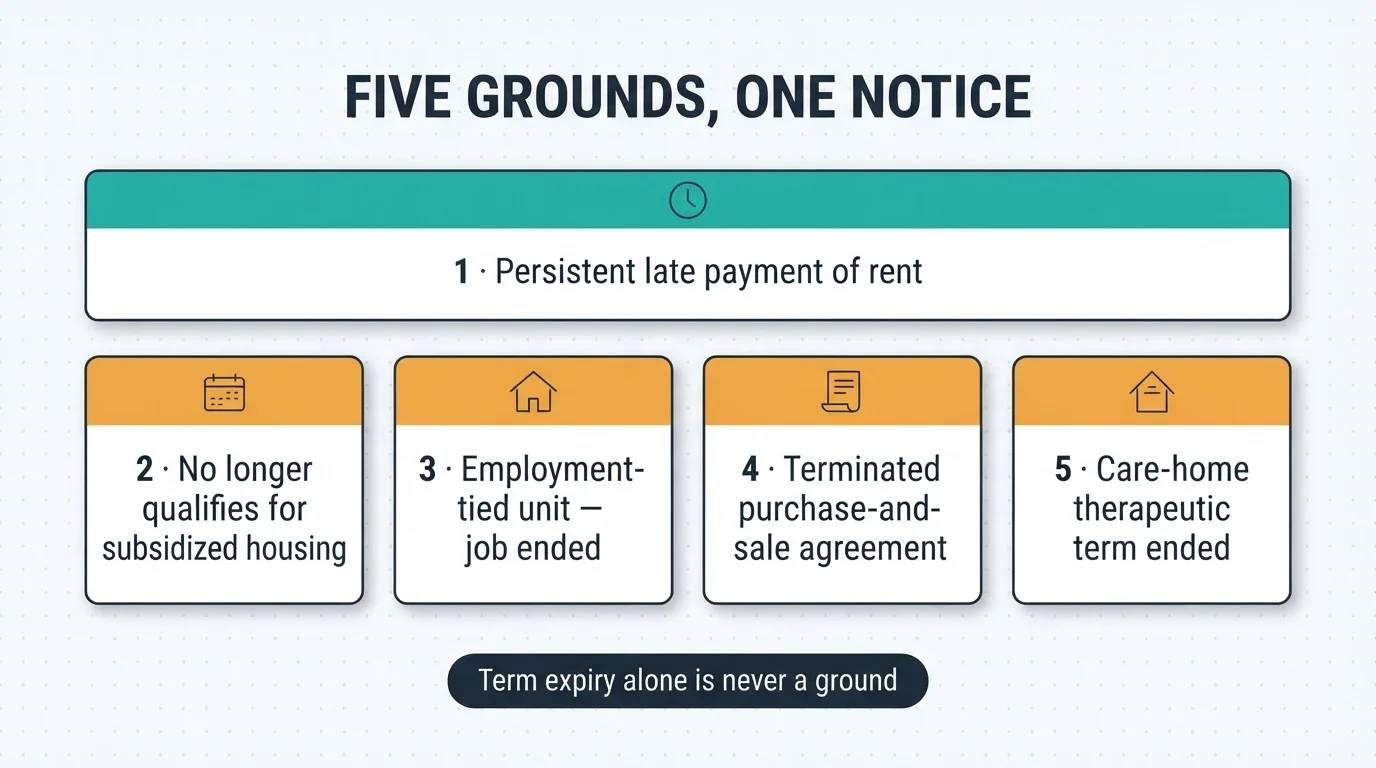
Notice what isn't on the list: "the lease expired." If you're hoping the calendar alone will end a tenancy, it won't — and treating an occupant casually past a term's end has its own traps, covered in our guide to the 60-day rule. Grounds two through five are real but narrow; for most landlords, the N8 question is the persistent-lateness question, so that's where we go next.
"Persistent" Late Payment: The Ground Everyone Uses
Here's the uncomfortable truth for anyone hoping for a bright line: under current in-force law, there is no fixed number of late payments that makes a pattern "persistent." The Board weighs frequency, recency, and the length of the tenancy together. In practice, the Landlord's Self Help Centre's benchmark is being able to show late payment roughly seven or eight times within a consecutive twelve months. At the other end sits the judicial floor: an adjudicator once dismissed an N8 built on two latenesses in a decade-old tenancy with words to the effect that two late payments is not persistence — it's two late payments. That case had another feature worth noting: the notice landed days after an unrelated conflict with the property manager, and the Board noticed. Thin patterns invite motive scrutiny.
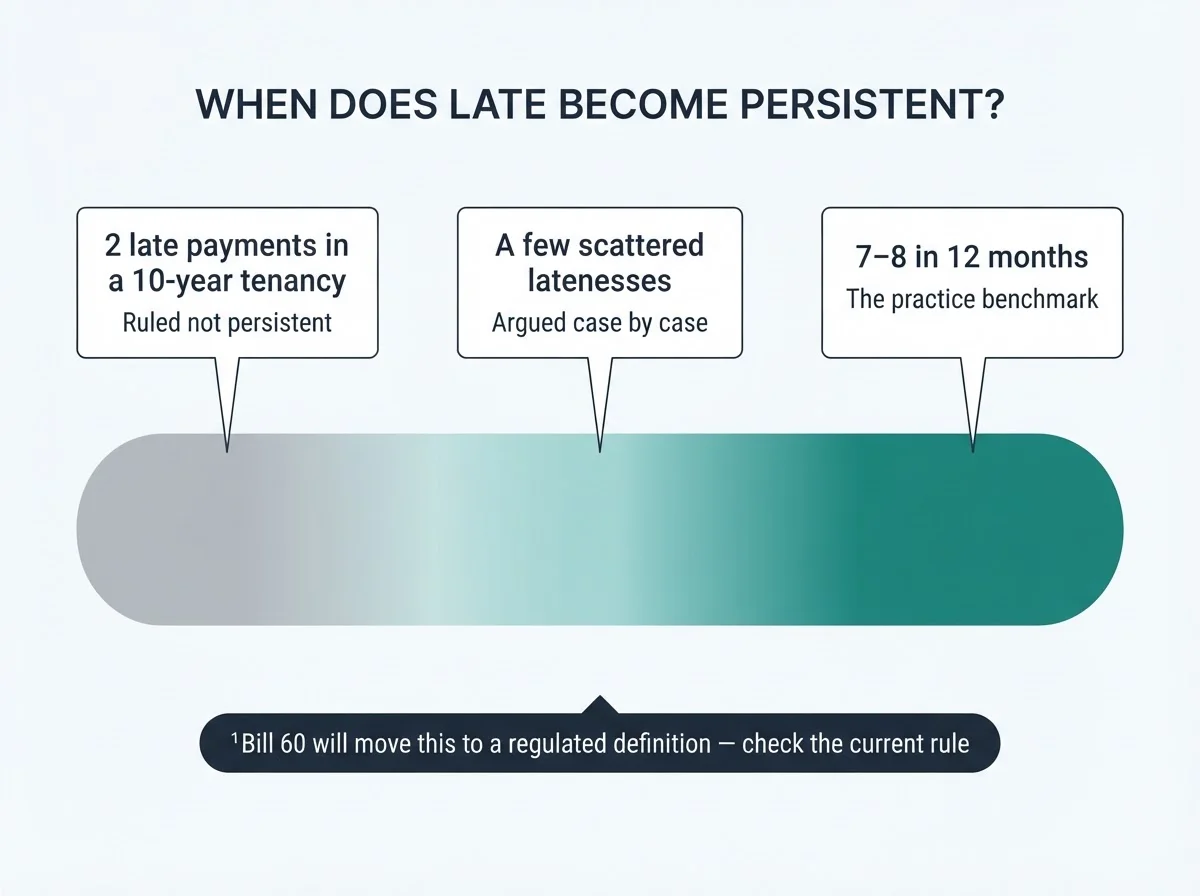
What counts as "late"? Anything after the due date in the lease — even a day. Grace periods are courtesy, not law. But a string of trivially short delays in an otherwise solid long tenancy is exactly the fact pattern adjudicators dismiss, so count honestly before you act.
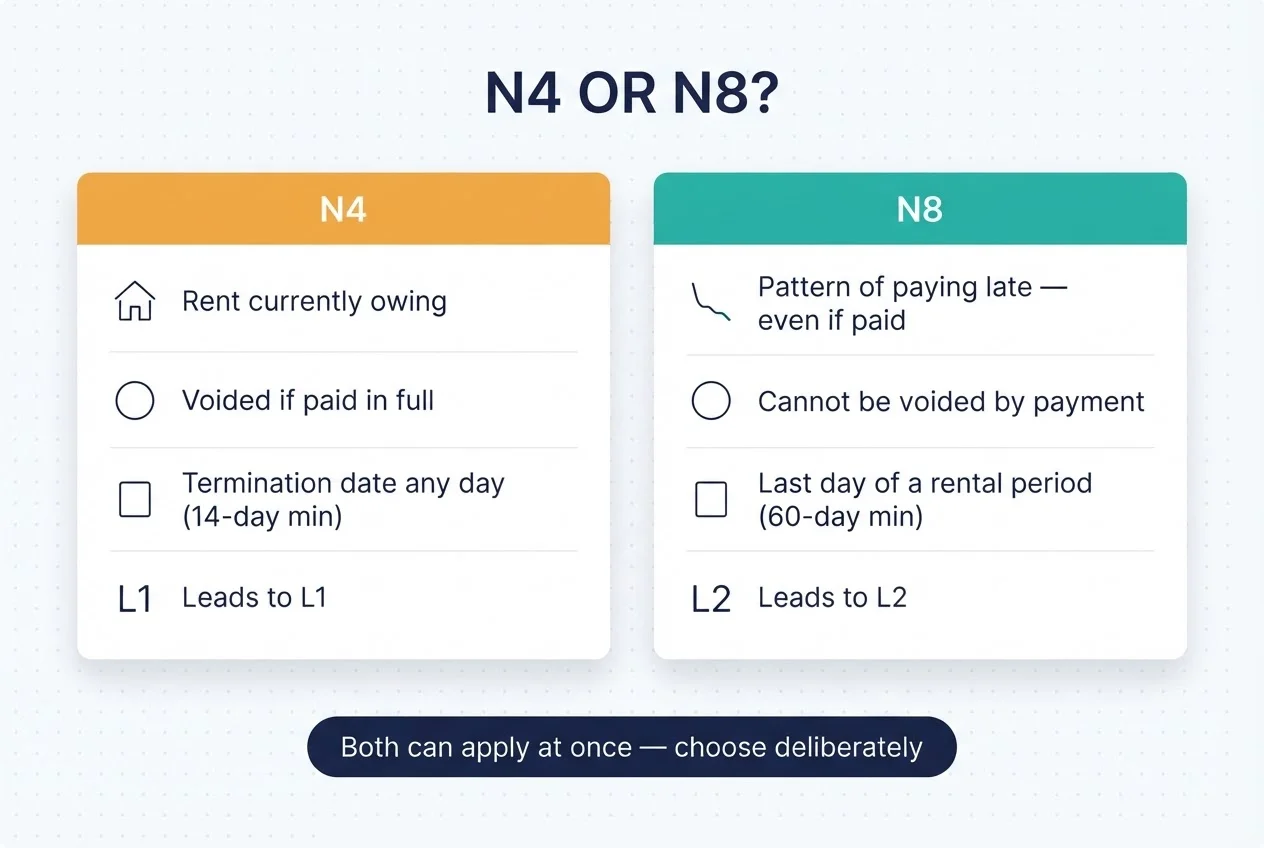
The decision that trips up more landlords than any other is N4 versus N8. They solve different problems. The N4 chases rent that is currently owing: it's voidable — pay in full and it dies — its termination date can land any day of the month (a 7-day minimum for notices given on or after September 21, 2026, previously 14 for monthly and yearly tenancies), and it leads to an L1 application. The N8 targets the pattern of paying late even where the rent is eventually paid: no payment can void it, its termination date must be the last day of a rental period at least 60 days out, and it leads to an L2. Both can exist at once — a tenant can be late-again and currently behind — and you must choose deliberately. In one 2022 case, an N8 was found defective because it pleaded non-payments rather than late payments: the wrong instrument for the facts sank the application.
Bill 60 watch: The 2026 reforms add section 58(1.1) to the RTA, which will hand the definition of "persistent" to a regulation-set standard — but the regulation's in-force status was not confirmed as of this writing, and acting on unproclaimed rules can invalidate a notice. Before serving, check the current law on Ontario's e-Laws and download the current N8 form; the form is expected to change when the definition lands. Our Bill 60 and Bill 97 guide tracks what's in force.
Why does this tool exist at all? Because Ontario prohibits late fees. A landlord cannot lawfully charge a penalty for late rent — so the N4/N8 framework is the lawful channel for chronic lateness, which is exactly why serving it correctly matters so much.
Serving a Valid N8: The Two Rules That Kill Most Notices
Rule one — the termination date. It must be the last day of a rental period, at least 60 days after service (28 days for daily or weekly tenancies), and never before a fixed term ends. The day you serve is day zero; add five days if you serve by mail. For a monthly tenancy running with the calendar, that means the 30th or 31st — dating the notice for the 1st is the classic fatal slip, and it has produced repeated dismissals (Ha v Pham in 2021; Blair-Denham v Rae in 2023). Weekly tenancies carry a quirk: if the period ends on a Sunday, the termination date must be a Sunday. Validate the date with the Termination Date Calculator before you print anything.
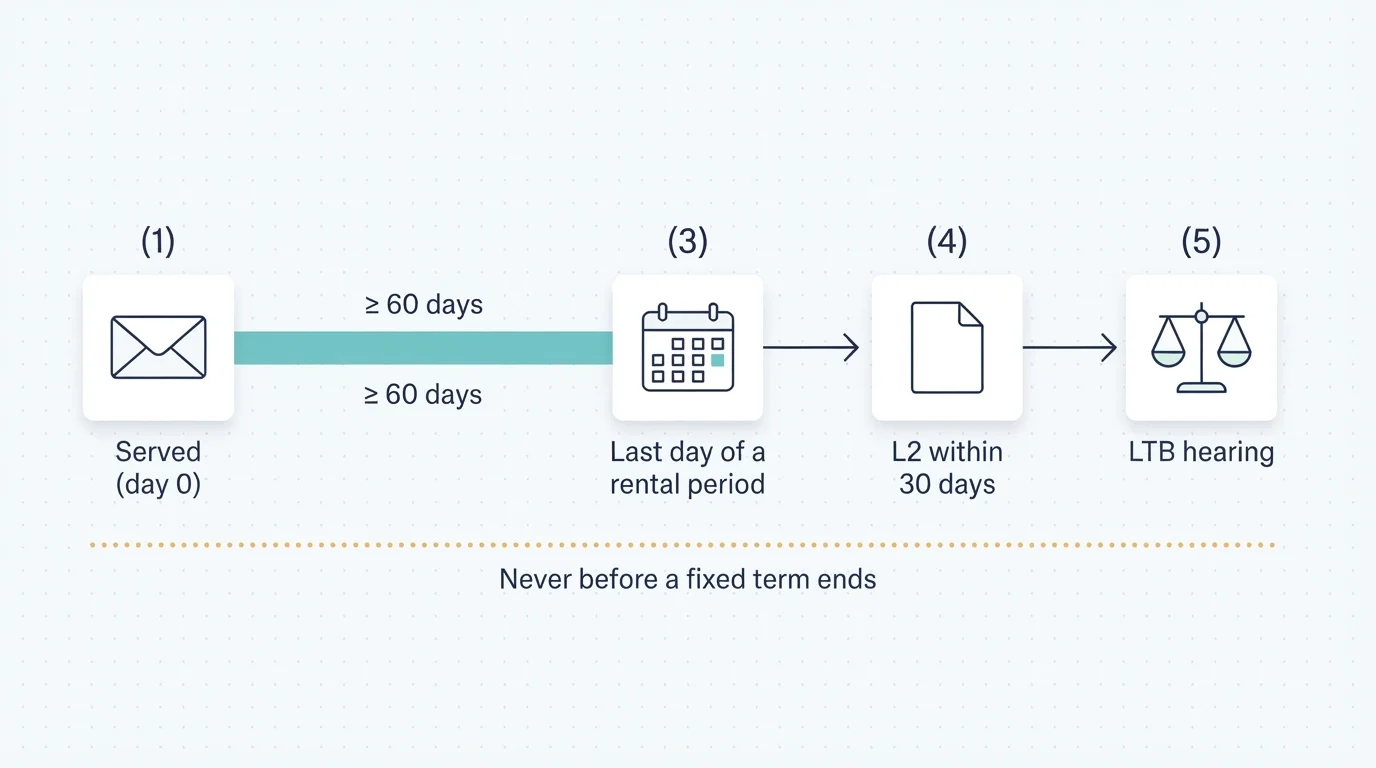
Rule two — the details. The N8's chart must set out the specifics: each rental period, the date rent was due, the date it was actually paid. Vague notices get dismissed because — as the Board put it in one 2021 housing case — the tenants are deprived of the information they need to defend themselves (see also Fawcett v Grattan, 2022). If the chart runs out of room, write "SEE ATTACHED" and append the full ledger. And understand what the notice is and isn't: in a procedural-fairness reversal, the Divisional Court overturned an N8 eviction where the Board had treated the notice's own contents as evidence and refused the tenants' bank records. The N8's contents are allegations. The ledger — due dates versus paid dates, with proof — is the case, and the tenant is entitled to answer it with records of their own.

Round out the discipline: identify the unit exactly (address errors have been fatal too — Garner v Ryan, 2023), serve by a proper method, complete a Certificate of Service the same day, and file the L2 on time — filing is allowed immediately after service, and mandatory no later than 30 days after the termination date.
What Actually Happens at the Hearing
Here's the expectation-setting most landlord content skips — and the reassurance most tenant content undersells. Even where a landlord proves a genuine pattern, the Board does not usually terminate a tenancy on a first persistent-lateness application. Under Interpretation Guideline 7 and section 83 of the RTA, the common outcome is a conditional order: the tenancy continues, and the tenant must pay on time for a specified number of months. The Divisional Court has described eviction as a remedy of last resort. Changed circumstances matter too — a tenant who lost a job, found a new one, and has paid punctually for months can defeat a stale pattern outright.
Conditional orders have teeth, though: a breach opens the section 78 fast-track, which can lead to an eviction order without a fresh hearing. That's the real leverage the N8 creates.
If you're the tenant reading this: an N8 is a notice, not an order — you do not have to move on the date it names, and receiving one goes on no public record. Check the termination date (is it the last day of a rental period? at least 60 days out? after your fixed term ends?) and the details chart for the defects above; gather your own payment records, because the landlord must prove the pattern with evidence and you're entitled to answer it; and raise your circumstances — the Board must weigh them under section 83 before any eviction.
Practical Takeaways
The landlord's discipline in seven moves:
- Confirm the facts are a pattern, not arrears. Arrears is the N4's job; both can coexist — choose deliberately and never plead non-payment on an N8.
- Build the ledger first: every due date versus paid date for 12+ months, with proof. It is the case.
- Pressure-test "persistent" honestly — a handful of latenesses in a long tenancy likely fails under current law.
- Nail the date: last day of a rental period, at least 60 days out, never before a fixed term ends, plus five days if mailed.
- Fill the details chart exhaustively and attach the ledger.
- Serve properly, Certificate of Service same day, L2 within 30 days of the termination date.
- Decide in advance whether a conditional on-time-payment order — the likely first outcome — works for you.
The tenant's quick-reference in three: check the termination date and the details chart for the defects that void notices; gather your own payment records, because the pattern must be proven with evidence; and know the Board weighs your circumstances and usually orders a plan before an eviction. The authoritative references are the Tribunals Ontario N8 form and instructions and LTB Interpretation Guideline 7; for the money-side sibling, see our complete N4 guide for landlords — or, from the other chair, what to do if you've received an N4.
The N8 Checklist: 19 Steps to Handle the Tenant Who Always Pays Late
Build the due-vs-paid ledger that wins, nail the termination-date rule that voids most N8s, and walk into the LTB hearing knowing a payment plan — not eviction — is the likely first outcome. Free landlord PDF.
Get Free PDF →The Bottom Line
The N8 is Ontario's answer to the tenant who always pays and always pays late — but it's a precision tool. Five grounds, one timing rule that voids most attempts, an evidence bar the notice itself can't satisfy, and a Board that reaches for payment plans before evictions. Serve it carefully or don't serve it at all. And keep one eye on the horizon: Bill 60's regulated definition of "persistent" is the next thing to change here — verify the current rule and the current form on the day you serve, not the day you first read about it. This is general information, not legal advice; for a live dispute on either side, a licensed paralegal or lawyer familiar with the RTA is worth the call.
The Ledger Builds Itself When Rent Flows Through Tenon10
Tenon10 records every due date and payment date automatically, generates the current N8 with a validated termination date, and tracks your 30-day L2 window — so the evidence is ready before you ever need it.
Free • No signup required • Updated for the Bill 60 changes in force 21 Sep 2026
Frequently Asked Questions
What is an N8 notice in Ontario?
It's the LTB's Notice to End your Tenancy at the End of the Term, used for five grounds — most commonly persistent late payment of rent. It requires at least 60 days' notice for monthly tenancies, and the termination date must be the last day of a rental period (and never before a fixed term ends).
How many late payments count as "persistent"?
There's no fixed number under current in-force law. The practice benchmark is roughly seven to eight late payments within a consecutive twelve months, and a couple of latenesses in a long tenancy has been ruled not persistent. Bill 60 directs a regulation to standardize the definition — confirm its status on e-Laws before relying on any fixed count.
What's the difference between an N4 and an N8?
The N4 addresses rent currently owing and is voided if the tenant pays in full, with a termination date that can fall any day (7-day minimum for notices given on or after September 21, 2026; previously 14 for monthly and yearly tenancies). The N8 addresses a pattern of paying late even when rent is eventually paid, cannot be voided by payment, and only takes effect on the last day of a term or rental period with 60 days' notice. They lead to different applications — L1 and L2 respectively — and both can apply at once.
Can a tenant void an N8 by paying?
No — payment can't void it, because the issue is the pattern, not the balance. But it's still only a notice: the tenant can stay, dispute it at the Board, and put the landlord to proof; only an LTB order enforced by the sheriff ends the tenancy.
Why do so many N8s get dismissed?
Two defects dominate the case law: a termination date that isn't the last day of the rental period (or falls before a fixed term ends), and a details chart without specific dates or an attached ledger. Unit-identification errors and improper service round out the list.
Does an N8 usually end in eviction?
Not on a first application. The Board commonly orders conditional on-time payments instead, and the Divisional Court describes eviction as a last resort. Breaching a conditional order, however, opens a section 78 fast-track that can end the tenancy without a fresh hearing.